
NOTE: This part resolves the central mystery surrounding the file, exposes the remaining deception, and brings the family to a decisive choice about truth, safety, and trust.
Daniel stared at the photograph for a long time.
Then he whispered his brother's name.
I had never heard him say it with that much fear.
The police took the phone from Marcus.
They enlarged the image.
Daniel's brother was standing outside a restaurant.
Beside him stood Evan.
The photograph was recent.
"Where did you get this?"
Marcus said a former coworker sent it to him.
"Why didn't you tell me?"
"I didn't know what to believe."
Daniel sat down.
His hands were shaking.
For twenty years, he had believed his brother was dead.
His family had told him there had been an accident overseas.
No funeral had been held because the body had never been recovered.
Daniel had accepted that uncertainty because grief sometimes leaves unanswered questions.
Now the unanswered question had a face.
His brother was alive.
And he had the missing page.
The police began tracing the photograph.
The restaurant had security cameras.
The image was taken two weeks earlier.
Evan and Daniel's brother had been meeting repeatedly.
They were not strangers.
They had been working together.
The old fraud had never truly ended.
Evan had been protecting Daniel's brother.
Daniel's brother had been protecting Evan.
And the missing page contained the evidence that could expose both.
But there was another question.
Why Noah?
The answer came from the school records.
Evan had learned that Daniel had a son.
He had also discovered that Daniel's father had stored the old evidence.
He did not know where.
So he created pressure.
He approached Marcus.
He encouraged suspicion around Noah.
He watched the school.
He contacted Daniel.
He wanted to frighten us into revealing the location of the file.
The accusation against Noah had never been about the missing school money.
The money had been real.
But the false accusation had been useful.
It created a reason for adults to become suspicious.
It put Marcus against us.
It gave Evan an excuse to approach Noah.
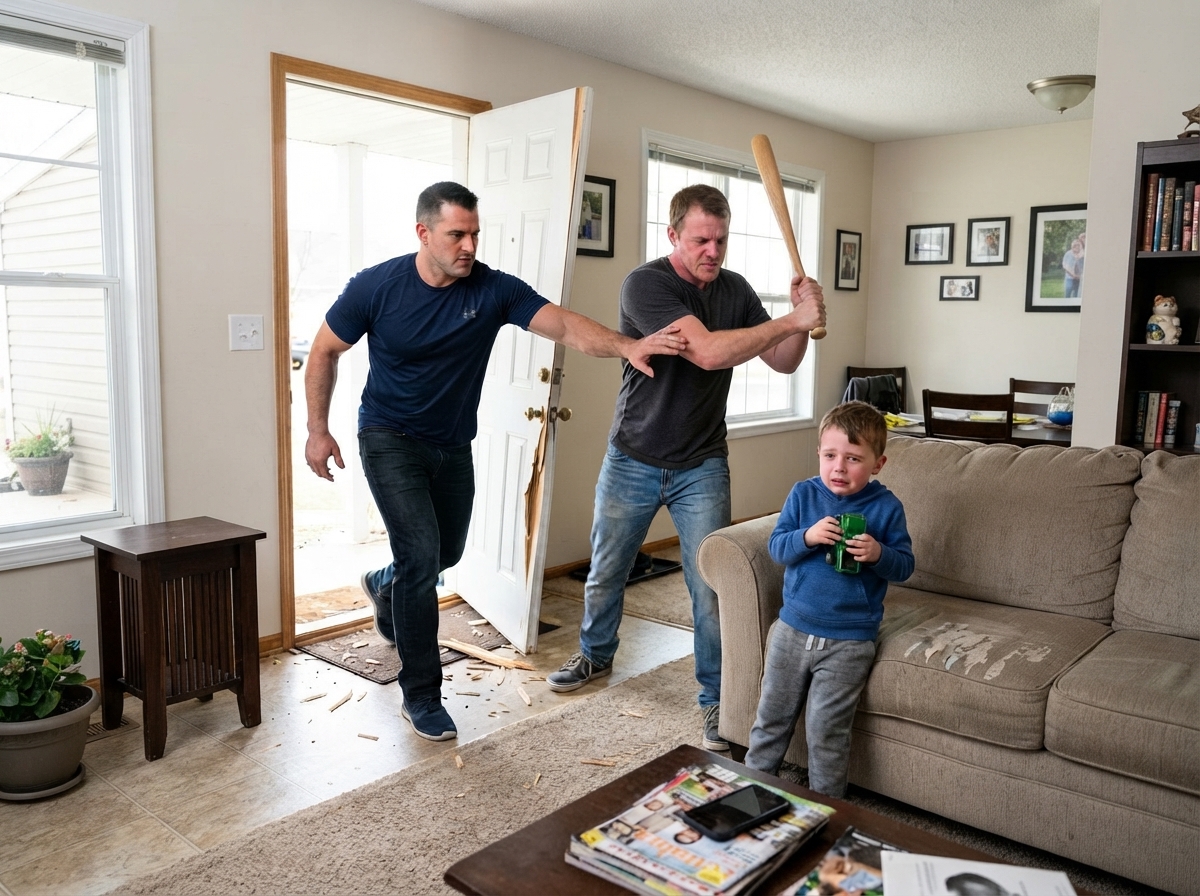
The broken door had been the consequence of another man's fear.
Marcus had believed Daniel was hiding the truth.
He had come armed because he was angry.
He had been wrong.
The police found the missing page two days later.
It was not in Daniel's brother's possession.
It had been scanned and stored inside an old email account.
The page identified the person who had altered the records.
Evan.
There was also evidence that Daniel's brother had helped conceal the manipulation.
He had not created it.
But he had known.
He had accepted money to remain silent.
That was the betrayal Daniel had spent years trying to hide.
The police confronted him.
He eventually admitted what he had done.
He explained that Evan had threatened to expose his debts.
Then Evan offered him money.
He took it.
When the investigation began, he disappeared.
He had never died.
He had simply built a new life under another name.
Daniel listened to the confession.
He looked devastated.
I sat beside him.
"You couldn't have known."
"I should have."
"You trusted your family."
"I let everyone else pay for my silence."
That was the truth.
And it mattered.
The police arrested Evan.
Daniel's brother cooperated with investigators.
Marcus apologized again.
This time, he apologized to both Noah and me.
"I let anger decide what I believed."
I accepted the apology.
But I did not pretend the broken door had not happened.
Trust is not repaired by one sentence.
It is rebuilt through choices.
Marcus paid for the repairs.
He also spoke to the school about what had happened.
His son apologized to Noah.
The boys eventually returned to school.
The accusation was formally cleared.
Noah's name was removed from the disciplinary record.
One afternoon, I picked him up.
He ran toward me.
"Mom!"
I hugged him.
"How was school?"
"Good."
"Anything happen?"
He smiled.
"Marcus's son gave me his best trading card."
I laughed.
"Did you give him something back?"
"Tomorrow."
Children could repair what adults had complicated.
Not always.
But sometimes.
Daniel became more open after the investigation.
He told me things he had never told anyone.
Not secrets about crimes.
Small things.
Fears.
Regrets.
Mistakes.
He had believed being strong meant carrying everything alone.
He finally understood that secrecy did not protect a family.
Sometimes it only delays the damage.
We replaced the front door.
The broken wood disappeared.
The house looked normal again.
But I kept one photograph from that morning.
Not of the broken door.
Of Noah sitting safely on the sofa afterward.
He had his green cup in both hands.
His face was still wet from crying.
I kept it because it reminded me what mattered.
Not the file.
Not Evan.
Not the old company dispute.
Not the lies.
My son.
Everything had begun with adults protecting themselves.
It ended with adults learning to protect a child properly.
Weeks later, the police returned the old documents.
The case had become part of a larger investigation.
There were legal consequences for the people involved.
Evan faced charges related to fraud, intimidation, and interference with the investigation.
Daniel's brother faced consequences for his participation in concealing evidence.
Marcus was not charged for the break-in after investigators determined the circumstances and reviewed his cooperation, though he remained responsible for the damage he caused.
Daniel was not accused of wrongdoing in the old fraud.
His mistake had been secrecy, not participation.
That distinction mattered.
So did accountability.
One evening, Daniel and I sat on the porch.
Noah was inside watching television.
"Do you hate me?" Daniel asked.
I looked at him.
"No."
"But you don't trust me."
"Not the way I used to."
He nodded.
"Fair."
I thought for a moment.
"I don't want the old kind of trust."
"What kind do you want?"
"The kind where we tell each other difficult things before someone else discovers them."
He smiled faintly.
"I can do that."
"You have to."
"I will."
Inside, Noah laughed.
Daniel looked toward the window.
"I almost lost everything because I thought keeping secrets was the same as protecting people."
I touched his hand.
"We're still here."
He squeezed my fingers.
"We are."
A few months later, the school held another fundraiser.
Marcus came.
His son came.
Noah played with him.
Nobody mentioned the accusation.
Nobody needed to.
The boys had moved on.
The adults were still learning.
Before leaving, Marcus approached me.
"I wanted to thank you."
"For what?"
"For making me face what I believed."
I smiled.
"You did that yourself."
He shook his head.
"No. You told the truth when it would have been easier to blame someone."
I thought about that.
Maybe that had been the most important choice of all.
When the stranger broke our door, I had been terrified.
When I learned my husband had kept secrets, I had been angry.
When I discovered Evan's manipulation, I had been afraid.
But at every stage, the truth had become clearer only when someone stopped trying to control the story.
I looked at Noah.
He was laughing with his friend.
The green cup from that terrible morning was still in our kitchen cabinet.
I had thought about throwing it away.
I never did.
It had become a reminder.
Fear can make people believe the first story they hear.
Truth requires patience.
It requires questions.
It requires admitting when we are wrong.
Most importantly, it requires protecting the people who cannot protect themselves from adult secrets.
That morning, my husband had stood between our son and a man holding a bat.
I had thought the danger was standing in front of us.
I was wrong.
The deeper danger had been the lies surrounding us.
The broken door could be replaced.
The damaged furniture could be repaired.
The old documents could be filed away.
But the trust between people had to be rebuilt.
That took longer.
And perhaps it always would.
One evening, years later, Noah asked me why we had replaced the front door.
I told him the truth.
"Someone broke it."
"Why?"
"Because too many adults were afraid."
He thought about that.
"Are you afraid now?"
I looked at Daniel.
Then at my son.
"No."
"Why?"
"Because we tell each other the truth."
He smiled.
"Good."
Then he ran outside.
I watched him go.
The house was quiet.
The door was strong.
The locks worked.
The family inside it had changed.
We had learned that protection did not mean hiding information.
It meant making sure the truth reached the people who needed it.
Daniel learned that silence could become its own kind of danger.
Marcus learned that anger could turn suspicion into reckless action.
His son learned that one lie could hurt another child.
Evan's actions finally came to light.
Daniel's brother had to face the consequences of the choices he had made.
And Noah learned something I hoped he would carry for the rest of his life:
When something feels wrong, speak.
Don't protect an adult secret just because someone tells you to.
Don't carry a burden that was never yours.
And never let fear convince you that you have to face the truth alone.
The morning our front door shattered, I thought I was watching my family fall apart.
Instead, I was watching the first crack appear in a wall of secrets.
Once that wall came down, everything changed.
Not perfectly.
Not easily.
But honestly.
And in the end, that was what saved us.
STORY TITLE: The Man at Our Door Was Holding a Baseball Bat, But My Son Knew the Truth Before I Did
Click Here to continue read next: PART5: After the Old Case Was Finally Exposed, I Thought Our Family Could Breathe Again Until One Forgotten Detail Returned to Trouble Us
The Door Exploded Open Before Sunrise, and My Son’s Terrified Face Told Me Something Was Wrong With the Story I Had Been Given
Part 4 of 8

