
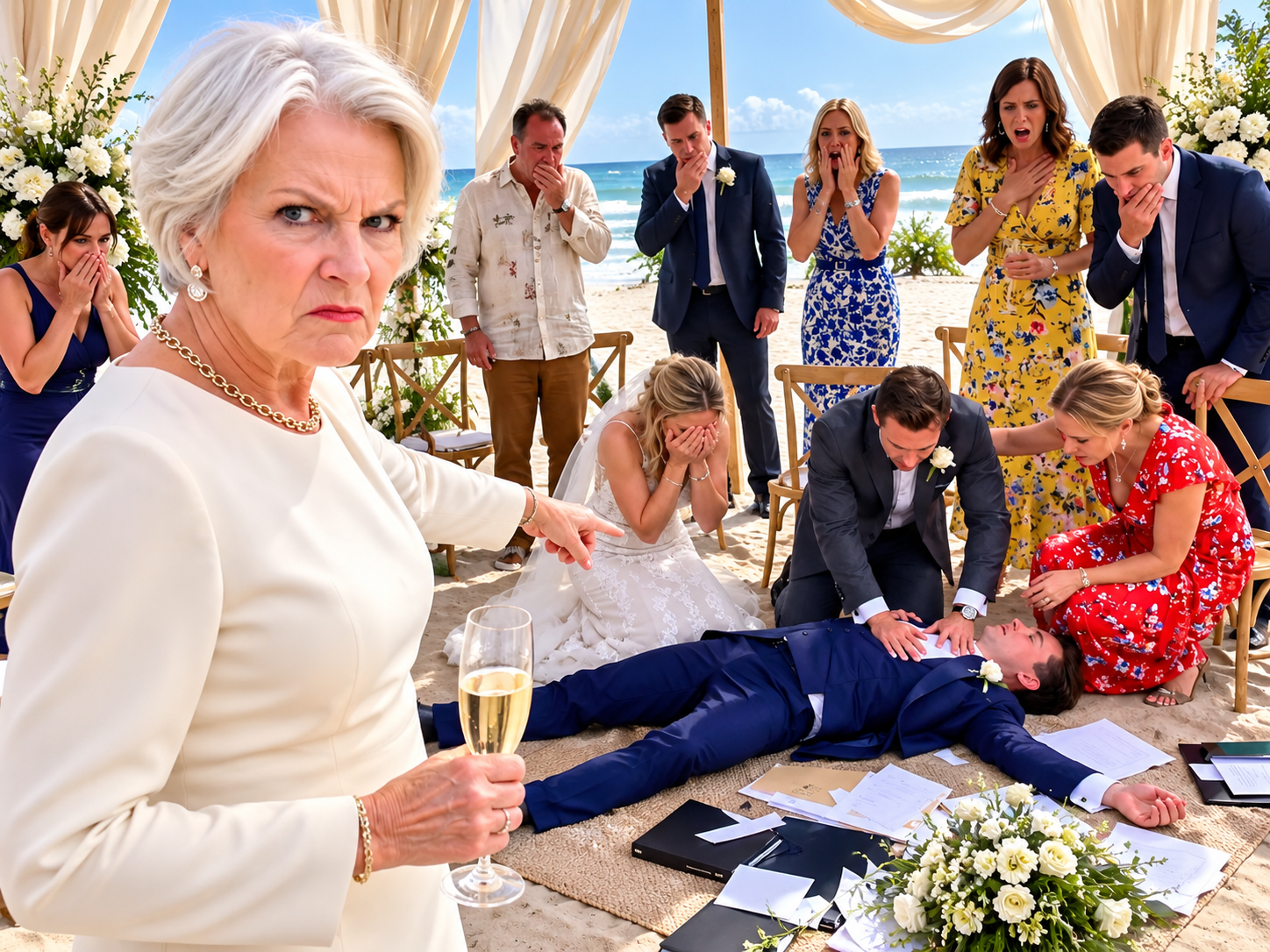
Years had passed since the wedding that never happened.
The story had become something I rarely discussed.
Marcus remained in prison.
The restitution process continued.
The nonprofit had grown.
Lydia had become one of its most trusted program directors.
My company continued without me taking such an active role, and I spent more time supporting organizations whose work mattered to me.
My life was quieter.
So was Lydia's.
One autumn morning, she called.
“Are you free this weekend?”
“For you?”
“Yes.”
“Then probably.”
She laughed.
“I want to go to the beach.”
I knew exactly which beach she meant.
The Hamptons.
The place where she had once stood in a wedding dress and asked me for fifty million dollars.
The place where Marcus had been arrested.
The place where our old relationship had ended.
And the place where our new one had begun.
We met there Saturday morning.
The sky was pale gray.
The ocean was restless.
Lydia carried two cups of coffee.
I brought a blanket.
We walked toward the dunes.
For several minutes, neither of us spoke.
Then Lydia said, “Do you ever think about that day?”
“Every year.”
“So do I.”
She looked toward the shoreline.
“I used to hate remembering it.”
“And now?”
“Now I'm grateful.”
I raised an eyebrow.
“That's a strong word.”
“I know.”
She sat on the blanket.
I sat beside her.
“I lost almost everything that day,” she said.
“You lost what you thought you needed.”
She nodded.
“That's true.”
She looked at the water.
“I lost Marcus.”
“You lost him before you knew who he was.”
“I lost the money.”
“You lost access to money.”
She smiled.
“You always correct me.”
“It's a habit.”
She laughed.
Then she became serious.
“I also lost the version of myself who thought being rich made me valuable.”
I looked at her.
“That was the most important thing you lost.”
She nodded.
“I know.”
We sat quietly.
Then she reached into her bag.
She pulled out an old photograph.
I recognized it immediately.
The cardboard crown.
Her missing front teeth.
That enormous childhood smile.
I stared at the photograph.
“You kept it?”
“Of course.”
She looked at me.
“I thought you hated this picture after everything.”
“I could never hate this picture.”
She smiled.
“I wanted you to have it.”
I took it.
For a moment, I couldn't speak.
That little girl had no idea what life would ask of her.
She didn't know about Marcus.
She didn't know about money.
She didn't know about betrayal.
She didn't know that her mother would one day have to choose between rescuing her and letting her fall.
All she knew was that she loved her mother.
And I realized something.
That love had never disappeared.
It had been buried beneath expectations.
Mine.
Hers.
Marcus's.
Society's.
Money had covered it until neither of us could see it clearly.
But it had survived.
Lydia reached for my hand.
“I was horrible to you.”
“Yes.”
She laughed through tears.
“You could at least pretend.”
“I spent years pretending.”
She leaned against me.
“I deserved that.”
I squeezed her hand.
“You also deserved a chance to become someone different.”
She looked at me.
“You gave me that.”
“No.”
She shook her head.
“You did.”
I thought about arguing.
Then I stopped.
Maybe she was right.
I had opened the door.
She had walked through it.
Neither of us could take credit for the other person's choices.
That was another lesson we had learned.
We watched the waves.
After a while, Lydia said, “Do you remember what Marcus said about the bank?”
“Yes.”
“He said banks can be foreclosed on.”
I smiled.
“He was very proud of that line.”
“He was.”
She shook her head.
“I think I finally understand what he got wrong.”
“What?”
“A bank is supposed to hold something securely.”
I looked at her.
“So?”
“I thought you were the bank.”
“And I thought I was supposed to be.”
She looked toward the house.
“But you weren't.”
“No.”
“You were my mother.”
I felt tears rise in my eyes.
She continued.
“And I kept asking you to prove it with money.”
I looked at her.
“I was asking you to prove it too.”
“How?”
“By giving you everything.”
She nodded.
We both understood then.
The tragedy hadn't been only Marcus.
It had been the belief we had shared that money could express love perfectly.
He exploited that belief.
But we had created it together.
I had used money to compensate for absence.
Lydia had learned to use money to measure affection.
Marcus had simply recognized the weakness.
The answer had never been more money.
It had been honesty.
Responsibility.
Boundaries.
Time.
The things none of us had understood when the wedding invitations went out.
Lydia rested her head against my shoulder.
“I don't want to change the past.”
“Neither do I.”
“Even the bad parts?”
“Especially those.”
She looked surprised.
“Why?”
“Because without them, we might never have learned this.”
She nodded.
The wind moved across the water.
The beach was nearly empty.
There were no cameras.
No guests.
No wedding planner.
No lawyer.
No man waiting to collect fifty million dollars.
Just my daughter.
Just me.
And the sea.
Eventually, Lydia stood.
“Come on.”
“Where?”
“Walk.”
We followed the shoreline.
Our footprints appeared briefly in the wet sand and disappeared behind us as the waves rolled forward.
I thought about all the things I had once wanted for her.
A beautiful home.
A prestigious husband.
A comfortable life.
A fortune large enough that she would never worry.
None of those things had made her happy.
What finally changed her was losing the ability to purchase comfort.
She learned to work.
She learned to budget.
She learned to ask questions.
She learned to accept consequences.
She learned to apologize without demanding forgiveness.
She learned to love without measuring the value of the gift attached to it.
And I learned something too.
I learned that motherhood did not mean making life painless.
It meant giving someone enough love to survive the moments when you could no longer make things painless for them.
We reached the place where the altar had once stood.
Nothing marked it.
I pointed toward the sand.
“This was where you stood.”
“I remember.”
“You were wearing that enormous dress.”
She laughed.
“It was beautiful.”
“It was absurdly expensive.”
“You paid for it.”
“I know.”
We laughed together.
Then she looked at me.
“I was so sure that day that I knew what I wanted.”
“You did.”
“I wanted Marcus.”
“And money.”
“And the life I thought he represented.”
She looked toward the ocean.
“I don't want any of it now.”
“What do you want?”
She answered without hesitation.
“A life I can recognize as mine.”
I nodded.
“That sounds good.”
She took my hand.
“Will you be in it?”
I looked at her.
“Yes.”
“Even when I make mistakes?”
“Yes.”
“Even when you disagree with me?”
“Especially then.”
She smiled.
“Even when I don't need your money?”
I laughed.
“Especially then.”
We stood together for a while.
Then we started walking back toward the house.
Not toward an inheritance.
Not toward a trust.
Not toward another financial arrangement.
Toward home.
For years, I had believed the greatest thing I could leave my daughter was a fortune.
Now I knew better.
Money could buy a house, but it could not make someone feel at home.
Money could buy education, but it could not teach judgment.
Money could buy security, but it could not create character.
Money could buy comfort, but it could not repair a relationship built on entitlement.
And money could never, by itself, prove love.
Lydia had once believed that my wealth was the measure of how much I loved her.
I had once believed that giving her everything was the measure of how well I loved her.
We were both wrong.
The day I refused to give her fifty million dollars was not the day I stopped being her mother.
It was the day I finally understood what being her mother required.
I had to let her face the consequences of her choices.
I had to let her fail.
I had to let her work.
I had to let her become responsible.
And eventually, I had to let her come back to me without asking her to become the person she had been before.
She became someone new.
So did I.
When we reached the house, Lydia paused at the steps.
“Mom?”
“Yes?”
“I love you.”
I looked at her.
“I love you too.”
She smiled.
Then we walked inside.
The ocean remained behind us.
The old wedding was gone.
The money was still there, but it no longer stood between us.
And that was the real ending to the story.
Not the arrest.
Not the ruined wedding.
Not the millions Marcus tried to steal.
Not even the fortune Lydia would never inherit.
The real ending was much quieter.
My daughter had learned the difference between wealth and worth.
And I had learned the difference between providing for someone and truly loving them.
We had lost a great deal that day.
But in the end, we had not lost each other.
We had finally found each other.
The End
Read more original stories on Feel Every Story.
My Daughter Wanted One Last Gift From Me, But Her Fiancé’s Demand Revealed What They Had Really Planned
Part 8 of 8

