
I waited until everyone was asleep.
The house was quiet except for the refrigerator humming downstairs.
I placed Claire's envelope on the kitchen table.
For several minutes, I didn't touch it.
Then I opened it.
Daniel,
If you're reading this, I didn't get the chance to explain something properly.
I stopped.
My vision blurred.
I wiped my eyes and continued.
When I met Maya, I thought I was helping one child.
I was wrong.
She was helping me see something I had spent years avoiding.
I had always believed that being useful meant being strong.
Maya taught me that sometimes people need permission to be uncertain.
I sat back.
The next page was longer.
Claire explained that during her illness, she had become increasingly worried about Sophie.
Not because Sophie lacked love.
Because I was becoming overprotective.
Claire knew I would try to build a world where nothing could hurt our daughter.
She knew that was impossible.
I read slowly.
You will want to protect Sophie from disappointment.
Please don't.
You will want to protect her from failure.
Please don't.
You will want to protect her from people who might hurt her.
Do what you can, but don't teach her that everyone outside our house is dangerous.
She needs judgment, not fear.
I stopped reading.
Those words were harder than anything else.
Because Claire had seen me becoming the man I was after her death.
A man who confused protection with control.
The letter continued.
Maya is going to teach you this without trying.
That made me laugh through tears.
Claire had apparently known exactly what would happen.
At the bottom of the page was another instruction.
If Maya ever becomes successful, don't make her responsible for being everyone's example.
Let her be selfish sometimes.
Let her leave.
Let her fail.
Let her choose a life that doesn't benefit anyone except herself.
I stared at that sentence.
It explained why Maya had struggled so much with leaving for Boston.
Claire had anticipated it.
She had anticipated me.
She had anticipated the project.
Maybe not the details.
But the pattern.
The letter ended with something I hadn't expected.
I was afraid when I met Maya.
Not of her.
For her.
Because I knew what the world could do to a child who learns too early that adults are temporary.
I wanted to give her certainty.
But certainty is not something one person can give another.
So give her options.
Give her time.
Give her the truth.
And when she chooses something you don't understand, trust that the choice belongs to her.
Love,
Claire.
I sat at the table until sunrise.
When Maya arrived that afternoon, I gave her a copy.
She read it twice.
Then she cried.
Not loudly.
She simply folded the pages against her chest.
“She knew.”
“Yes.”
“She knew everything.”
“No.”
Maya looked at me.
“What do you mean?”
“Your mother didn't know everything.”
I touched the letter.
“She knew you.”
Maya smiled.
“That may be better.”
It was.
The letter changed nothing and everything.
The Claire Project expanded nationally over the next several years.
Maya built regional partnerships instead of one giant organization.
She trained local teams.
She refused to become its permanent face.
That decision frustrated journalists.
They wanted a founder who could be photographed beside every new building.
Maya preferred training manuals.
“You're terrible at publicity,” I told her.
“I consider that a compliment.”
Sophie, meanwhile, became an illustrator.
She designed educational materials for the project.
She drew children without making their circumstances the center of the picture.
One illustration showed a girl holding a mathematics book while standing beside a bus stop.
Another showed a boy doing homework at a kitchen table.
Another showed two children arguing over a chessboard.
Normal scenes.
That was the point.
“People need to see children living,” Sophie said.
“Not just surviving.”
Maya nodded.
“You've been listening.”
“To you.”
“To your mother.”
“To both.”
The three of us worked together more often than I ever imagined.
Not as a perfect family.
We argued.
Maya thought I interfered.
I thought she took unnecessary risks.
Sophie thought we were both dramatic.
She was usually right.
One winter, Maya received an offer to lead a major education initiative overseas.
It would require three years away.
She didn't want to go.
Then she realized she did.
She called me.
“I hate this.”
“Why?”
“Because I want it.”
“That's not a crime.”
“It feels like one.”
“Why?”
“Because everyone keeps telling me how important I am to the project.”
I smiled.
“That's exactly why you need to leave.”
She laughed.
“Claire would say that.”
“Claire would say it more aggressively.”
Maya became quiet.
“Are you sure?”
“No.”
She laughed again.
“But I'm sure you should decide.”
She accepted.
Before she left, she visited the Claire Project one final time.
Students filled the classroom.
She didn't give a speech.
She sat with them.
One boy asked why she was leaving.
“For work.”
“Are you coming back?”
“Yes.”
“How do you know?”
Maya looked at him.
“I don't.”
The boy frowned.
“That's a bad answer.”
“It's an honest answer.”
He considered it.
Then nodded.
“Okay.”
Maya smiled.
That became one of her favorite memories.
Years later, when she returned, she brought changes from the program abroad.
The project began supporting students across several countries.
But Maya never changed its central rule.
No student had to perform suffering to earn dignity.
No child had to become inspirational.
No donor was entitled to a piece of someone else's pain.
And no adult got to decide that a difficult beginning meant a limited future.
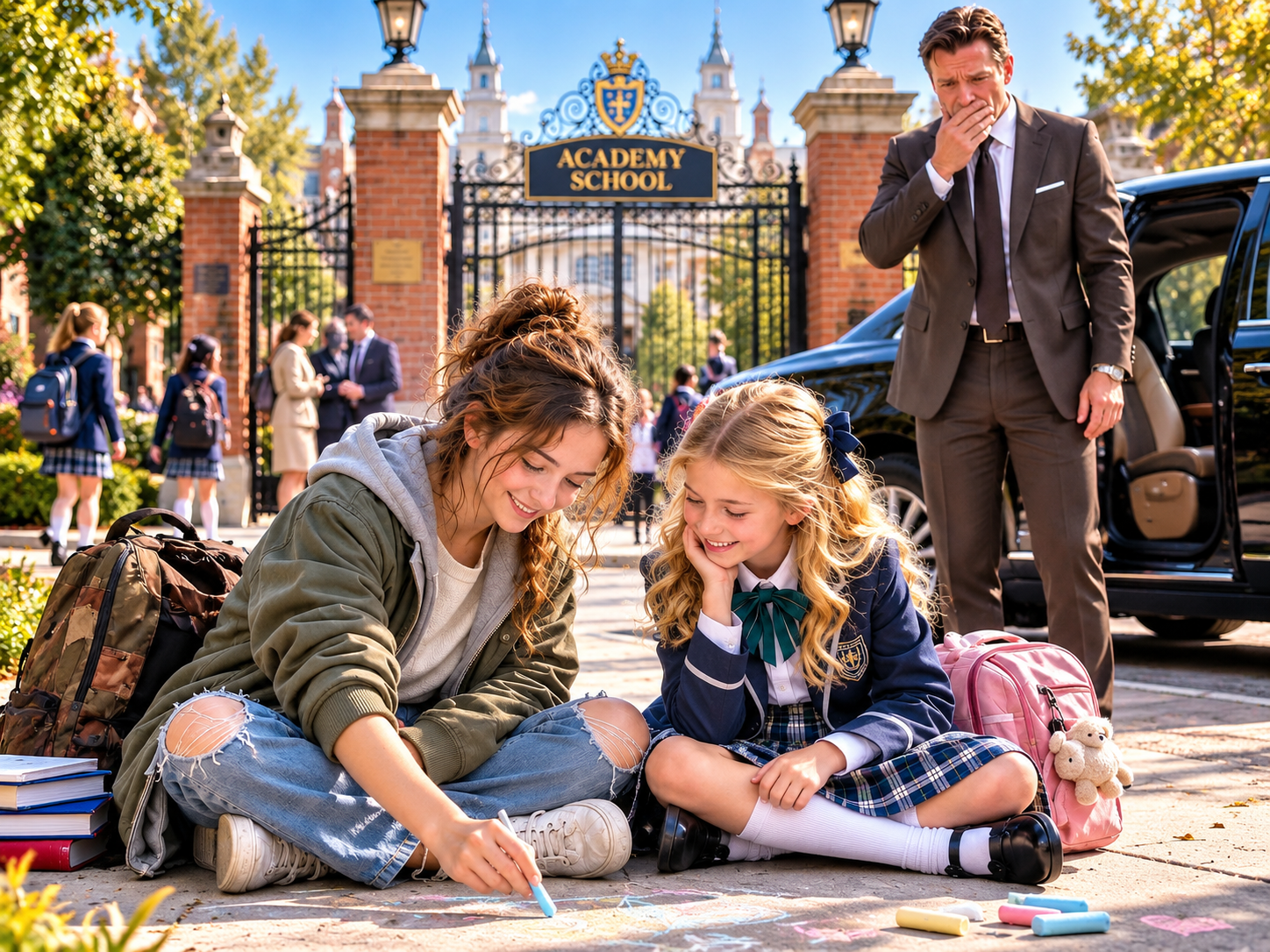
By then, the original sidewalk had changed.
The old academy entrance had been renovated.
The curb had been repaired.
The tree where Maya once sat had been replaced after a storm.
But she still remembered exactly where she had been.
We visited one evening.
The city was beginning to darken.
Maya stood at the curb.
“I thought I'd feel different.”
“Do you?”
“No.”
“What did you expect?”
“I don't know.”
She looked toward the school.
“I thought maybe I'd feel victorious.”
“You don't?”
She shook her head.
“I don't want to be victorious over a place.”
She looked at me.
“I just want children to have choices.”
I understood.
That had always been the heart of Claire's letter.
Not rescue.
Not revenge.
Choices.
Maya reached into her coat.
She carried a copy of Claire's letter with her.
“I keep thinking about the sentence where she says certainty can't be given.”
“She was right.”
“She usually was.”
“Don't tell her.”
Maya laughed.
Then she became serious.
“Do you think she would be proud?”
I looked at the school.
Then at Maya.
“She'd probably tell you to stop asking.”
Maya smiled.
“That sounds right.”
She folded the letter.
Then she looked at me.
“You know what I think?”
“What?”
“I think the reason she helped me wasn't because she thought I needed saving.”
“Why, then?”
“Because she saw me trying.”
I nodded.
“She always respected that.”
Maya looked down the sidewalk.
“I was trying very hard.”
“I know.”
“And you?”
“What about me?”
“Were you trying?”
I thought about the man I had been when Claire died.
The schedules.
The rules.
The locked doors.
The belief that money could solve any problem if I spent enough of it.
Then I thought about the man sitting beside a frightened teenager at a pharmacy.
“Yes,” I said.
“I think I was.”
Maya smiled.
“That counts.”
We walked home.
Neither of us mentioned the future.
For once, there was no need.
Click Here to continue read next: PART8: The Story Finally Came Back to the Sidewalk Where It Began, and What We Chose to Leave Behind Became Claire’s Most Lasting Legacy
I Came for My Daughter Twenty Minutes Early, Then Saw a Stranger Beside Her—and the Name Inside That Girl’s Backpack Stopped Me Cold
Part 7 of 8

