
Ten years after that October afternoon, the Claire Project opened its hundredth student center.
Maya refused to attend the ceremony.
Instead, she sent the students a handwritten note.
The center was in a neighborhood where families had spent years moving from one temporary apartment to another.
The building was modest.
A library occupied the front room.
There were computers along one wall.
A kitchen stood in the back.
Two counselors shared an office.
There was a small classroom for tutoring.
Nothing about it looked grand.
That was exactly how Maya wanted it.
She said children should enter and think, “I can belong here.”
Not, “Someone important built this for people like me.”
I was seventy by then.
My hair had turned almost completely gray.
Sophie teased me about it.
“You look distinguished.”
“I look old.”
“You are old.”
“Thank you.”
“You're welcome.”
Sophie was married by then.
She had become an illustrator and educator, creating children's books about ordinary kids dealing with complicated lives.
Maya remained Maya.
Brilliant.
Stubborn.
Suspicious of unnecessary praise.
Still incapable of leaving a bookstore without buying something.
Still keeping Claire's photograph in her office.
One evening, Maya came to dinner.
She brought a young woman with her.
The woman looked nervous.
Maya introduced her.
“This is Elena.”
Elena smiled.
“I've heard a lot about you.”
I looked at Maya.
“What did you tell her?”
“That you're difficult.”
“Accurate.”
Elena laughed.
Then Maya explained.
Elena had received a scholarship through the Claire Project years earlier.
She had graduated from college.
Now she wanted to work for the organization.
“I don't know if I'm qualified,” Elena said.
Maya looked at her.
“You are.”
“How do you know?”
“Because you're asking the wrong question.”
Elena frowned.
“What should I ask?”
“Whether you care enough to learn.”
Elena nodded.
Maya smiled.
“You'll fit in.”
After dinner, Maya and I sat outside.
The evening was warm.
She looked older than the girl I had met years ago, but there were moments when I could still see that teenager in her expression.
“Do you ever think about the first day?”
“Every year.”
“Why?”
“Because I was twenty minutes early.”
She laughed.
“You really were.”
“And because I almost kept walking.”
Maya turned toward me.
“Why didn't you?”
“I saw Claire's name.”
She nodded.
“That saved me.”
I looked at her.
“No.”
She smiled.
“Fair enough.”
“You were already there.”
“And Sophie was already there.”
“And Claire had already done what she could.”
“And you finally listened.”
I laughed.
“You're very committed to correcting my version.”
“It's important.”
We sat quietly.
Then Maya asked something she had never asked before.
“Do you regret anything?”
I thought carefully.
“Yes.”
“What?”
“Not meeting you sooner.”
She looked down.
“I don't.”
“You don't?”
“No.”
“Why?”
“Because if I had met you sooner, I might have tried to control everything.”
I smiled.
“You know me too well.”
“I learned from Claire.”
That night, Maya gave me a box.
Inside were copies of every major document from the project's history.
The original scholarship agreement.
The audit.
The new oversight standards.
Photographs.
Student letters.
And the original photograph of Maya and Claire.
On the back, Claire's handwriting remained.
Daniel would like her.
Maya had added one sentence beneath it.
You were right.
I held the photograph.
For years, I had thought the most important object in the story was Claire's letter.
It wasn't.
It was this photograph.
Because Claire hadn't known what would happen.
She hadn't known Maya would graduate.
She hadn't known the scholarship system would change.
She hadn't known the Claire Project would exist.
She hadn't known Sophie would grow into the woman she became.
She had simply looked at a child and paid attention.
That was enough to begin.
The next morning, Maya asked me to walk with her.
We drove to Whitmore.
The school had changed leadership several times.
Its scholarship program now operated under independent oversight.
Students could appeal decisions.
Housing instability no longer automatically interrupted scholarship support.
The old technology wing still existed.
My family name was gone.
That pleased me.
Maya stopped outside the gate.
The sidewalk was almost exactly where it had been.
She stood there for a while.
“Do you remember what I wore?”
I smiled.
“The jacket was too thin.”
“You noticed.”
“The shoes had tape.”
“You noticed those too.”
“I noticed everything eventually.”
She laughed.
“Eventually.”
A school bell rang.
Students began coming outside.
One boy ran toward the gate.
A girl chased him.
Two teachers stood talking.
Cars pulled up.
Parents waved.
The ordinary noise of school life filled the street.
Maya looked at the children.
“None of them know.”
“Know what?”
“What happened here.”
“Do they need to?”
She thought about it.
“No.”
I nodded.
That was another lesson.
Not every place needs to remember your pain.
Sometimes the best evidence that something has changed is that children can simply live there without knowing what once went wrong.
Maya took Claire's photograph from her bag.
She looked at it.
Then put it away.
“You ready?”
“For what?”
“To leave.”
I looked at her.
“Where are we going?”
“Lunch.”
“That was dramatic.”
“I learned from you.”
We laughed.
We walked away from the gate.
Neither of us looked back.
The story could have ended there.
But later that afternoon, Maya received a message from the Claire Project.
A fourteen-year-old girl had arrived at one of the centers.
She had been sleeping in a laundromat.
She was behind in mathematics.
She was afraid to tell her school.
The staff had already contacted a counselor.
A housing advocate was coming.
A tutor had been assigned.
A meal was being prepared.
No one had called the girl inspirational.
No one had photographed her.
No donor had been invited.
They were simply helping.
Maya read the message.
Then she smiled.
“Everything is working,” she said.
I looked at her.
“What did you expect?”
“Honestly?”
“Yes.”
“That we'd fail.”
I laughed.
“Why?”
“Because every system fails sometimes.”
She looked at the message again.
“But it doesn't have to fail the same way twice.”
That was the answer.
Not perfection.
Not rescue.
Not a miracle.
A better system.
A child noticed.
An adult listened.
A door opened.
Then another.
Then another.
That evening, I went home alone.
I opened the old storage box.
Claire's photograph was still inside.
So was her letter.
I read the final paragraph again.
Give her options.
Give her time.
Give her the truth.
And when she chooses something you don't understand, trust that the choice belongs to her.
I finally understood that Claire had not written those words only for Maya.
She had written them for me.
For Sophie.
For every parent who believes love means removing every obstacle.
For every adult who thinks money can substitute for attention.
For every institution that confuses a difficult circumstance with a difficult child.
I closed the letter.
Then I put it back.
I didn't need to read it again.
Not tonight.
The next morning, Sophie called.
“Dad?”
“Yes?”
“I'm pregnant.”
I sat down.
There was a long silence.
Then I asked the only question that mattered.
“What do you need?”
She laughed.
“I don't know.”
“Good answer.”
“You're not going to make a schedule?”
I looked at the calendar on my desk.
Then closed it.
“No.”
She laughed again.
“I knew Maya changed you.”
“Maya didn't change me.”
“Who did?”
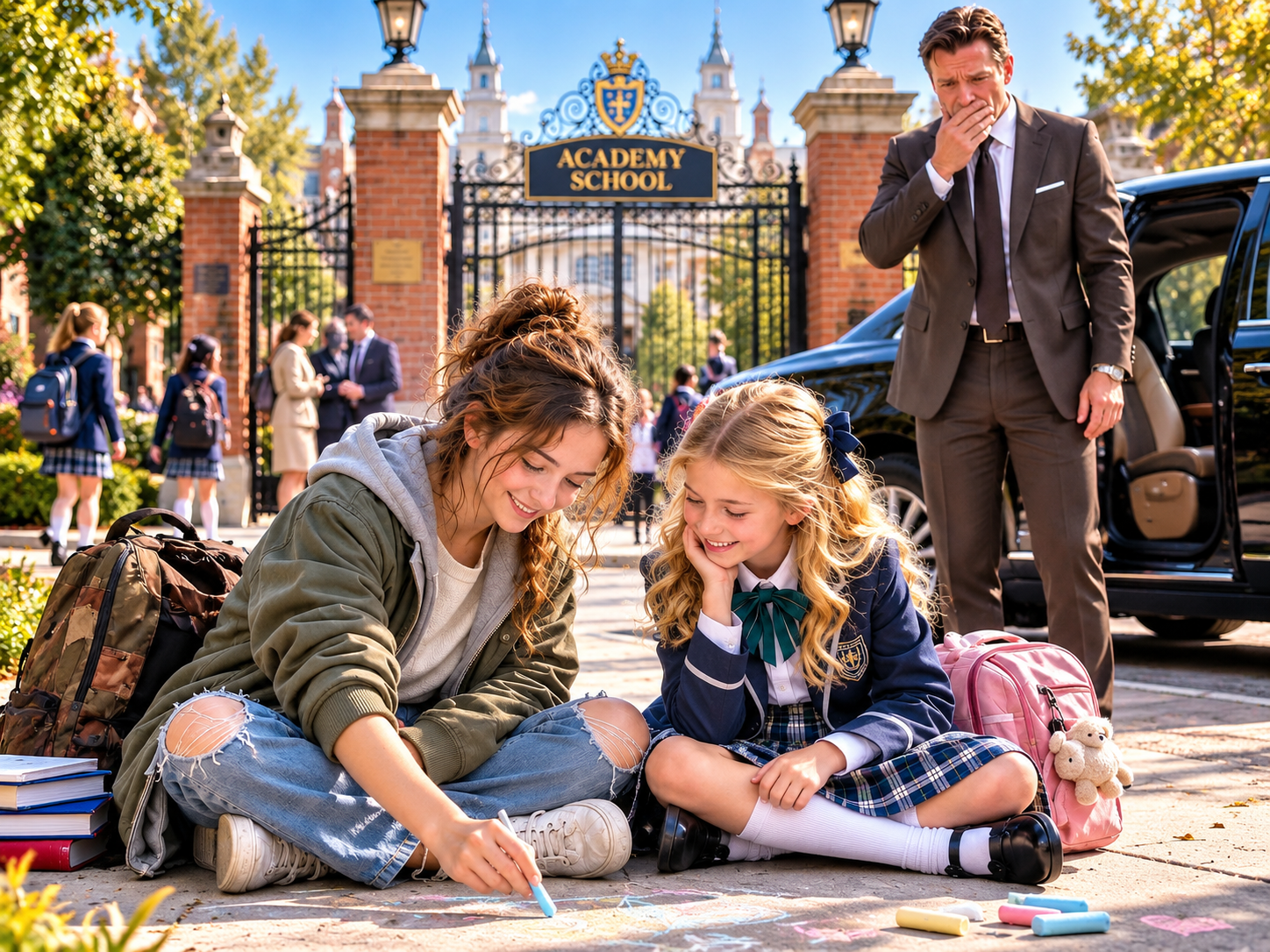
I thought about a girl sitting on a sidewalk.
A child beside her with a pencil.
A woman who had left behind a letter.
A teenager who had learned how to keep walking.
“All of you,” I said.
Months later, when Sophie's baby was born, Maya stood beside me at the hospital.
She held the newborn carefully.
“You're going to spoil this child.”
“Obviously.”
“You'll make a schedule.”
“No.”
She raised an eyebrow.
“I won't.”
“You're lying.”
“Maybe a little.”
She smiled.
The baby opened her eyes.
Maya looked down.
For a moment, nobody spoke.
Then Sophie said, “Tell her about Grandma Claire.”
I looked at the baby.
I thought about the woman she would never meet.
How strange that a person could be gone and still shape the lives of people she never had the chance to know.
“Your grandmother believed in noticing people,” I said.
The baby obviously had no idea what I was saying.
But Maya smiled.
Sophie smiled.
And I continued.
“She believed that where someone begins isn't the same as where they can go.”
Outside the hospital window, Chicago moved beneath the afternoon light.
People hurried along the sidewalks.
Cars waited at intersections.
A delivery worker carried boxes through the entrance.
A woman held her child's hand.
Nobody knew our story.
They didn't need to.
Stories like ours aren't valuable because strangers know them.
They're valuable because someone learns something and carries it forward.
Maya carried Claire forward.
Sophie carried Maya forward.
And now, in some small way, we would carry them both forward.
I had once believed the most important moment was when I arrived early and saw Maya.
I was wrong.
That was only the moment I noticed.
The real story was everything that happened afterward.
The questions.
The mistakes.
The doors.
The choices.
The people who refused to let circumstances become verdicts.
The institutions that were forced to change.
The girl who became a woman and built something larger than the help she had once received.
And the family that learned that love is not ownership.
It is attention.
It is patience.
It is truth.
It is knowing when to step forward and when to step aside.
Most of all, it is trusting another person enough to let them become themselves.
Years earlier, I had arrived twenty minutes early at a school.
I had expected to pick up my daughter and go home.
Instead, I saw a frightened teenager sitting on a sidewalk.
I saw my wife's name.
I opened a letter.
I learned that money without attention could disappear into a system.
I learned that protection without trust could become a cage.
I learned that grief could change shape without disappearing.
And I learned that sometimes the person you think you are helping is the person who teaches you how to help.
The sidewalk is still there.
Children still walk past it.
Cars still stop beside it.
The city has continued moving.
So have we.
And somewhere, another child is probably sitting on another sidewalk, convinced that the world has already decided who she is.
Maybe someone will notice.
Maybe someone will sit beside her.
Maybe a door will open.
And maybe, years from now, she will open one for someone else.
That is enough.
It always was.
The End
Read more original stories on Feel Every Story.
I Came for My Daughter Twenty Minutes Early, Then Saw a Stranger Beside Her—and the Name Inside That Girl’s Backpack Stopped Me Cold
Part 8 of 8


One Comment on “PART 8 – The Story Finally Came Back to the Sidewalk Where It Began, and What We Chose to Leave Behind Became Claire’s Most Lasting Legacy”