
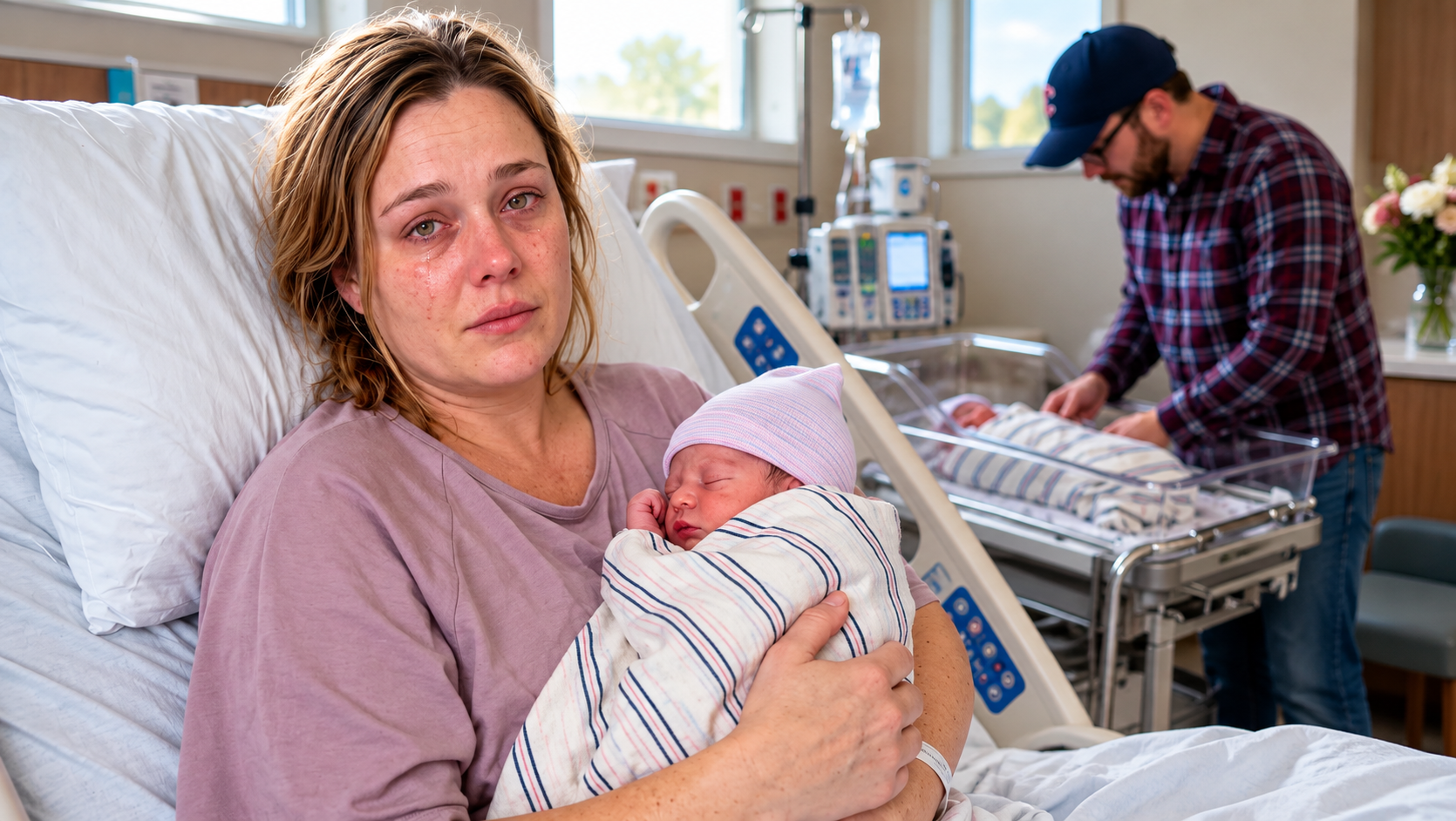
The first thing I noticed was the ceiling. It was white, blurred at the edges, and moving slightly every time I tried to focus on it. The second thing I noticed was the pain. It lived everywhere—deep in my abdomen, behind my ribs, along both arms where something had been taped to my skin. I tried to move and immediately regretted it.
“Hailey?”
Mark’s voice came from my right. His hand closed around mine before I could turn my head. His fingers were warm, almost painfully tight. I looked at him and saw red-rimmed eyes, an unshaven jaw, and a face arranged into an expression of grief so convincing that, for a few seconds, I wondered why I felt afraid instead of comforted.
“Where am I?”
“The hospital.” His voice cracked. “You’re awake.”
I swallowed. My throat felt scraped raw. I tried to remember what had happened, but my thoughts broke apart whenever I reached for them. There had been pain. A terrible pressure in my stomach. Someone shouting that the ambulance was coming. Then lights above me, hands moving quickly, and Mark’s face disappearing behind a pair of swinging doors.
“How long?”
Mark lowered his eyes.
“You’ve been unconscious for three days.”
Three days.
The number seemed impossible. I stared at him, trying to make sense of it. Then another memory surfaced, clearer than everything else. Two heartbeats. Two tiny lives. Two boys we had spent months imagining.
“My babies.”
Mark's grip tightened.
For a moment, he said nothing.
Then tears filled his eyes.
“I’m so sorry.”
My stomach seemed to drop beneath me.
“What happened?”
He bent forward, pressing my hand against his forehead.
“They couldn't save one of them.”
The words did not enter my mind properly. I heard them, but they seemed to belong to someone else’s conversation in another room.
“What?”
“They tried everything, Hailey.”
“No.”
“One of the boys…”
He stopped because he was crying too hard to finish.
“No.”
I pulled my hand away from him, then immediately winced as pain tore through my body. My voice came out thin.
“Which one?”
Mark looked at me.
“They said we have to focus on the baby who survived.”
I stared at him until his face became watery through my tears.
One survived.
One did not.
That was how I learned that my life had been divided into before and after while I slept.
The nurses told me my surviving son was stable in the neonatal intensive care unit. They explained that my body had suffered complications and that I needed time to recover. Every sentence seemed to come from very far away. I asked about the baby who had died, but nobody gave me details beyond what Mark had already told me.
Mark stayed beside me.
He brought flowers. He adjusted my pillows. He helped me drink water when my hands shook too badly to hold the cup. When relatives called, he answered for me and told them I was resting. When nurses came in, he stood beside my bed with the solemn patience of a man who had lost something precious.
People praised him.
“You’re lucky to have such a devoted husband,” one of the nurses said.
I believed her.
I wanted to believe her.
Grief had made everything strangely simple. I had lost a son. Mark had lost a son. We were supposed to hold each other up because nobody else could understand what that absence felt like.
But something about his grief never quite reached his eyes.
I noticed it only once.
It was late at night, and Mark thought I was asleep. He was sitting in the chair beside the window, staring at his phone. The light from the screen touched his face. He looked tired, but not devastated. Then he noticed me shift and immediately locked the phone.
“Need anything?”
“No.”
He smiled.
“Try to sleep.”
I closed my eyes.
At the time, I told myself I had imagined the difference.
The next morning, the doctor said my surviving son was improving enough that he could be brought to my room later that day. I had been waiting for that moment since waking. I wanted to see his face. I wanted to count his fingers. I wanted proof that at least one part of the life I had imagined was still intact.
Mark seemed relieved.
“He’s a fighter,” he said.
I nodded.
Neither of us mentioned the other baby.
Around midmorning, a nurse named Judy entered with a wheelchair and a small bassinet. She was in her forties, with tired eyes and dark hair pulled tightly behind her head. I had seen her before, but only briefly.
“There he is,” she said softly.
My heart began pounding.
Judy lifted the baby carefully and placed him in my arms.
He was smaller than I expected. His face was wrinkled from sleep, one fist tucked against his cheek. A hospital cap covered most of his head. When I touched his hand, his fingers curled around mine.
I started crying.
Mark smiled.
“He knows you.”
I could barely speak.
“My baby.”
Judy adjusted the blanket around his shoulders. Mark stood on the opposite side of the bed, watching us.
Everything seemed peaceful.
Then Judy leaned closer.
Her smile never changed.
“Don’t react.”
I looked at her.
She continued folding the blanket as though she were simply checking that the baby was warm.
“I sent something to your phone.”
My pulse jumped.
“What?”
“Please keep smiling.”
I looked toward Mark.
He was watching the baby.
Judy lowered her voice.
“Watch it only after your husband leaves.”
My fingers tightened around the blanket.
“What did you send me?”
She glanced at Mark before speaking again.
“You need to see what happened to your other baby.”
For one second, I forgot how to breathe.
Judy straightened.
“Don't let him know I told you.”
She moved away before Mark could notice anything unusual.
I kept smiling.
I don't know how.
Mark leaned over and kissed my forehead.
“You look beautiful.”
I almost laughed at the absurdity of it. I had spent three days unconscious, lost a child, and could barely sit upright. Yet he said it with such tenderness that another woman might have melted into him.
“I look terrible.”
“You look like my wife.”
He kissed my forehead again.
I watched him.
For the first time, I wondered whether I truly knew the man standing beside me.
About half an hour later, Mark checked his phone.
“I’m going downstairs for coffee. Want anything?”
“No.”
“You sure?”
I nodded.
He smiled, touched the baby's blanket, and walked toward the door.
“Be right back.”
The door shut.
I waited.
One second.
Five.
Ten.
I heard his footsteps fade.
Only then did I reach beneath my pillow for my phone.
There was a message from an unknown number.
No greeting.
No explanation.
Only a video.
Twenty-seven seconds long.
My hand trembled as I pressed play.
The picture was grainy, taken from somewhere high above a hospital corridor. At first I couldn't understand what I was seeing. Then a man entered the frame.
Mark.
My husband.
He was standing beside a transport incubator.
Inside it was a newborn.
A newborn wearing the same tiny hospital cap I had seen on my baby.
I stopped breathing.
A woman stood beside Mark.
His mother.
Wendy.
I knew that coat. I knew that voice.
She held a folder in one hand and a pen in the other.
The video continued.
I watched Wendy hand Mark a document.
I watched him read it.
Then she pointed toward the incubator.
I couldn't hear every word clearly, but one sentence came through.
“Tell her the second twin was stillborn.”
My stomach turned.
Mark signed something.
Then he reached toward the incubator.
The screen shook in my hand.
“No.”
I watched him hand the newborn to another man waiting near the door.
The video ended.
I stared at the frozen screen.
The room seemed to tilt.
My son was alive.
The baby I had mourned was alive.
And Mark had known.
He had stood beside me while I cried.
He had let me believe our child was dead.
The door handle moved.
I shoved the phone beneath my pillow and forced my face into something resembling calm.
Mark walked back inside carrying two cups of coffee.
He smiled at me.
“How’s my strong girl?”
I looked at him and understood something terrifying.
The man who had comforted me while I grieved was not grieving with me.
He had been lying.
And somewhere inside this hospital, my other son was still alive.
Click Here to continue read next: PART2: The Twenty-Seven Seconds That Changed My Grief Into a Fight for the Child Someone Had Already Promised Away
I Woke Believing One Son Was Gone, Until a Nurse’s Quiet Warning Made Me Question Everything I Had Been Told
Part 1 of 8

