
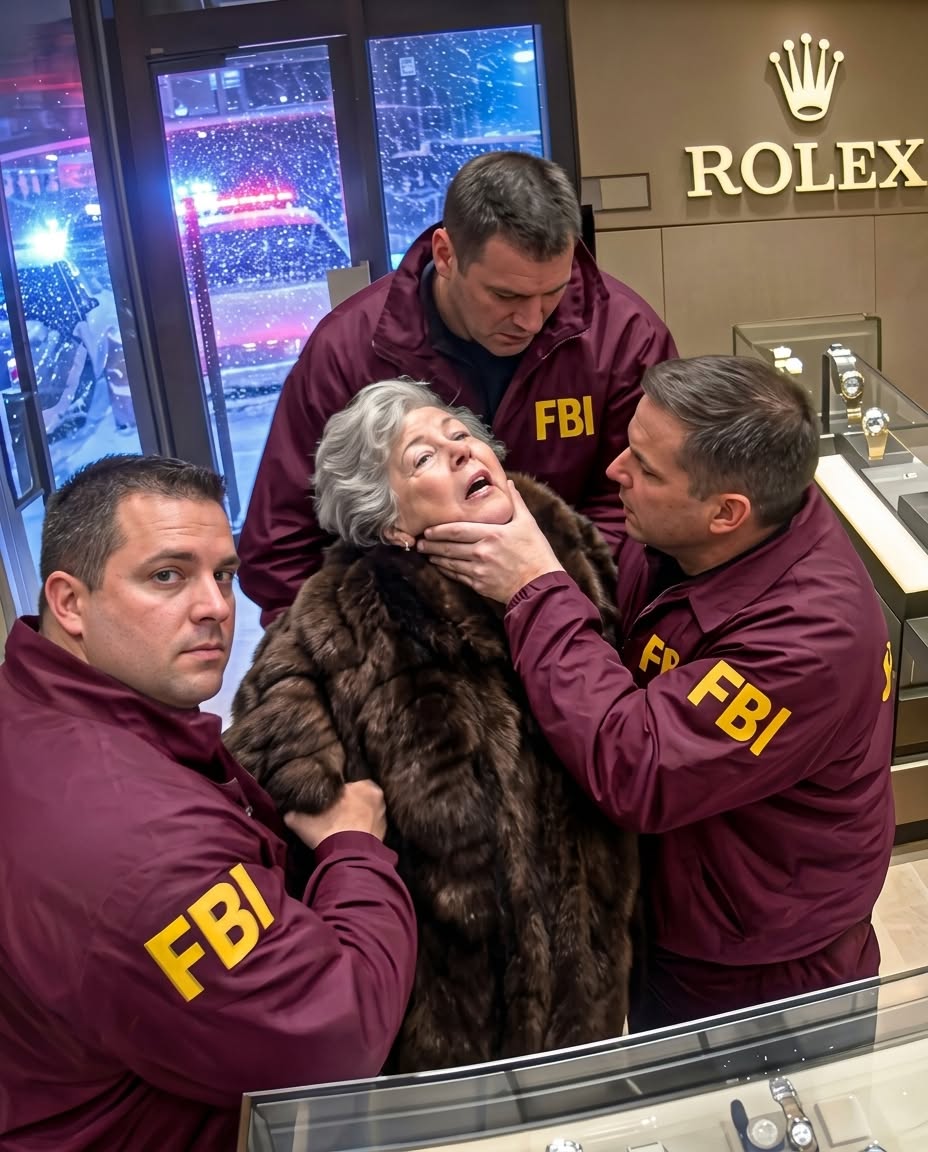
Constance kept asking for someone important.
First she demanded Chad.
Then she demanded his father.
Then she asked whether anyone could contact the senator.
Nobody answered.
The officers walked her through the front doors while snow blew across the driveway. The blue lights reflected against the glass walls, turning the house into a strange mixture of celebration and crime scene.
Brittany arrived minutes later.
She came through the doorway without knocking, holding her phone tightly in one hand.
Her hair was disheveled.
Her coat was open.
She looked nothing like the polished woman from the photograph in seat 1A.
“Where is Mom?”
Nobody answered immediately.
Brittany looked toward the driveway.
Then she saw the police vehicle.
Her face tightened.
“She told me to stay at the rental.”
I said nothing.
She looked at me.
“What did you do?”
“I didn't arrest her.”
“You caused this.”
“No.”
She stepped closer.
“Chad just blocked me.”
That was the first thing she chose to tell me.
Not that our mother had been arrested.
Not that she had attempted to have me committed.
Not that she had stolen a federal card.
Her concern was Chad.
“My fiancé's family doesn't want anything to do with us now,” she said. “They said this is a federal case.”
I nodded.
“It is.”
Brittany's eyes filled.
“You ruined my life.”
I looked at her for a long moment.
“No, Brittany.”
She waited.
“I stopped paying for it.”
The sentence landed harder than shouting would have.
She looked away.
For years, I had been the person behind the scenes.
When her tuition was due, I paid.
When she wanted to travel, I paid.
When her car needed repairs, I paid.
When Mom needed something, I paid.
When the family wanted to appear successful, I paid for the appearance.
None of them had asked how much of my own life I had sacrificed to keep doing it.
They had simply assumed the money would continue.
Brittany finally whispered, “You could help Mom.”
“I could.”
“Then do it.”
“No.”
Her face hardened.
“You have connections.”
“Yes.”
“You have money.”
“Yes.”
“You can afford a lawyer.”
“Yes.”
“Then why won't you?”
I looked toward the driveway.
“Because this is not my responsibility.”
She stared at me as though I had spoken a foreign language.
“It’s our mother.”
“She made her choices.”
Brittany folded her arms.
“You're really going to abandon her?”
I answered quietly.
“She abandoned me first.”
Nobody spoke.
Grandma Josephine walked toward us.
“Brittany, enough.”
Brittany turned.
“You're taking her side?”
Grandma shook her head.
“No. I'm taking the truth's side.”
Brittany looked down.
Aunt Sarah came to stand beside Grandma.
For once, the family was not dividing itself according to the rules Constance had created.
There was no favored daughter.
No successful branch.
No embarrassing relative.
There were simply people who had witnessed what happened.
Uncle Mike sat down heavily.
“I still can't believe this place belongs to you.”
I smiled faintly.
“Neither can I sometimes.”
He shook his head.
“Your mother told everyone you were barely making rent.”
“I know.”
“Why did you let her say that?”
I considered the question.
“Because correcting her would have meant admitting how much money I had. And every time my family learned I had something, they wanted a piece of it.”
He looked ashamed.
“Did you think we were like that?”
“Not all of you.”
I glanced at Grandma.
“That was why tonight mattered.”
Grandma squeezed my hand.
The house slowly became quiet.
The police left.
The ambulance disappeared.
Dr. Aris was taken away for questioning about his involvement in the attempted commitment.
Brittany remained near the doorway.
She looked smaller without the confidence she usually wore around Mom.
“What happens to the rental?” she asked.
I understood immediately.
She was still thinking about logistics.
Money.
Shelter.
What happened next.
I walked to the window.
“You can stay there until ten tomorrow morning.”
She frowned.
“Why?”
“After that, you'll need to leave.”
She stared at me.
“What are you talking about?”
“I own that property too.”
Her mouth opened slightly.
Nothing came out.
I watched the realization move across her face.
The Aspen rental had never been some random house my mother found.
It was part of an investment portfolio I had built quietly over several years.
The deposit Constance had complained about.
The bills she had expected me to cover.
The property she had used to impress Chad's family.
All of it had been connected to assets I controlled.
Brittany sat down.
“You knew?”
“I knew you were staying there.”
“But Mom—”
“Mom knew I was paying for it. She just didn't know why I owned it.”
Brittany looked toward the floor.
For the first time that night, she had nothing to demand.
She left before midnight.
The rest of us remained.
Grandma and I stepped onto the terrace.
The snow had stopped.
The mountain was quiet again.
Far below, the police vehicles had disappeared.
Grandma linked her arm through mine.
“She may never forgive you.”
“I know.”
“Does that hurt?”
I thought about it.
“A little.”
She nodded.
“Good.”
I looked at her.
She smiled.
“Feeling hurt means you're still human. But you don't have to surrender because someone is angry with you.”
I looked out across the valley.
For most of my life, I had confused peace with obedience.
If someone was angry, I fixed it.
If someone needed money, I gave it.
If someone insulted me, I swallowed it.
If my mother created a problem, I solved it before anyone else had to notice.
I had called that love.
Maybe sometimes it was.
But much of the time, it had simply been fear wearing the clothes of loyalty.
Grandma leaned against the railing.
“Your mother thought your silence meant she controlled you.”
“She did for a long time.”
“No,” Grandma said. “You allowed her to believe it.”
I smiled sadly.
“That may be worse.”
“No. It means you can stop.”
Inside, my relatives had begun clearing the dining table.
There was no frantic discussion about the police.
No one was calculating how the family would look tomorrow.
Nobody was worrying about Chad.
The room felt strangely peaceful.
Not because the problem had disappeared.
Because the truth was finally allowed to remain visible.
Grandma looked through the glass.
“Your mother always wanted a perfect family.”
“She wanted a perfect picture.”
“And you?”
I looked around the room.
At Aunt Sarah laughing with my cousins.
At Uncle Mike helping gather dishes.
At the empty chair where Brittany had been sitting.
At Grandma standing beside me.
“I want a real one.”
She smiled.
“Then keep this.”
I understood what she meant.
Not the house.
Not the jet.
Not the money.
The boundary.
The decision.
The refusal to keep rescuing people from consequences they had created themselves.
That night changed the balance of my family.
But it also left one final question hanging over all of us.
What would happen when morning came, the police reports became public, and the people who had spent years believing my mother's version of me finally had to choose whether they believed the truth?
For the first time, whatever they chose would not be my responsibility.
Click Here to continue read next: PART5: By Morning, the Story My Mother Had Told for Years Began Falling Apart in Places She Could No Longer Control
The Seat They Gave Away Revealed a Family Secret I Had Spent Years Protecting From Everyone
Part 4 of 8

