The final round of negotiations did not produce a dramatic confrontation. It unfolded through documents, careful revisions, and conversations with my attorney about what the available evidence could support. My parents’ side responded to the proposed changes, and the attorneys worked through the remaining issues. There were moments when I felt impatient, especially when a paragraph seemed to create another question instead of answering one. But I had learned to value precision over speed. A settlement that ended the case but left the essential terms unclear could become another problem I would have to live with.
My attorney reminded me that I was not required to accept a proposal merely because the process had taken a long time. If the terms were not acceptable, we could continue pursuing the claims through the court. That did not mean litigation would be easy or that every issue would be decided in my favor. It meant I still had choices. The distinction mattered because my family had spent years presenting its preferences as necessities. Now I could examine the options, consider the consequences, and decide without allowing someone else’s disappointment to determine my answer.
I read the revised agreement at my dining table, with my notes arranged beside it. The document addressed the claims included in the settlement, the financial obligations being resolved, and the matters that would remain outside its scope. I asked my attorney to explain the language I did not understand and to confirm how the agreement would interact with the ongoing proceedings. I wanted no hidden assumptions and no informal promise that everyone would behave differently once the papers were signed.
After reviewing the details, I decided the revised terms were acceptable. The agreement did not restore every loss, and it did not contain the apology I had once imagined receiving from my father. It did, however, provide a defined legal resolution to the claims it covered and avoided leaving me dependent on another vague family promise. My attorney confirmed the final language and explained the steps required to complete the process. I gave him authorization to proceed.
Signing the documents was quieter than I expected. There was no audience and no speech. I reviewed the final pages, confirmed that they matched the terms we had discussed, and signed where instructed. When the process was complete, I put the pen down and sat still for a moment. I had imagined that legal closure would feel like a door slamming shut. Instead, it felt like setting down a heavy bag I had carried for a long time, knowing that I would still have to decide where to go next.
The agreement resolved the claims it covered, but I understood that it could not rewrite the past. It did not erase Britney’s identity theft or mean that my family’s behavior had been harmless. It did not transform my parents into people who could suddenly acknowledge every choice they had made. Nor did it settle the emotional questions I still carried. Those were separate from the legal process, and I would have to work through them in my own time.
My attorney explained the practical steps that followed, including the formal documentation needed to complete the resolution and any remaining administrative matters. I kept copies of the signed agreement and related correspondence in the same secure folder where I had stored the will, financial records, and earlier filings. I did not treat the completion of the agreement as permission to discard the evidence. The records had helped me establish what happened, and they remained important to my understanding of the past.
When I told my mother that the legal matter had reached a resolution, she replied that she hoped we could finally be a family again. I looked at the message for a long time before answering. I told her that I was relieved the legal issues covered by the agreement had been addressed, but that our relationship would need to be considered separately. I was not ready to return to family gatherings or resume the old patterns. If we were ever going to build something different, it would have to begin with honesty and respect for boundaries, not with an expectation that signing papers had restored everything.
She replied that she did not know how long I expected her to wait. I felt the old pressure rise—the urge to reassure her, explain myself more gently, and promise that I would try harder. Instead, I told her I was not asking her to wait for a specific date. I was telling her where I stood. She could decide what to do with that information, just as I could decide what kind of contact was right for me. I sent the message and did not add another paragraph to soften it.
Dad did not contact me directly about the agreement. Through the attorneys, the necessary communications were completed. I heard no acknowledgment of the Thanksgiving humiliation, no admission about the years I had spent supporting the family, and no apology for the way he had used Grandma’s name to pressure me. Part of me still wanted those words. I wanted to hear him say that I had not deserved to be treated that way, that my questions had been reasonable, and that my future mattered as much as everyone else’s. But the agreement had never promised emotional repair. I had to stop expecting a legal document to make my father into someone he had not chosen to be.
My credit records required their own attention after the estate resolution. I continued following up on the disputed Visa account, keeping the issuer’s final communications and the records showing how the identity-theft matter had been handled. I reviewed my reports and confirmed that the information reflected the correction process as expected. I retained the police report details and FTC affidavit rather than assuming that a single notice meant I could never need them again. Protecting my credit was now a routine responsibility, not an emergency that consumed every waking hour.
Britney wrote after hearing that the estate case had reached a resolution. She said she hoped it would make life easier for me and that she knew the legal outcome did not erase what she had done. She did not ask whether I would visit her or send money. She wrote that she was trying to accept the consequences without turning every conversation into a request for someone else to make her feel better. I read the letter and felt cautious hope. It was possible that she was learning. It was also possible that the work would be harder than she expected once the immediate structure of prison no longer surrounded her.
I replied that I hoped she would continue taking responsibility and make careful choices in the future. I told her I was focusing on my own life and could not make promises about what our relationship would become. I did not write those words to punish her. I wrote them because they were true. A future relationship, if there was one, would have to grow from the reality of what had happened, not from an agreement that I should forget it.
At work, I received an update about the higher-level position. The decision had not been made yet, but my manager confirmed that my work and preparation had placed me under serious consideration. I thanked him and continued doing my job. I no longer treated uncertainty as a reason to stop investing in myself. If I earned the position, I would be ready. If someone else was selected, I would use the feedback to keep improving. My professional life was not a consolation prize for losing the family I wanted. It was a meaningful part of the life I was building.
One evening, I sat with my budget open and reviewed the financial plan I had made when I bought the condo. I adjusted the savings categories, set aside money for home maintenance, and made room for the short trip I had been planning. The figures were ordinary and manageable. I was not suddenly wealthy, and the settlement had not transformed every aspect of my financial life. What had changed was that I could make plans without building them around the assumption that I would soon have to rescue someone else.
I returned to the old spreadsheet one last time. The $63,418.72 total was still there, with the payments listed beneath it. I did not delete it or pretend the money had never mattered. I kept it as a record of the choices I had made and the pattern I had finally recognized. Then I moved it into my archive folder and labeled it clearly. It no longer needed to sit on my desktop like an accusation against myself. I had learned what it could teach me.
For a while, I had been embarrassed by how much I had given. I thought the total proved that I had been foolish, that I should have recognized the pattern sooner, or that I had somehow invited the way my family treated me. But I could not change the past by punishing myself for having wanted to help. I had acted with the information and emotional habits I had at the time. Now I knew more. The responsibility I had going forward was to use that knowledge, not to spend the rest of my life ashamed of the person I had been.
I also stopped measuring my worth by whether my family called me generous. I could be generous when it was appropriate, and I could decline when it was not. I could offer a meal, listen to a friend, or help someone understand a process without becoming responsible for their rent, debt, or decisions. I could care about another person’s struggle without handing over my financial security. Kindness did not require unlimited access to my time, my money, or my identity.
On a quiet Sunday, I took Grandma’s quilt from the cedar chest and spread it across the sofa. The brass key rested beside the framed photograph I had kept from her home. I thought about the house she had left me, the trust she had arranged, and the years in which I had believed those things were gone because my parents said so. The legal resolution had given the estate dispute a defined outcome, but the deeper lesson had begun earlier, when I finally stopped treating their confidence as proof.
I would never know exactly what Grandma had imagined when she made her plans. I could not ask her whether she had anticipated the conflict or what she would have advised at every turn. But I knew what she had actually said to me. She had wanted me to protect what she had left me and not allow my father to talk me out of it. I had honored that instruction by asking questions, finding records, and following the legal process. I had also learned to protect things she could not leave in a will: my judgment, my peace, and my right to build a life that was not organized around fear.
Mom continued to send occasional messages. Sometimes they were practical; sometimes they carried a hint that I should be ready to reconcile. I responded when I felt able and left messages unanswered when they seemed designed to restart the old argument. I did not block her simply to make a statement, nor did I give her unrestricted access because she was my mother. I allowed the relationship to exist at the level it could sustain without requiring me to abandon my boundaries.
Dad remained distant. I accepted that he might never offer the apology I wanted. There was grief in that acceptance, but also a kind of freedom. I no longer needed to rehearse what I would say if he finally admitted the truth. I no longer needed to imagine the perfect conversation that would make him understand why I had acted. I could acknowledge what had happened without waiting for him to agree with my account.
Britney’s future remained uncertain. Her sentence would run its course, and she would eventually have decisions to make about work, housing, and rebuilding her life. I hoped she would do that honestly. I would not promise to become her safety net, but I would not deny the possibility that she might grow into someone who could maintain a relationship based on accountability. Whether that relationship ever became close again would depend on what happened over time, not on the fact that we were sisters.
The first evening after the legal resolution, I made a simple dinner and ate at my own table. I looked around the condo—the shelves I had assembled, the curtains I had chosen, the quilt that reminded me of Grandma—and felt the quiet satisfaction of belonging to my own life. There were still repairs to plan, work deadlines to meet, and decisions ahead. Nothing had become perfect. But no one could demand that I prove my love by sacrificing my future, and no one could tell me that my questions were disloyal simply because the answers were uncomfortable.
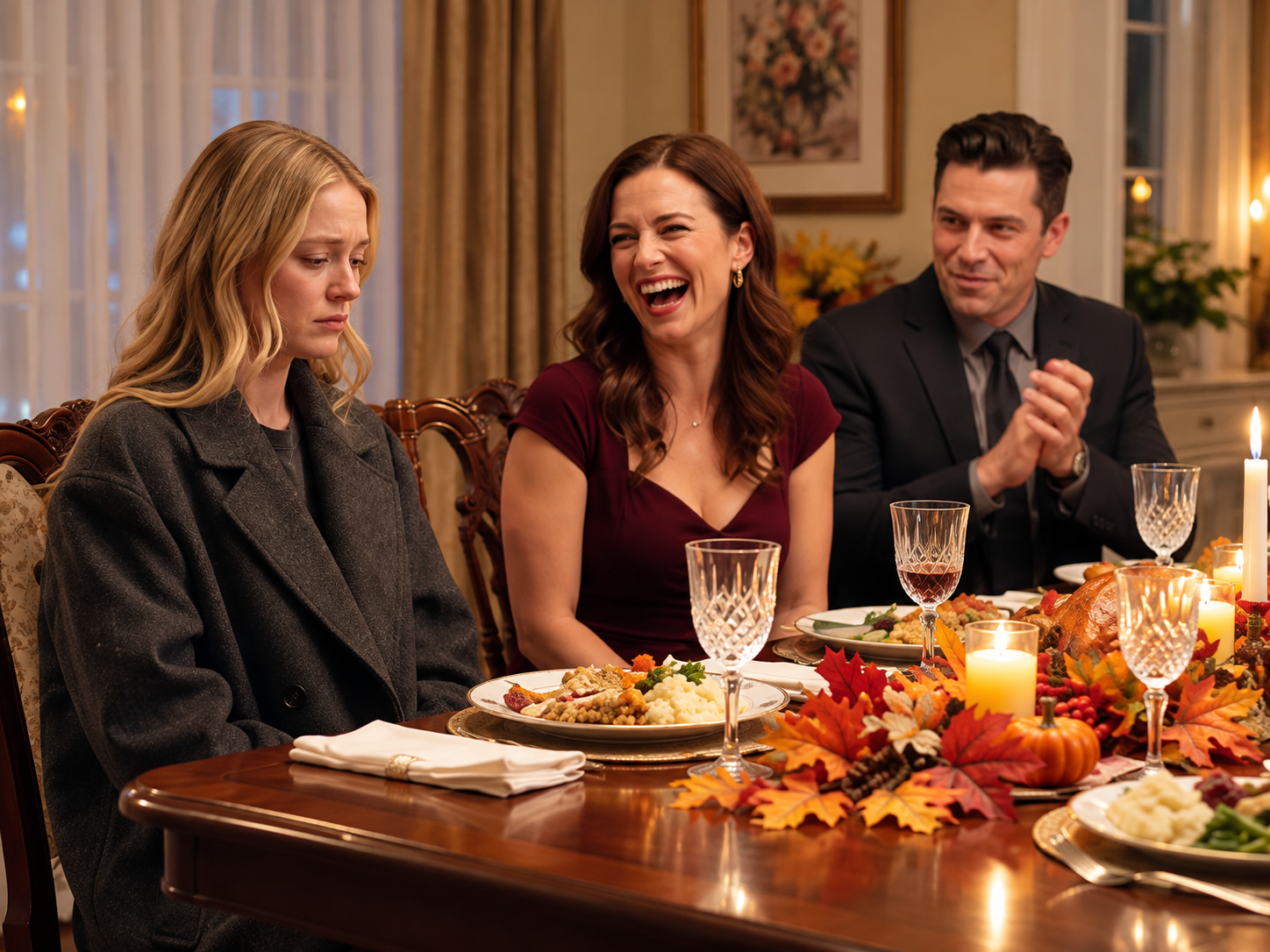
I thought back to the Thanksgiving dinner that had changed everything. I had walked into that house believing that if I kept giving, my family would eventually recognize what I meant to them. I left understanding that the money had never guaranteed the respect I wanted. The humiliation forced me to confront a truth I had been avoiding: I could not purchase a healthy family relationship through endless generosity. I could only decide what I would accept and how I would live when the answer was not what I hoped.
I had not won back the family I wanted, and I would not pretend otherwise. I had lost illusions, endured legal uncertainty, and faced the painful realization that people I loved had made choices that harmed me. But I had also reclaimed my financial independence, protected my identity, honored Grandma’s wishes through the proper channels, and begun to invest in my own future. Those were not small things. They were the foundation of a life in which love could be offered freely rather than extracted through guilt.
Before bed, I checked the front door and turned off the lights. Pickles followed me into the bedroom and curled beside the quilt. I set my phone on the nightstand without worrying that a family emergency would require me to abandon everything in the morning. If a genuine problem arose, I would assess it then. I would not automatically assume that the solution had to come from me.
The future would still bring difficult days. I might miss my mother and wish she could be different. I might read one of Britney’s letters and feel both hope and anger. I might wonder whether Dad ever understood the damage he had done. Those feelings could return without undoing the choices I had made. Healing was not a single decision that permanently erased grief. It was the repeated practice of living according to what I now knew.
I had spent years trying to keep everyone else from falling apart. Now I was learning that I could let other adults face the consequences of their own decisions while I continued building something steady. I could remember my family without returning to the role they had assigned me. I could honor Grandma without allowing her memory to become a weapon in someone else’s argument. And I could move forward without needing everyone to approve of the direction I chose.
In the quiet of my own home, the old brass key caught a little light from the hallway. It no longer represented a secret I had to uncover or a family argument I had to win. It reminded me of a promise I had finally learned to keep to myself: I would not let anyone talk me out of my right to a future.
Click here to continue reading: PART 17: After the Estate Case Ended, My Family Expected Me to Return to Normal, but I Had Finally Learned What Normal Had Cost Me
My Father Raised His Glass to Insult Me at Thanksgiving, Unaware That the Daughter He Mocked Had Been Paying for Nearly Everything He Owned
Part 16 of 20