My mother’s message arrived on a Friday afternoon, just as I was finishing a report at work. It was shorter than the letters she had sent before. She asked whether we could meet for coffee, just the two of us, without lawyers or arguments. She said she missed me and wanted an opportunity to explain things face-to-face. There was no mention of Grandma Dot’s estate, the disputed documents, or the money that had disappeared. Still, I read the message several times, wondering whether she had finally reached the point where she could speak honestly.
For most of my life, a request from my mother had carried an invisible obligation. I was supposed to make room, listen patiently, and leave her feeling better than she had before the conversation began. If she apologized, I was expected to accept it. If she cried, I was expected to comfort her. If she said the family had been under pressure, I was expected to understand that pressure as a reason to overlook whatever had happened. I knew how easily I could fall into those old habits, so I did not answer immediately.
I forwarded the message to my attorney and asked whether meeting her could complicate the case. He told me I was not prohibited from speaking to my mother, but he advised me not to discuss the disputed estate or make informal agreements about money. Any relevant communication should be documented, and any proposed settlement should go through the proper channels. He was not telling me what to feel or whether to meet her. He was reminding me that emotions could not replace safeguards.
After thinking about it over the weekend, I agreed to meet at a coffee shop near downtown Columbus. I chose a public place, set a time limit for myself, and told her in writing that I would not discuss settlement terms or make promises about financial support. She replied with a simple, “All right.” The brevity made me uneasy. My mother had never been good at accepting a limit without first testing whether it could be moved.
When I arrived, she was already seated by the window, holding a paper cup between both hands. She looked older than she had at Thanksgiving. Her hair had more gray around the temples, and the lines beside her mouth seemed deeper. For a moment, I felt the familiar urge to cross the room, hug her, and tell her that everything could still be repaired. Then I remembered the months of unanswered questions and the messages insisting that Grandma’s money had never existed.
She stood when she saw me, but neither of us moved in for an embrace. We exchanged a cautious greeting and sat down. She asked about my job, the condo, and whether Pickles was adjusting to the new place. I answered politely. The conversation felt like walking through a house where the furniture had been moved: everything looked familiar, but I no longer knew where it was safe to step.
Eventually, she lowered her cup and said, “I never wanted you to feel that we didn’t appreciate you.”
I looked at her. “That isn’t what I’ve been asking you.”
Her eyes shifted toward the window. She said the family had been struggling for years, that Dad had made poor financial decisions, and that they had worried about keeping the household together. She described bills, arguments, and the pressure of trying to make everything appear normal. I listened without interrupting. Some of those things could have been true. They still did not explain why she had told me Grandma’s estate was gone when the records indicated otherwise.
“Did you know Grandma left me the house and the trust?” I asked.
My mother’s fingers tightened around the cup. “Your father handled most of the paperwork.”
“That’s not an answer.”
She took a breath and said she had known Grandma wanted me to receive something, but she claimed she had not understood the details. She said the family believed the sale of the house had been necessary and that everything had become confused after Grandma’s death. I asked whether she had read the will. She hesitated long enough for the silence to answer before she finally admitted that she had seen some of the paperwork.
“Then why did you tell me there was nothing left?” I asked.
She began to cry. She said she had been afraid that the truth would destroy the family, that Dad had insisted the decisions were legal, and that she had not known how to challenge him. She said she had wanted to protect everyone from a painful situation. I watched her wipe her cheeks with a napkin and felt grief rise in me, not because her explanation solved anything, but because it sounded so much like the explanations I had accepted for years.
“You protected everyone from having to answer my questions,” I said. “You didn’t protect me.”
She looked up sharply. For a moment, I thought she might argue. Instead, she lowered her gaze and whispered that she was sorry. It was the first direct apology she had given me about the inheritance, and I wanted it to matter. But when I asked whether she would provide a complete account of what she knew to the attorneys, she became defensive again.
“I can’t just turn against your father,” she said.
“I’m not asking you to turn against him. I’m asking you not to turn against the facts.”
She said I was making everything worse by involving lawyers and the courts. I reminded her that the legal process existed because the family had not given me truthful answers when I asked privately. I had tried asking questions. I had accepted their explanations for years. I had paid bills, transferred money, and told myself that keeping the peace was more important than being right. None of that had resolved the problem. It had only allowed the problem to continue.
My mother asked whether I would withdraw the case if she and Dad agreed to leave the past behind. The question landed heavily between us. I explained that I could not promise that, and I would not bargain away my rights over coffee. The attorney would evaluate any formal proposal. If there was a settlement, it would need to address the actual claims, the supporting records, and the legal obligations involved. I was not going to sign away the truth in exchange for the possibility of a family dinner.
“So you really don’t trust us anymore,” she said.
“I don’t trust what you say without evidence,” I replied. “That’s different.”
The sentence hurt her. I could see it in the way she sat back and folded the napkin into a small square. But I knew that trust could not be demanded as proof of love. Trust was what remained after a person had shown, repeatedly, that their words and actions could be relied upon. My mother wanted the comfort of our old relationship without the difficult work required to build a different one.
When our time was nearly up, she asked whether I was still angry with her. I told her that anger was part of it, but it was not the only thing I felt. I was disappointed, exhausted, and grieving a version of my family that I had spent years trying to preserve. I missed the mother I wanted her to be. I missed Grandma. I missed the ordinary holidays I had imagined we would have when I was older. None of those feelings meant I could pretend nothing had happened.
She reached across the table, then stopped before touching my hand. I appreciated that she paused. It was a small recognition that closeness was no longer something she could assume. I told her I would consider future contact, but I needed honesty, consistency, and respect for my boundaries. I also told her that any information about the estate had to be shared through the attorneys.
We left the coffee shop separately. I walked several blocks before heading to my car, allowing the cold air to clear my head. I had hoped the meeting might provide a sense of closure, but what it gave me was more complicated. My mother had admitted knowing more than she previously acknowledged, yet she was still struggling to accept that fear and loyalty did not excuse silence. Her apology was a beginning, not a resolution.
That evening, I wrote a factual account of the meeting and sent it to my attorney, noting the questions I had asked and the answers she had given. Then I closed my laptop and made dinner. I did not send my mother a message to reassure her that we were all right. We were not all right. Pretending otherwise would have been another way of making her comfort more important than my own reality.
Later, I took Grandma’s recipe card from the cedar chest and placed it beside the bowl where I kept my keys. Her handwriting was faded, but I could still recognize the way she crossed her sevens and pressed hard on the downstrokes. I remembered her telling me that love should not require a person to become smaller. For the first time, I understood that keeping a boundary could be a form of love, too—not a promise to reconcile, but a refusal to let resentment decide every future choice.
I did not know whether my mother would follow through or retreat into the old story again. I could not control that. What I could control was whether I mistook one emotional afternoon for proof that everything had changed. I had spent years living on promises that were never supported by action. I would no longer build my future on them.
Click here to continue reading: PART 11: The Court Asked for the Truth in Numbers, and I Finally Saw the Difference Between What My Family Owed Me and What I Had Given Away
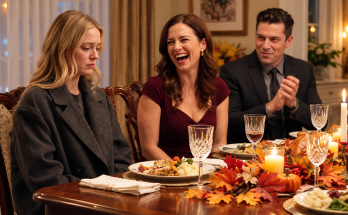
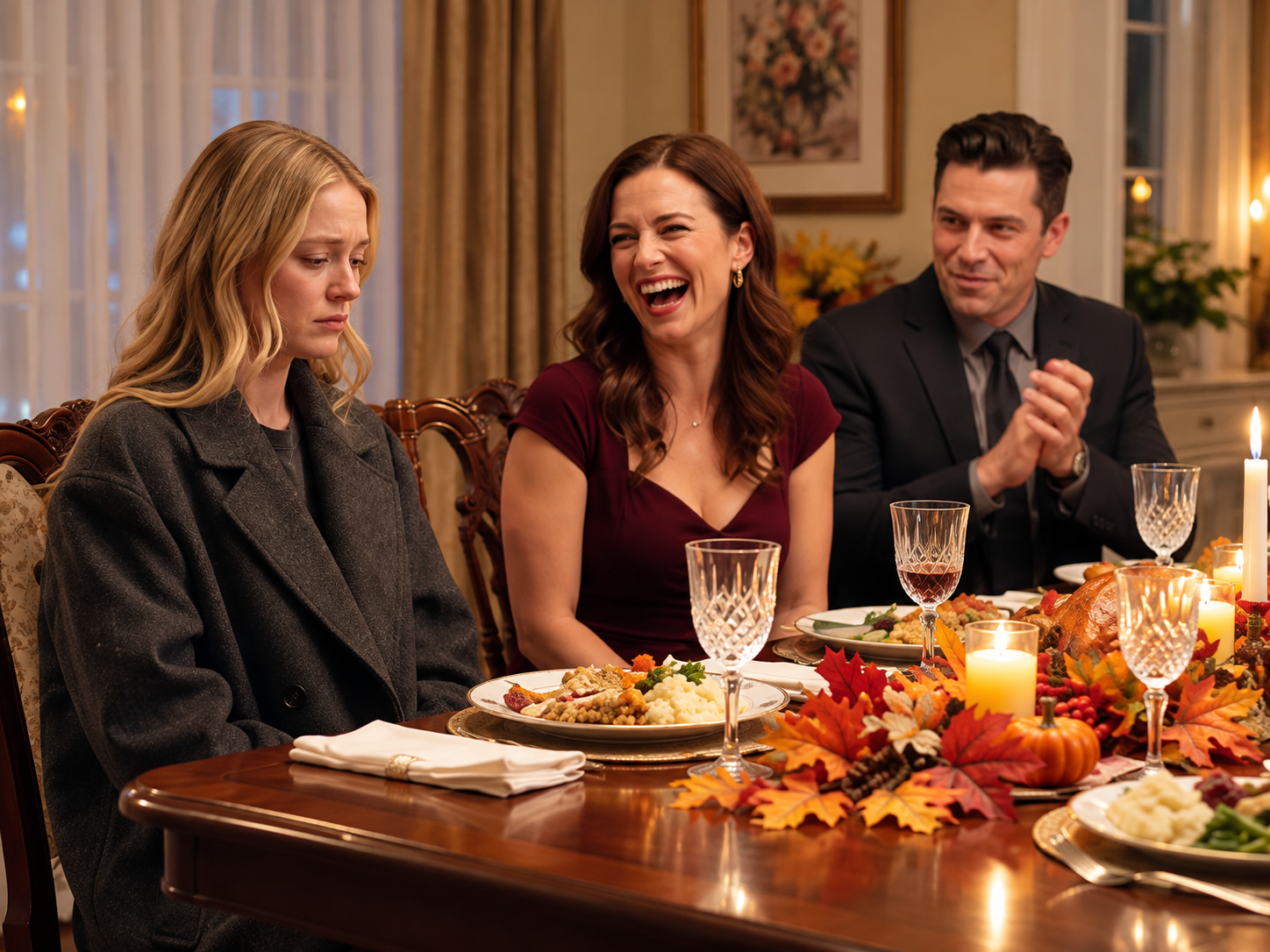
My Father Raised His Glass to Insult Me at Thanksgiving, Unaware That the Daughter He Mocked Had Been Paying for Nearly Everything He Owned
Part 10 of 20