The first question Leo asked after the court proceedings ended was not about Elena, Mark, or the old well. It came on a rainy Tuesday morning while Sarah was packing his lunch for school. He stood beside the kitchen counter, watching her cut an apple into slices, then asked, “How old would I be now if none of this had happened?”
Sarah's knife stopped against the cutting board. I looked up from the school forms in front of me, unsure whether I should answer or give her time. Leo had begun asking more questions since the case ended. At first, they were practical: how long he would need therapy, whether he could return to his old classroom, and whether his friends remembered him. Now he was trying to measure the years that had disappeared from his life.
“You're still eight,” I told him gently. “Your birthday is coming, and you'll turn nine. The time you spent away doesn't change that.”
“But I missed things.”
“Yes,” I said. “You did.”
He looked down at the apple slices. “I missed school. I missed Maya getting bigger. I missed my birthday.”
Sarah set the knife down and came around the counter. She pulled out a chair and sat beside him. “We can't give those days back,” she said, “but we can help you make new memories. You don't have to catch up with everything at once.”
Leo considered that. He didn't look convinced, but he sat down and ate his breakfast. I had learned not to measure a conversation's success by whether it ended with a smile. Sometimes the most honest answer left a child sad, and the sadness was not evidence that we had answered badly.
The school had offered a gradual return, with shorter days and access to a counselor if Leo felt overwhelmed. We arranged for a trusted staff member to meet him at the entrance, and we made sure he could call us if he needed to leave early. On his first morning back, he held Sarah's hand until we reached the gate. Then he turned toward me.
“Will you be here when I get out?”
“I'll be right here at the usual time.”
He studied my face. “Promise?”
“I promise.”
I arrived twenty minutes early and waited in the car until the school day ended. When Leo came through the gate, his backpack hanging from one shoulder, he looked tired but not frightened. He told me that his class had been learning fractions and that someone had changed the seating arrangement. He didn't mention the hallway, the locked doors, or the moment he had hesitated at the classroom entrance. I didn't ask him to. He had made it through the day, and that was enough.
At home, Maya had prepared a welcome sign with colored markers. She had written his name in large blue letters and drawn three stars beneath it. Leo stared at the sign, then gave her a small smile. She asked whether he wanted to play a game. He said yes, and they sat on the living-room rug with a box of building blocks between them.
I watched from the kitchen doorway, feeling grateful and guilty at the same time. Maya had spent months without her brother, and she had carried a burden no six-year-old should have carried. Leo had lost time, safety, and trust. Neither child had escaped the consequences of what the adults had done. I could not repair the past for either of them, but I could make sure their pain was not ignored simply because the investigation had reached an outcome.
The therapist warned us that recovery would not follow a straight line. Leo might appear settled for weeks and then become frightened by a sound or smell that reminded him of the concealed room. He might ask the same question repeatedly, not because he had forgotten the answer but because he needed to hear it again. We were advised to respond calmly, maintain routines, and avoid treating every difficult moment as a setback.
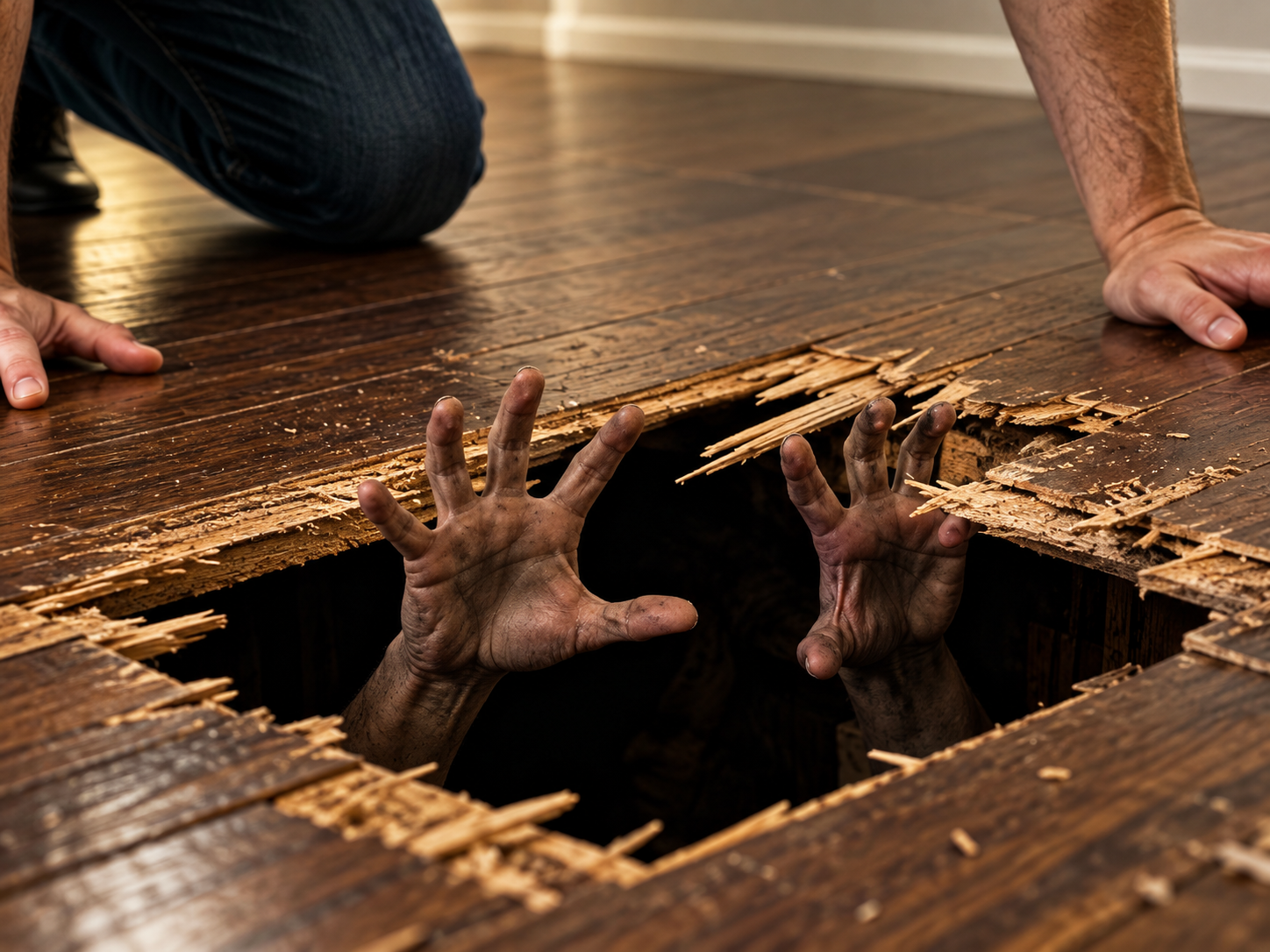
That advice helped when a floorboard creaked outside his bedroom one night. Leo woke screaming and ran into our room, convinced someone was beneath the house. Sarah turned on the light while I walked with him through the hallway. We checked the rooms together, then sat on the edge of his bed until he could breathe normally. I explained that old houses made noises as the temperature changed. He nodded, but he kept hold of my hand until he fell asleep again.
The following morning, he apologized for waking us.
“You don't have to apologize for being frightened,” Sarah told him.
“But you were tired.”
“We can be tired and still take care of you,” I said.
He seemed to absorb that slowly. Then he asked for pancakes, and Sarah made them. We let the morning continue without turning it into a discussion about the nightmare. He needed to know that fear could arrive without becoming the only thing the family talked about.
As Leo grew stronger, the school counselor began helping him reconnect with classmates. Some children asked where he had been. Others repeated things they had heard from adults. We agreed on a simple explanation he could use if he wanted: he had been through something serious, and he was getting help. He didn't owe anyone a detailed account. If he wanted to tell a close friend more, that would be his choice, made with support.
One afternoon, he came home upset because a classmate had said he was lucky to be famous. Leo didn't understand why anyone would call his experience lucky. He asked whether people thought the attention meant he should be happy. I told him that sometimes people spoke carelessly because they didn't understand what had happened. His experience had not been a gift, and he did not need to pretend it was. We contacted the school so the staff could address the comments without making Leo the center of another public discussion.
Meanwhile, the case continued to affect our family in quieter ways. News articles had summarized the court's findings, and people who barely knew us sometimes approached me with questions. Some offered genuine sympathy. Others wanted to know whether my father had known all along or whether Elena had acted alone. I kept my answers brief. The legal process had established responsibility for the acts supported by the evidence, and I would not add speculation simply to satisfy curiosity.
My father continued to cooperate with the authorities and accepted the limits we placed on contact. He did not attend school events unless we explicitly invited him. He sent cards to the children, and I read them before deciding when to pass them along. It was not a punishment. It was a way to ensure that our children were not drawn into adult emotions before they were ready.
One card contained a photograph of the old pocket compass he had once wanted to give Leo. On the back, he had written that he hoped his grandson would someday use it on a trip he chose for himself. He did not mention the court, the well, or his own guilt. I placed the card in Leo's keepsake box. I didn't know whether he would ever want the compass, but I wanted him to have the choice.
I had not forgiven my father, but my anger had changed. In the beginning, I could barely hear his voice without remembering his admission that he had seen Leo alive and stayed silent. Now I could recognize that he was attempting to take responsibility without demanding a reward. That did not make his choices less serious. It meant only that I was watching what he did now rather than allowing every decision to be determined by what he had done before.
Sarah and I also began speaking more openly about our own grief. For months, we had concentrated on the children and the investigation, postponing our feelings until there was a quieter moment. The quieter moment never arrived by itself. We had to make room for it. We began seeing a counselor together, where we could talk about the guilt we carried and the anger that sometimes appeared without warning.
I admitted that I still blamed myself for turning away during the barbecue. Sarah told me she had replayed the day she received the first missing-person call, wondering whether she should have noticed something earlier. Our counselor reminded us that hindsight made ordinary moments look like warnings after we knew how the story ended. We had been deceived by people who possessed information we did not have. Our responsibility now was to protect the children and learn from the failures that had been exposed, not to punish ourselves forever for failing to predict the actions of others.
That conversation did not erase my guilt, but it helped me stop treating guilt as proof that I had caused what happened. I had looked away for a moment during an ordinary family gathering. Elena and Mark had made deliberate choices afterward. Those facts were not equal. I could wish I had been more attentive without accepting responsibility for their actions.
Several months after Leo returned home, the therapist suggested that he might benefit from making a memory book. It would not be a record of the confinement unless he wanted it to be. It could include drawings, photographs, and descriptions of ordinary things he enjoyed. The goal was to help him connect his life before the disappearance with his life now, without forcing him to relive the frightening parts.
Leo chose a photograph of himself and Maya building a snowman during a winter trip years earlier. He added a picture of the model airplane he had made with me and a drawing of our backyard. At first, he left a large blank page in the middle. When I asked whether he wanted to add something there, he said he didn't know what belonged in it.
“You don't have to fill every page,” I told him.
He thought about that, then wrote one sentence in small letters: “This part was hard, and I'm still here.”
I read it quietly, then asked whether he wanted me to help him add anything. He shook his head. The sentence was his, and it was enough.
One evening, while Sarah prepared dinner, Leo asked whether Elena had been frightened when the police found him. I told him I didn't know exactly what she had felt. He asked whether she had been sorry. I explained that she had admitted some of what she did and had written a letter, but that being sorry did not change the fact that she had hurt him.
“Could she be sorry and still be wrong?” he asked.
“Yes,” I said. “People can regret what they did and still have to take responsibility for it.”
He looked toward the window. “I don't want to see her.”
“You don't have to decide anything about that right now,” I told him. “We won't arrange contact unless it is safe and appropriate, and your feelings will matter.”
He nodded and returned to his drawing. I was relieved he could express a clear boundary without being told to reconsider it for the sake of family peace. He had spent too long believing that the adults' fear mattered more than his own.
As the year moved forward, the children began to enjoy ordinary family activities again. We visited a small lake on a quiet weekday, taking a picnic and leaving whenever Leo wanted. At first, he stayed close to us. Then he noticed a group of ducks near the shore and asked whether he could feed them. We checked the park's rules, bought appropriate feed from the kiosk, and walked with him toward the water.
Maya laughed when a duck waddled toward her shoes. Leo laughed, too, and the sound startled me with its familiarity. I didn't call attention to it. I simply stood beside Sarah and watched the children scatter a few handfuls of feed. The moment did not prove that the trauma was gone. It showed that happiness could return without asking permission from the past.
On the drive home, Leo fell asleep against the window. Maya asked whether she could choose the music. Sarah handed her the phone, and she played a song the children had loved before he disappeared. I felt the old ache rise, but this time it was mixed with gratitude. We were not restoring the exact life we had lost. We were building a new one from the pieces that remained.
The following week, the detective called with an update about the remaining legal matters connected to the old well. He said the authorities had completed another round of evidence review and that the records supported the findings already presented. There were still details that could not be established with complete certainty, but no new information changed the central conclusions. I thanked him for the update and asked him to continue contacting our lawyer rather than reaching out to Leo directly unless there was a necessary reason.
After the call, I stood in the kitchen for a long time. I had spent fourteen months waiting for someone to tell me what happened to my son. Now I was learning to live without asking the investigation to answer every emotional question. The evidence could explain who had acted, what they had concealed, and how the concealment had continued. It could not tell me when Leo would stop being afraid or whether my father and I would ever rebuild our relationship.
Those questions belonged to the life we were living now.
That night, Leo asked me to sit with him while he arranged his memory book. He placed the photograph of the snowman near the front and the new drawing at the end. He looked at the blank page in the middle for a moment, then turned it over and began sketching a small yellow house with open windows.
“What's this one?” I asked.
“Our house now,” he said. “The windows are open because we can open them.”
I smiled. “I like that.”
He colored the door blue and drew the hallway light as a bright yellow square. When he finished, he placed the picture beside the sentence he had written earlier. The two pages did not explain everything that had happened. They did not need to. They showed that his life contained more than the months he had lost.
Before bed, he tapped three times against the wall. I answered with two.
“Dad?”
“I'm here.”
“Can we do that tomorrow too?”
“Every night you want to.”
He settled into bed, and I left the door open. For the first time in weeks, he did not ask me to check beneath it. I stood in the hallway for a moment, then walked downstairs to join Sarah.
The years he had lost would always matter. We would not pretend they hadn't happened or ask him to turn them into a lesson for other people. But we would help him build a life that included school, friends, laughter, and the freedom to make choices. He had already survived what no child should have faced. He deserved the chance to grow beyond it.
Click here to continue reading: PART 10: My Father Asked for One Honest Conversation, but I Wasn’t Ready to Let His Regret Become My Responsibility
My Daughter Put Her Ear Against My Sister’s Perfect Floor and Whispered That Her Missing Brother Was Still Alive
Part 9 of 16