
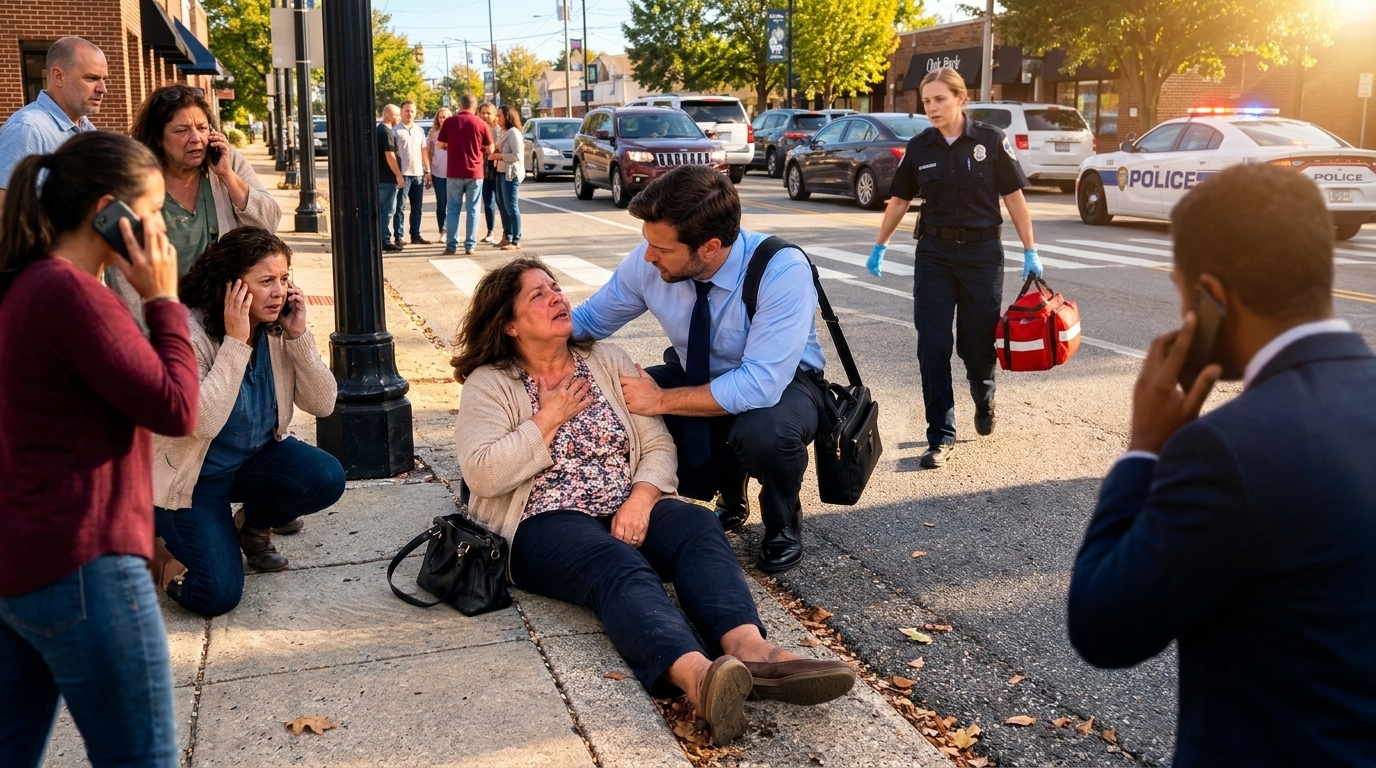
I went home that afternoon and told Claire everything.
She listened from the other side of the kitchen table.
When I finished, she didn't immediately smile.
Instead, she asked, “Did Martin pull the account?”
“Yes.”
“Because of what Nick said?”
“Yes.”
She nodded slowly.
“You didn't ask Thomas to do that.”
“No.”
“You didn't ask Martin to hire you.”
“No.”
“So what happened?”
I thought about it.
“The truth reached the right person.”
Claire looked at me.
“That matters.”
She stood and began clearing the dishes.
Then she stopped.
“There's something I want you to remember.”
“What?”
“Don't tell the girls that doing the right thing always gets rewarded.”
I frowned.
“Why not?”
“Because that's not true.”
She sat again.
“Sometimes you do the right thing and nothing good comes from it.”
I knew she was right.
“Sometimes you stop for someone and still lose the job.”
“Yes.”
“Sometimes you help and nobody notices.”
“Yes.”
“Sometimes you do everything right and life still hurts.”
I nodded.
“Then what do I tell them?”
She looked toward the hallway where the girls were playing.
“Tell them the choice matters.”
“The choice itself?”
“Yes.”
She took my hand.
“You didn't stop because you knew Martin Ellery would hear about it.”
“I didn't even know Thomas.”
“Exactly.”
“You didn't stop because you thought someone would reward you.”
“No.”
“You stopped because you couldn't keep driving.”
I looked down.
“I almost did.”
Claire smiled.
“And that's the part they need to know.”
The next few days moved quickly.
The company sent paperwork.
I had interviews with people in human resources.
There were forms, references, and practical questions.
But the position was real.
So was the salary.
So were the benefits.
For the first time since Cora's ear infection had begun, Claire and I could look at the medical expenses without calculating which bill could be delayed.
Still, something felt unfinished.
I hadn't met Eleanor.
I kept thinking about her.
Not because I expected gratitude.
Because the last image I had of her was on the asphalt.
On Thursday evening, Thomas called.
“She wants to see you.”
“When?”
“Whenever you're ready.”
“I'd like to come.”
“She'll be home.”
A few weeks after the morning on the highway, I drove to the Marsh house.
It was in a quiet suburban neighborhood with mature trees and small front gardens. Nothing about the place suggested wealth or importance. It looked lived in.
Thomas opened the door.
“Sebastian.”
We shook hands.
“Thank you for coming.”
“Thank you for inviting me.”
His wife greeted me, and then Thomas led me into the living room.
Eleanor was sitting in an armchair with a blanket over her legs.
For a moment, I didn't recognize her.
On the highway, she had seemed enormous somehow. Not physically, but because every second around her had felt urgent.
Here she was simply an older woman with short gray hair, steady eyes, and hands folded neatly over the blanket.
She looked at me.
“You're him.”
I smiled.
“I suppose I am.”
“You held my hand.”
“Yes.”
“I remember that.”
“I remember you being scared.”
“I was.”
She looked at Thomas.
“He told you I was frightened?”
“No.”
“Then how did you know?”
I thought about it.
“You were squeezing my hand.”
She looked down.
“I suppose I was.”
There was a quiet moment.
Then she said, “Thank you.”
I shook my head.
“You don't have to thank me.”
“Yes, I do.”
She said it firmly enough that I knew there was no point arguing.
“I didn't know what would happen,” she continued. “I was on the ground, and I couldn't get up. I saw cars going past.”
She paused.
“I thought perhaps nobody would stop.”
I remembered that.
“I’m glad I did.”
“So am I.”
She studied my face.
“Thomas told me what happened afterward.”
I knew what she meant.
“The job?”
“Yes.”
I nodded.
“I found another position.”
“I know.”
She smiled faintly.
“But you didn't know that when you stopped.”
“No.”
“You didn't know Thomas.”
“No.”
“You didn't know Martin.”
“No.”
“You didn't know what any of it would become.”
“No.”
She leaned back.
“Then why did you stop?”
The answer came more easily than I expected.
“Because you were there.”
Eleanor looked at me for several seconds.
Then she said quietly, “That's the whole answer.”
I smiled.
“I think so.”
She folded her hands.
“I was a teacher for thirty-two years.”
“I didn't know that.”
“Middle school science.”
“That sounds difficult.”
“It was.”
She smiled.
“But I loved it.”
She looked toward the window.
“For thirty-two years, I tried to teach children that the world is full of moments when you have to decide whether you're going to respond.”
I listened.
“You see someone being bullied. You can walk away or intervene.”
She continued.
“You see someone struggling. You can pretend not to notice.”
Her fingers tightened around the edge of the blanket.
“You see someone who needs help. You can tell yourself someone else will handle it.”
She looked back at me.
“Most people keep moving.”
I nodded.
“Some people turn around.”
Neither of us spoke for a moment.
“I spent thirty-two years wondering whether any of that stayed with my students,” she said.
Then she gave a small laugh.
“I suppose I finally got an answer.”
I understood.
“You taught people to go back.”
“I tried.”
“You succeeded.”
She shook her head.
“No.”
She pointed gently toward me.
“You did.”
I smiled.
“I learned it somewhere too.”
“From whom?”
“My father.”
She waited.
“He used to talk about building houses. He told me that the parts you can't see matter just as much as the parts everyone notices.”
Eleanor nodded.
“The foundation.”
“Yes.”
“Good advice.”
“It was.”
She looked down at her hands.
“My mother taught me something similar.”
“What?”
“When you're frightened, you don't have to be brave alone.”
I remembered her hand around mine on the highway.
“She held your hand?”
“At everything.”
She smiled.
“When I was a child. When I was sick. When I failed. When I was afraid.”
She looked at me.
“I held my students' hands too.”
I smiled.
“Not literally, I hope.”
She laughed.
“No. Usually not.”
Her eyes grew thoughtful.
“But I tried to give them the feeling that someone was there.”
The room became very quiet.
“That is what you gave me,” she said.
I didn't know how to respond.
So I simply said, “I'm glad.”
She nodded.
Then she looked toward Thomas.
“He told me you were worried about whether accepting the new job would make everything seem as though it had been worth it.”
I turned to Thomas.
“You told her that?”
Thomas raised both hands.
“She asks questions.”
Eleanor smiled.
“It's all right.”
I laughed.
She looked back at me.
“Listen carefully.”
I did.
“The job doesn't prove you made the right decision.”
I nodded.
“The money doesn't.”
I nodded again.
“Martin doesn't.”
She paused.
“Neither does my survival.”
That caught me.
“What do you mean?”
“You made the right decision before you knew any of those things would happen.”
I sat very still.
“That is why it was the right decision.”
She touched the blanket with one hand.
“The outcome cannot be what makes the choice good.”
I thought about Claire saying almost the same thing.
Eleanor smiled.
“You and I both almost didn't.”
I looked at her.
“What?”
“You almost kept driving.”
“Yes.”
“I almost stopped calling out.”
I remembered her voice.
“I heard you.”
“I was embarrassed.”
“Why?”
“Because I thought perhaps I was making a fuss. I thought maybe I was having a bad moment and someone would tell me to wait.”
She looked at me.
“So we both hesitated.”
“Yes.”
“But you came back.”
“Yes.”
“And I called out.”
“Yes.”
She smiled.
“And here we are.”
I laughed softly.
“Here we are.”
She reached toward me.
I took her hand.
This time, she wasn't frightened.
She squeezed my fingers.
“Thank you for coming back,” she said.
I squeezed her hand in return.
“Thank you for calling out.”
Thomas smiled from across the room.
I drove home just before sunset.
The city was settling into evening traffic. Storefronts were lighting up. People were heading home from work. The ordinary world continued around me.
At a red light, I thought about the cardboard box I had carried from Calloway.
I thought about the meeting with Martin.
I thought about Eleanor in the chair.
And I thought about Claire.
She had been right.
The important part wasn't that everything had eventually worked out.
The important part was that when I had looked into the rearview mirror, I had realized I couldn't live with what I had seen.
I pulled into our driveway.
The kitchen light was on.
Through the window, I could see Claire standing near the stove.
Lily was at the table.
Cora was bent over something with the intense concentration only a five-year-old could give to a completely ordinary object.
I stayed in the car for a moment.
I thought about the job I had lost.
The job I was about to begin.
The account Calloway had lost.
The woman who had almost been left alone.
And the choice that had connected all of it.
I remembered something my father used to say.
Build the part nobody sees properly.
If the foundation is sound, everything above it has a chance.
I opened the car door.
Inside, Cora looked up.
“Daddy!”
“Yes?”
“I made a dinosaur.”
She held up a strange little construction made from cheese, crackers, and what appeared to be a pea.
I studied it seriously.
“That is an excellent dinosaur.”
“I know.”
She returned to her creation.
Claire looked over from the stove.
“How was your day?”
I smiled.
“Good.”
“How good?”
I looked at my daughters.
Then at my wife.
“Very good.”
She smiled.
“Tell me later.”
“I will.”
I put my bag down.
For the first time in weeks, I felt no need to rush toward the next thing.
I was home.
And somewhere between the highway shoulder and that kitchen, I finally understood what had happened.
I had thought the story was about losing a job.
Then I thought it was about getting another one.
It wasn't.
It was about the moment before either outcome existed, when I had been driving toward something important and saw a stranger in trouble.
I had passed her.
Then I had turned around.
Everything else came afterward.
Click Here to continue read next: PART5: My First Week at the New Company Exposed a Problem I Had Not Expected, and Suddenly the Decision That Cost Me My Old Job Had Consequences Beyond Me
I Left Home Before Sunrise for the Most Important Presentation of My Career, Then One Glimpse on the Highway Forced Me to Choose
Part 4 of 8

