
At 6:15 that morning, I was already on the highway, dressed in the suit I usually saved for presentations that mattered. The presentation that day mattered more than most. By 8:30, my team was supposed to convince a major pharmaceutical company to trust our agency with a contract large enough to change the company’s future. I had spent weeks preparing for it. I had no idea that before I reached the conference room, I would make a decision that would cost me my job.
My name is Sebastian Reyes. I was forty-one then, married to Claire, and the father of two girls, Lily and Cora. I had been a senior account director at Calloway Creative for nearly three years. Before that, I had spent more than a decade learning the advertising business from the inside out. I knew how to read a nervous client, rescue a failing campaign, and stay calm when a presentation went wrong. I believed those skills had made me valuable.
That morning, I had done everything I could to make sure nothing went wrong.
My alarm had gone off at 5:30. I had showered quietly, checked the presentation twice, and gone through the financial figures one last time at my desk. The house was dark except for the small lamp in the hallway. Claire and the girls were asleep. I stood outside Lily’s room for a moment, watching her breathe beneath her blanket, then did the same with five-year-old Cora.
Cora had been sick for several nights with an ear infection. Claire had stayed up with her the previous evening, holding her whenever the pain woke her. I had helped until midnight, then returned to my laptop and worked until 2:30. Three hours of sleep was not enough, but I had told myself it did not matter. I could sleep after we won the account.
The pharmaceutical company had been considering agencies for months. Everyone at Calloway knew what winning it could mean. New hires. Bigger projects. Better bonuses. Security. Nick Calloway, the owner, had made the importance clear in almost every meeting.
“Be early,” he had told us more than once. “Be ready before they are ready.”
So I was early.
Until I saw her.
At 6:28, traffic was moving quickly. I was thinking about the opening slide when something on the shoulder caught my attention. A gray sedan was stopped with its hazard lights flashing. Beside it was an elderly woman.
At first, I thought she might have dropped something.
Then I realized she was on her hands and knees.
I passed her.
For several seconds, I kept driving.
That is the part I have never tried to make sound better than it was. I did not immediately pull over. My mind was still inside that presentation. I was thinking about the first thirty seconds, the figures on slide twelve, and whether the client would challenge our proposed budget.
Then the image returned to me.
The woman’s posture.
The way one hand had been pressed against the pavement.
The fact that someone her age should not have been crawling around on a highway shoulder at that hour.
I looked in my rearview mirror.
I had gone perhaps a hundred yards.
“Damn it.”
I moved toward the shoulder, stopped, and sat there for three seconds.
Those three seconds mattered.
Then I put the car into reverse and went back.
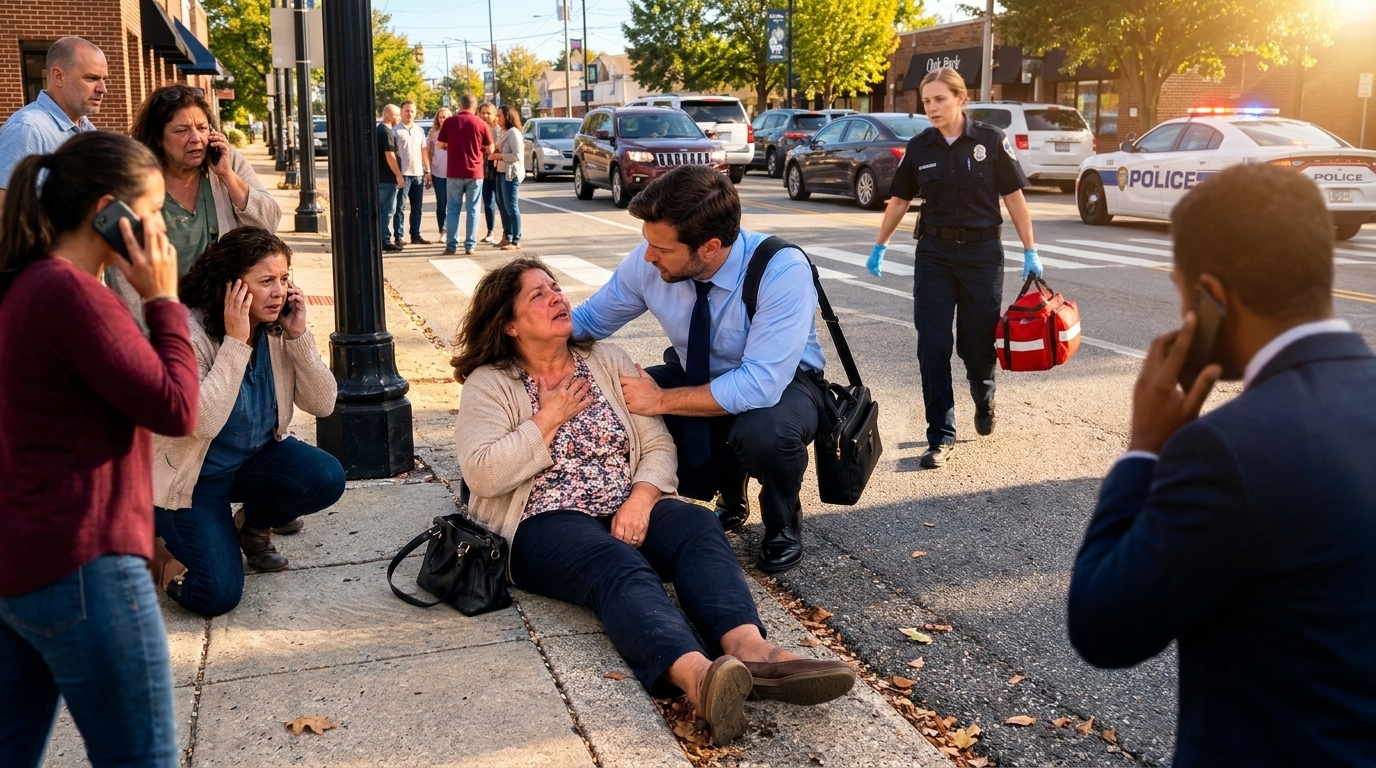
When I reached her, she was breathing strangely. She looked to be in her seventies. Her face had lost its color, and one hand was pressed tightly against her chest.
I crouched beside her.
“Can you hear me?”
She looked at me.
“I’m sorry,” she whispered.
“You don't need to apologize. Are you having chest pain?”
She nodded.
“Yes.”
I pulled out my phone.
“I’m calling emergency services.”
“My husband,” she said.
“I’ll help you contact him. First, we need an ambulance.”
The dispatcher answered quickly. I gave our location, described what I could see, and followed every instruction. The woman told me her name was Eleanor.
I kept talking to her because the dispatcher told me to keep her awake.
“What’s your full name, Eleanor?”
“Eleanor Marsh.”
“Okay. Eleanor, stay with me.”
“I’m trying.”
“I know.”
She closed her eyes.
“Keep them open if you can.”
She opened them again.
I stayed beside her, one hand lightly against her back. I could feel how tense she was beneath her coat.
“My son,” she murmured.
“Do you want me to call him?”
She nodded.
“Your phone?”
She pointed weakly toward the car.
I found it, but there was no time to start searching through contacts. The dispatcher told me the ambulance was close.
“Just stay with me,” I said.
She looked at me.
“I was afraid nobody would stop.”
I did not know what to say to that.
So I said the simplest thing.
“I stopped.”
The ambulance arrived eleven minutes after my call.
The paramedics took over immediately. One of them asked what had happened, and I explained what I had seen. Another knelt beside Eleanor and began working while the first checked her condition.
As they lifted her onto the stretcher, one of the paramedics looked at me.
“Good thing you came back.”
I nodded.
I watched the ambulance pull away.
Then I looked at my watch.
8:47.
My presentation had started seventeen minutes earlier.
I stood beside my car for a moment, staring at the road.
Then I drove to Calloway Creative.
The office felt different when I walked in late. People looked at me, then looked away. Nobody had to tell me how the presentation had gone. The answer was written across the faces of everyone who had been waiting.
Nick was standing near the conference room.
The presentation deck was still glowing on the wall behind him.
“Where were you?”
I explained.
I told him about Eleanor. The ambulance. The highway. The eleven minutes.
He listened without interrupting.
When I finished, his jaw tightened.
“You missed the presentation.”
“I know.”
“The client left.”
“I know.”
“We may have lost the account.”
“I know.”
He looked at me as though those words were not enough.
“You were supposed to be here.”
“There was a woman having a medical emergency.”
“You had a commitment.”
“I understand.”
“No, Sebastian. I don't think you do.”
The room had gone quiet.
Nick lowered his voice.
“You should have kept driving.”
I stared at him.
For a moment, I honestly wondered whether I had misunderstood.
“What?”
“You heard me.”
“She was having chest pain.”
“And you had a presentation worth millions of dollars.”
“I couldn't leave her there.”
“You could have called emergency services.”
“I did.”
“And then you could have continued here.”
I looked toward the conference room.
“So you would have preferred that I leave her alone?”
Nick didn't answer directly.
Instead, he said, “You made a decision. Now there are consequences.”
He turned toward the hallway.
“Clean out your desk.”
I didn't move.
“Are you firing me?”
“Yes.”
There it was.
Three years reduced to one sentence.
I looked at Greg, who had been standing near the back of the room. Greg had been with the agency for eleven years. He had trained me when I first arrived and was probably the closest thing I had to a mentor there.
He wouldn't look at me.
That told me enough.
I went to my desk.
I packed slowly because moving quickly would have made the moment feel real. A framed picture of Claire and the girls. A notebook filled with campaign ideas. A coffee mug Lily had painted at school. A stack of papers I had been planning to review that afternoon.
Then I carried the box outside.
I sat in my car and placed both hands on the steering wheel.
For several seconds, I was completely still.
Then I broke.
Not with words. I couldn't find any.
It was just one raw sound that came from somewhere below anger, below embarrassment, below fear.
I had worked nights. I had missed dinners. I had answered calls on weekends. I had spent hours fixing problems that were not technically mine because I cared about the work and the people around me.
And now the reason I had been fired was that I had stopped beside a highway to help a stranger breathe.
I drove home.
Claire was in the kitchen with the girls.
Lily looked up first.
“Daddy, why are you home?”
I set my keys down.
“I’m working from home today.”
The lie sounded weak even to me.
I walked into the bedroom.
Five minutes later, Claire followed.
She closed the door.
She looked at my face.
“Tell me.”
So I did.
I told her everything.
The highway. Eleanor. The ambulance. The presentation. Nick. The firing.
Claire listened without interrupting.
When I finished, she sat beside me.
“He told you that you should have kept driving?”
“Yes.”
“Past a woman who might have been having a heart attack?”
“Yes.”
She stared at the floor for several seconds.
Then she took my hand.
“You did the right thing.”
I looked at her.
“We have a mortgage.”
“I know.”
“Cora has medical bills.”
“I know.”
“Property taxes are due.”
“I know.”
“I don't know how I'm supposed to fix this.”
Claire squeezed my hand.
“You don't have to fix all of it today.”
“I’m forty-one.”
“So?”
“So I don't know how to start over.”
She looked at me.
“You aren't starting over.”
“What am I doing?”
“Starting from somewhere else.”
I almost laughed.
“That sounds nicer than being unemployed.”
“I didn't say it wasn't terrible.”
She paused.
“I said you did the right thing.”
Through the bedroom door, I could hear Lily explaining something to Cora in the serious voice she used whenever she believed she knew more than her little sister.
Claire listened for a moment.
Then she asked, “What would you tell them to do if they were the one on that highway?”
I knew the answer.
I just didn't want to say it.
She waited.
Finally, I said, “Stop.”
“Exactly.”
I looked down at my hands.
“What if doing the right thing ruins everything?”
Claire's voice softened.
“Then we deal with what it ruins.”
She stood.
“We'll make a plan.”
“A plan for what?”
“For tomorrow.”
She opened the door.
“And for the day after that.”
I stayed on the bed after she left.
I thought about Eleanor.
I thought about the paramedic telling me it had been good that I came back.
And for the first time since leaving the office, I wondered what had happened to her after the ambulance doors closed.
Click Here to continue read next: PART2: I Returned to the Office Expecting Only an Awkward Goodbye, but One Conversation and an Unexpected Phone Call Changed What My Firing Might Mean
I Left Home Before Sunrise for the Most Important Presentation of My Career, Then One Glimpse on the Highway Forced Me to Choose
Part 1 of 8

