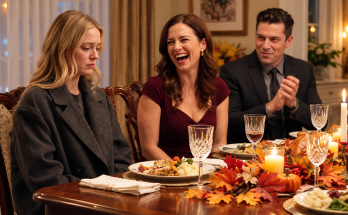
On the evening of her father’s birthday, Emma changed her outfit twice before settling on a simple blue dress. She stood in front of the bedroom mirror, fastening a small silver necklace her father had given her years earlier, and wondered why an ordinary family dinner had begun to feel like an examination she had not agreed to take. She knew she was not the one who had broken the family’s trust, yet she could already imagine herself being watched for signs of anger, forgiveness, or weakness.
Daniel appeared in the doorway with his jacket over one arm. “You look lovely,” he said.
“Thank you.” Emma adjusted the necklace. “I just wish I could go there without thinking about every possible thing that might happen.”
“You can think about it if you need to. You don't have to arrive perfectly calm to prove you're ready.”
She turned toward him. “What if someone says something they shouldn't?”
“Then you can answer, change the subject, take a break, or leave. We don't owe anyone a performance.”
His words eased something inside her. Emma slipped her phone into her handbag and took one last look at the mirror. She was not going to the house as the woman who had entered a wedding chapel carrying hospital papers and a truth no one had expected to hear. She was going as herself, with all the uncertainty that remained, and she did not have to be fearless to walk through the door.
Her parents’ house looked almost exactly as it had when she and Victoria were growing up. The porch light glowed above the front steps, and a row of potted plants lined the railing. Through the kitchen window, Emma could see her mother moving between the counter and the table. The familiar sight brought back the comfort of countless childhood evenings, but it also reminded her how easily familiarity could hide things people were unwilling to confront.
Her father opened the door before she could knock twice. He pulled her into a careful embrace, mindful of the lingering tenderness in her wrist. “There she is,” he said, his voice warm with relief. “I was beginning to think you were going to make an old man wait for his birthday dinner.”
“You've been calling yourself an old man since you turned forty,” Emma replied.
“And every year, I become more correct.”
She laughed, and the sound came more easily than she had expected. Her father held her for another moment before welcoming Daniel inside. Her mother emerged from the kitchen, kissed Emma’s cheek, and asked whether the drive had been comfortable. There was no interrogation about her feelings, no attempt to tell her how the evening ought to unfold. Emma appreciated the restraint more than she could express.
Aunt Margaret arrived shortly afterward carrying a wrapped present and a homemade cake. She hugged Emma, then Daniel, and greeted the others with her usual brisk warmth. Her gaze lingered on Emma’s face for a moment, as though she wanted to say something important, but she waited until Emma had settled into the living room before speaking.
“I’m glad you came,” Margaret said quietly.
“So am I.”
“I know that doesn't mean everything is settled.”
“No,” Emma replied. “It doesn't.”
Margaret nodded, accepting the answer without adding a plea for patience or family unity. Emma realized that this was what she had wanted from people all along: not perfect understanding, but the willingness to hear what she said without immediately translating it into something more comfortable.
Victoria arrived last. Emma heard the car door close outside and felt her shoulders tighten before she could stop them. A moment later, Victoria stepped through the front door carrying a gift bag. She wore a dark green blouse and black trousers, her hair pulled back from her face. She looked older than Emma remembered, though Emma knew the difference was not simply time. Since the wedding, Victoria seemed to have lost the effortless certainty with which she had once entered a room expecting everyone to accept her version of events.
Her eyes met Emma’s. For a second, neither sister spoke.
“Happy to see you here,” Victoria said at last. “Happy birthday to Dad, too.”
“Thank you,” Emma answered, uncertain whether the first sentence was meant for her or was simply an awkward way of greeting the room.
Victoria placed the gift beside the others and moved toward their father. She did not attempt to hug Emma, and she did not make a show of avoiding her. She simply left a respectful amount of space between them. Emma noticed the choice, then deliberately turned her attention back to her mother, who was asking Daniel whether he wanted something to drink.
The dinner began with the familiar chaos of a family trying to serve too many dishes at once. Their father complained that no one had allowed him to help with his own birthday meal. Their mother insisted that his idea of helping involved tasting half the food before it reached the table. Daniel offered to carry the serving bowl, and Aunt Margaret warned him that the gravy was hot. For a little while, the ordinary rhythm of the family carried them forward.
Emma found herself laughing at a story about her father attempting to assemble a bookshelf without reading the instructions. Victoria added that he had somehow managed to install one shelf upside down. Their father protested that the instructions had been badly written, and the table erupted in affectionate argument.
The laughter did not erase Emma’s discomfort, but it reminded her that discomfort and enjoyment could occupy the same evening. She did not have to remain solemn to prove that the past mattered. Nor did she have to pretend that the past no longer mattered just because she was capable of laughing.
When the plates were cleared, her father opened his gifts. He made exaggerated guesses about each package, then feigned disappointment when none contained the fishing boat he had been hinting at for years. The family laughed again. Emma watched him lean back in his chair, looking content in a way that made her grateful she had come.
Then their mother brought out the cake.
As she set it on the table, Victoria rose to help find the candles. The two sisters reached for the same drawer at the same time. Their fingers brushed, and Emma instinctively pulled her hand away. The movement was small, but she saw Victoria notice it. For a moment, the old pattern seemed ready to return: an awkward silence, a hurried apology, and a comforting explanation intended to make everyone feel better.
Instead, Victoria stepped back. “Go ahead,” she said. “You know where they are.”
Emma opened the drawer and took out the candles. It was a tiny exchange, almost too insignificant to remember, but it mattered because Victoria had not demanded that Emma act as though physical closeness were easy. She had noticed the discomfort and given Emma room.
After the cake was served, their father raised his glass and thanked everyone for coming. He spoke about the passing year, the things he had learned, and how much it meant to have his family around him. His voice faltered slightly when he looked at Emma, and she knew he was thinking about the time she had been missing and the fear that had filled the family before she returned.
“I've learned that having everyone in the same room isn't the same as having everything right,” he said. “I used to think keeping peace meant making sure nobody argued. But sometimes, trying to avoid an argument means leaving the wrong thing unspoken.”
The table grew quiet. Emma felt her throat tighten, but she kept her eyes on her father.
“I can't change the choices any of us made,” he continued. “I can only try to do better with the choices I have now. I want this family to be honest with each other, even when the truth is uncomfortable. And I want every one of you to know that being family doesn't mean you have to pretend you're not hurt.”
He raised his glass again. This time, no one hurried to fill the silence with a joke.
Emma lifted her own glass. “Happy birthday, Dad.”
Everyone echoed her, and the moment passed without anyone turning to Emma for a response or asking her to make a speech. She was grateful for that. Her father had said what he needed to say, and he had not made her pain the centerpiece of his birthday.
Later, while Daniel helped her father carry dishes into the kitchen, Emma stepped onto the back porch for a little air. The garden was dark except for the soft light above the door. She could hear the others talking inside, their voices rising and falling in the comfortable way she remembered from childhood.
Victoria appeared at the doorway but stopped before stepping outside. “Would you like me to leave you alone?” she asked.
Emma looked at her. The question was careful, and it gave her an actual choice.
“You can come out,” Emma said. “I just don't want to talk about the wedding tonight.”
“I won't bring it up.”
Victoria came onto the porch and stood near the railing, leaving several feet between them. For a while, they watched the garden without speaking. Emma remembered the old treehouse ladder, the summers when they had shared a room, and the secrets they had once promised never to tell anyone else. Those memories remained precious, but the woman standing beside her was no longer someone she could trust simply because she had once known her best.
“I didn't know whether you'd come,” Victoria said eventually.
“I almost didn't.”
“I understand.”
Emma glanced at her. “Do you? Or are you trying to say the right thing?”
Victoria lowered her eyes. “I can't prove I understand everything you feel. I can only try not to make it harder.”
For once, Emma found no immediate reason to challenge the answer. It was not a declaration that Victoria had become trustworthy, and Emma did not accept it as one. It was simply an honest admission of limitation.
“I don't know what our relationship will look like,” Emma said. “Some days I think I might be able to speak to you more easily. Other days, I remember what happened and feel like I don't know you at all.”
Victoria’s hands tightened around the railing. “I wish I could tell you that you'll never feel that way again.”
“But you can't.”
“No. I can't.”
Emma looked toward the garden. “Then don't promise it. Just respect what I tell you, even when you don't like it.”
“I will try.”
“Trying matters,” Emma said, “but what you do matters more.”
Victoria nodded. She did not defend herself or ask for a second chance. After a moment, she said that she would go inside and check whether their mother needed help. Then she left Emma alone on the porch.
Emma remained outside for several more minutes. She felt neither victorious nor reconciled. She had not forgiven Victoria for everything, and she had not decided that the two of them would someday become close again. Yet she had managed to share an evening with her sister without surrendering her boundaries, and the evening had contained genuine moments of happiness.
When Emma returned inside, Daniel was standing by the kitchen counter drying a plate. He looked at her questioningly, and she gave a small nod.
“I'm okay,” she said. “Not perfectly comfortable. But okay.”
“That's enough for tonight.”
As they said their goodbyes, Victoria approached Emma near the front door. “Thank you for coming,” she said. “I know it wasn't easy.”
Emma considered her answer. “I came because I wanted to celebrate Dad. I'm glad I did.”
Victoria accepted the distinction. She did not try to turn it into something larger.
On the drive home, Emma watched the familiar streets pass through the car windows. She thought about her father’s words and the strange relief of hearing someone finally acknowledge that family harmony could become another way of silencing the person who had been hurt. For years, she had feared that establishing boundaries would make her the cause of further division. Now she was beginning to understand that she was not responsible for maintaining a peace built on her silence.
At home, Daniel placed the keys in the bowl by the door while Emma removed her shoes. She felt tired, but it was the ordinary tiredness of a long evening rather than the exhaustion of defending her right to speak.
“Would you go again?” he asked.
Emma thought about the question. “Yes. If I wanted to. But I wouldn't go just because someone expected me to.”
Daniel smiled. “That's the important part.”
She leaned against him, resting her head on his shoulder. The night had not repaired the family, and it had not transformed Victoria into the sister Emma remembered. But it had shown Emma that she could enter a difficult room, decide what she was willing to give, and leave with her sense of self intact.
For the first time, she no longer thought of every family gathering as a test of whether she had healed enough. It could simply be an evening she chose to attend, with whatever feelings came along.
Click here to continue reading: PART 15: An Unexpected Request Forces Emma to Decide Whether Protecting Her Peace Means Walking Away or Speaking Honestly One More Time
The Bride Was Waiting Behind the Church Doors When She Heard Her Own Sister Promise to Love the Man She Had Left Behind
Part 14 of 20