Elena called Claire on Tuesday afternoon with an update about Noah’s request for another overnight visit. The team had reviewed the previous visits, including the argument over the sketchbook, and agreed that another overnight could be considered within the existing support plan. They wanted to confirm the arrangements with Noah’s current carers, establish the pickup and return times, and make sure he knew whom to contact if he became uncomfortable. Nothing in the decision authorized an immediate move or guaranteed a permanent placement. It was simply permission to take another careful step.
Claire thanked Elena and wrote down the details, although she already knew she would remember them. When she put down the phone, she found herself smiling at the kitchen counter. She let herself enjoy the feeling for a moment before reminding herself that Noah had asked for another night because he wanted to discover whether the first one had been a matter of luck. Her job was not to convince him that everything would work out. It was to make the next visit as safe and predictable as she could.
That evening, Claire told Sophie that Noah might stay overnight again soon. Sophie immediately began listing activities they could do, including building a larger car track, making pancakes, and sleeping in a blanket fort. Claire listened before explaining that Noah would decide how he wanted to spend the visit, and that he might want some time alone.
“Even if I have a really good idea?” Sophie asked.
“Even then.”
“What if my idea is the best idea?”
“You can tell him once.”
“And if he says no?”
“You let him say no.”
Sophie considered this with a seriousness that made Claire smile. “Being a sister is complicated.”
“Being a person is complicated,” Claire replied.
The following day, Claire received a message from Hannah requesting a brief discussion about the next overnight. The team wanted to understand what had helped Noah sleep during the first visit and what had made him uneasy. Claire described the hallway light, the open door, the reassurance that he could ask to leave, and the way they had talked about his birth without requiring him to respond. She also mentioned that he had kept his backpack close and had chosen when to leave his sketchbook at the house.
Hannah reminded her that those details mattered because they gave the team practical information about what helped Noah feel in control. She also asked Claire not to interpret his willingness to leave belongings behind as proof that he was ready for a permanent placement. A child could enjoy a home and still need time before making a larger decision. Claire agreed, grateful that someone was helping her keep her expectations from outrunning Noah’s comfort.
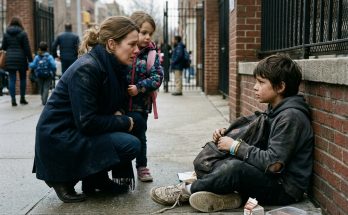
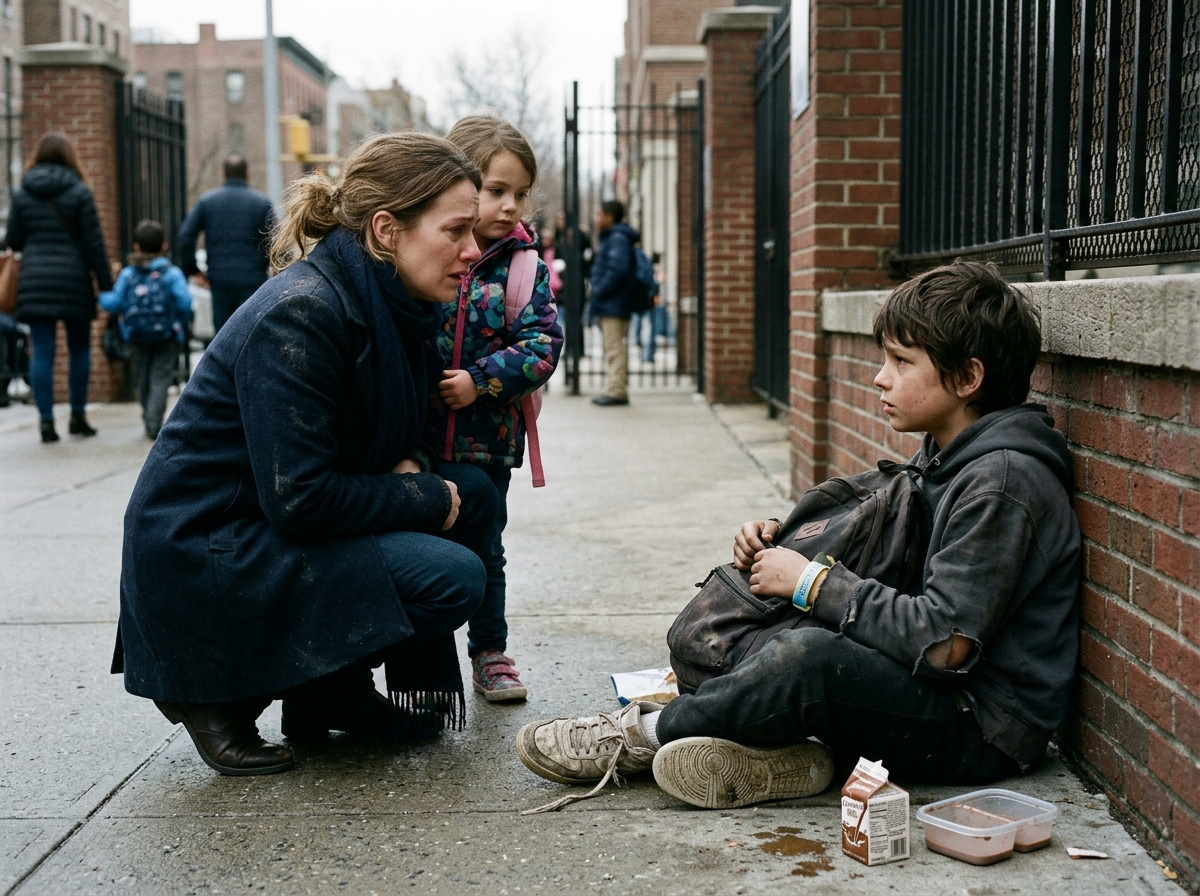
On Saturday morning, Noah arrived with Elena just after ten. He wore his dark-blue sweatshirt and carried his battered backpack. The faded blue hospital bracelet was visible around his wrist, its worn surface catching the light when he adjusted the strap. Claire greeted him, and he stepped inside without waiting for a second invitation.
“Is tonight definitely happening?” he asked.
“If the plan stays as arranged,” Claire answered. “Elena will check in with you, and she'll tell us if anything changes.”
“So I don't have to guess?”
“No. We'll tell you what we know.”
He seemed satisfied with that answer, at least enough to remove his shoes and place his backpack beside the chair. He checked the living room shelf, where his dog drawing still rested. He picked it up, examined the crooked-legged creature, and returned it to exactly the same spot.
“You kept it,” he said.
“You left it here.”
“I thought you might put it in a drawer.”
“I didn't know whether you wanted it moved.”
He nodded and looked toward the kitchen. “Are there pancakes?”
“Not yet.”
“That's disappointing.”
“I'm sure you'll recover.”
He gave her a brief grin, then followed Sophie to the table, where she had arranged paper and pencils for an afternoon drawing session. She had placed the shared basket beside them, with her sign about asking before touching other people's things still taped to the front.
Noah read the sign and said, “You spelled everything correctly.”
“I know how to spell.”
“I was checking.”
“You weren't.”
“I was being helpful.”
Sophie rolled her eyes, and the tension that had marked the previous visit eased a little. Claire did not tell them how pleased she was to see them joking again. She knew that pointing out every sign of improvement could make the children feel watched, as though ordinary moments were being collected as evidence.
After lunch, Elena arrived for the scheduled check-in. She spoke privately with Noah and then reviewed the overnight plan with Claire. Noah could request a quiet conversation, contact Elena, or ask to return to his current placement if he felt unable to continue. The adults would respond to his concerns and follow the agreed safety arrangements. Claire was not to persuade him to remain simply because the visit had been planned.
When Elena asked Noah whether he still wanted to stay, he glanced at the window before answering.
“Yes. I think so.”
“Do you feel comfortable with the plan?” Elena asked.
“I know what happens if I want to leave.”
“And do you know you can tell us if something changes?”
“Yes.”
Elena reminded him that he did not need to prove he was brave by staying. Noah frowned at the word brave and said he was not trying to be brave. He simply wanted to see whether he could sleep there again.
“That's a good enough reason,” Elena told him.
After Elena left, Noah spent the afternoon drawing while Sophie built a small cardboard house for the toy cars. They worked separately until Sophie asked whether he could help her cut a window into one of the walls. Noah agreed, but he insisted that she hold the cardboard steady and let him handle the scissors. When the window came out uneven, Sophie declared it a special architectural feature.
“It's crooked,” Noah said.
“It's artistic.”
“That's what you said about the bridge.”
“And the bridge was good.”
“The bridge collapsed.”
“Only because the cars were too powerful.”
Noah laughed, and Sophie laughed with him. Claire watched from the kitchen doorway, relieved that the earlier argument had become something they could learn from rather than a permanent division between them.
As evening approached, Noah began checking his backpack more often. He unzipped the front pocket, touched something inside, and zipped it again. He repeated the action several times while Claire prepared dinner. Finally, he brought the bag to the kitchen table and set it beside his chair.
“Do I have to leave this downstairs?” he asked.
“No. You can keep it with you.”
“What if I want it beside the bed?”
“That is fine.”
“And if I want to take it back tomorrow?”
“You take it back tomorrow.”
He looked at her for a long moment. “What if I forget something here?”
“We'll keep it safe and arrange for you to get it back.”
“What if I don't come next time?”
“Your things will still be yours. We can talk with Elena about how to return anything you want.”
Noah looked down at the zipper. “I don't want people deciding that because I left something here, I have to stay.”
Claire pulled out the chair opposite him and sat down. “Leaving something here doesn't mean you've agreed to live here. You can leave a drawing, a sweatshirt, or a book because you want to. It doesn't make a decision for you.”
“Even if I leave lots of things?”
“Even then.”
He rubbed the bracelet on his wrist. “Sometimes I don't know if I want to leave things because I like the house or because I'm trying to make myself like it.”
Claire did not rush to answer. “You can take time to work that out. You don't have to make every feeling mean something important.”
He seemed to think about that. Then he took a small notebook from the backpack and placed it on the table. “This stays with me.”
“Understood.”
“And the sketchbook can stay here.”
“That's your choice.”
He placed the notebook back inside the bag, but he did not zip the pocket immediately. Instead, he looked around the kitchen, studying the chairs, the window, and the small marks on the table where Sophie had once pressed too hard with a pencil. Claire wondered whether he was trying to memorize the room or simply noticing it. She did not ask.
Dinner was pasta, salad, and bread. Sophie talked about a class activity, while Noah listened and occasionally asked questions. When Sophie mentioned that her teacher had praised her drawing, Noah told her the cardboard house still needed a stronger roof. She announced that he was banned from architectural criticism. He replied that he had never wanted the job anyway.
After dinner, Claire offered Noah a choice between reading in the living room and going upstairs to prepare for bed. He chose the living room first. He sat on the sofa with his backpack beside him and looked through the sketchbook he had brought from home. Sophie asked if she could sit on the other end of the sofa. He agreed, provided she did not lean over his shoulder.
“I can look at my own book,” she said.
“Good.”
They read and drew quietly until Sophie became sleepy and went upstairs. Noah remained on the sofa, his feet tucked beneath him. Claire sat in the armchair nearby, reading without commenting on his silence.
After a while, he said, “Do you think the team will let me stay here more?”
“I think they will keep looking at whether it can be safe and right for you. I don't know what their final decision will be.”
“Do you want them to say yes?”
“Yes,” Claire answered honestly. “I want to have more time with you. But I don't want that answer to come at the cost of your safety or your choice.”
He studied her. “What if I want to stay, but I don't want to call you Mom?”
“You don't have to call me Mom.”
“What if I never do?”
“I will still be Claire, and I'll still care about you.”
“What if I don't forgive you?”
Claire set her book aside. “I will still be responsible for the choices I made. You don't have to forgive me to deserve a safe home or a relationship with me.”
He looked away, his expression unreadable. “You always say I don't have to.”
“Because I don't want you to feel you owe me something.”
“Sometimes it sounds like you're trying to convince yourself.”
The observation surprised her. For a moment, she considered denying it, but the truth was more complicated. She did have to remind herself not to ask for more than Noah was ready to give. She wanted forgiveness, and she wanted him to see her as his mother, but neither desire gave her the right to demand either thing.
“Sometimes I do have to remind myself,” she admitted. “I have hopes and feelings too. But they're mine to manage. You shouldn't have to take care of them.”
Noah seemed to accept that more readily than a perfect answer. He returned to his sketchbook and drew a small house with a square window. He added a path leading away from the door, then another path leading back toward it.
“What are the paths?” Claire asked.
“One goes out. One comes back.”
“Do they have to meet?”
“No. They're just paths.”
She nodded. “That makes sense.”
When it was time for bed, Noah carried his backpack upstairs himself. He asked Claire to leave the hallway light on and the bedroom door open a little wider than before. She adjusted it without comment. He placed the backpack beside the bed, took out his hospital bracelet's small protective pouch, and checked that the bracelet remained secure around his wrist.
“Can you tell me what time you'll wake up?” he asked.
“I usually get up around seven. Sophie may wake earlier.”
“And if I wake up before you?”
“You can come downstairs, or you can stay in your room. If you're worried, you can call for me.”
He nodded and climbed into bed. Claire stood near the doorway, waiting to see whether he needed anything else.
“I'm not sure I'll sleep all night again,” he said.
“You don't have to.”
“What if I wake up and want to go back?”
“Then tell me or contact Elena, and we'll follow the plan.”
Noah pulled the blanket over his legs. “Okay.”
Claire wished him good night and left the door open as he had requested. She did not stand in the hallway listening for signs that he had fallen asleep. She went downstairs, turned off the kitchen light, and allowed the house to settle into its usual nighttime sounds.
An hour later, Noah called her name. Claire went upstairs immediately, but she did not rush into the room. She stood at the doorway and asked whether he was all right.
“I heard something,” he said.
“What did it sound like?”
“Like somebody walking.”
Claire listened. A branch was brushing against the outside wall, making a faint scraping noise each time the wind moved. She explained what she heard and asked whether he wanted her to show him the branch from the window.
He hesitated, then nodded. They looked outside together. The branch moved gently against the siding.
“That's all it is,” she said.
“I know.”
“You can still be startled by it.”
He climbed back into bed. “Will you leave the light on?”
“Yes.”
He hesitated before adding, “I'm not asking you to stay here all night.”
“Thank you for telling me what you need.”
“I just wanted you to know.”
“I know.”
Claire returned downstairs, leaving the light on and the door open. She did not interpret his request as a rejection or his decision to settle back into bed as proof that he was ready for anything larger. He had woken, asked for help, learned what the noise was, and chosen to try sleeping again. That was enough for one night.
In the morning, Noah came downstairs wearing the same sweatshirt and carrying his backpack. He looked tired but calm. Claire was preparing toast when he appeared.
“I woke up once,” he said.
“I heard you.”
“But I went back to sleep.”
“You did.”
He sat at the table and set his backpack beside his chair. “I think the first night wasn't just luck.”
Claire felt her eyes sting, but she kept her voice steady. “I'm glad you feel that way.”
“I'm not saying I want to move here.”
“I know.”
“I'm saying I want to do another night.”
“Then we'll ask the team what comes next.”
Noah nodded and reached for a piece of toast. The decision was still far away, and the team would continue assessing the arrangement. Yet he had begun to trust something small: that waking in the night did not have to end the visit, that asking for help would not automatically lead to disappointment, and that a room could remain available even when he was unsure.
After breakfast, he packed his belongings and checked the bedroom once more. He left nothing behind that morning. Claire did not ask him to. At the door, he paused and looked back into the house.
“Can I still leave my sketchbook here next time?”
“Of course.”
“Even if I take it home after?”
“Yes.”
He nodded, apparently satisfied by the fact that the answer had not changed. Then he stepped outside with Elena, carrying his backpack and the blue bracelet that had connected his present to a past he was still learning to understand.
Claire watched them leave, then returned to the kitchen. There was a cup on the table, a crumb on the floor, and a small pencil mark on the corner of the paper basket. The house had not transformed overnight. It was simply a place where Noah had slept, awakened, asked for help, and chosen to try again.
Click here to continue reading: PART 22: A Longer Trial Becomes Possible, but When Noah Asks Whether He Can Return to His Current Placement Without Disappointing Claire, She Must Put His Choice Before Her Hope
The Blue Hospital Bracelet That Made a Mother Stop in the Middle of the Street
Part 21 of 28