The invitation to spend a full Saturday at my house came from Noah himself.
He asked during a routine visit while Sophie was showing him a collection of drawings she had made for the school art display. He had been sitting at the kitchen table, sketching a small house with a crooked roof, when he looked up and said, “Could I come for the whole day next Saturday?”
I set down the dish I was drying.
“We can ask Elena and make sure the plan works for you.”
“I already asked her.”
He looked at the drawing again, pretending that the question had not mattered much.
“She said we could plan it.”
I nodded, trying to keep my excitement from overwhelming the moment.
“Then let's plan it.”
We discussed the details with Elena. Noah wanted to arrive in the morning, have lunch with us, spend time drawing, and return to his temporary home before bedtime. He did not want a special activity arranged around him, and he asked whether Sophie could choose what we ate for lunch.
Sophie immediately suggested pancakes.
“Pancakes are breakfast,” Noah pointed out.
“They can be lunch if you make enough.”
“That isn't how lunch works.”
“It's how our house works.”
Noah looked at me.
“Is that true?”
“Sometimes,” I admitted.
He shook his head, but he was smiling.
On Saturday morning, I heard the doorbell just after nine. Noah stood outside with his backpack, a clean sweatshirt, and the blue bracelet visible beneath his sleeve. He looked toward the kitchen window, where Sophie was already mixing batter.
“Smells like pancakes,” he said.
“It does,” I replied.
He stepped inside without needing to be invited twice.
The morning unfolded slowly. Sophie burned the first pancake because she became distracted while explaining a complicated rule for a card game. Noah laughed at her expression, then helped me prepare another batch. He insisted that the pancakes should be evenly shaped, although his own attempt came out looking more like a map than a circle.
We ate at the kitchen table. Noah had a second pancake, then a third half when Sophie declared that she could not possibly finish hers.
After breakfast, he asked whether he could look through the family photographs again. I brought the folder to the living room and placed it on the coffee table. He sorted through the pictures at his own pace, sometimes asking questions and sometimes simply studying a face.
When he reached the photograph of himself as a newborn, he paused.
“Did you ever show this to anyone?”
“No,” I said. “I kept it private.”
“Why?”
“I was ashamed of the way things had happened, and I didn't know how to talk about you without feeling that I had failed you.”
He looked at the picture.
“Were you ashamed of me?”
“No. Never of you.”
He waited.
“I was ashamed of the choices I made and of the fact that I didn't ask more questions when I should have. I should have faced the truth instead of hiding from it.”
Noah returned the photograph to the folder.
“Okay.”
He did not say that he understood or that he forgave me. He simply moved to the next picture, and I allowed the conversation to end there.
Later, he and Sophie went into the garden to build a small obstacle course for a toy car. They used flowerpots as barriers, a piece of cardboard as a ramp, and a row of stones as a finish line. Their first attempt failed when the car rolled sideways into the grass.
Sophie blamed the ramp.
Noah blamed the stones.
They argued for several minutes before agreeing to change both.
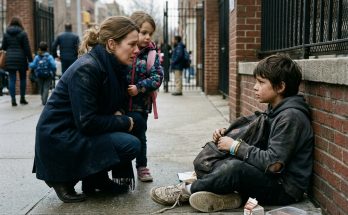
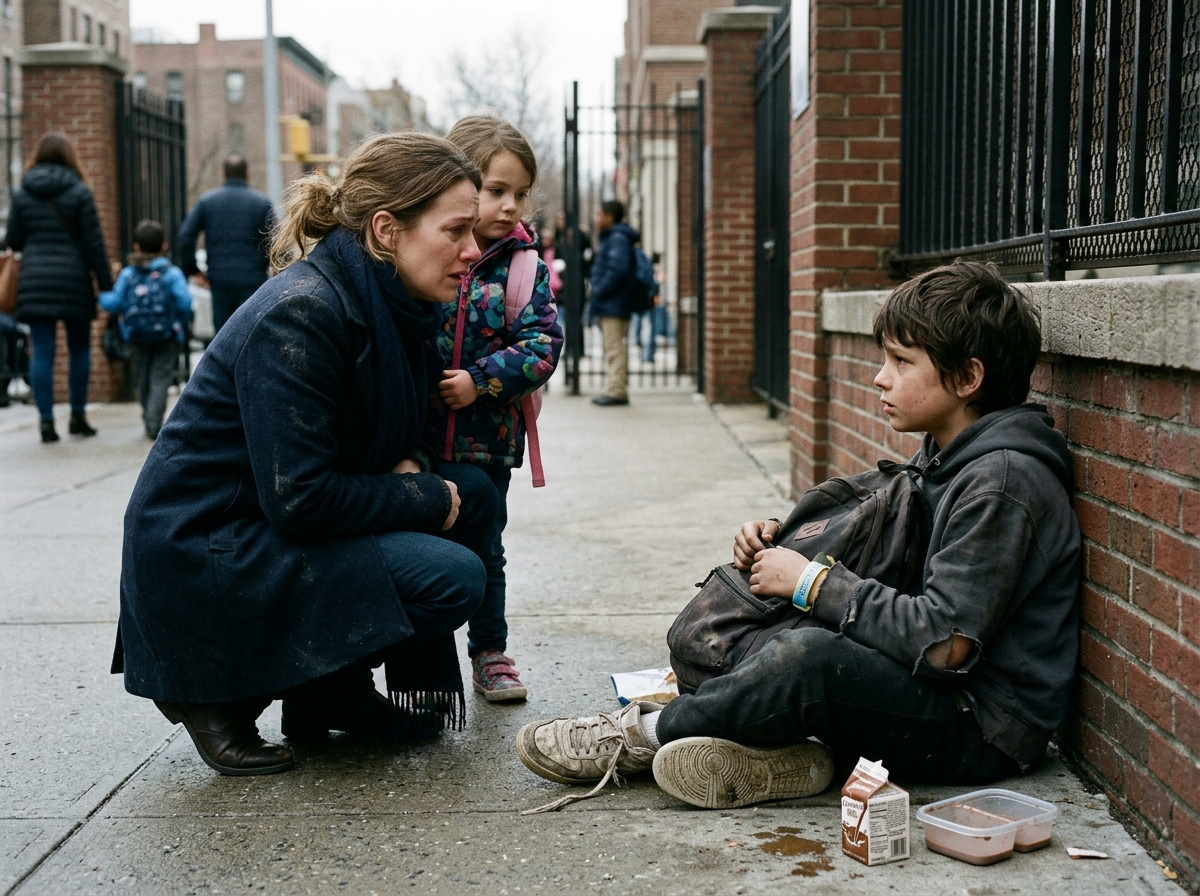
I watched from the kitchen window, remembering the frightened child who had stood near the school gates with his backpack pressed against his chest. That child was still part of Noah, but he was not the whole of him. He was also a boy who liked drawing, enjoyed chocolate biscuits, corrected other people's logic, and believed a toy car deserved a properly designed course.
I had to resist the urge to turn every ordinary moment into proof that he was healing. He did not need to become evidence of my redemption. He needed the freedom to be a child.
At lunchtime, Noah helped carry plates to the table. He placed one beside Sophie, one opposite me, and then stopped with the final plate in his hands.
“Where should this go?”
I looked at the empty chair near the window.
“Wherever you want to sit.”
He examined the table. For a moment, I thought he might choose the chair nearest the door, where he could leave quickly if he felt uncomfortable. Instead, he placed the plate beside Sophie and sat down opposite me.
It was a small choice, made without announcement.
We ate sandwiches and fruit. Noah talked about the book he was reading and asked whether I had enjoyed reading when I was his age. I told him that I used to borrow books from the library and that I had once returned one so late that I had to use my pocket money to pay the fine.
“You could have just returned it,” he said.
“I did return it. The fine was because I kept it too long.”
“That seems unfair.”
“Libraries have rules.”
“Then you should have read faster.”
Sophie burst out laughing. I joined her, and Noah looked pleased with himself.
After lunch, we worked on a drawing together. Sophie drew the house, Noah drew the garden, and I added a small table beneath the window. They argued about whether the tree should have green or yellow leaves, then decided it could have both.
When the picture was finished, Noah examined it.
“You should put it in the notebook,” he said.
“Our family notebook?” I asked.
He nodded.
I brought the notebook from the shelf. Its pages contained photographs, short entries, and drawings from the months since our reunion. We had used it to record ordinary events: the first cake Noah remembered eating on his birthday, Sophie's bean plant, the school entrance, and the small blue sun he had drawn during one of our earlier visits.
Noah turned through the pages until he found a blank space.
“Write today's date,” he said.
I did.
Then he added a sentence himself: Today I stayed for the whole day. We made pancakes, built a car track, and drew a house.
He paused before writing the final line.
I might come again.
I looked at the words but did not add anything.
“Do you want to write more?” I asked.
“No. That's enough.”
I closed the notebook and returned it to the shelf.
The afternoon passed without a major event. Noah read on the sofa, Sophie worked on a school project, and I prepared a small snack. Once, Noah became irritated when Sophie reached for his pencil without asking. He told her sharply to leave his things alone.
She apologized and moved her hand away.
A few minutes later, Noah placed the pencil between them.
“You can use it if you ask first,” he said.
“Okay.”
There was no dramatic reconciliation. They simply continued drawing.
When the time came for Noah to leave, he packed his backpack and checked that the photograph of his newborn self was still inside. He had begun carrying it in a protective sleeve, along with a small notebook of his own. The blue bracelet remained on his wrist, and he had made it clear that he wanted to keep it.
At the door, he looked back toward the dining room.
“Can I leave the big sketchbook here?”
“Of course.”
He placed it on the shelf beside the pencils.
Then he turned to me.
“Could I come next Saturday, too?”
I felt my eyes sting.
“If the plan works for you, yes.”
He nodded, satisfied with the answer.
As Elena arrived, Noah stepped toward the door, then paused.
“Claire?”
“Yes?”
“Thanks for today.”
“You're welcome.”
He looked as though he might say something else, but he changed his mind and followed Elena outside.
I watched until the car disappeared.
Sophie came to stand beside me.
“Do you think he likes being here now?”
“I think he's beginning to feel more comfortable. But we don't have to decide what that means for him. We can let him tell us.”
She nodded.
“I'm glad he sat beside me.”
“So am I.”
That evening, I opened the family notebook and read the entry Noah had written. It was not a declaration of belonging or a promise that everything would be easy. It was simply a record of a day he had chosen to spend with us.
For nine years, I had believed that losing Noah was the end of a story I could never reopen. Then the blue hospital bracelet had brought him back into my life, revealing not a perfect reunion but a long series of difficult choices.
I could not give him back the childhood he had missed. I could not make him trust me on a schedule or persuade him that my regret was enough. I could not turn the years of separation into something harmless.
But I could give him a table where he could choose his own seat, a shelf where he could leave his drawings, and a home where he could say no without losing the invitation to return.
I could tell him the truth, even when it hurt. I could protect his privacy, respect his anger, and keep showing up without asking him to reassure me that I was a good mother.
Those were small things, but they were real.
I placed the notebook back beside the framed hospital photograph. On the refrigerator, Noah's drawings stood beside Sophie's pictures, each one different, each one belonging to the child who had made it.
The house was not the family I had imagined nine years earlier. It carried the marks of decisions that could not be undone, and there were questions we had not yet answered. Noah's future arrangements still required careful work, and our relationship would continue to change as he grew older.
Yet the table had held four plates that afternoon, and Noah had chosen where to sit.
For now, I let that be enough.
Click here to continue reading: PART 13: The Papers That Could Change My Son’s Future Arrived Just as He Began to Believe He Belonged
The Blue Hospital Bracelet That Made a Mother Stop in the Middle of the Street
Part 12 of 28