
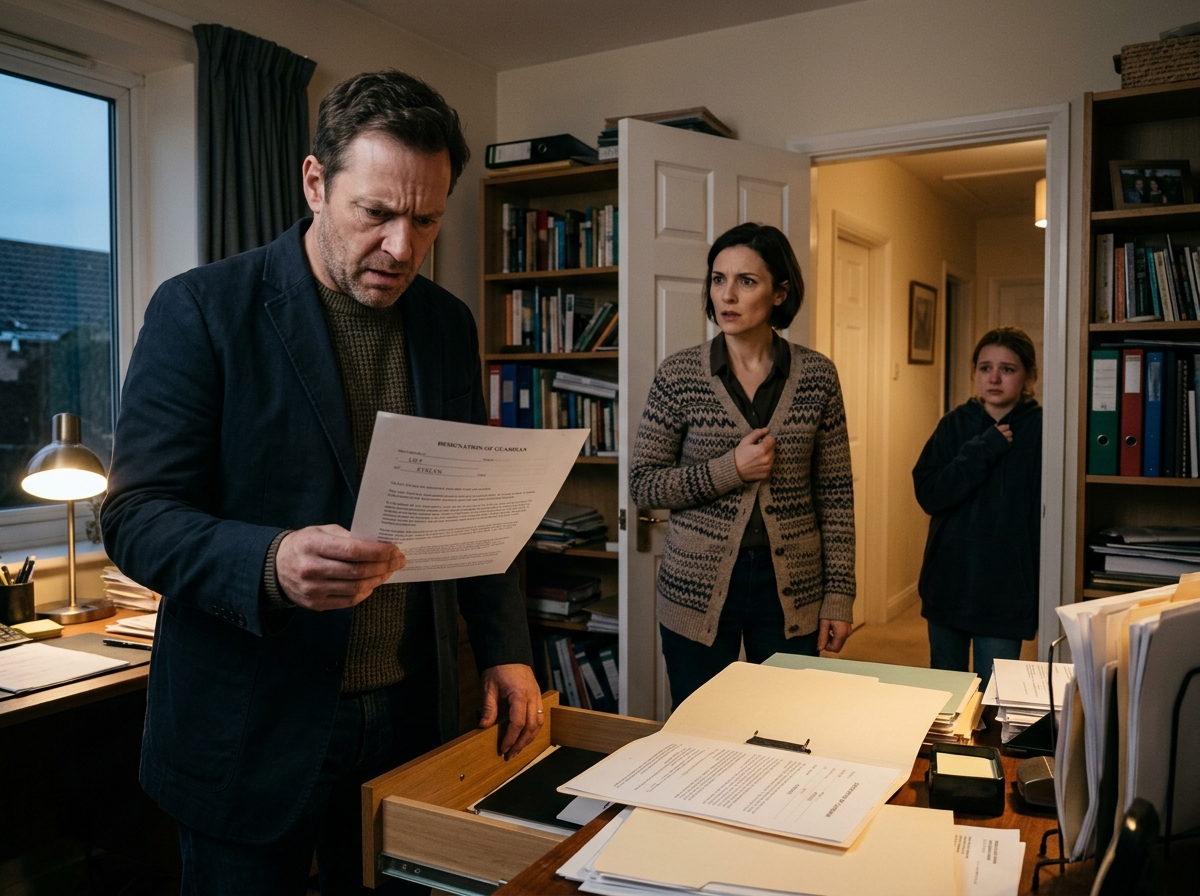
The first anniversary of the afternoon Richard came home early passed without ceremony. He did not mark it on the calendar or tell Lily that the date had arrived. He remembered it when he was sorting through old work papers and found a note he had written to himself during the first week of the crisis: ask questions, listen, don't assume silence means everything is fine.
He read the sentence twice before putting the note away. At the time, he had written it out of fear that he might overlook something important again. Now he understood it as a principle that applied to more than emergencies. Listening required patience when there was no obvious danger, honesty when an answer was uncomfortable, and humility when the person speaking was a child who knew something he did not.
Richard had made changes to his work life that continued long after the divorce. He still worked hard, but he no longer treated every extra hour as unavoidable. He discussed schedule changes with Lily, kept commitments when he could, and told her when he could not. He had learned that a parent's presence was not measured only by the number of hours spent at home. It was also measured by whether a child believed she could speak without being punished for what she said.
Lily had grown taller. Her school uniform fit differently, and she had developed strong opinions about music, books, and which friends were most likely to make her laugh. She still had moments when unexpected changes unsettled her. Sometimes she asked Richard to repeat an arrangement they had already discussed, and sometimes she checked that her phone was charged before leaving the house. Those habits had become less frequent, but he did not criticize her when they returned.
Her counselor had helped her recognize that feeling safe was not a switch that could be turned on permanently. It was a sense of trust built through experience. Lily had learned to notice when fear belonged to the present and when it was a memory warning her about something that was no longer happening. She did not always make the distinction easily, but she was becoming more confident in asking for help.
One evening, she told Richard that she wanted to join a school trip that would keep her away overnight. He saw her watching his face, ready for him to refuse or raise a list of concerns. He asked for the details, reviewed the arrangements, and discussed how she could contact him if she needed anything.
“You can go if you want to,” he said. “Let's make sure we understand the schedule and what the teachers have planned.”
Lily blinked. “You're not worried?”
“Of course I'm a little worried. You're my daughter. But being worried doesn't mean I should stop you from doing things that are right for you.”
She smiled. “I want to go.”
They completed the permission forms together. Richard checked the contact information and explained that he would be available throughout the trip. He did not tell her that this was a milestone or that she had proven she was recovering. He let it be a school trip, something she could anticipate with excitement and ordinary nervousness.
When the trip arrived, Lily called him the first evening to say that the group had reached the hotel safely. She described the long bus ride and a game her classmates had played. Richard listened, asked whether she had everything she needed, and told her to enjoy herself.
After the call, he set his phone on the table and returned to his work. He did not keep checking for another message. He trusted the arrangements and the people responsible for supervising the students. For years, fear had taught him that safety depended on constant attention. Now he was learning that responsible preparation could allow him to step back.
Lily returned home tired and full of stories. She talked about the places she had visited, the food she had disliked, and a joke that had made her friends laugh so hard they had nearly missed a group photograph. Richard helped her unpack, then let her rest. She had done something important for herself, but he did not need to turn it into a speech about courage.
Vanessa continued her life separately. She had moved into a smaller apartment and developed routines that did not depend on the family she had lost. Therapy remained difficult, particularly when she examined how she had used fear to secure obedience. She had begun to understand that she could not repair the past by becoming endlessly ashamed of it. Shame could keep her focused on how she saw herself; accountability required her to remain focused on the people her actions had affected.
She had also learned not to use Evelyn's history as a reason to avoid responsibility. She could acknowledge that her mother had hurt her and that the old wounds still influenced her reactions. But she could no longer say that those wounds had forced her to take Lily's phone or threaten the child. Her past explained some of the feelings she had carried into adulthood. It did not make her choices inevitable.
Evelyn remained outside Lily's life. There were no new legal filings, no attempts to collect Lily from school, and no evidence that she had violated the boundary she had agreed to respect. Richard did not contact her to ask whether she had changed. He did not need an answer to that question in order to maintain the arrangements protecting his daughter.
The proposed guardianship document remained secured with the other relevant records. Its meaning had changed for Richard over time. At first, it had represented the possibility that someone might secretly take Lily from him. Later, it became evidence of the way Vanessa's need for control had drawn her into a plan she had no authority to carry out. Now it was simply a document that belonged to the history of the separation, preserved in case it was ever needed.
Richard sometimes thought about how differently the crisis might have unfolded if he had dismissed Lily's fear as a discipline problem or accepted Vanessa's explanation without asking questions. He could not know what would have happened. He resisted turning the past into a series of imaginary alternatives, because doing so made him feel responsible for events he could no longer change.
What he could change was how he responded now. When Lily disagreed with him, he listened to her reasons. When she made a mistake, he addressed the mistake without attacking her character. When he needed to set a limit, he explained it clearly and did not threaten to withdraw his love or her place in the family. These were not extraordinary acts. They were the ordinary responsibilities of being her father.
On a Sunday afternoon, Lily found him looking through the album of photographs of Anna. She asked whether he was remembering her, and he said yes. Lily sat beside him and turned a few pages.
“Do you think Mom would be proud of me?” she asked.
Richard considered the question. “I think she would be proud of the person you're becoming. But I don't think you need to do something special to deserve her love.”
Lily rested her head against his shoulder. “Sometimes I wish she were here.”
“So do I.”
They sat quietly for a while. Richard did not try to make the sadness disappear by telling a funny story or pointing out how much good had happened since. Anna's absence was part of their family history, just as the difficult years with Vanessa were part of it. Neither grief nor fear had to be erased for them to continue living.
Later, Lily asked whether she could call Rebecca again. Richard arranged a time, and the two sisters spoke about Anna's childhood and Lily's recent school trip. Rebecca promised to send copies of a few old photographs, and Lily said she would choose a place to put them. The conversation gave Lily a connection to her mother's family without turning that connection into another guardianship question.
When the call ended, Lily went to her room to make space for the photographs. Richard watched her move a stack of books and rearrange a small shelf. The room reflected a life being built from many things: school projects, friends, family memories, and the objects she chose to keep. Vanessa's letter was not there. Evelyn's name was not there. Lily did not have to display every part of her history to prove she understood it.
That evening, Richard asked Lily what she wanted for dinner. She suggested something he had never cooked before, and he agreed to try. The meal turned out badly enough that they ordered food instead, and Lily laughed at the way he had tried to pretend the sauce could still be rescued.
“You should not be allowed to experiment without supervision,” she told him.
“That's a harsh judgment.”
“It's an accurate one.”
He laughed too. The ease of their exchange reminded him that family life did not need to be solemn to be healthy. There could be rules and disagreements, mistakes and apologies, without anyone being made to fear that one bad evening might cost them their home.
Before bed, Lily asked whether he thought people could really change. Richard knew the question could refer to Vanessa, to Evelyn, or to anyone she had met. He answered it without assuming which person she had in mind.
“Yes,” he said. “People can change when they take responsibility and keep doing the work. But you don't have to trust someone just because they say they've changed. You can watch what they do, and you can decide what you need.”
“Even if they feel bad?”
“Even then. Feeling bad matters, but it doesn't erase what happened.”
Lily considered the answer. “I think that's fair.”
Richard nodded. He was glad she could understand the difference without being asked to apply it to any particular person. It was a lesson that might serve her throughout her life, not because she had been hurt, but because every person deserved the ability to recognize the difference between an apology and a pattern of trustworthy behavior.
The next morning, she left for school with a packed lunch and her phone charged. Richard reminded her that he would collect her at the usual time. She told him she remembered, gave him a quick hug, and walked out the door.
He watched until she reached the waiting car. Then he went back inside and began his workday. He no longer needed to stand at the window wondering whether she was afraid to leave. He knew that she might still have difficult feelings, and he knew that he could not protect her from every disappointment the world would bring. But he also knew that she had people she could trust and a home where her voice mattered.
The years ahead would bring decisions he could not predict. Lily would become older, develop her own relationships, and decide which parts of her childhood she wanted to discuss. She might one day ask more questions about Vanessa, or she might prefer to leave that chapter behind. Richard would answer honestly when she asked, without pressuring her to forgive or insisting that she remember the past in a particular way.
Vanessa would continue living with the consequences of her choices. Her therapy might help her build healthier relationships and prevent her from repeating old patterns, but it would not restore her marriage or create an obligation for Lily to welcome her back. She would have to accept that becoming a better person was worthwhile even when it did not earn her the relationship she most wanted.
Richard did not wish Vanessa further suffering. He hoped she would find a way to live honestly, understand her history, and stop passing its harm to others. He could hold that hope without opening the door to reconciliation. He could recognize her efforts without making them the foundation of Lily's safety.
Evelyn's place in the story was different. She had been part of the pressure that led Vanessa toward a harmful plan, but Richard did not need to turn her into a continuing threat to justify his decisions. Her history had been reviewed, the legal issue was resolved, and she remained outside Lily's life. The boundary was clear. Richard intended to keep it that way unless circumstances changed and a legitimate reason required a different response.
The most important change was not that every difficult feeling had disappeared. It was that the family no longer depended on pretending there was nothing wrong. Lily could ask about the past, disagree with her father, keep her phone, and make plans without fearing that someone would use her dependence against her. Richard could admit his mistakes without asking her to reassure him. Vanessa could acknowledge her actions without demanding forgiveness.
One evening, months after the divorce, Richard stood in the garden while Lily watered the flowers they had planted together. The tallest plants had grown beyond the height she had expected, and a few had bent toward the fence. She adjusted the watering can and complained that one of the flowers was leaning too far.
“It might need support,” Richard said.
“Or maybe it just grows that way.”
“Maybe.”
She looked at him and smiled, then returned to watering. Richard did not try to turn the moment into a lesson. The flowers did not need to represent the family, and Lily did not need to be compared to them. They were simply growing in the garden, and he was glad to see them there.
When the watering was finished, Lily carried the can inside and asked whether they could watch a film. Richard said yes. She chose a comedy, and they settled on the sofa with a bowl of popcorn between them. Within minutes, Lily was laughing at a ridiculous scene and telling him he had missed the funniest part because he had been looking for the remote.
He laughed along with her. The sound filled the room without needing to prove that the past had been overcome. It was only a moment of happiness, but it belonged entirely to the life they were living now.
Richard had once believed that keeping a family together meant protecting its appearance, preserving the routines, and finding explanations for anything that threatened the peace. He now understood that a family could look intact while a child was frightened inside it. Keeping Lily safe had required him to accept a truth that cost him the marriage he had wanted, and to build something different without asking his daughter to pay for the change.
He could not give Lily back the years when she had been afraid to ask for her phone. He could not remove every memory of Vanessa's threats or guarantee that fear would never return. But he could make sure that her future was not governed by those memories. He could keep listening, keep his promises, and make room for her to grow into a person who knew that love did not have to be earned through silence.
As the film ended, Lily gathered the empty popcorn bowl and headed toward the kitchen. She paused at the doorway and asked whether they could invite her friends over the following weekend.
“Absolutely,” Richard said. “Let's check which day works best.”
She began listing possibilities, talking faster as she worked out the details. Richard listened and opened the calendar. Their plans were ordinary, their future uncertain in the ways every future is uncertain, and their home was no longer a place where fear decided what could be said.
He wrote the date on the calendar and showed it to her. Lily nodded, satisfied, then went upstairs to message her friends.
Richard remained at the table for a moment, looking at the simple note he had written. It was a small promise, one he intended to keep. There would be other promises, other difficult conversations, and other opportunities to show Lily that she could trust the people responsible for her care.
He turned off the kitchen light and followed her upstairs, knowing that the family he had imagined was gone, but the responsibility that mattered most remained. He would keep Lily safe, tell her the truth, respect her choices, and never ask her to carry the weight of an adult's fear or guilt again.
Click here to continue reading: PART 17: Lily’s School Project Brought Her Face-to-Face With Questions About Trust, and Richard Discovered That His Daughter Was Ready to Tell Her Story Without Letting It Define Her
Richard Returned Home Before Sunset and Heard His Daughter Begging for Her Phone, but Vanessa’s Explanation Made Him Question Everything
Part 16 of 20

