
By the time the leaves began to turn outside the kitchen windows, the house had developed a rhythm that Richard no longer mistook for happiness. He knew which mornings Lily needed extra time before school, which evenings she preferred to talk about ordinary things, and which silences meant she wanted company without questions. The absence of Vanessa had changed the shape of their lives, but it had also removed the uncertainty that once hung over every conversation. For the first time in months, Lily could leave her phone on the table without watching to see who might reach for it.
Richard had expected relief to arrive more cleanly. Instead, it came mixed with guilt, exhaustion, and the uncomfortable recognition that he had missed warning signs while believing he was keeping his family together. He had adjusted his work schedule, stopped accepting late meetings whenever he could, and made a point of telling Lily where he would be and when he expected to return. If something changed, he called. These were small acts, but he had learned that promises were only reassuring when they became dependable habits.
Lily noticed the difference. One Thursday afternoon, she came into the kitchen while he was preparing dinner and asked whether he would be home the following Friday. Richard explained that he had a meeting scheduled but was trying to move it earlier. She studied him for a moment before asking, “Are you sure you can come?”
“I can’t promise the meeting won’t change,” he answered, putting down the knife. “But I can promise I’ll tell you if it does. And if I can’t get home when I planned, we’ll make another arrangement together.”
She seemed to consider that answer more seriously than he expected. Then she nodded and began telling him about a class project. Richard listened without interrupting. He understood that trust was not rebuilt by giving the perfect answer to one question. It was rebuilt when the same honesty appeared again and again, even when the truth was inconvenient.
Vanessa had begun to understand a different kind of repetition. Her therapist had asked her to describe the moments when she took Lily’s phone, threatened to send her away, or told her that Richard was tired of her. At first, Vanessa had described each incident separately, explaining the argument that came before it and the behavior she believed justified her reaction. Her therapist kept returning to the same question: what had Vanessa chosen to do when she felt frightened, embarrassed, or out of control?
The question was harder to answer than she wanted to admit. She had grown up believing that the person who controlled the room was the person least likely to be hurt. Evelyn had taught her that lesson through fear, and Vanessa had spent much of her adult life insisting that she would never become like her mother. Yet when Lily challenged her authority or asked to call Richard, Vanessa had reached for the very methods she claimed to despise. She had made a child feel unsafe in her own home, then defended herself by calling it discipline.
Her therapist did not tell her that recognizing the pattern made her innocent. Instead, she asked Vanessa what she intended to do differently the next time she felt rejected or powerless. Vanessa began keeping a written record of those moments, including the thoughts she would once have used to justify herself. The exercise was uncomfortable. It showed her how quickly she could turn a child's ordinary behavior into a personal insult, and how readily she could mistake obedience for affection.
Meanwhile, Richard received a message from Mr. Lawson confirming that the relevant guardianship records had been reviewed and secured. The unsigned proposal naming Evelyn Mercer had never transferred authority, and no valid application had changed Lily's legal arrangements. Richard had followed the attorney's advice to preserve the correspondence and document what had happened. There was no reason to believe Evelyn had taken any further formal action, and no evidence that she had approached Lily or attempted to contact her school.
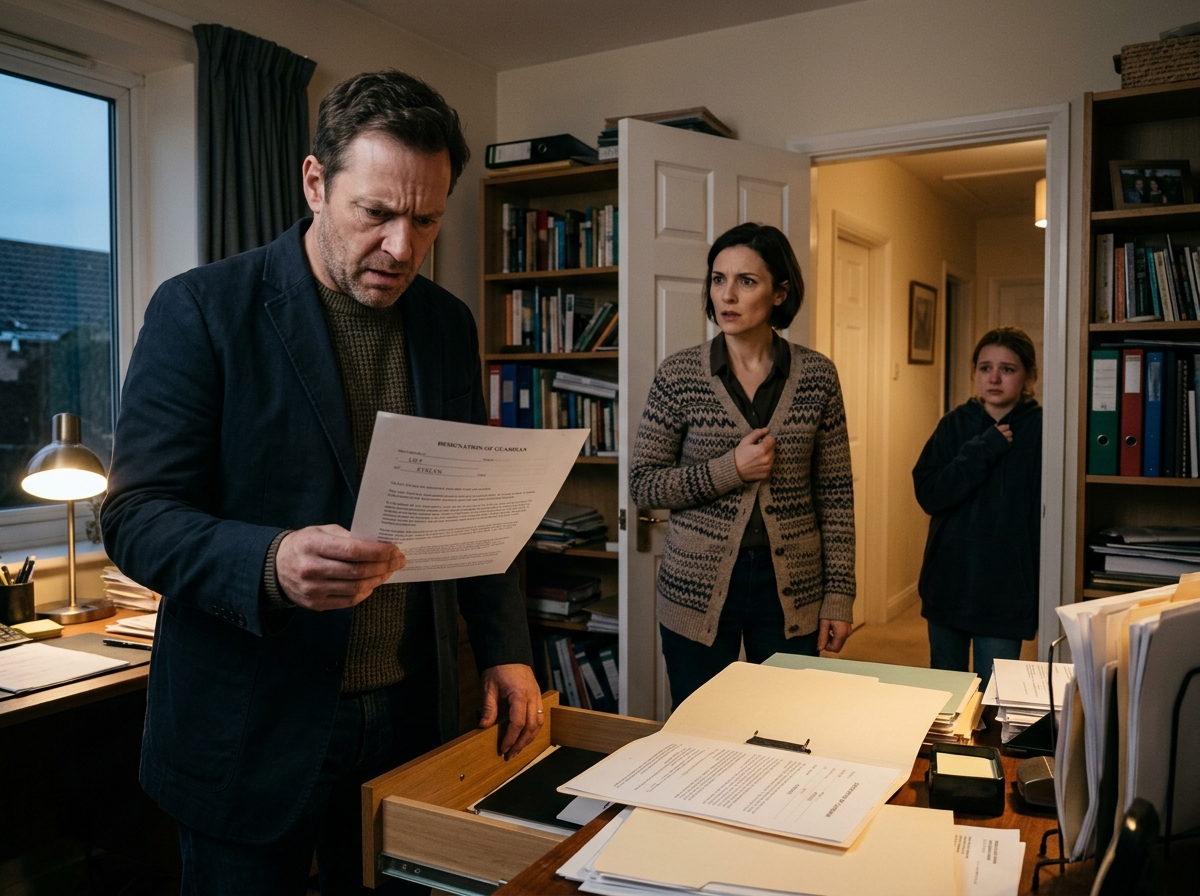
The confirmation should have settled the matter. Legally, it settled the immediate question. Emotionally, Richard still found himself checking the locks on the study cabinet and making sure the folder containing Lily's documents was where he had left it. He knew these habits were partly practical and partly the residue of a period in which he had discovered that someone living under his roof had been making plans behind his back.
Mr. Lawson reminded him that he did not need to keep investigating Evelyn simply because she had once been part of Vanessa's secret. “Preserve what matters,” the attorney said. “Keep the arrangements clear. If new information appears, we can respond to it. But you don't have to live as though something is happening every day.”
Richard took the advice seriously, although it took time to stop treating every quiet afternoon as a temporary reprieve. He had spent months anticipating the next discovery. Learning to live without constant suspicion was its own kind of work.
One evening, Lily asked whether Vanessa still lived with the relative who had taken her in. Richard told her that Vanessa had found a stable place to stay and was continuing therapy. He did not offer details Lily had not requested, nor did he describe Vanessa's progress as proof that she was ready to return.
“Does she still want to see me?” Lily asked.
“I believe she would like that someday,” he said carefully. “But what she wants doesn't decide what you have to do.”
Lily traced a small circle on the table with her fingertip. “What if I never want to?”
“Then we take that seriously. You don't have to decide forever tonight, either.”
She looked relieved, though not entirely comfortable. “I don't hate her,” she said. “I just don't want her near me.”
“Those feelings can exist together,” Richard replied. “You can care about what happens to someone and still need distance from them.”
The conversation ended without a grand declaration. Lily returned to her homework, and Richard finished washing the dishes. Yet the simplicity of the exchange mattered. No one had asked Lily to prove she was forgiving, and no one had suggested that her boundaries were cruel.
A few days later, Vanessa sent Richard an email asking whether he would be willing to meet with her and Mr. Lawson to discuss practical arrangements. She did not ask for Lily to attend. She did not suggest that the meeting should be a step toward reconciliation. She wrote that she wanted to clarify finances, retrieve a few personal belongings still stored at the house, and understand what Richard needed from her while they remained separated.
Richard read the message twice. He was wary of any conversation that might become a request for reassurance, but the questions were legitimate. He forwarded the email to Mr. Lawson and agreed to meet at the attorney's office.
Vanessa arrived on time, carrying a notebook and a folder. She looked tired, and her hair was tied back more simply than Richard remembered. He did not interpret the change as evidence of transformation. People could look different without behaving differently, and he had learned not to confuse appearances with accountability.
Mr. Lawson began with the practical matters. Vanessa listed the belongings she wanted, agreed that any collection from the house would be arranged in advance, and confirmed that she would not enter the property without Richard's knowledge. They discussed shared expenses and the documents each of them needed. The conversation remained formal until the attorney asked whether either had anything else to raise.
Vanessa looked at Richard. “I want to say something, but I don't want you to think I'm asking you to change your mind.”
“Then say what you need to say,” he replied. “I can't promise what I'll feel about it.”
She pressed her hands together. “I used to tell myself that I was trying to make Lily behave. I know now that I was also trying to make myself feel safe. When she wanted her phone, when she disagreed with me, when she wanted you, I felt as if I were losing control. I punished her for feelings she had every right to have.”
Richard remained still. He had heard parts of this before, but there was a difference between admitting a fact and explaining the choice behind it. Even so, he did not let himself be moved into offering comfort.
“You knew she was afraid,” he said. “You heard her ask for help, and you used that fear to make her obey.”
Vanessa lowered her eyes. “Yes.”
“And you told her I was tired of her.”
“Yes.”
“She believed you.”
“I know.” Her voice broke, but she continued. “I can't undo that. I can only stop defending it.”
Richard felt the old instinct to soften the conversation, to tell her that people made mistakes and that perhaps everything could still be repaired. He recognized the instinct for what it was: the desire to make a painful moment end. This time, he let the silence remain.
“I need you to understand something,” he said at last. “If I ever consider rebuilding a relationship with you, it won't be because you've explained your childhood or because you feel guilty. It would have to be because your behavior changes over time. And Lily's safety will never be the price of giving you another chance.”
Vanessa nodded. She did not ask him to define how much time would be enough.
On the drive home, Richard wondered whether that restraint represented genuine progress or simply the beginning of a longer process. He could not know yet. What he did know was that he had stopped treating the future of his marriage as a problem he needed to solve before anyone else could be comfortable.
That night, Lily was sitting on the living-room floor surrounded by colored paper for her school project. She asked him to help cut a complicated shape, then laughed when he trimmed the wrong corner. The sound startled him, not because it was unfamiliar, but because he realized he had spent so long listening for fear that he had almost forgotten to listen for ordinary happiness.
He sat beside her and tried again with the scissors. Neither of them spoke about Vanessa. They did not need to. For that evening, the house belonged to the people who lived in it, and no one had to earn the right to feel safe.
Click here to continue reading: PART 10: Lily Asked Richard a Question He Could Not Answer for Her, and His Response Forced Him to Face the Difference Between Protecting His Daughter and Making Every Decision in Her Place
Richard Returned Home Before Sunset and Heard His Daughter Begging for Her Phone, but Vanessa’s Explanation Made Him Question Everything
Part 9 of 20

