
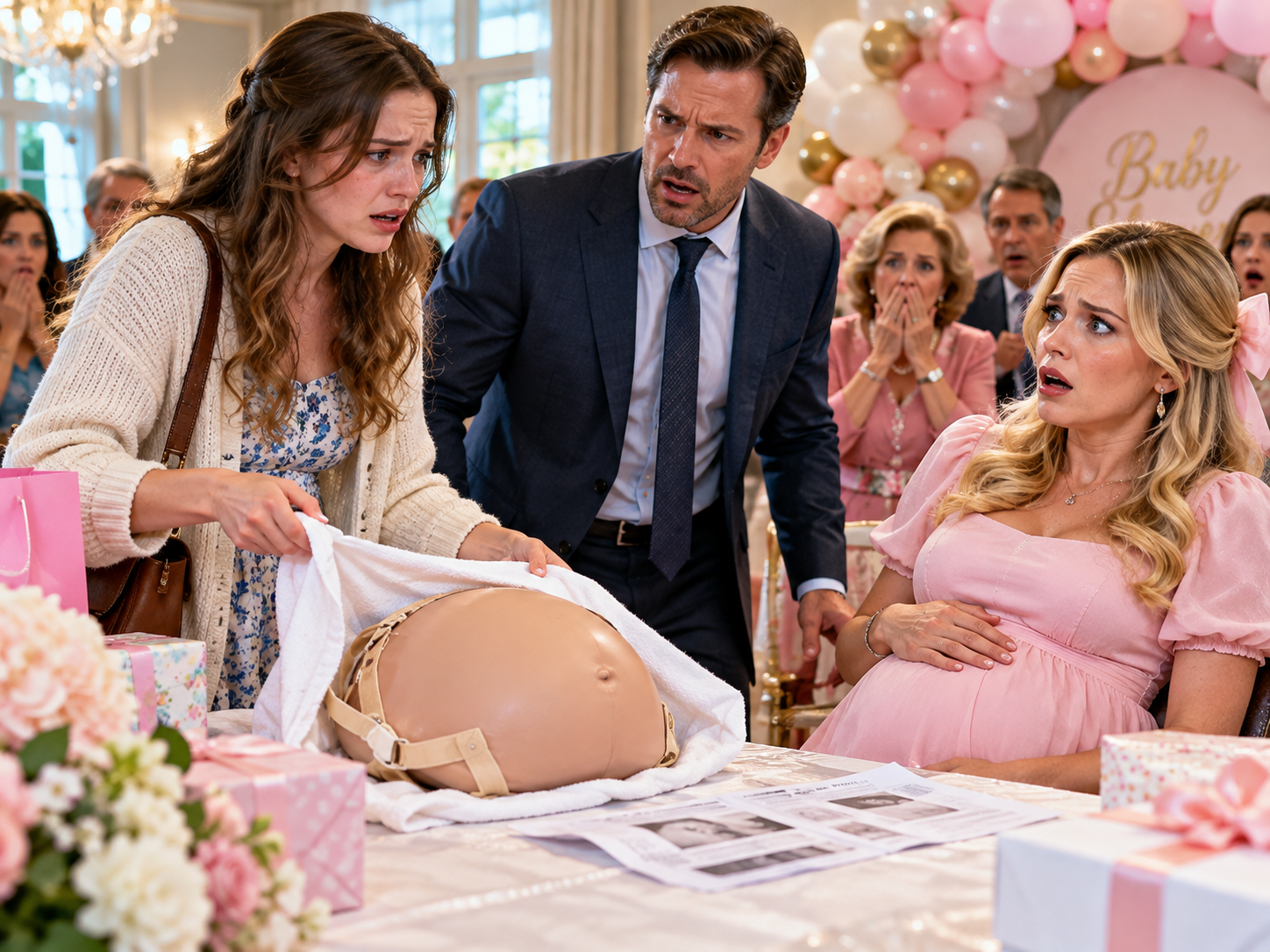
By the time the seasons began to change, the separation had become part of their daily lives. Daniel still stayed with his brother, though he had collected most of his belongings from the house. Claire continued living there, keeping up with the ordinary responsibilities that did not disappear simply because her marriage was uncertain. They attended counseling and spoke when necessary, sometimes with care and sometimes with the strain of people who knew each other well enough to recognize every hesitation.
There were days when Claire felt encouraged by the way they communicated. Daniel no longer ended every conversation as quickly as possible, and there were moments when they could talk about work or family without the baby shower filling every silence. Then a small reminder would reopen the hurt. A relative might mention a baby, or Daniel would remember a supposed appointment, and his face would close as he returned to the reality of what Claire had done.
She stopped treating those changes as signs that he was moving backward. Trust did not follow a straight path, and Daniel was not responsible for making his recovery look orderly. Claire learned to listen when he said a memory had returned, without insisting that they had already discussed it or that he should be ready to move on.
One evening during counseling, Daniel described the moment he had realized he could no longer trust his own memories of the pregnancy. It was not the prosthesis itself, he explained, but the ordinary conversations around it. He had remembered Claire describing symptoms and appointments, and he had believed her because he had no reason to suspect otherwise. After the truth emerged, he began revisiting those memories as though he were searching a room in which someone had secretly moved the furniture.
“I keep asking myself what else I missed,” he said. “I know this was one particular lie, but I don’t know how to stop wondering whether there were other things I accepted because I wanted to believe you.”
Claire felt the familiar impulse to reassure him that there had been nothing else. She could tell him that she had not fabricated the whole marriage, that the good years had been real, that her love for him had never been an invention. Those things were true as she understood them, but she also knew that insisting on them would not answer the question he was struggling to ask.
“I can tell you what I know about my choices,” she said. “I can answer your questions honestly. But I can’t force you to feel certain just because I want you to.”
Daniel looked down at his hands. “I miss being able to believe you without thinking about it.”
“I know.”
“No,” he said gently, “I don’t think you can know exactly what that feels like.”
Claire accepted the correction. She had often used the words “I understand” to close a conversation before she had fully heard the other person. Now she saw that acknowledging another person’s pain did not require claiming to experience it in the same way.
“You’re right,” she said. “I don’t know exactly what it feels like for you. I’m sorry I made you question something that should have been safe.”
The counselor let the silence remain. Daniel did not offer forgiveness, but neither did he withdraw from the conversation. They stayed with the difficult truth without rushing to turn it into a lesson or a solution.
Outside the office, they walked toward the parking area together. Daniel had driven himself, as usual, and Claire had come separately. At the cars, he told her he had been thinking about the decision they had postponed for months. He wanted to discuss it with her at their next session, after he had given himself a little more time to be certain that he was not reacting to one difficult day.
Claire’s heart began beating faster. She knew what the conversation might mean, and she wanted to ask whether he was leaning toward staying or leaving. She wanted to protect herself from the suspense by making him say something before he was ready.
Instead, she said, “All right. I’ll listen.”
Daniel gave a small nod. “That’s what I need.”
The days before their next session seemed longer than usual. Claire found herself rehearsing possible outcomes, then deliberately stopping when she realized she was trying to prepare a response for a decision that was not hers to make. She continued therapy, spoke honestly when friends asked how she was doing, and resisted the urge to portray the separation as a temporary difficulty they would certainly overcome.
Emily had begun speaking with her more regularly, though their friendship remained cautious. They met for lunch one afternoon, and Emily asked whether Claire and Daniel were getting back together. Claire told her that they had not decided. She explained that Daniel was considering the future of the marriage and that she could not promise what he would choose.
Emily stirred her drink. “That must be hard.”
“It is,” Claire said. “But it would be unfair to ask him to make a decision just so I could stop being afraid.”
Emily considered this, then said she was glad Claire was learning to speak plainly. She did not call their friendship repaired, and Claire did not ask her to. They finished lunch and talked about other things, allowing the conversation to become ordinary without pretending the past had vanished.
When Claire met Daniel for their next counseling session, she could tell he had prepared what he wanted to say. He was quieter than usual, but not distant. The counselor invited him to begin.
“I’ve spent a lot of time asking whether I can forgive you,” Daniel said. “I think I was treating forgiveness like the same thing as deciding whether to stay married. They aren’t necessarily the same.”
Claire held her breath.
“I still love you,” he continued. “That hasn’t disappeared. But I don’t know if I can rebuild the trust I need to live with you as your husband. I’ve tried to imagine coming home and going back to our ordinary life. Every time I do, I think about how ordinary everything looked while you were lying to me. I don’t want to spend the rest of my life wondering whether I’m missing something.”
Claire’s eyes filled with tears, but she kept her hands still. She wanted to tell him that she had changed, that she would do whatever it took, that she could spend years proving herself if he would only give her the chance. But she knew that he had already heard her intentions. He was speaking about what he could live with, not asking her to make a better argument.
Daniel took a slow breath. “I don’t think I can continue the marriage as it was. And I don’t think it’s fair to keep us separated indefinitely while I wait for a certainty that may never come. I think we need to begin moving toward ending the marriage.”
The words landed with a quiet finality. There was no raised voice, no dramatic gesture, and no accusation added for emphasis. Daniel had reached the decision he believed he needed to make, and the absence of anger made it more painful, not less.
Claire looked at him through her tears. For months she had feared losing him, and part of her had believed that if she showed enough remorse, the fear that had started the lie might finally be relieved. Now she understood that remorse could not guarantee the outcome she wanted. Daniel’s decision was not a punishment she could negotiate away. It was his response to the damage she had caused and the limits of what he felt able to rebuild.
“I don’t want that,” she said. Her voice shook, but she did not try to hide the truth of her own feelings. “I want us to stay married. But I know that wanting it doesn’t mean you have to.”
Daniel closed his eyes briefly. “I’m sorry.”
Claire shook her head. “You don’t need to apologize for making a decision about your own life.”
She cried then, unable to keep the grief contained. Daniel looked devastated too. They had loved each other, built a home, and imagined a family together. Even the decision to separate permanently could not make those years meaningless. Yet the good parts of their marriage did not erase the lie, and the lie did not mean every good memory had been false.
The counselor gave them time before asking what they needed to do next. They discussed practical steps slowly, agreeing not to make rushed decisions about the house or shared finances. They would seek appropriate advice, communicate clearly, and avoid using relatives as messengers. They would also continue individual therapy. Daniel wanted to make sure the separation was handled with respect rather than allowing hurt to dictate every interaction.
Claire agreed. She did not ask him to reconsider the decision that day. She did ask whether he would be willing to have one more conversation after they had both had time to process it, not to pressure him but to discuss the practical changes ahead. Daniel said yes, provided they remained honest about the purpose of the conversation.
After the session, they walked outside together. The air was cool, and the sky had begun to darken. They stood beside their cars for a moment, neither quite ready to leave.
“I wish I had told you the truth before any of this happened,” Claire said.
“So do I.”
“I keep thinking about how many chances I had.”
Daniel looked at her. “I know you were afraid. I believe that. But I also know you kept making choices that protected the lie instead of protecting us.”
Claire nodded. “You’re right.”
It was a painful acknowledgment because there was no defense hidden inside it. She had been afraid, but fear had not forced her to buy the artificial belly, invent appointments, download ultrasound images, or keep a notebook of reminders. Those were choices she had made, and accepting that fact was the beginning of accountability, not the end of the consequences.
Daniel said he hoped she would keep working on herself, regardless of what happened between them. Claire told him she intended to. Neither treated that hope as a secret promise of reconciliation.
They parted at the parking lot, and Claire drove home alone. The house was still hers to live in for the time being, but it no longer felt like a place where she could wait for Daniel to return and restore the life they had once shared. She began to understand that the future would have to be built around the truth of what had happened, whether or not he remained part of it.
In the weeks that followed, they began making arrangements for a formal separation and the practical steps that might lead to divorce. The process was painful, but they handled it without turning every disagreement into another trial of the marriage. Daniel remained clear about his decision. Claire remained sad, but she did not try to make him responsible for easing her grief.
She continued therapy. She spoke with Sophie occasionally, and their relationship grew a little more comfortable, though it was not suddenly free of hurt. Sophie did not have to become Claire’s confidante, and Claire did not expect her to. When they talked about Daniel, Claire avoided asking Sophie to interpret his feelings or carry messages between them.
Margaret eventually told Claire that she was not ready to return to their former closeness. Claire thanked her for being honest. She did not ask about the blanket, and Margaret did not offer to bring it out of storage. Some things would remain painful for a long time, and neither woman needed to pretend otherwise.
One afternoon, Claire found the old blue notebook among the papers she had kept from the months of the false pregnancy. She sat with it for a long time, remembering how carefully she had recorded the dates, symptoms, clothing choices, and appointments she needed to invent. The notebook had once seemed like a way to keep her story from falling apart. Now it showed her how much effort she had spent maintaining a reality that did not exist.
She considered throwing it away, but she stopped. Destroying it would not undo what it recorded, and keeping it did not require her to treat it as a relic. She placed it in a folder with the receipts and other records of the deception, then put the folder away. It was part of the truth, and she no longer needed to pretend it had never existed.
The story of the supposed baby would remain a painful chapter in their family’s history. Daniel would carry the memory of the future he had imagined and lost. Sophie would remember the moment she decided she could no longer stay silent. Margaret would remember the blanket she had knitted with love. Claire would have to live with the knowledge that her fear had become a lie that reached far beyond her own private life.
But the lie was no longer being protected. There would be no invented miscarriage to soften the story, no new explanation designed to preserve Claire’s image, and no promise that the marriage would survive simply because the truth had finally been spoken. The consequences had become real, and so had the possibility of living differently.
Claire had wanted to believe that admitting the truth would bring Daniel home. It had not. What it brought instead was the end of the false future she had built, the loss of the certainty she had tried to manufacture, and the difficult responsibility of becoming honest without knowing whether honesty would win her anything back.
Daniel, for his part, did not leave because he had never loved her. He left because love had not made the deception bearable, and he could no longer ask himself to live inside a marriage where the trust he needed had been broken so deeply. His decision did not erase the good years, but it recognized the harm that had come after them.
They would each have to carry their own part of the story forward. Claire would have to learn that being frightened did not make her worthless, and that being loved did not entitle her to conceal the truth. Daniel would have to grieve the future he had expected and decide how to trust again, even if that trust eventually belonged to a different life. Sophie and the rest of the family would have to find their own ways of remembering the event without allowing it to define every relationship forever.
There was no child waiting at the end of the story, no sudden reconciliation that could make the pain disappear, and no perfect sentence that could return the family to the day before the shower. There was only the truth, late and painful, and the choices each person would make after it.
The baby shower had exposed the lie. The months afterward had shown what the lie had cost. And although Claire could not rebuild the future she had invented, she could begin to live without inventing another one.
Click here to continue reading: PART 13: The First Steps Toward Divorce Forced Claire to Face the Life She Had Tried to Control, While Daniel Discovered That Ending a Marriage Did Not Mean the Love Had Never Been Real
My Daughter Interrupted a Perfect Baby Shower With One Quiet Accusation, and the Strange Object She Placed on the Gift Table Changed Everything
Part 12 of 20

