
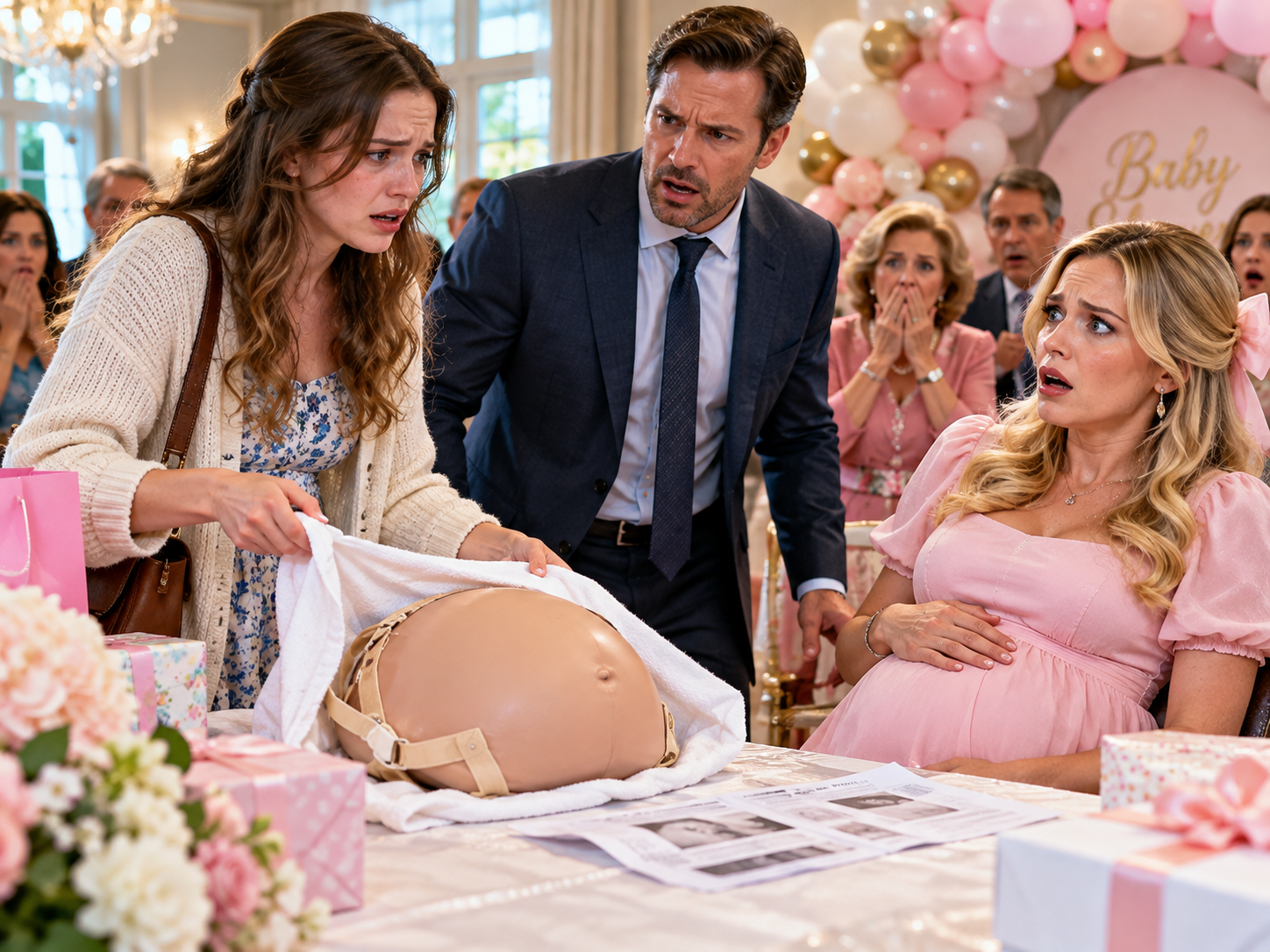
Claire reached for the loose sheet, but I placed my hand over it before she could take it.
“Who wrote this?” I asked again.
She looked toward the front door, as if Daniel might return and answer for her. Then she lowered her eyes.
“I did.”
The sentence on the paper was dated three weeks before the baby shower. It had been written beside the receipt for the artificial belly, in the same handwriting as the notes in the blue notebook. I had initially thought it might refer to Daniel discovering the prosthesis. But Claire's words suggested something more complicated: she had been anticipating a conversation in which she would have to decide what to reveal and what to conceal.
“What did you think Daniel was planning to do?” I asked.
Claire shook her head. “I don't know how to explain it.”
“Then start with the part you do know.”
She sat with her hands folded on the table. For several minutes, she said nothing. Finally, she admitted that the lie had become so elaborate that she no longer knew how to end it without losing everything. She had imagined confessing after the shower, then after a family visit, then after another supposed medical appointment. Each time, she had convinced herself that one more delay would give her a better opportunity to tell the truth.
The note had been written after Daniel asked whether they should discuss names for a future child in case the pregnancy did not continue as expected. He had not accused her of lying. He had simply said that he wanted them to be prepared for whatever the doctor might tell them. Claire had panicked because she realized he was beginning to talk about possibilities beyond the story she had created. She wrote the note to remind herself not to let him see the receipt, then continued pretending everything was normal.
“You were afraid he would discover the truth,” I said.
“Yes.”
“But you still invited everyone to the shower.”
“I thought I could get through it. I thought I could tell him afterward.”
“And when Sophie found the prosthesis?”
Claire pressed her hands against her forehead. “I knew it was over.”
I watched her carefully. There was no satisfaction in seeing her frightened. I had known Claire for years. I had attended her wedding, celebrated holidays with her, and welcomed her into my family. I could recognize her distress without ignoring the choices that had brought her here.
“Why didn't you tell Daniel the truth when Sophie found it?” I asked.
“Because I was ashamed. I thought if I admitted everything, he would never look at me the same way again.”
“He has already been forced to look at the truth without your help.”
She began to cry again.
I left the house shortly afterward. I could not make Claire confess more honestly, and I could not decide what Daniel should do with the information. That was a choice he would have to make himself. On the drive home, I thought about Sophie standing in front of the family, knowing she would probably be blamed for the scene even though she had not created the lie. I was proud of her courage, but I wished she had not been forced into the position of revealing something so painful.
Daniel called me that evening. He said he had spent several hours walking around the neighborhood because he could not bear to sit in the house. He had not decided whether he would return that night or stay with his brother. He said he had spoken with Claire briefly by phone, and she had admitted that the receipt and the notebook were hers.
“Did she tell you anything else?” I asked.
“She told me she has been lying about the pregnancy from the beginning. She said she never had a positive test, never had a scan, and never saw a doctor about a baby. She said the symptoms were things she described because she thought people expected her to have them.”
He paused.
“I asked her whether she understood what she had done to me. She said she did. I asked how she could know that when she had spent months making decisions for me without telling me the truth. She couldn't answer.”
I listened while he spoke. He sounded less angry than he had the day before, but the quietness frightened me more. His anger had given him something to push against. Now he was facing the loss of the future he had believed was already on its way.
“I don't know whether I can stay married to her,” he said.
“You don't have to decide tonight.”
“What if I never trust her again?”
“Then you will have to decide what that means for your life. But you don't need to force an answer while you're still trying to understand what happened.”
He thanked me and said he would contact me when he had made a plan.
The next morning, Daniel returned home to speak with Claire. He asked me to come over afterward because he wanted someone else present when he explained his decision. I agreed, though I told him I would not take sides in every disagreement between them. I would support him in making a careful decision, and I would encourage Claire to seek professional help, but neither of them could ask me to pretend the lie had not happened.
When I arrived, they were sitting at opposite ends of the dining table. The blue notebook and artificial belly had been placed in a cardboard box near the wall. Claire looked exhausted. Daniel had not shaved, and his shirt was creased as though he had slept in it.
He began by saying he had spent the night thinking about the difference between the marriage he believed he had and the one he now understood he was in. He said he had always assumed that if they faced a difficult problem, they would face it together. They might disagree, become frightened, or need time to understand their options, but they would begin with the truth.
Claire listened without interrupting.
“You decided that I couldn't handle the possibility of infertility,” Daniel continued. “You never gave me a chance to face it with you. Instead, you made me believe we had a child on the way. You let me build a room for that child. You let my parents celebrate. You let your family celebrate. You watched people buy gifts for someone who did not exist.”
“I know,” Claire whispered.
“I don't think you do. I think you understand that you were caught. I don't know whether you understand what you took from me.”
Claire looked up, tears gathering in her eyes. “I wanted to give you a family.”
“We already were a family.”
The words fell into the room with such quiet force that Claire stopped moving.
Daniel continued. “I married you because I wanted to share my life with you. I wanted children, yes, but I never told you that you had to become pregnant to deserve being my wife. You decided that for me. You decided I would rather live inside a lie than face an uncertain future with you.”
Claire shook her head. “I was wrong.”
“Yes. You were.”
She reached for a tissue and wiped her cheeks.
“I was so afraid of disappointing you that I created something I thought you would love. Then I became afraid of losing it, even though it was never real. I kept telling myself I would confess when I found the right moment. But every time I thought about telling you, I imagined your face. I imagined everyone finding out. I imagined being the woman who couldn't have a baby.”
Daniel listened, his expression guarded.
“I know that doesn't excuse it,” she continued. “I know I hurt you. I don't expect you to forgive me just because I'm finally telling you the truth.”
For the first time, Daniel seemed to believe she understood at least part of the damage. He nodded slowly.
“I believe you were frightened. I believe you were ashamed. But those feelings don't explain every choice you made. You had chances to stop. You had chances to tell me. Every time you chose to continue, you made the lie more important than our relationship.”
Claire lowered her head.
“I know.”
Daniel took a long breath. “I am not going to pretend we can go back to normal. I can't live with you as though this was one bad decision that we can put behind us. I need time away from the marriage, and I need you to get help understanding why you did this. I am going to stay with my brother for now. I want us to speak through a counselor before we make any final decisions about the future.”
Claire's face crumpled.
“So you're leaving me.”
“I'm leaving this house for a while. I am not promising that our marriage will end, and I am not promising that it will survive. I need to make that decision without being pressured to reassure you.”
She covered her mouth with one hand. “I don't want to lose you.”
Daniel looked at her with a sadness that seemed deeper than anger.
“Then you should have trusted me with the truth.”
Nobody spoke for several seconds. I could hear a clock ticking in the kitchen and the faint rumble of a bus passing outside. The artificial belly remained in its box, a physical reminder of the lie that had changed their lives. Daniel stood and picked up his keys.
Before he left, he turned back toward Claire.
“There is one thing I need you to understand,” he said. “The worst part is not that you couldn't give me a child. The worst part is that you made me believe I was going to be a father, then allowed me to celebrate that future while you knew it was invented. You let me love someone who did not exist, and you watched me do it.”
Claire began sobbing. Daniel's voice remained steady, though his eyes were wet.
“I don't know how to forgive that yet.”
He left the house with a small overnight bag.
I stayed with Claire for a while, not to excuse what she had done but to make sure she was not alone in the immediate aftermath. She cried until her face was swollen and her voice had become hoarse. She spoke about her fear of infertility, the pressure she had felt when friends became parents, and the shame she had carried without discussing it with Daniel. I listened, but I reminded her that she would need help beyond what I could provide. Her fear deserved attention, but it did not erase the harm she had caused.
In the days that followed, the news spread through the family. Daniel told his parents what had happened, and he asked them not to turn the situation into a public argument. Margaret returned the baby blanket to her knitting basket. She said she could not bear to look at it for a while, but she did not throw it away. She was grieving the grandchild she had imagined, just as Daniel was grieving the future he believed he had been preparing for.
Sophie struggled with the consequences of being the person who had spoken first. Some relatives thanked her privately for bringing the truth to light. Others said she should have handled the matter differently and questioned whether the baby shower had been the right place to reveal it. Sophie listened to those criticisms, but she did not apologize for telling Daniel what she had found. She acknowledged that the public confrontation had hurt people, yet she understood that the deception could not continue indefinitely.
I told her that courage did not mean every decision had to be perfect. She had been faced with a serious discovery and had chosen to reveal it. We could discuss what she might do differently in another situation without placing the responsibility for Claire's lie on her shoulders.
Over the following weeks, Claire began meeting with a therapist. She told me that she needed to understand why she had allowed fear to become a plan and why she had kept choosing deception even when the consequences grew more serious. Daniel continued staying with his brother and attended counseling sessions with Claire when he felt ready. He did not promise reconciliation, and she did not demand it. They began talking about practical matters and the future of their marriage with the help of someone who could keep the conversations from becoming another struggle over blame.
They also spoke with a medical professional about fertility, not because either of them had been diagnosed with a problem, but because Daniel wanted them to understand the facts rather than build their future around assumptions. Claire acknowledged that she had never had evidence she was infertile. Her fear had been based on uncertainty, comparisons with other people, and the belief that she would be less valuable as a wife if she could not conceive. The evaluation did not provide a simple answer to every question, but it gave them a truthful place to begin.
Daniel's decision was not a dramatic declaration that he would never see Claire again. He chose separation while they worked through what had happened. He said he could not make a permanent decision while he was still trying to understand the deception, but he also would not move back simply because Claire was frightened of losing him. He needed to see sustained honesty, accountability, and a willingness to face difficult questions without inventing another explanation.
Claire accepted that decision, though it was painful. She returned the gifts that could be returned and contacted relatives to explain that there would be no baby. She did not ask me to make excuses for her or to tell people that she had suffered a miscarriage. That mattered. For the first time, she was allowing the truth to be uncomfortable without trying to replace it with a story that would make her look better.
The family did not recover quickly. Margaret needed time before she could speak to Claire without remembering the blanket she had knitted. Daniel's father stopped discussing grandchildren for a while. Sophie and Claire remained distant, although they exchanged a few careful messages. No one could erase the memory of the baby shower or the moment the artificial belly appeared on the gift table. The humiliation had been public, but the deeper injury was private: Daniel had to rebuild his understanding of a marriage he had believed was honest.
Months later, Daniel told me that he and Claire were still separated. They had made progress in counseling, but he was not ready to decide whether they could live together again. He said he no longer wanted to make parenthood the measure of their relationship. If he became a father one day, he wanted that future to be built on truth and mutual choice. If he did not, he wanted a partner who could face that possibility with him rather than hide from it.
Claire continued working on herself. She spoke more openly about her shame and stopped treating the absence of a pregnancy as a personal failure that had to be concealed. She knew that therapy did not guarantee Daniel would return, and she was beginning to understand that accountability meant accepting consequences without demanding a particular reward. She had lost his trust, and restoring it—if that was possible—would require far more than saying she was sorry.
Sophie and I eventually spoke about the baby shower without either of us becoming overwhelmed. She admitted that she wished she had found a private way to reveal the evidence. I told her that I understood, but I also reminded her that the lie had been created and maintained by Claire, not by the person who discovered it. Sophie had made a difficult choice in front of a room full of people, and she would remember the consequences for a long time. Still, she had refused to participate in a deception that was hurting someone she loved.
When I think back to that afternoon, I remember the balloon arch, the untouched cake, and Margaret holding the tiny yellow blanket. I remember Daniel looking at the artificial belly as if the object might somehow explain how his life had changed. Most of all, I remember the moment he said that the worst part was not the absence of a child, but the knowledge that he had been allowed to love an invented future.
That was the truth at the center of everything. Claire's fear had been real, but the pregnancy was not. Her shame had been real, but it did not justify the choices she made. Daniel's grief was real, even though there had never been a baby to lose. And Sophie's accusation, however painful its timing, had ended a deception that could only have grown more damaging with time.
I did not know whether Daniel and Claire would eventually rebuild their marriage. That decision belonged to them, and it would depend on what they learned, how honestly they faced the past, and whether trust could grow again without being forced. But I knew that no family could build a future on a false pregnancy, no matter how carefully the lie was hidden or how badly everyone wanted it to be true.
The baby shower had begun as a celebration of a child who never existed. It ended with a family facing a truth nobody had wanted to imagine. We could not undo the embarrassment, return the gifts to the people who had bought them, or give Daniel back the months in which he believed he was preparing to become a father. We could only stop pretending, allow the consequences to unfold, and begin making decisions based on what was real.
Click here to continue reading: PART 5: Daniel Moved Out Without Looking Back, but the Questions He Left Behind Forced Claire to Face the Difference Between Regretting a Lie and Understanding Its Damage
My Daughter Interrupted a Perfect Baby Shower With One Quiet Accusation, and the Strange Object She Placed on the Gift Table Changed Everything
Part 4 of 20

