
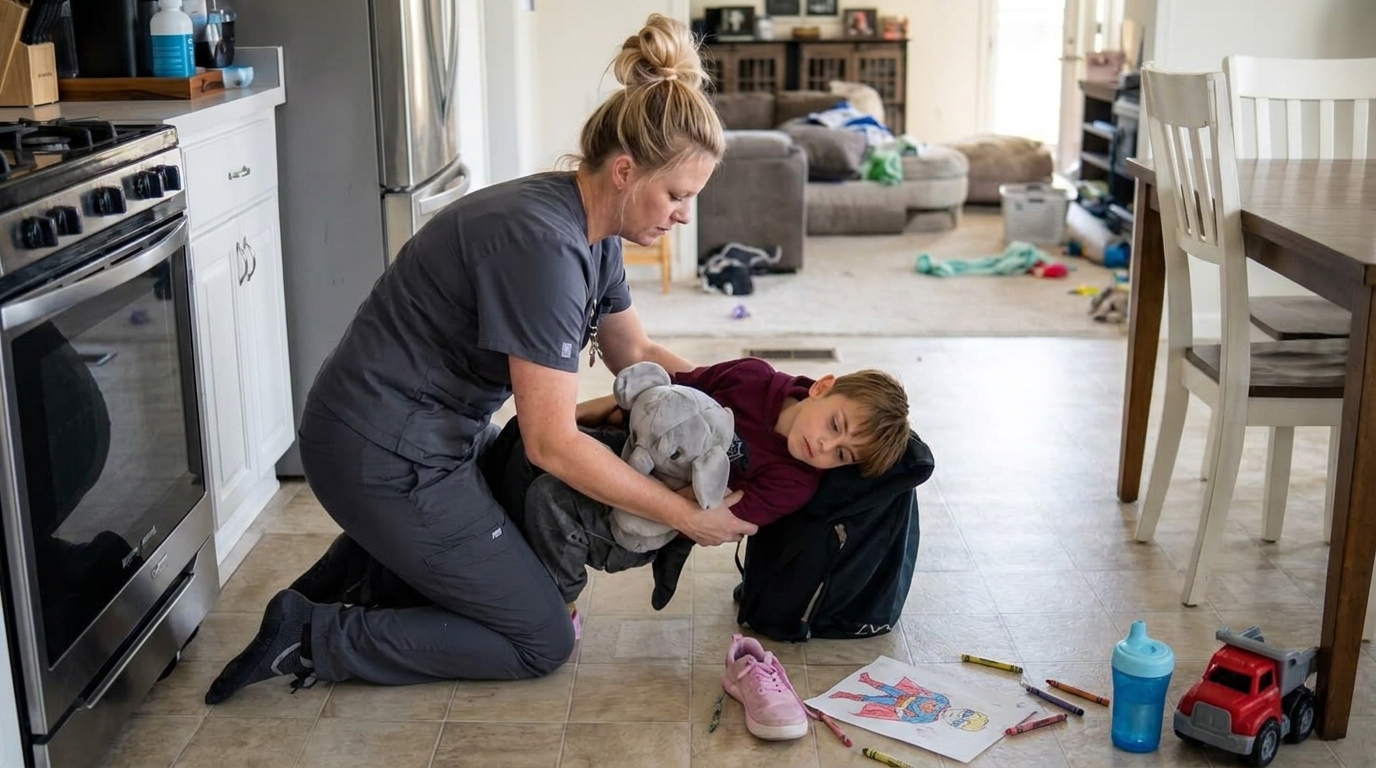
The first custody hearing took place on a gray morning that made the courthouse windows look almost colorless. I arrived early with my attorney, carrying a folder thick enough to feel heavier than it actually was. Inside were work schedules, school records, medical appointments, financial statements, messages, and photographs of the conditions in which I had found Roger. I had spent years keeping ordinary records because life required them. Now those ordinary records had become the clearest account of who had actually been caring for my son.
Gideon arrived with his attorney fifteen minutes later. He looked composed, almost detached. Celina was not with him. She had agreed to provide a statement, but she had also asked not to be present in the courtroom unless required. I understood why. She had betrayed me, yet she was frightened of what Gideon might do if she openly turned against him. I no longer knew whether I could call her my sister, but I knew she had finally stopped protecting him.
The judge began by asking about Roger's current living arrangement. My attorney explained that Roger had been staying with me at my parents' home and that the arrangement was temporary while the court considered the evidence. Gideon's attorney emphasized that Gideon had been an active parent and that my night-shift schedule had created long periods when I was away.
I listened without reacting.
There was something almost surreal about hearing my life reduced to phrases like “night-shift schedule” and “parental availability.” The years I had spent packing Roger's lunches, attending school meetings after working overnight, filling prescriptions, paying bills, washing tiny socks, and sitting beside him when he had fevers were being converted into arguments over hours on a calendar.
Then my attorney introduced the records.
The hospital schedule showed exactly when I worked. The childcare records showed who cared for Roger during those hours. School communications showed that I regularly communicated with his teachers. Medical records showed appointments I had attended. Bank statements showed that my income had supported the household in substantial amounts.
Then came Gideon's messages.
The courtroom became very quiet.
My attorney presented messages in which Gideon discussed the nights I would be working and arranged for Celina to come to the house. Other messages referred to Roger being downstairs. One showed Gideon telling Celina that Roger would “wait.” Another established that Gideon knew Roger was awake while he was upstairs with her.
Gideon's attorney objected to several messages.
The judge reviewed them.
The objections did not erase them.
When the message about Roger waiting was displayed, Gideon lowered his eyes.
I looked at him only once.
He didn't look back.
My attorney then presented the messages concerning custody. They showed that Gideon had been speaking with an attorney about custody before I discovered the affair. The timing mattered. He had not suddenly become concerned about Roger's welfare after our marriage began falling apart. He had been preparing a strategy while maintaining the appearance that our marriage was normal.
The judge asked Gideon's attorney whether his client disputed the authenticity of the messages.
There was a pause.
“No,” the attorney said.
That single word changed the room.
The messages were no longer accusations.
They were evidence.
My attorney moved to the financial records. The unexplained transfers from our joint savings were introduced next. Gideon had moved money into a separate account over several months. The realtor inquiry about the house followed.
The judge asked Gideon directly why he had sought a valuation of the property without discussing it with me.
Gideon shifted in his chair.
“I was trying to understand our options.”
“Were you contemplating separation at that time?”
“Yes.”
“Had you discussed separation with your wife?”
“No.”
The answer landed heavily.
The judge asked whether he had also been discussing custody at the same time.
Gideon hesitated.
“Yes.”
I felt my hands tighten in my lap.
The judge looked toward him.
“Before your wife knew there was a problem in the marriage?”
Gideon didn't answer immediately.
“Yes.”
The hearing paused for a recess.
I walked into the hallway and stood beside a window. My attorney joined me.
“You did well,” she said.
“I didn't do anything.”
“You told the truth.”
I looked down at my hands.
“That shouldn't feel like an accomplishment.”
“It does when someone has spent months preparing to make the truth look different.”
I didn't answer.
Across the hallway, Gideon stood with his attorney. His face was tight. He looked over at me, then away.
For the first time since I had discovered him with Celina, I saw something other than anger in his expression.
Fear.
The hearing resumed after lunch.
Gideon's attorney proposed that Roger spend limited daytime periods with his father. My attorney did not oppose reasonable contact, but she argued that overnight arrangements should wait until the court had a clearer understanding of what had happened in the house.
The judge agreed.
Gideon was granted structured daytime visitation.
No unsupervised overnight stays.
No changes to Roger's school.
No removal from the area.
The house and finances would remain under review.
It wasn't a victory.
It was a boundary.
And for the first time, Roger's needs—not Gideon's preferred narrative—were setting the terms.
That evening, I returned to my parents' house before Roger's bedtime.
He was sitting at the table eating rice and vegetables, swinging his legs beneath the chair.
“How was Daddy?”
I sat beside him.
“He's okay.”
“Is he coming here?”
“Not tonight.”
Roger nodded.
He did not ask why.
Children sometimes accept a new reality before adults have figured out how to explain it.
After dinner, I helped him brush his teeth.
When he climbed into bed, he asked whether I would be working the following night.
“No.”
“You're staying?”
“Yes.”
He smiled.
“Good.”
I turned off the lamp.
As I walked toward the door, he called me back.
“Mommy?”
“Yes?”
“I wasn't bad that night.”
I stopped.
The words broke something inside me.
I went back to his bed and sat beside him.
“No,” I said quietly. “You weren't bad.”
“Daddy said I had to wait.”
“I know.”
“Did I make him mad?”
“No.”
I put my hand over his small one.
“You didn't do anything wrong.”
He nodded.
I stayed until he fell asleep.
Later that night, my phone rang.
Celina.
“I heard about the hearing.”
“Yes.”
“I told them everything.”
“I know.”
“I don't expect you to forgive me.”
“You shouldn't.”
She was quiet.
Then she said, “There's one thing I haven't told you.”
My body stiffened.
“What?”
“The night you found them wasn't supposed to happen that way.”
I stared at the wall.
“What do you mean?”
“Gideon knew you were coming home early.”
My heart began beating faster.
“Why?”
“He said your shift schedule had changed.”
“Did you know?”
“No.”
“Then why were you there?”
“He told me you wouldn't be home until seven.”
I looked at the clock.
6:28.
I understood.
Gideon had not simply been surprised by my arrival.
He had believed he had another forty minutes.
Enough time to hide everything.
Enough time to put Roger back upstairs.
Enough time to erase the scene.
But I had arrived at 6:14.
Forty-six minutes earlier than he expected.
I closed my eyes.
The timing of that morning suddenly made sense.
The cold kitchen floor.
The guest-room light.
The quiet voices.
The unfinished deception.
Celina's voice trembled through the phone.
“He told me you never came home before seven.”
I whispered, “That's why Roger was still downstairs.”
“Yes.”
The truth had been sitting in that cold kitchen with my son.
I simply hadn't understood it yet.
Click Here to continue read next: PART6: Celina Finally Told Me What Happened Before Dawn, and One Forgotten Detail Explained Why Gideon Had Been So Confident I Would Never Know
The Cold Floor Told Me Something Was Wrong Long Before My Husband Ever Had the Chance to Explain Himself
Part 5 of 8

