
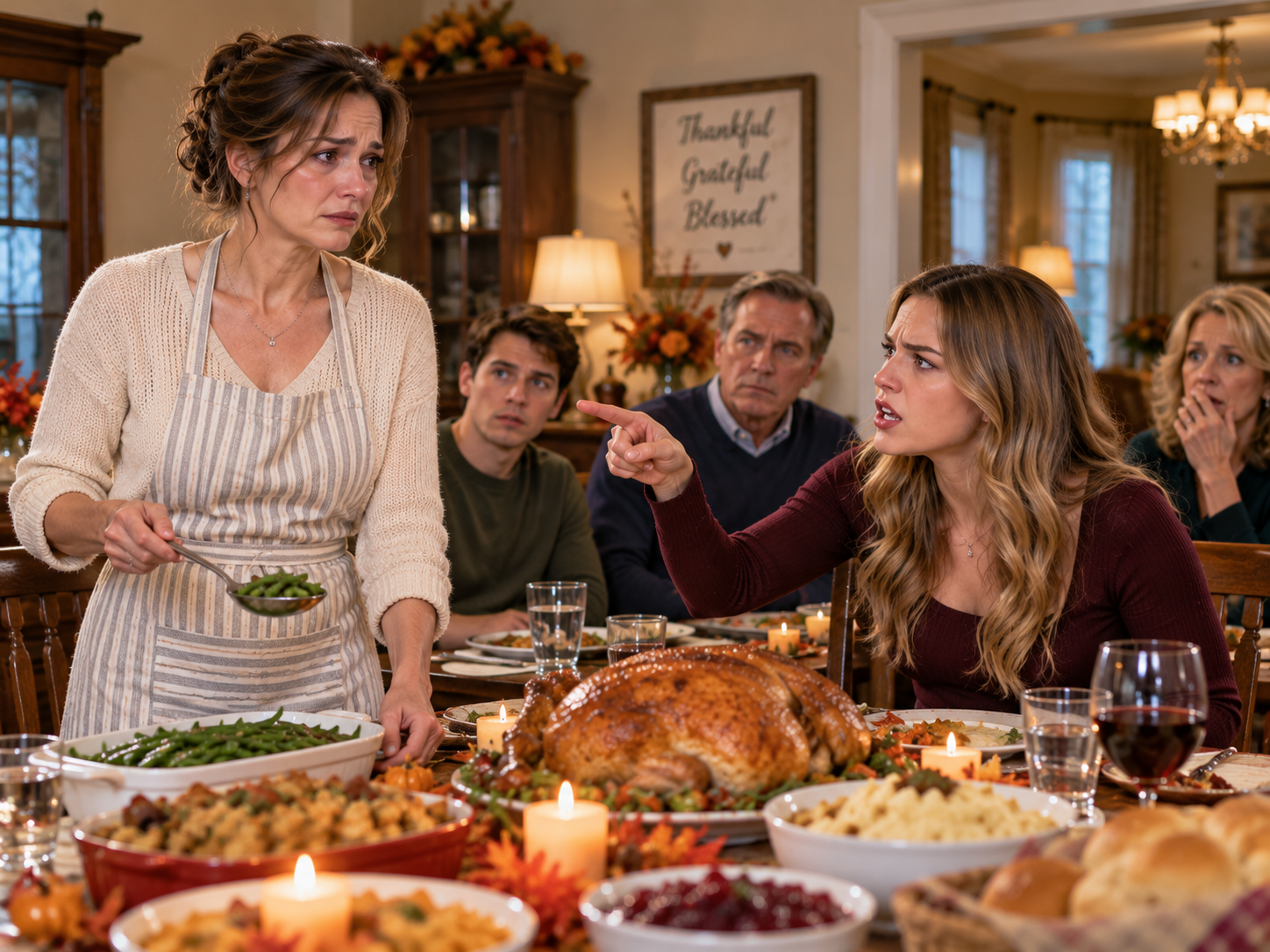
The following Thanksgiving was smaller than the first one.
I preferred it that way.
There were eight people at my table.
Carol.
Gary.
Lucas.
Brittany.
Richard.
Two of my friends.
And me.
The invitation had surprised several people.
Even me.
But I had learned that forgiveness did not require forgetting.
It did not require reopening a marriage.
It did not require pretending the past had been harmless.
It simply meant I no longer wanted anger to occupy every empty chair.
Brittany arrived early.
She brought the green bean casserole.
"Carol's recipe?"
"Mostly."
Carol inspected it.
"Too many onions."
Brittany laughed.
"I knew you'd say that."
Lucas carried in a box of rolls.
Richard arrived with flowers.
He handed them to me.
"For the table."
"Thank you."
No one made a speech.
No one needed to.
We ate.
Conversation moved slowly at first.
Then naturally.
Gary complained about the weather.
Lucas told a story about work.
Brittany talked about a project.
Richard listened more than he spoke.
That detail was perhaps the strangest.
The man who had once filled every silence now seemed willing to let other people occupy it.
After dinner, everyone helped clean.
I stood at the sink.
Brittany dried dishes.
Lucas put leftovers away.
Carol wiped the table.
Richard carried plates.
Nobody asked me where anything belonged.
Nobody assumed I would handle it.
They simply helped.
I looked around.
For a second, I remembered the first Thanksgiving.
The same kind of table.
The same kind of food.
A completely different life.
I felt something rise in my chest.
Not sadness.
Gratitude.
Not gratitude for what had happened.
Gratitude for what I had learned afterward.
When the kitchen was clean, we moved into the living room.
Brittany sat beside me.
"Can I ask you something?"
"Of course."
"Do you ever regret leaving?"
I thought about it.
"No."
"Not even once?"
"I've missed people."
She looked at Richard.
"That's different."
"Yes."
She nodded.
"Do you regret marrying Dad?"
I took my time.
"No."
That surprised her.
"Why not?"
"Because the marriage gave me things too."
"Like what?"
"Experience."
She laughed.
"That's a very polite answer."
"It's also true."
I looked toward Richard.
"I loved him."
He looked at me.
"And I don't need to pretend I didn't just because we ended badly."
Richard lowered his eyes.
Brittany asked, "Do you think you could have stayed?"
"Yes."
"Would you have been happy?"
"No."
She nodded.
That was the answer she needed.
Not a dramatic condemnation.
Not a perfect explanation.
Just truth.
Later that evening, everyone left except Brittany.
She helped me put away the last dishes.
Then she stood beside the kitchen window.
"Thank you."
"For what?"
"For letting me be here."
"You earned your place."
She shook her head.
"No."
I looked at her.
"That's not what I mean."
She took a breath.
"I mean thank you for letting me come back after I hurt you."
I thought about the girl who had sat at my Thanksgiving table and called me the help.
Then I looked at the woman standing in my kitchen.
People could change.
Not always.
Not automatically.
But sometimes.
"You came back differently," I said.
She nodded.
"I tried."
"I noticed."
She hugged me.
This time, neither of us felt awkward.
After she left, I locked the door.
The house became quiet.
I turned off the kitchen lights.
Only the lamp over the dining table remained on.
The wooden box sat on the shelf.
I opened it.
My father's letters were still there.
I read the first one again.
Trust is not the same as surrender.
I smiled.
Then I read the second.
Never let anyone make your kindness a debt.
I had spent years learning that sentence.
I finally understood it.
Kindness was something I could give.
It was not something other people could invoice.
Love was something I could offer.
It was not permission for someone else to consume me.
Family was not defined by how much inconvenience I could tolerate.
It was defined by whether people could stand beside one another without making one person disappear.
I closed the box.
Then I went upstairs.
My bedroom was exactly as I liked it.
A book on the nightstand.
A sweater over the chair.
The window cracked open to let in cold air.
I changed into pajamas.
Before turning out the light, I checked my phone.
There was a message from Brittany.
Thank you for tonight.
I replied:
Thank you for coming.
A minute later, another message arrived.
I think Grandpa would be proud of you.
I stared at the screen.
Then I wrote:
I think he'd be proud of you too.
I put the phone down.
Outside, the neighborhood was silent.
I thought about the first morning after the Thanksgiving dinner.
The cold coffee.
The financial records.
The email.
The fear.
At the time, I had believed I was discovering how badly my marriage had failed.
Now I understood I had been discovering something else.
My own voice.
It had been there all along.
Quiet.
Patient.
Waiting for me to stop talking over it.
Years earlier, I had believed that keeping everyone happy was the safest way to keep a family together.
I know better now.
Happiness cannot be maintained through one person's exhaustion.
Peace cannot be built on silence.
Generosity cannot survive where it becomes an obligation.
And love without respect eventually becomes a cage with comfortable furniture.
Leaving did not make me brave.
Leaving simply became necessary.
The bravery came afterward.
It came when I stopped explaining.
It came when I said no.
It came when I allowed other adults to solve their own problems.
It came when I accepted that someone could be disappointed in me and I could still be a good person.
That was perhaps the hardest lesson.
I had spent so much of my life avoiding disappointment that I had forgotten disappointment was not an emergency.
Someone could be upset.
Someone could misunderstand.
Someone could call me selfish.
I could survive it.
The morning after Thanksgiving, I woke before sunrise.
I went downstairs.
The house was quiet again.
I made coffee.
I opened the curtains.
The sky was beginning to brighten.
I stood at the kitchen window and watched the first light touch the rooftops.
For a moment, I thought about Richard.
Not with longing.
Not with anger.
Just recognition.
He had been part of my life.
A large part.
A complicated part.
But no longer the center.
Brittany had found her own footing.
Lucas had built his own life.
Carol remained exactly as blunt as ever.
And I had learned to stand in my own.
The coffee maker clicked off.
I poured the cup.
Then I smiled.
The life I had feared losing had never been the life I truly wanted.
I wanted this.
A quiet kitchen.
A table where nobody was afraid to speak.
People who helped because they cared rather than because one person had trained them to expect service.
A home where generosity could exist without obligation.
A life in which I could say yes because I wanted to and no because I needed to.
That was enough.
More than enough.
Years later, people would probably remember the Thanksgiving dinner differently.
Brittany might remember the embarrassment.
Richard might remember the moment he realized the marriage was over.
Carol might remember the silence.
Lucas might remember the look on my face.
I remembered something else.
The morning after.
The cold coffee.
The laptop.
The printed financial list.
The moment I understood that I had a choice.
That was the true beginning.
Not the divorce papers.
Not the empty townhouse.
Not the wooden box.
The beginning was the moment I stopped confusing being needed with being loved.
Everything afterward came from that.
I did not become harder.
I became clearer.
I still helped people.
I still gave generously.
I still answered calls.
I still cooked too much food.
I still worried about people I loved.
But now there was a boundary beneath all of it.
I was included in my own life.
That was the difference.
A few days later, Brittany called.
"Mom—"
She stopped.
We both went quiet.
She had never called me that before.
I waited.
"Sorry."
I smiled.
"You don't have to apologize."
"I don't know why I said it."
"I do."
"What?"
"You were trying to say something that felt true."
She was silent.
Then she asked, "Is it okay?"
I looked around my kitchen.
At the photographs.
At the wooden box.
At the chair my father had once sat in.
At the sunlight on the floor.
"Yes."
Her voice softened.
"Okay."
We talked for another twenty minutes.
When we hung up, I stood by the window.
There was no dramatic feeling.
No tears.
Just a quiet sense that something had finally settled.
The family had changed.
The marriage was over.
The wounds had scars.
But the future was not required to resemble the past.
That was the final thing I learned.
Leaving had not been punishment.
It had been permission.
Permission to stop carrying what belonged to other people.
Permission to choose peace without paying for it with my dignity.
Permission to love people without managing their lives.
Permission to forgive without returning.
Permission to remember without going back.
And permission, finally, to live without waiting for someone else to tell me that I was allowed.
I poured another cup of coffee.
The morning was bright now.
I opened the back door.
Cold air moved through the kitchen.
I stepped outside.
For once, there was nothing I needed to fix.
Nothing I needed to arrange.
Nothing I needed to carry.
I simply stood there.
And that ordinary moment felt like freedom.
Click Here to continue read next: PART9: The Phone Call Before Sunrise Forced Me to Face a Problem That Had Nothing to Do With Richard or the Marriage We Left Behind
The Dinner Table Went Quiet, and I Finally Heard What My Husband Had Been Saying Without Words
Part 8 of 16

