
The first week alone was stranger than I expected.
I had imagined freedom would feel dramatic.
It didn't.
It felt like making coffee for one.
It felt like choosing what to cook without asking anyone else.
It felt like sleeping diagonally across a bed because nobody was there to complain.
Most of all, it felt like not waiting for the next problem.
Carol came over one evening with soup.
She set the container on my counter.
"You look tired."
"I am."
"But?"
I smiled.
"But I slept."
She nodded.
"That's something."
We ate at the kitchen island.
She didn't ask whether I regretted leaving.
She didn't need to.
She already knew the answer.
Richard began sending messages.
At first they were practical.
Can we talk about the utilities?
Then emotional.
I don't understand how we got here.
Then defensive.
You're making this bigger than it was.
I answered only when an answer was necessary.
The less I explained, the more peaceful my life became.
Meanwhile, the paperwork began.
There were forms.
Transfers.
Insurance changes.
Address updates.
Property questions.
Tax documents.
The unromantic machinery of ending a marriage.
At one point Richard called about a utility account.
"You could at least help me with this."
"I already sent you the account number."
"I don't know how to change it."
"You can call the company."
Silence.
Then he said, "You used to do these things."
"Yes."
"You could still."
"I could."
Another pause.
"But I won't."
He hung up.
I sat at the kitchen table afterward and realized how much of our marriage had been built around my willingness to do things simply because I could.
That was different from being responsible for them.
I began noticing other patterns.
How often Richard had said "we" when he meant me.
How often he had said "you know how to handle this."
How many times I had heard "it's easier if you do it."
None of those sentences had sounded cruel at the time.
Together, they told a story.
Brittany called again in January.
This time her voice was quieter.
"I got a job."
"That's good."
"At a boutique near campus."
"I'm glad."
She hesitated.
"My dad said you probably wouldn't want to talk to me."
I looked toward the window.
Snow had collected along the curb.
"I'm listening."
She exhaled.
"I didn't know how much you paid."
"I know."
"I knew some things."
"Okay."
"I thought he was paying."
"I know."
Then she said, "What I said at dinner was supposed to be funny."
I waited.
"But it wasn't."
"No."
"I was trying to be cruel."
That surprised me.
She continued.
"I don't know why."
"Maybe because you thought there would never be a consequence."
She didn't argue.
"I think that's true."
For several seconds, neither of us spoke.
Then she asked, "Do you hate me?"
"No."
"Are you angry?"
"Yes."
"Will you ever forgive me?"
"I don't know."
She accepted that.
Before we ended the call, I told her something I hoped she would remember.
"Learn the difference between being helped and being entitled to help."
She was quiet.
"I think I'm starting to."
When we hung up, I did not feel triumphant.
I felt sad.
Brittany was young enough to learn.
Richard was old enough to know better.
That distinction mattered.
The divorce moved forward.
There were meetings and signatures.
There were conversations about property.
There were moments when Richard tried to reopen emotional negotiations inside practical ones.
"You don't have to do this."
"I know."
"We could work things out."
"We could have."
He would look at me.
I would look back.
And neither of us would say the sentence underneath everything.
You chose not to.
Eventually, the final papers were ready.
The morning I signed them, I expected some enormous wave of emotion.
Instead, I felt strangely calm.
The pen moved across the page.
That was it.
No music.
No thunder.
No revelation.
Just ink.
I walked outside afterward and stood beside my car.
The sky was pale.
A delivery truck passed.
Someone was scraping ice from a windshield.
Life continued.
I drove home.
That afternoon, Lucas came by.
He had brought a small toolbox because a cabinet door in my kitchen was hanging crooked.
"You look different," he said.
"Different how?"
"Lighter."
I thought about that.
"Maybe."
He fixed the hinge.
Then we made coffee.
He didn't ask me to explain the divorce.
He didn't need the entire story.
He had seen enough.
That was one of the things I learned afterward.
People who love you do not require a courtroom before believing you.
The people who benefited from your silence are the ones who demand evidence.
Spring came slowly.
The snow disappeared.
The roads dried.
I planted herbs in small pots near the kitchen window.
I started walking in the mornings.
I cooked when I wanted to.
I left dishes in the sink sometimes.
That last one sounds ridiculous, but it mattered.
I had spent years believing a peaceful home had to be perfectly maintained.
Now I understood that peace could include an unwashed plate.
One afternoon in April, I saw Richard at a hardware store.
He was standing near the paint aisle.
I nearly walked the other direction.
Then I decided I had nothing to fear from a man who no longer had access to my life.
"Brenda."
"Richard."
He looked older.
Not dramatically.
Just less polished.
Less protected by someone else's organization.
"How are you?"
"Fine."
"You look good."
"Thank you."
He smiled awkwardly.
For a moment, neither of us knew what to say.
Then he said, "I didn't think it would matter that much."
I understood immediately.
The dinner.
The insult.
The email.
The money.
The marriage.
All of it.
"You didn't think," I said.
His face tightened.
"I didn't mean—"
"I know."
I turned back toward the paint samples.
He stood there for another moment.
Then he left.
I watched his reflection disappear between the shelves.
I did not feel victorious.
I felt finished.
That summer, Carol and I sat on my patio.
She had brought strawberries.
The evening was warm.
A lawn mower droned somewhere nearby.
She studied me over her glass.
"What?"
She smiled.
"You've spent a lot of your life confusing endurance with virtue."
I laughed.
"That sounds like something you practiced."
"I did."
We sat quietly.
Then I said, "I really believed that if I kept everything steady, eventually I'd feel like I belonged."
Carol picked up a strawberry.
"People who benefit from your steadiness eventually stop seeing it as a gift."
I looked at her.
"They start seeing it as the weather."
That sentence stayed with me.
Because she was right.
Richard had stopped noticing my effort.
Brittany had never learned to see it.
My care had become background noise.
Something expected.
Something that was simply there.
Until I removed it.
Then suddenly everyone noticed.
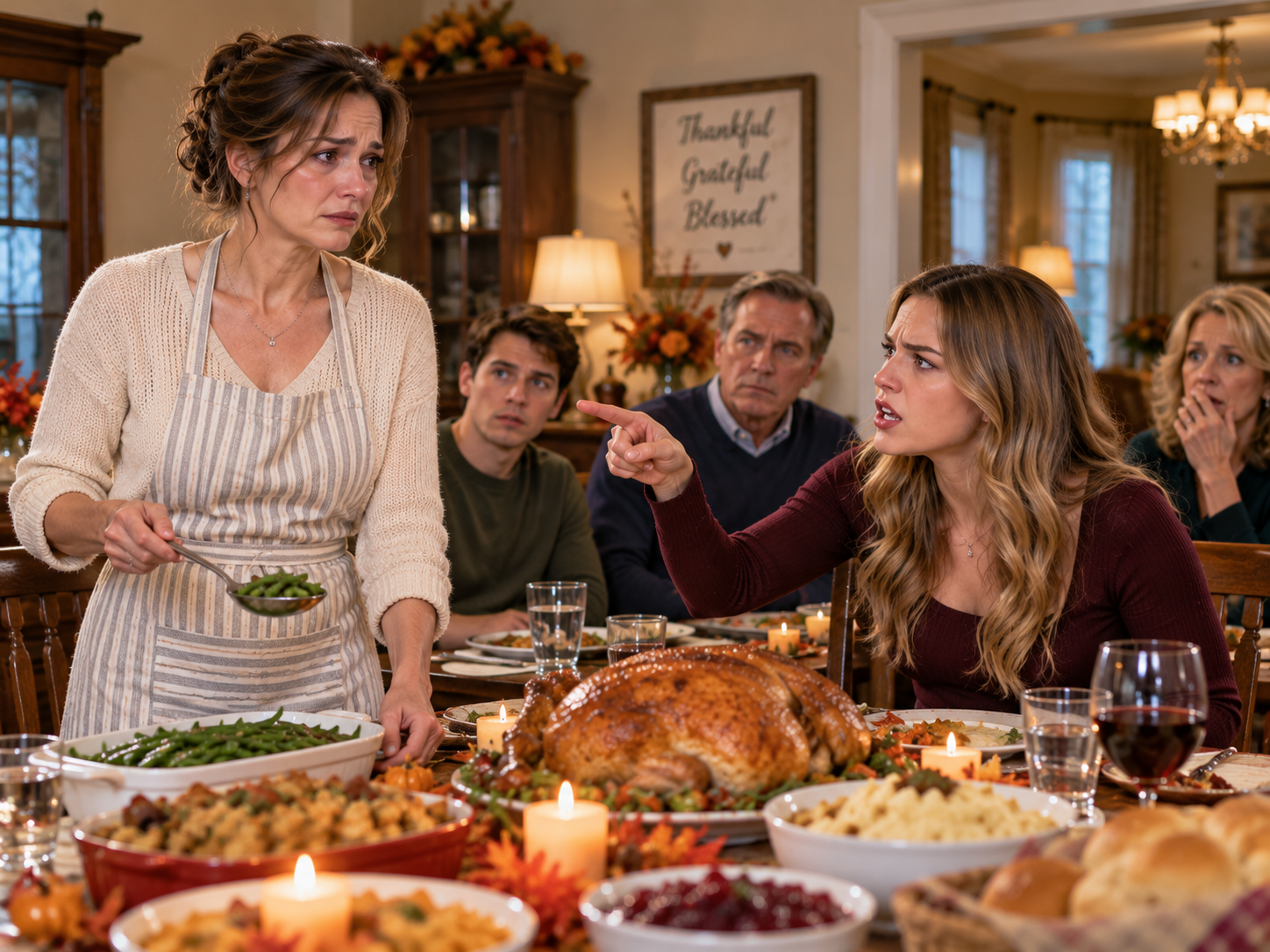
A year after that Thanksgiving dinner, I hosted Thanksgiving again.
The guest list was smaller.
Carol and Gary came.
Lucas came.
Two close friends joined us.
The house was warm.
Carol brought the green bean casserole.
Still too many onions.
Gary complained about football.
Lucas arrived smelling like cold air and machine oil.
At one point, I stood in the kitchen holding a dish towel.
For a second, I remembered the previous Thanksgiving.
The insult.
Richard's voice.
The silence.
The decision I had made before sunrise.
Then Lucas walked in.
He looked at the serving dish in my hands.
"Give me that."
"I can carry it."
"I know."
He took it anyway.
That simple gesture nearly brought me to tears.
Not because I needed rescuing.
Because he had noticed.
He had seen the weight before I had to ask for help.
Dinner was noisy.
Not perfect.
Someone spilled gravy.
Gary argued about a referee's call.
Carol laughed so hard she coughed.
Lucas stole the last dinner roll.
It felt ordinary.
And ordinary had become precious.
After everyone left the table, I stepped outside.
The air was cold.
My breath appeared white in front of me.
The neighborhood was quiet.
I thought about how much had changed.
Not my age.
Not my address.
Not even my marital status.
The deepest change was smaller.
I no longer believed peace had to be purchased with my own disappearance.
That was the part I wished I had understood sooner.
I had spent years thinking a good woman kept everything together.
A good wife absorbed inconvenience.
A good stepmother gave without expecting recognition.
A good partner made life easier.
None of those things were wrong.
What was wrong was believing they had to continue after respect disappeared.
Inside the house, I could hear Carol laughing.
Lucas called my name.
I opened the door.
And for the first time in a long time, I entered a room without wondering whether I had earned my place there.
I simply belonged.
Click Here to continue read next: PART4: One Year Later, I Realized the Dinner Had Not Broken My Life; It Had Shown Me the Life I Needed to Leave
The Dinner Table Went Quiet, and I Finally Heard What My Husband Had Been Saying Without Words
Part 3 of 16

