
THE FINAL PART: 👇👇🙏❤️
Here’s the final part, resolving the trust, Martin Voss, the stolen inheritance, and what became of Eleanor, Richard, Davina, Juny, and the lake house.
Nobody spoke.
Not at first.
The bank’s private viewing room was so quiet I could hear the fluorescent lights humming above us.
Martin Voss.
The name sat on the report in clean black type.
Davina’s biological father.
My mother’s attorney.
The man who had helped prepare the documents that transferred away the land Grandma Ruth left me.
The man standing beside Eleanor now as she tried to challenge Juny’s inheritance.
Davina took the report from Miss Castellano.
Her hands shook.
“No.”
She read it herself.
Then again.
Dad was staring at the table.
Juny stood beside me, silent.
I wanted to send her outside.
Then I remembered how many times adults in our family had decided what truths children were allowed to know.
So I did not.
I simply put my hand on her shoulder.
Davina looked at Dad.
“Did you know?”
He shook his head immediately.
“No.”
“For real this time?”
That hurt him.
I saw it.
He deserved it.
“No,” he said. “I knew Eleanor had been involved with Malcolm. Or I thought she had. I never knew about Voss.”
Miss Castellano picked up Augusta’s notarized statement.
“There’s more.”
Davina laughed bitterly.
“Of course there is.”
The statement had been signed four years earlier.
Augusta wrote that Eleanor had finally admitted the truth during an argument at the lake house.
Martin Voss had not merely been an attorney who later became involved in family matters.
He and Eleanor had been having an affair before Davina was born.
The affair continued intermittently for years.
Voss later helped Eleanor arrange the fraudulent sale of Ruth’s land.
Charles Wynn’s company had acted as purchaser.
The transaction had been structured so my parents could access money quickly while Wynn acquired the property below market value.
Voss handled the documents.
My mother forged my signature.
My father falsely certified it.
Then Wynn resold the land months later for a substantial profit.
Everybody took something.
Except me.
I got told Grandma Ruth had left almost nothing.
Miss Castellano continued reading.
Augusta believed Voss had maintained influence over Eleanor because they shared liability.
He knew what she had done.
She knew what he had done.
Neither could expose the other without risking themselves.
Then came the line that explained why Augusta had preserved everything.
If Eleanor ever attempts to control Juniper’s property through litigation, Martin Voss will almost certainly assist her. Their interests remain connected.
I stared at those words.
Grandma Augusta had predicted the exact thing unfolding around us.
Not because she was dramatic.
Because she paid attention.
Davina suddenly pushed her chair back.
“I want to talk to him.”
Miss Castellano looked up.
“To Voss?”
“Yes.”
“I strongly advise against contacting him personally.”
“I don’t care.”
“You should.”
Davina’s eyes flashed.
“That man has known I was his daughter my entire life.”
“We don’t yet know what he knew.”
My sister slapped the report onto the table.
“He represented my mother for years.”
“Yes.”
“He came to family events.”
I remembered that too.
Not many.
But enough.
Christmas drinks.
A graduation party.
One summer barbecue.
He had stood ten feet from Davina while everyone treated him like an old family professional.
Davina covered her mouth.
“Did he know?”
Nobody answered.
Then Juny spoke softly.
“Maybe Grandma Augusta recorded that too.”
Everyone looked at her.
The tape recorder.
We had almost forgotten it.
Miss Castellano picked it up.
Inside was a microcassette.
A note had been taped to the back.
PLAY AFTER PATERNITY REPORT.
Miss Castellano asked whether Davina wanted to continue.
My sister nodded.
This time, she did not hesitate.
The recording crackled.
Then Augusta’s voice.
“Say it again.”
My mother’s voice followed.
“You heard me.”
“I want there to be no confusion later.”
A chair scraped.
Then Eleanor said, “Martin is Davina’s father.”
Davina closed her eyes.
The tape continued.
Augusta asked, “Does Richard know?”
“He knows enough.”
“No. Does he know Martin is her father?”
“No.”
“Does Martin?”
A pause.
“Yes.”
Davina made a sound beside me.
Not quite a sob.
Not quite anger.
Something between them.
Augusta’s voice remained steady.
“And yet he participated in stealing Mara’s inheritance?”
Mom replied, “Don’t make it sound like that.”
“What should I call forging a seventeen-year-old girl’s signature?”
“We needed money.”
“Martin received money.”
“He did legal work.”
“For a fraudulent transaction.”
Silence.
Then Eleanor said something I will never forget.
“Mara never would have done anything with that land anyway.”
There it was.
The philosophy beneath everything.
If my mother decided I did not deserve something, taking it became reasonable.
My money.
My land.
My dignity.
My daughter’s pain.
Everything was negotiable if she could convince herself the rightful owner was unworthy.
Augusta said, “And Juniper?”
Mom’s voice sharpened.
“What about her?”
“If I leave her the lake house?”
“You wouldn’t.”
“If I do?”
“She is a child.”
“She will not always be.”
“Then Mara will control it.”
“Until Juniper is old enough.”
My mother laughed.
“You think Mara can manage property?”
Augusta answered, “I think Mara has spent her entire life surviving people who benefit when she doubts herself.”
I had to look away.
Juny took my hand.
The recording continued.
Mom said, “You are turning them against me.”
“No, Eleanor. I am leaving them somewhere you cannot reach without showing everyone exactly who you are.”
Then came one final exchange.
My mother said, “If you do this, I will contest it.”
Augusta replied, “I know.”
“And Martin will represent me.”
“I know.”
“You think you’ve thought of everything.”
Augusta’s answer was almost gentle.
“No. I only thought of you.”
The tape ended.
Nobody moved for a while.
Then Dad started laughing.
It was not amusement.
It was disbelief.
“She knew.”
Miss Castellano nodded.
“She did.”
“All those years, she knew.”
“Yes.”
Dad rubbed both hands over his face.
“And she never told me.”
Davina turned toward him.
“Would you have believed her?”
He looked at his daughter.
His answer took too long.
“No.”
Davina nodded.
“At least that’s honest.”
We left the bank with copies placed into Miss Castellano’s custody.
The originals stayed secured.
By that afternoon, everything changed.
Voss withdrew from representing Eleanor.
Not voluntarily at first.
Miss Castellano sent formal notice raising conflict concerns and preserving claims relating to the old land transaction.
Once Voss understood the amount of documentation Augusta had retained, his position became impossible.
Two days later, he hired his own attorney.
Eleanor hired another.
The trust challenge did not disappear immediately, but its foundation collapsed quickly.
Augusta’s competency evaluations were clear.
Her doctors had documented her capacity.
Her estate planning had been completed independently.
Her reasons were written repeatedly and consistently over years.
There was no sudden change.
No mysterious caregiver.
No evidence I had pressured her.
In fact, most of the evidence showed Augusta had protected the plan from me too.
She had wanted the decision to be hers.
Not mine.
And then there was Eleanor’s recording.
Threatening Augusta.
Discussing the trust.
Promising Voss would help challenge it.
Miss Castellano told me later that few things damage an undue-influence claim faster than evidence showing the person making the accusation was the one applying pressure.
Within three weeks, Eleanor withdrew the challenge.
Not because she apologized.
She did not.
Because continuing would expose more.
The land transaction became a separate matter.
Seventeen years had passed.
That complicated everything.
Records were old.
Entities had dissolved.
Properties had changed hands.
But forged documents do not become less forged because families refuse to discuss them.
Miss Castellano brought in another attorney who specialized in financial fraud and estate litigation.
They traced what they could.
Lakeview Development Holdings had been created specifically for several transactions.
Charles Wynn had profited heavily.
Voss had received payments.
My parents’ debts had been covered.
And my name had been used without permission.
I did not get my original land back.
It had been subdivided years earlier.
Homes stood on part of it now.
At first, that broke something in me.
I kept thinking of Ruth’s photograph.
For Mara. Someday she will build something here that belongs only to her.
That future had been stolen before I was old enough to understand I had it.
There was no court order capable of restoring that exact possibility.
But there were settlements.
Charles Wynn was still alive.
Still wealthy.
Still very interested in avoiding prolonged litigation around old transactions bearing his name.
Voss was even more interested.
Their lawyers negotiated separately.
I will not pretend justice arrived in some perfect shape.
It did not.
Real justice rarely does.
The land was gone.
Seventeen years were gone.
My father could not undo his signature.
My mother could not give me back the version of myself who had spent decades believing she owed everyone gratitude for surviving what they had taken from her.
But enough money was recovered that Grandma Ruth’s gift was no longer just a story about theft.
Part of it came back.
With interest.
With damages.
With legal consequences attached.
Dad waived any claim to funds connected to the old transaction.
Then he did something I did not expect.
He sold his share of the home he had owned with Eleanor after they separated and placed a portion of his proceeds into an account for Juny.
I refused it initially.
He said, “It isn’t repayment.”
“You can’t repay this.”
“I know.”
“Then what is it?”
He looked at Juny.
“Something I should have done when her mother was seventeen.”
Juny did not hug him.
I was glad she did not feel obligated to.
But she said thank you.
That was more generosity than he had earned yet.
Dad started therapy.
He moved into a small apartment.
He called me every Sunday.
Sometimes I answered.
Sometimes I didn’t.
The biggest change was that he stopped demanding forgiveness as proof that he was sorry.
That mattered.
Davina’s story was harder.
She confronted Voss through attorneys first.
Eventually, he requested a private meeting.
She asked me to go with her.
We met him in a conference room across town.
Martin Voss looked smaller without a briefcase.
Older too.
He did not resemble Davina dramatically.
Not in some movie-perfect way.
But once I knew, I could see pieces.
The chin.
The way they both pressed their lips together when uncomfortable.
Davina sat opposite him.
“Did you know?”
He said yes.
No explanation first.
Just yes.
She flinched.
“For how long?”
“Since shortly after you were born.”
“You knew my entire life.”
“Yes.”
“You stood in rooms with me.”
“Yes.”
“You represented my mother.”
“Yes.”
“You helped steal from my sister.”
Voss looked at me.
“I participated in a transaction I should never have touched.”
“That wasn’t my question,” Davina said.
He looked back at her.
“Yes.”
“Why didn’t you tell me?”
He stared down at his hands.
“Cowardice.”
The answer surprised all of us.
“I told myself Richard was your father in every meaningful sense. I told myself disclosure would destroy your family. I told myself Eleanor knew what was best.”
Davina laughed softly.
“You all loved that phrase.”
“What?”
“What’s best for the family.”
Voss said nothing.
“It always meant what’s easiest for the adults.”
He nodded.
“Yes.”
Davina did not forgive him that day.
She did not call him Dad.
She did not promise a relationship.
She asked for his medical history.
Family health information.
Nothing more.
Then she left.
Months later, she exchanged occasional emails with him.
That was her decision.
Not Eleanor’s.
Not Richard’s.
Not mine.
For the first time, Davina was allowed to decide what family meant without somebody else arranging the answer.
My relationship with my sister changed slowly.
Not overnight.
She had hurt Juny.
She had hurt me.
Understanding why did not erase that.
But she stopped defending herself every time I named something painful.
That was new.
One evening, she came over with takeout.
Juny was upstairs doing homework.
Davina sat at my kitchen table and said, “I spent my whole childhood thinking winning Mom’s approval meant I was better than you.”
I waited.
She continued.
“I think I needed that to be true because otherwise I had to admit she was being cruel to you and I was benefiting from it.”
“That sounds right.”
She gave me a sad smile.
“You don’t make forgiveness easy.”
“No.”
“Good.”
Several weeks after that, she apologized to Juny again.
Properly this time.
No explanation.
No childhood story.
No tears requiring comfort.
She said, “I mocked you when you were sick. I went to the pool when you were in surgery. You deserved an aunt who believed you. I wasn’t that person. I’m sorry.”
Juny looked at her for a long time.
Then said, “I forgive you a little.”
Davina laughed.
“That’s fair.”
Juny eventually forgave her more.
Not because anyone told her to.
Because Davina behaved differently.
There is a difference.
Eleanor did not.
At first, she sent messages.
Long ones.
Some furious.
Some sentimental.
Some describing herself as a mother who had sacrificed everything.
She mailed me photographs from childhood.
She sent Juny a birthday card with five hundred dollars inside.
I returned it.
Then came the message I had been expecting.
You are keeping my granddaughter from me.
I replied once.
Juny is old enough to decide whether she wants contact. Right now she doesn’t.
Mom responded:
Because you’ve poisoned her.
I did not answer.
Eventually, the messages stopped.
Not because Eleanor changed.
Because she realized they no longer moved me.
That was the part she could not tolerate.
Not anger.
Not even separation.
Irrelevance.
That summer, Juny and I returned to the lake house.
Just the two of us.
Her surgical scars had faded into three small marks.
She wore the yellow sundress again.
The one she had worn in the restaurant.
I noticed while she was packing.
“You sure?”
She looked down at it.
“Yeah.”
Then she shrugged.
“I like this dress.”
That answer nearly made me cry.
The dress did not belong to the worst night of her life.
My mother did not get to own that either.
We arrived in the afternoon.
The lake was still.
Dragonflies skimmed above the reeds.
Inside, the house smelled like pine cleaner and old books.
Juny walked straight into the kitchen.
She stood over the pantry floor where we had found Augusta’s box.
“Do you think she knew all of this would happen?”
“No.”
“Really?”
“I think she knew Grandma Eleanor.”
That made Juny smile.
We carried sandwiches down to the dock.
For a while, we ate without talking.
Then she asked, “What are we going to do with the house?”
It was a strange question because technically the answer belonged to her future.
The trust would preserve the property until she reached the age Augusta specified.
But eventually it would be Juny’s decision.
“Whatever you want when you’re old enough.”
She looked over the water.
“I don’t want it to be a revenge house.”
I turned toward her.
“A what?”
“A place everybody talks about like Grandma lost it and we won it.”
I thought about that.
“What do you want it to be?”
She pulled her knees up carefully.
“I don’t know yet.”
Then she smiled.
“Maybe somewhere people actually get to rest.”
That became the idea.
Not immediately.
But over the next year, it grew.
Part of Augusta’s trust income was permitted for maintenance and charitable use consistent with Juny’s welfare and the property’s preservation.
With Miss Castellano’s help, we created a small summer program.
Nothing enormous.
A few weekends each year.
Families referred through a local hospital could stay at the house while a child recovered from treatment.
No charge.
No obligation.
No photographs for publicity unless they wanted them.
Just quiet.
Water.
Beds.
A kitchen.
Space for frightened children to be inconvenient.
Juny chose the name.
Augusta House.
The first family arrived the following June.
A mother.
A father.
A twelve-year-old boy recovering from surgery.
And his little sister.
Before they came, Juny placed a framed card in the guest room.
It said:
You never need to apologize for being sick here.
I had to leave the room after reading it.
On the second anniversary of Augusta’s death, we held a small gathering by the lake.
Miss Castellano came.
Davina brought her kids.
Dad arrived alone.
Even Malcolm came.
He had never intended to steal Augusta’s box for Eleanor.
The investigation supported his story.
He had learned Eleanor was searching for the hidden documents and panicked, believing she would destroy them.
Taking the box had still been reckless.
But he returned it.
And for once, one of our family’s secrets survived because someone decided not to hand it to Eleanor.
Malcolm and Davina had their own complicated relationship.
He was not her biological father after all.
But he had spent decades believing he might be.
That created a strange kind of grief between them.
They eventually became friends.
Not father and daughter.
Something harder to name.
Maybe that was healthier.
We scattered Augusta’s remaining ashes near the maple tree.
Juny read a short letter she had written.
She did not cry until the end.
Then she said, “Grandma Augusta was the first person in this family who made me feel like being sensitive wasn’t the same as being weak.”
Davina looked down.
Dad wiped his face.
I stood beside my daughter.
When she finished, we walked to the dock.
The sunset turned the lake copper.
Juny leaned against the railing.
“Mom?”
“Yeah?”
“Do you still wish you’d yelled at them in the restaurant?”
I thought about it.
That night had replayed in my head hundreds of times.
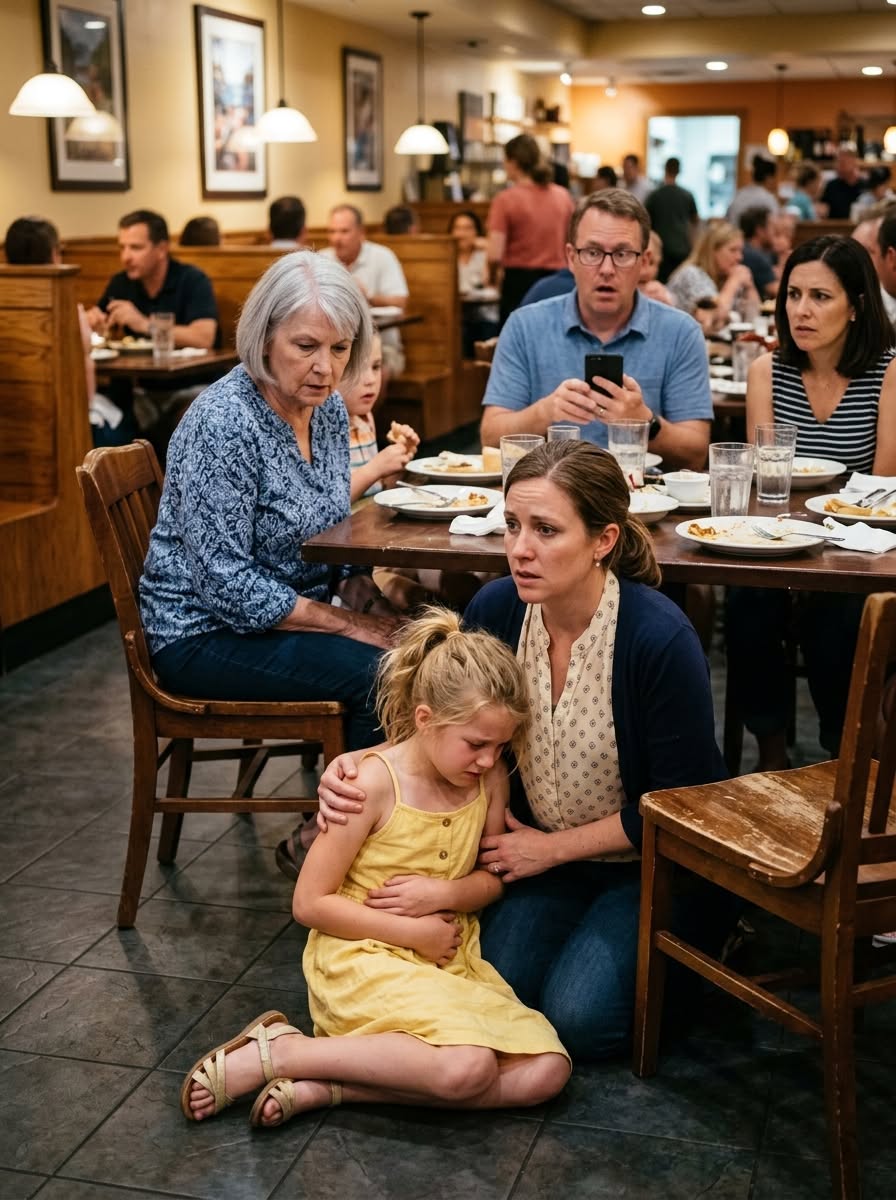
My mother calling Juny a drama queen.
Davina laughing.
My father telling her not to milk it.
Juny collapsing.
Me kneeling beside her.
For a long time, I hated myself for all the moments before the collapse.
All the times I had smiled weakly.
Changed the subject.
Asked Juny privately whether she was okay instead of publicly telling everyone else to stop.
“Yes,” I said.
“Sometimes.”
She nodded.
“But?”
I looked at her.
“But I think I spent too much time wishing I could go backward instead of paying attention to what I do now.”
She considered that.
“That’s very therapist of you.”
I laughed.
“Your grandfather is not the only one going.”
“I know.”
She bumped my shoulder gently.
Then she looked at the house.
“Do you know what I remember most from the hospital?”
“What?”
“When I asked if I’d ruined the trip.”
My chest tightened.
“And you said no.”
“I should have said it sooner.”
“You said it when I needed it.”
I looked at her.
Fourteen had become sixteen.
She was taller.
Louder.
Funnier.
She argued with teachers when she thought assignments were unfair.
She sent food back when restaurants got her order wrong.
The first time she did that, she looked at me afterward and said, “Growth.”
I laughed so hard I nearly embarrassed us both.
She was still sensitive.
Thank God.
We had simply stopped treating sensitivity like evidence against her.
A car pulled into the driveway behind us.
For one terrible second, I thought it might be Eleanor.
It wasn’t.
A family arriving early for Augusta House stepped out.
The little girl ran toward the lake.
Her mother called after her to slow down.
Juny smiled.
“Should we help them?”
“Yeah.”
We started toward the house.
Halfway there, Juny stopped.
“Mom.”
I turned.
She looked back at the water.
“Do you think Grandma Augusta left me the house because she knew I would do this?”
“No.”
That surprised her.
“You don’t?”
“I think she left it because she wanted you to have choices.”
Juny thought about that.
Then nodded.
“That’s better.”
It was.
That became the part I finally understood.
Grandma Ruth had tried to leave me land because she wanted me to possess something no one could take.
My mother took it anyway.
Grandma Augusta learned from that.
She did not leave Juny only property.
She left structure.
Evidence.
Protection.
Choices.
Most of all, she left a record proving that the version of our family history Eleanor had repeated for decades was not the only version.
I had never been the difficult daughter who owed everyone gratitude.
Juny had never been the drama queen who ruined vacations.
Davina had never been the perfect child who somehow deserved more.
Dad’s silence had never been peace.
And Eleanor’s control had never been love simply because she called it family.
A year after the trust fight ended, I received one final letter from my mother.
I almost threw it away.
Then I opened it.
There was no apology.
Not really.
She wrote that Augusta had always judged her.
That Ruth had interfered.
That Richard was weak.
That Davina was ungrateful.
That I had always misunderstood how difficult motherhood could be.
Then, near the end, one sentence stood out.
Someday Juny will understand that mothers do what they have to do.
I read it twice.
Then I took out a pen.
For most of my life, I would have written pages.
Explained.
Defended.
Argued.
Tried to make her see me.
Instead, I wrote one sentence.
She already understands.
I mailed it.
Then I went outside.
Juny was waiting on the dock with two glasses of lemonade.
She handed me one.
“Who was the letter from?”
“Grandma Eleanor.”
“What did she want?”
“The same thing she always wanted.”
“What?”
“To tell me who I am.”
Juny looked at me.
“And?”
I dropped into the chair beside her.
“I finally know she doesn’t get to.”
The lake moved softly against the posts beneath us.
Inside Augusta House, a child laughed.
Somewhere behind the trees, wind stirred through the maple leaves.
Juny stretched her legs toward the sunlight.
And for the first time in my life, silence did not mean somebody was swallowing the truth.
It simply meant there was nothing left we needed to hide.
Thank for reading. Please click here to read another new interesting story drama❤️🙏


One Comment on “My fourteen-year-old daughter hit the restaurant floor while my family kept calling her a drama queen.”