
Anna had never asked Helen about the first year of her life in detail.
She knew the broad facts. She knew she had been taken from the boarding house, raised under another name, and protected by a woman who had risked everything to keep her safe.
But broad facts were not enough anymore.
One Sunday afternoon, Anna arrived carrying a notebook.
Helen saw it immediately.
“You have questions.”
Anna smiled.
“A lot.”
Mara was sitting nearby.
Rose was making tea.
Daniel had gone outside to repair the garden gate.
Helen looked at the notebook.
“Ask.”
Anna opened the first page.
“Do you remember holding me?”
Helen's face changed.
“Yes.”
“How old was I?”
“Newborn.”
“Where?”
“In the hidden room.”
Anna wrote something down.
Helen watched her.
“Why are you writing?”
“Because I don't want to forget your answers.”
Helen smiled sadly.
“You won't.”
“I might.”
“No.”
Anna looked at her.
“How can you know?”
“Because I spent my life trying to forget.”
The answer silenced the room.
Anna continued.
“Was I afraid?”
Helen took a breath.
“You were too young to understand fear.”
“Then why do I remember crying?”
“Because babies cry.”
Anna smiled faintly.
“Fair.”
Mara watched her mother.
The questions were simple.
The answers were not.
Anna asked about the nurse.
About the blue house.
About the day Helen had stood across the street.
About the red ribbon.
About the woman who had raised her.
Helen answered as honestly as she could.
When she didn't know, she said so.
That was important.
There was a time when Helen would have filled gaps with guesses.
Now she refused.
“I don't remember,” became an acceptable answer.
Anna eventually reached the hardest question.
“Did you choose me?”
Helen looked at her.
“What?”
“Did you choose to keep me?”
“Yes.”
“Even when your father threatened you?”
“Yes.”
“Why?”
“Because you were my daughter.”
Anna closed the notebook.
Helen reached across the table.
“I wish I could give you a better answer.”
Anna shook her head.
“That is the answer I needed.”
Later, Mara found Anna alone in the garden.
“You okay?”
Anna nodded.
“Mostly.”
“That sounds honest.”
“It is.”
She looked at the house.
“I used to imagine my mother as someone who had abandoned me.”
Mara listened.
“Then I imagined her as someone who had been forced to lose me.”
“And now?”
“Now I think she was both.”
Mara nodded.
“She was a person.”
Anna smiled.
“That makes it harder.”
“It does.”
They stood quietly.
Anna looked at Mara.
“Did you ever resent me?”
Mara was surprised.
“For what?”
“For taking so much of your mother's attention.”
Mara laughed softly.
“You were missing for thirty-seven years. I think you earned some attention.”
Anna smiled.
“I mean it.”
“So do I.”
Mara touched her shoulder.
“I never lost a mother because of you.”
Anna looked away.
“I wish I could say the same.”
“You didn't lose anything.”
“I lost a childhood.”
Mara nodded.
“That is true.”
Neither tried to make the sentence prettier.
Some losses could not be repaired.
They could only be acknowledged.
That evening, Helen asked Anna to stay.
They sat together in the bedroom.
Helen opened a drawer.
Inside was a small notebook.
She handed it to Anna.
“I wrote this when you were born.”
Anna opened it.
The first page contained a single sentence.
Her name will be Anna.
The second page described the day she was born.
Helen had written about the weather.
The clinic.
The nurse.
The sound of rain against the windows.
Anna read slowly.
Then she stopped.
“What is this?”
Helen looked.
A paragraph had been crossed out.
Anna read the visible words.
I saw him standing outside the clinic.
“Who?”
“My father.”
Helen's face tightened.
“I didn't know he was there.”
“You wrote that you saw him.”
“I thought I did.”
“What does that mean?”
Helen closed the notebook.
“I was frightened.”
Anna looked at her.
“You don't remember?”
“Not clearly.”
Anna nodded.
That was enough.
The next morning, Mara took the notebook to the archive.
She scanned every page.
One paragraph caught her attention.
Helen had written that a man had entered the clinic shortly after Anna's birth.
He carried a brown leather case.
Mara remembered the man who had come to the hidden room years later.
The same kind of case.
She checked the recovered photographs.
There it was.
The man standing behind Helen's father.
Mara called Rose.
Within an hour, Rose arrived.
They compared the photographs.
“It’s him,” Rose said.
Mara frowned.
“But he was supposedly dead.”
Rose shook her head.
“The man we met wasn't him.”
“Then who?”
Rose pointed to the photograph.
“This is the older brother.”
Mara froze.
“There were two?”
“Yes.”
The family had spent years thinking they had identified every major person involved.
They had not.
But this discovery did not change the central truth.
It simply explained one more gap.
The brothers had operated together.
One managed the records.
The other managed transportation.
The second brother had disappeared after the fire.
Mara searched the archive.
There was no death record.
No burial record.
No confirmed disappearance.
Only an absence.
She told Helen.
Helen listened quietly.
“Does that mean he's alive?”
“We don't know.”
Helen nodded.
“Then we don't assume.”
Mara smiled.
“That sounds like you.”
Helen laughed.
“I'm learning.”
Anna joined them.
“What did you find?”
Mara explained.
Anna listened.
Then she shook her head.
“I don't want another person to chase.”
Mara looked at her.
“Neither do I.”
Rose nodded.
“We already have enough ghosts.”
They decided not to search actively for the man.
If he existed, authorities could determine that.
The family did not need to reopen every wound simply because a document contained another unanswered question.
That decision brought Helen relief.
For the first time, she realized that truth did not mean pursuing every mystery until nothing remained.
Truth also meant knowing when evidence stopped.
That evening, she told Anna something she had never said before.
“I am sorry.”
Anna looked at her.
“For what?”
“For thinking that if I could remember everything, I could fix everything.”
Anna smiled.
“You can't.”
“I know.”
“Good.”
Helen laughed.
Anna took her hand.
“You don't have to be perfect now.”
Helen's eyes filled.
“I was never good at that.”
“I know.”
They laughed together.
Mara watched from the doorway.
The family had changed in small ways.
Not every day was peaceful.
Sometimes old anger returned.
Sometimes Helen needed space.
Sometimes Anna wanted answers Helen couldn't provide.
Sometimes Rose remembered something that made Daniel uncomfortable.
But they had stopped treating conflict as proof that the family was broken.
They argued.
Then they stayed.
That mattered.
One year later, the archive held an exhibition about the Bellweather records.
Mara helped prepare it.
The display included photographs, documents, and explanations of how false identities had been created.
At the center was a simple statement:
A record is not a life.
But a record can help a life be remembered.
Helen attended the opening.
Anna stood beside her.
Rose came too.
Daniel remained in the back of the room.
When Mara gave her short speech, she did not mention herself.
She spoke about the families whose names had survived.
She spoke about the people who had been forgotten.
She spoke about the danger of allowing fear to decide what history should contain.
Afterward, Helen hugged her.
“You sounded like you belonged there.”
Mara smiled.
“I do.”
Helen looked at the exhibit.
“So does Anna.”
Mara followed her gaze.
Anna was standing beside the restored photograph of the blue house.
She was smiling.
Not because the photograph showed a happy childhood.
Because it showed a truth that could finally be seen.
Click Here to continue read next: PART15: When the Archive Asked Mara to Tell the Family’s Story Publicly, She Faced the One Fear Her Mother Had Passed Down Without Meaning To
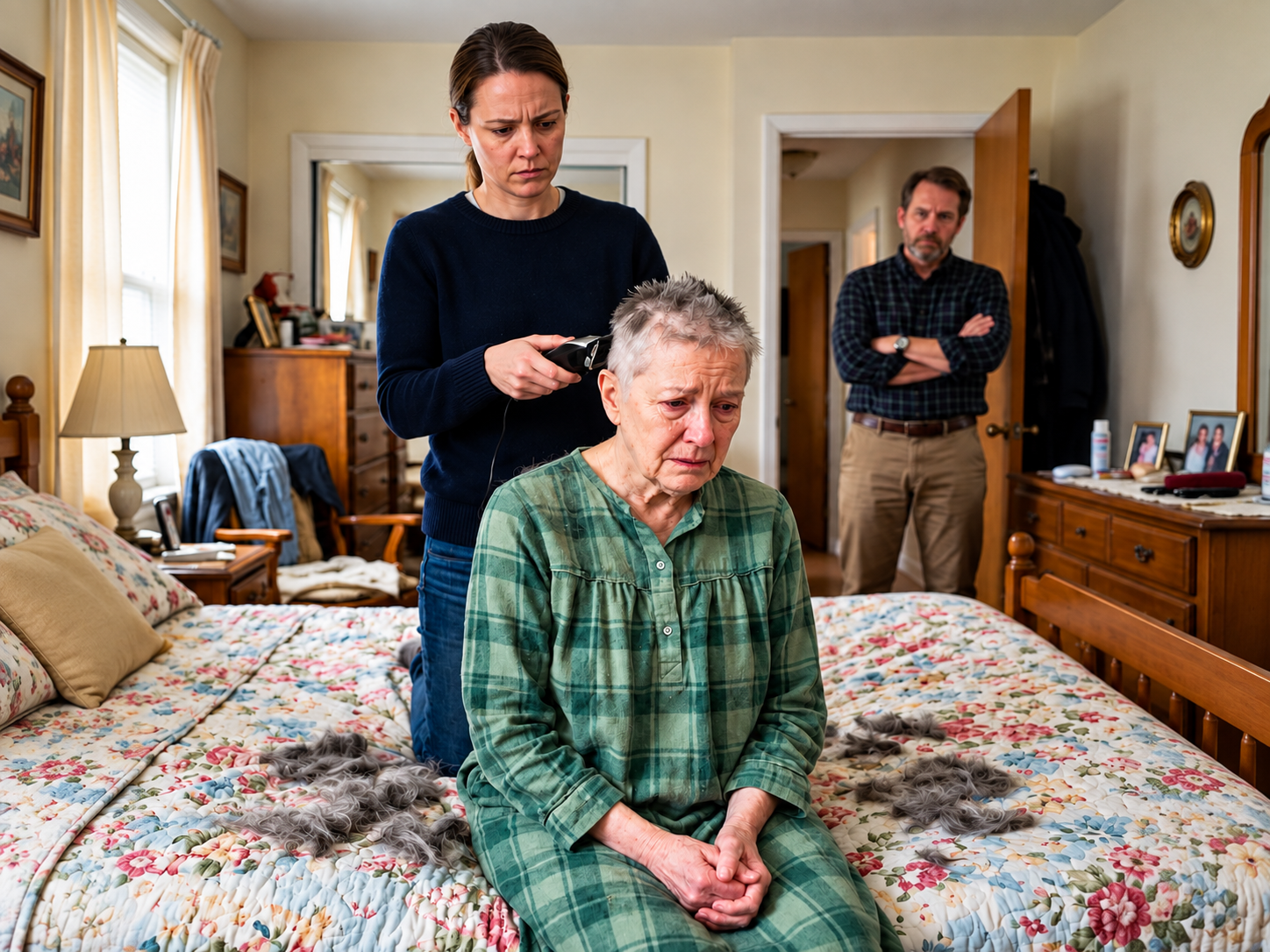
By the Time the Last Gray Hair Fell, Mara Knew Her Mother Was Hiding Something More Painful Than Fear
Part 14 of 16

