
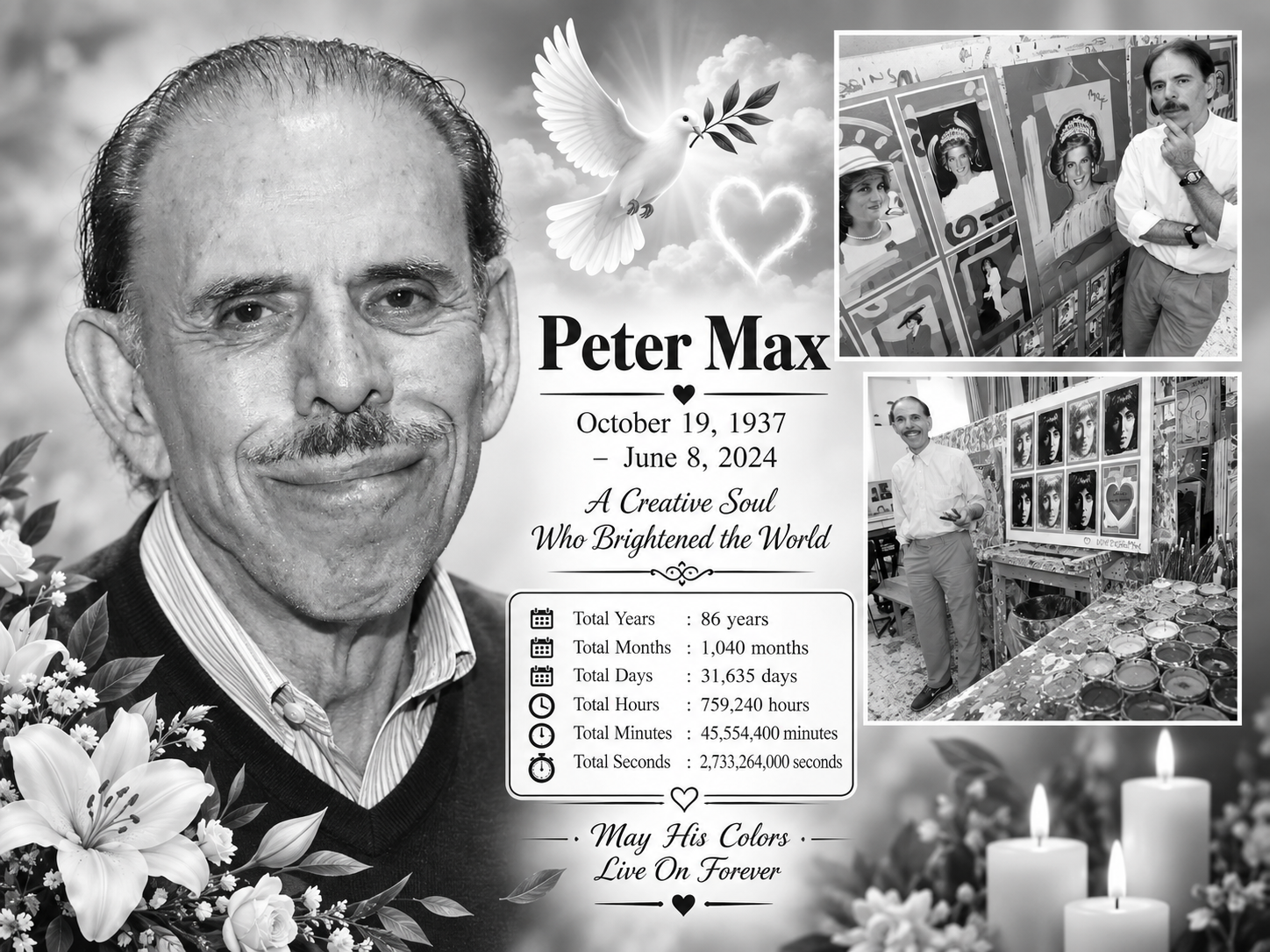
Peter Max's public image was remarkably consistent. His pictures were bright. His suns seemed to radiate outward. Faces appeared in intense colors. Flowers, stars, planets, hearts, and figures occupied fields where one color seemed to collide happily with another.
His private life did not always resemble that surface.
That contrast became increasingly visible as Max grew older. His career had brought wealth, celebrity, major commissions, and a level of recognition unusual for an artist. It had also brought complicated business arrangements, legal disputes, family tensions, and public scrutiny.
In 1997, Max pleaded guilty to tax fraud after federal authorities alleged that he had concealed more than $1 million in income from his art. He was initially sentenced to prison time, but ultimately served through a work-release arrangement, paid back taxes and a fine, and completed hundreds of hours of community service teaching art in Harlem schools. ([AP News][1])
The legal case became an unavoidable part of his biography. It did not erase his artistic achievements, but neither could it simply be ignored because his paintings were associated with optimism.
That distinction matters when looking at a public figure's life. A recognizable artistic style can create a powerful public narrative, but a human life contains decisions and consequences that do not necessarily fit the mood of the artwork.
Max continued working after the case. His name remained attached to major commissions and exhibitions, and his images continued circulating widely.
In the late 1990s and 2000s, his art reached audiences through increasingly varied channels. His work was associated with sporting events, commercial products, public projects, transportation, and large-scale celebrations. A Boeing 777 carried his imagery. A Norwegian Cruise Line ship became another enormous surface for his visual language. ([AP News][1])
The scale of the work made Max's art almost architectural. A poster could be held in two hands. A ship could carry the same visual language across oceans.
His relationship with popular culture also remained strong. He had connections with musicians and celebrities, and his portraits included prominent public figures. His subjects could range from presidents to entertainers and athletes.
One persistent point of confusion involved the Beatles' Yellow Submarine. Max was sometimes credited with the artwork associated with the film and album, but the official art direction and character design were credited to German illustrator Heinz Edelmann. Reporting has noted that Max claimed involvement in an early stage of the project, while other accounts describe his role as early consulting work rather than the completed design. ([AP News][1])
The episode illustrated something larger about Max's fame. His visual style had become so closely associated with the psychedelic era that people sometimes connected him to major works simply because they looked as though they belonged to his world.
But artistic history depends on distinctions. A resemblance in style is not the same as authorship.
Max's actual achievements were substantial enough that he did not need every famous psychedelic image to belong to him. His own career already included major public commissions, international events, postage stamps, magazine covers, portraits, environmental imagery, and museum exhibitions.
His work entered institutional collections as well. The Museum of Modern Art in New York holds seven of his works, and his art appeared in museum exhibitions internationally. ([AP News][1])
The tension between popular accessibility and institutional recognition remained part of his story. Some observers argued that his enormous popularity and commercial reach made the traditional art establishment less willing to treat him as a serious artist. Others argued that accessibility was precisely part of what made his work culturally important. The disagreement was about how art should be valued, not about whether Max had reached an enormous audience. ([Los Angeles Times][2])
Max himself did not seem interested in abandoning the broad public that had made his work famous.
His art could be understood without specialized knowledge. A viewer did not need to know the history of modernism to recognize a Max sun. A child could understand a brightly colored flower or face before knowing anything about the artist who painted it.
That accessibility was one reason his imagery continued to circulate long after the original psychedelic period had ended.
But the private side of his life became more difficult in the 2010s.
Max's second wife, Mary Max, became involved in legal disputes concerning his care, finances, artwork, and family relationships. His son Adam and others raised allegations concerning her treatment of Max and his finances, while Mary disputed those allegations and made counterclaims. The family conflict became public through court proceedings and media reports. ([AP News][1])
The disputes were complicated and deeply personal. They involved questions about who should have authority around an aging artist, what should happen to his artwork, and how his financial interests should be managed.
Max's own position was difficult to interpret from the public record because reports described him as increasingly frail.
The conflict also exposed the vulnerability that can accompany extreme longevity and fame. When an artist has accumulated decades of paintings, valuable works, contracts, licensing arrangements, and public associations, protecting the person and protecting the artistic legacy can become intertwined.
The issue was not simply who owned a painting. It was who controlled the circumstances in which the artist's work continued to be bought, sold, exhibited, or reproduced.
The family dispute continued to generate attention. In 2019, Mary Max died by suicide, shortly after the New York Times had published an article concerning the legal battles surrounding Peter Max's work. ([AP News][1])
That loss added another painful chapter to an already complicated family history.
Yet outside those private troubles, the public image of Peter Max remained remarkably bright.
That contrast could be seen in the way his work was discussed. His paintings were associated with peace, love, optimism, cosmic imagery, and vivid color. Max himself described his visual approach as avoiding negative subjects and emphasized the peaceful character he wanted his paintings to convey. ([AP News][1])
The cheerful imagery did not mean his life had been cheerful at every stage. The paintings were choices. They represented the world Max wanted to show, not a complete record of everything that had happened to him.
Perhaps that was why the colors remained so important.
Max had been born into a family forced to leave Germany. He had grown up across continents. He had watched his art become a commercial machine. He had stepped away from that machine to paint again. He had been drawn into legal problems. He had experienced family conflict. He had continued to work while his personal circumstances became increasingly difficult.
Yet the paintings kept presenting another vision.
That vision was not necessarily an argument that life was always peaceful. It was an artistic decision to keep returning to images that suggested possibility rather than destruction.
The sun could rise again on another canvas.
The Statue of Liberty could be painted again.
The stars could return.
A familiar face could be transformed into another combination of color.
This repetition became a kind of visual continuity. Max did not need to invent an entirely new universe every time he painted. He had built a vocabulary and spent decades exploring how many ways that vocabulary could be rearranged.
By the 2000s, the vocabulary was instantly recognizable. The public could see a bright cosmic composition and associate it with Max before reading the signature.
That recognition was both an accomplishment and a limitation.
For many viewers, the name Peter Max meant the 1960s. But the man had continued living and working long after the decade ended.
His later career therefore became a negotiation with his own legend. He was the artist of the Summer of Love, but he was also the older painter working decades afterward. He was the creator of psychedelic imagery, but he was also the man who painted presidents, sports events, environmental messages, Liberty, and public commissions.
His life could not be frozen at the moment his work first became famous.
The same was true of his family.
His first marriage to Elizabeth Nance ended in divorce. He later married Mary Max. His surviving children were his son Adam and daughter Libra Astro. ([AP News][1])
By the final decade of his life, the person behind the famous images was becoming increasingly vulnerable.
The problem was no longer whether the public remembered Peter Max.
It was whether Peter Max could still fully participate in the life that had made his name unforgettable.
Click Here to continue read next: PART7: As His Memory Faded, the Artist Behind the Rainbow World Became Harder to Reach, While the Work Around Him Continued Speaking Without Him
Before the Colors Became Famous, a Child Escaped a Dangerous Europe and Carried a Memory of the World Into His Art
Part 6 of 16

