
Peter Max's later years brought a painful contrast to the public image that had defined much of his career. For decades, his name had been associated with movement, color, constant production, and an almost overflowing visual imagination. His studio biography presented a life filled with paintings, public commissions, exhibitions, products, and recurring subjects. But age eventually introduced a limitation that no artistic technique could simply overcome.
Max had continued to be associated with his recognizable imagery well into the twenty-first century. His work remained visible in exhibitions, galleries, collections, and licensed reproductions. New generations could encounter the same bright colors that had first become famous decades earlier, even if they had no personal connection to the 1960s.
That was part of the unusual durability of his career. The cultural moment that had produced his earliest fame disappeared, but the imagery did not. The visual language survived the era that had made it famous.
Max's influence was therefore not limited to one generation. His work could be encountered by people who had been alive during the Summer of Love and by younger viewers who knew the imagery only through later exhibitions, reproductions, or popular culture.
The artist himself, however, was becoming increasingly distant from the active career represented by those images. Reports in the final years described his health as deteriorating, and sources reported that he had been suffering from advanced dementia. The condition affected the later part of his life and was an important reason his ability to continue painting declined. ([AP News][7])
That distinction matters when describing his death. Peter Max died on September 14, 2026, at a hospital in New York City, at the age of 88. His family confirmed his death through statements reported by major news organizations. ([AP News][7])
The cause of death, however, should not be stated more precisely than the available reporting allows. The Los Angeles Times reported that no cause of death was provided, while the Associated Press reported that Max had been suffering from advanced dementia. Some obituary reporting has described his long illness, but the available reliable reports do not establish dementia as an officially announced cause of death. ([Los Angeles Times][8])
His death closed a career that had begun before the Second World War and stretched across almost nine decades of changing American culture. He had lived through the rise of television, the space race, the counterculture, the expansion of mass advertising, the transformation of New York, the fall of the Berlin Wall, the digital age, and the enormous globalization of popular imagery.
Yet his work remained recognizably rooted in something older: the simple power of a vivid image.
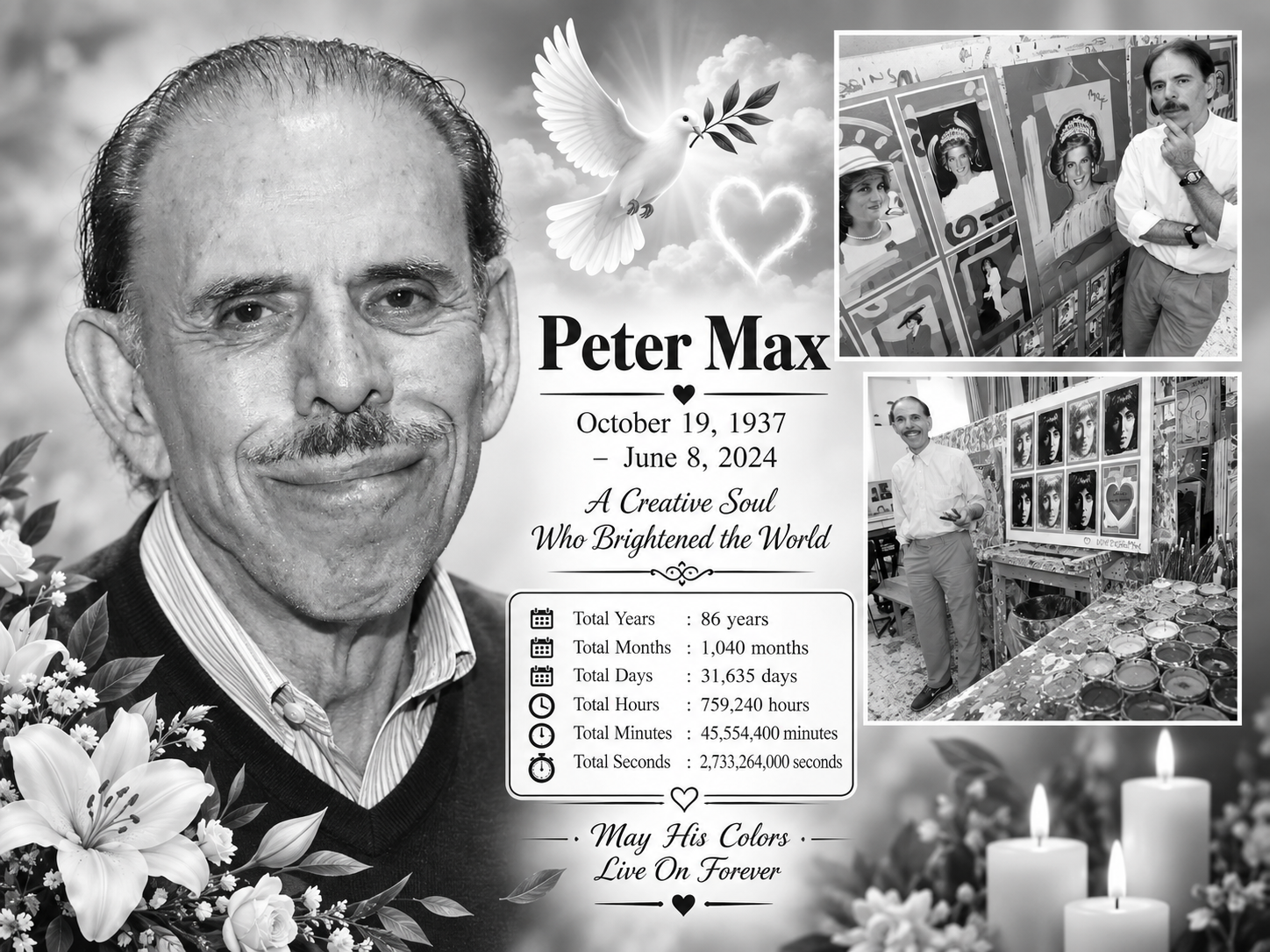
The photograph of Max in the supplied image shows an older man with a thin mustache, receding hair, and a slight smile. Beside the portrait are photographs from his studio, surrounded by canvases crowded with faces and saturated color. The contrast is striking. The man appears physically still, while the painted surfaces around him seem to move in every direction.
That studio environment was an appropriate setting for an artist whose career had always been difficult to separate from the physical act of making images. Paint was not simply an ingredient in his work. It was part of the visual identity associated with him.
His best-known imagery had an unmistakable vocabulary: radiant suns, cosmic backgrounds, flowers, hearts, figures, faces, stars, sweeping lines, and intense colors. Those elements could be rearranged endlessly without losing their connection to Max's name.
Among the recurring subjects was the Statue of Liberty. He began his annual Liberty painting tradition in 1976 after returning from a White House celebration connected with the American Bicentennial. Ten years later, he became involved in the campaign surrounding the monument's restoration. In 1981, he painted six enormous Liberty paintings at the White House. ([Peter Max Studio][1])
Those episodes reveal why Liberty became more than another recognizable image in his catalog. For Max, immigration was not an abstract historical subject. His family had fled Nazi Germany when he was a baby. He spent formative years in Shanghai and Israel before reaching the United States at sixteen.
His biography therefore contained a physical journey that paralleled one of the central ideas represented by the Statue of Liberty: arrival.
Another thread ran through his work from childhood onward—space. His fascination with astronomy began when he was young, and cosmic imagery later became one of the defining elements of his art. In 1969, the year humans first landed on the moon, Max produced commemorative posters connected to Apollo 11. ([Peter Max Studio][1])
The cosmic imagery was not merely a fashionable feature of psychedelic design. It had roots in a lifelong fascination. The stars that appeared in his mature work were connected to a curiosity that had begun before he became famous.
His career also demonstrates how an artist can influence culture without remaining inside the conventional boundaries of a museum. Max's images appeared on products, magazines, posters, postage stamps, aircraft, ships, sporting events, music-related projects, and public installations. His art reached people who might never have entered a gallery. ([People.com][6])
That accessibility was one of the defining facts of his career. A person did not need to know the terminology of Pop Art or psychedelic design to understand a bright sun, a smiling face, a heart, a rainbow, or a field of stars.
But there was a cost to becoming so recognizable. Once an artist's vocabulary becomes a commercial language, it can begin to appear everywhere independently of the artist. Products can outlive exhibitions. Posters can survive their creators. A symbol can become familiar even when the history behind it has been forgotten.
Peter Max's work crossed that boundary.
His name became attached not only to individual paintings but to a visual era. He was repeatedly described as one of the artists who helped define the psychedelic look of the 1960s. His work became part of the visual memory of the counterculture even as his later career moved into different territory. ([Reuters][5])
His life also contained contradictions that make a simple celebration incomplete. There was enormous commercial success alongside artistic retreat. There were public honors alongside legal troubles. There was cultural fame alongside a later struggle with dementia. There was an image of endless color alongside the physical decline that eventually limited his ability to create.
Those contradictions do not cancel one another. They are part of the same biography.
By the time Max died in Manhattan on September 14, 2026, the public could already look back across an enormous body of work. His exact cause of death had not been publicly established in the reliable reports available at the time, but his long struggle with advanced dementia had been reported by the Associated Press. He was 88. ([AP News][7])
His children, Adam and Libra, remained part of the family story reported after his death. His second wife, Mary Max, had died in 2019, and her death had been followed by legal disputes connected to his estate and personal affairs. Those later difficulties formed a much more complicated background than the cheerful public imagery associated with Max's paintings. ([AP News][7])
Still, the paintings remained.
The child who escaped Berlin had become the artist who painted America. The teenager who arrived in New York had turned the city's visual energy into a career. The student of realism had moved toward abstraction and psychedelic design. The designer who watched his work spread onto consumer products had retreated to the studio and rediscovered large brushes. The artist fascinated by astronomy had painted the moon, stars, planets, and cosmic figures for generations.
And the man who spent decades painting the Statue of Liberty had ultimately become part of the cultural history of the country he entered as a sixteen-year-old immigrant.
His life therefore cannot be reduced to the phrase “psychedelic artist.” That description explains an important chapter, but not the whole journey. It does not contain the refugee child in Shanghai, the student drawing anatomy in New York, the designer working beside Tom Daly, the artist appearing on national television, the painter making public commissions, the advocate for the Statue of Liberty, or the older man whose memory was gradually being lost while his images remained recognizable.
Peter Max died, but the circumstances of his death did not erase the complexity of his life. The exact medical cause was not publicly disclosed in the most authoritative reports available immediately after his death. What was documented was his age, the date and place of his death, and the advanced dementia that had marked his final years. ([AP News][7])
The final irony was quiet. Max had spent his career making images that were almost impossible to forget.
In his last years, forgetting became part of his own story.
Click Here to continue read next: PART5: When the World Put His Colors on Everything, Peter Max Had to Decide Whether Fame Was Helping His Art or Slowly Replacing It
Before the Colors Became Famous, a Child Escaped a Dangerous Europe and Carried a Memory of the World Into His Art
Part 4 of 16

