
The later years of Peter Max's life introduced a cruel reversal.
For decades, his work had depended on recognition. A viewer saw the colors and knew the name. A collector recognized a signature. A magazine recognized a visual language. A public event knew exactly what a Peter Max image could communicate.
Now the artist himself was becoming less able to participate in that world.
Reports in the final period of his life described Max as suffering from advanced dementia. The condition became a major part of the story surrounding his death, although it was not publicly given as an official cause of death. The Associated Press reported that no cause was provided when his son announced that Max had died. ([AP News][1])
The distinction is important.
Peter Max died on September 14, 2026, at a Manhattan hospital, according to reporting based on a statement from his son Adam. He was 88. Reliable reports available immediately afterward did not provide a specific medical cause of death. What they did report was his advanced dementia. ([AP News][1])
That final uncertainty should remain part of the record rather than being replaced by speculation.
His death came after a life that had crossed nearly every major cultural boundary of modern American visual art.
He had entered the United States as a teenager. He had studied art seriously. He had worked in graphic design. He had helped shape the visual atmosphere of the 1960s. He had become a commercial phenomenon. He had withdrawn from that commercial success because he wanted to paint again. He had returned to public life through enormous commissions.
He had painted America.
He had painted the cosmos.
He had painted famous faces.
He had painted the Statue of Liberty again and again.
He had painted the Berlin Wall.
He had painted for international sporting events.
He had put his imagery on objects that millions of people could encounter without ever visiting a gallery.
And eventually, he reached a point where the paintings could remain visible even as the artist's own ability to remember and work declined.
That separation between creator and creation is one of the most difficult aspects of his final story.
Art does not age in precisely the same way a person does.
A painting can remain intact in a museum while its creator becomes elderly. A poster can remain bright after the person who designed it has forgotten the circumstances in which it was made. A photograph can preserve a face even after the person in it is gone.
Max had created thousands of images capable of surviving him.
His son Adam's statement after his death reflected that distinction. The family would remember Max's creativity, warmth, curiosity, and the way he saw beauty and possibility, but the statement also separated the public artist from the private father. The paintings belonged to American culture; the person belonged to his family. ([AP News][1])
That difference is easy to miss when a celebrity becomes inseparable from a visual brand.
Peter Max had become a brand.
The name appeared alongside colors, shapes, and recurring symbols. His signature could function almost like a logo. Yet the person behind the signature had once been a child in Berlin, a boy in Shanghai, a teenager arriving in New York, and a student learning anatomy.
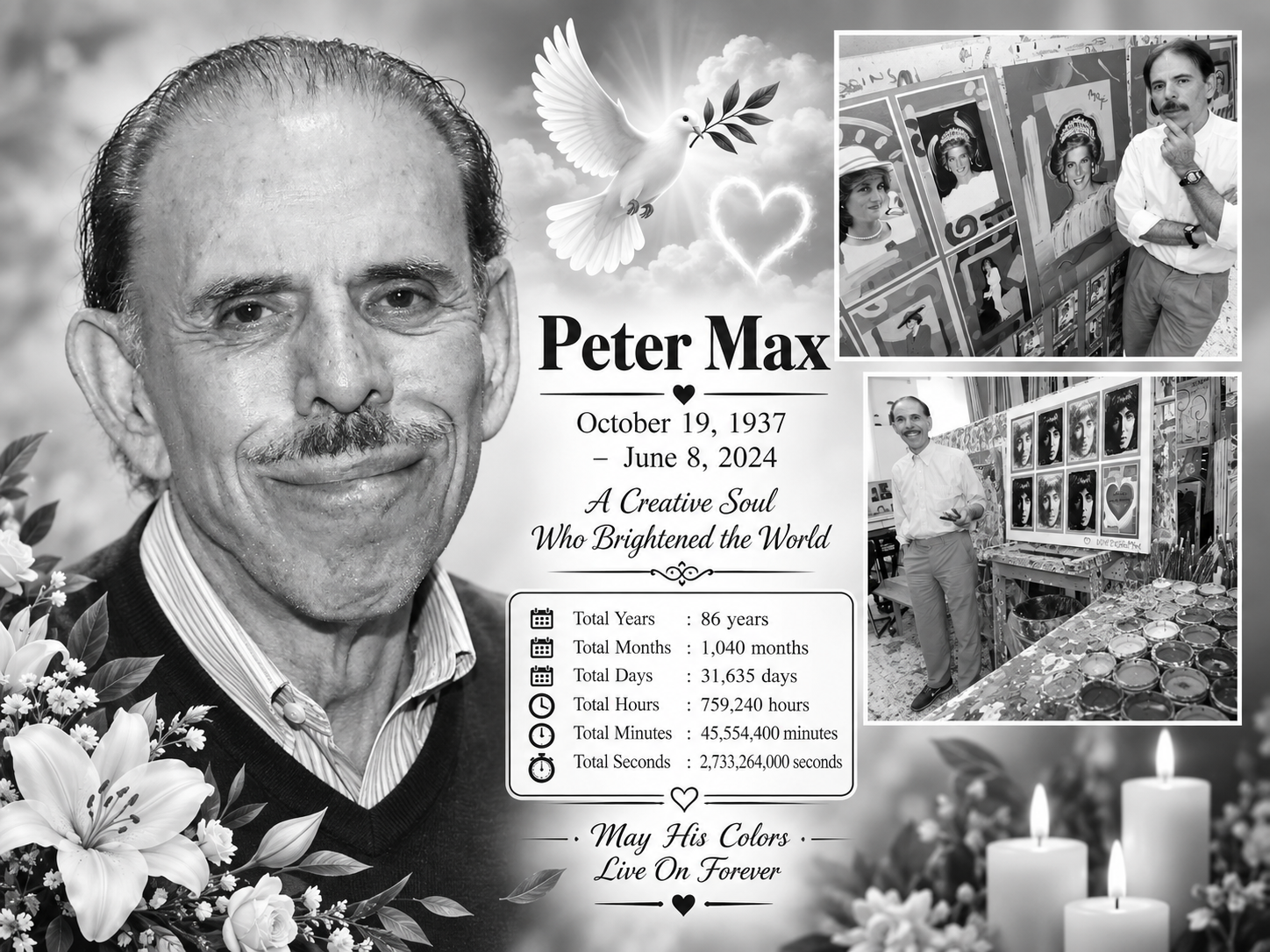
The image in the supplied photograph captures the later man, not the child.
He has an older face and a slight smile. The photographs surrounding him show paintings and studio scenes. The colors behind the portrait appear almost to belong to another world.
That visual contrast summarizes a central tension in his biography.
The public saw an artist whose work seemed to overflow with energy.
The private reality of old age was increasingly constrained.
The distance between those two images grew larger as Max's dementia advanced.
Yet the historical importance of his work did not depend on his final years.
His cultural influence had already been established decades earlier.
His 1969 Life magazine cover had announced him as a major cultural figure. His psychedelic imagery had become part of the visual identity of the late 1960s. His work had spread through mass-market products, making his style familiar to people who might never have known the names of the movements in which art historians placed him. ([AP News][1])
His later projects demonstrated that he had not simply remained trapped in that era.
He became associated with the Olympics, Super Bowl, World Series, Kentucky Derby, Indianapolis 500, World Cup, and other major events. His work appeared on aircraft and cruise ships. His portraits extended across generations of public figures. ([AP News][1])
The scale of that output also explains why Max could not easily be described as a single-period artist.
The psychedelic 1960s made him famous, but the rest of his life was spent negotiating what that fame meant.
He could have simply repeated the style indefinitely.
Instead, he returned to painting, developed large-scale works, pursued public commissions, and maintained recurring subjects that allowed him to explore different meanings over time.
Liberty changed because America changed.
The world changed because the Cold War ended.
The Berlin Wall changed from a symbol of division into a piece of history.
Environmental awareness became increasingly important.
Major sporting events became global television spectacles.
Popular culture became more saturated with visual imagery.
Through all of those changes, Max's work retained its distinctive vocabulary.
That durability was partly because the images were simple enough to travel.
A sun did not require translation.
A heart did not require a long explanation.
A face could be recognized in almost any country.
A rainbow could communicate through color before words entered the conversation.
Max's international background may have helped him understand the power of visual symbols. He had lived in several cultures before adulthood. He had encountered American culture from a distance before arriving in New York. He knew that images could cross boundaries more easily than language.
His art often behaved that way.
The visual language could move from a poster in a dormitory to a postage stamp, from a museum wall to a ship, from a presidential event to a commercial object.
That movement was not accidental.
It was part of what Max had become.
His interest in spirituality also remained an important part of the story. He had developed a relationship with Swami Satchidananda Saraswati and helped introduce the teacher to American audiences. Max's interest in yoga and Eastern spirituality influenced how he thought about creativity and consciousness. ([AP News][1])
The influence fit with his lifelong fascination with the universe.
Astronomy gave him images of vast physical space.
Spirituality gave him another way to think about the connection between individual consciousness and something larger.
Art gave him a way to combine both.
That combination helps explain why his pictures so often looked expansive. The figures were not always confined by realistic space. They floated, repeated, overlapped, and merged into backgrounds that suggested planets, stars, or endless color.
For someone who had crossed continents as a child, perhaps movement was never simply movement.
It was part of his biography.
Berlin to Shanghai.
Shanghai to other parts of Asia and Israel.
Israel to Europe.
Europe to New York.
Graphic design to painting.
Commercial work to private painting.
The 1960s to the 1970s.
The 1970s to the 1980s.
The twentieth century to the twenty-first.
Each stage changed the circumstances without entirely erasing what had come before.
That continuity became especially meaningful after his death.
Max could no longer create a new image.
He could no longer decide which new commission to accept.
He could no longer repaint Liberty or add another cosmic figure to a canvas.
But the existing work remained available for viewers to interpret.
The question of what would happen to that enormous legacy therefore became more important.
His children survived him, and his artwork remained part of collections, galleries, museums, archives, and private holdings. The family history surrounding his art had already demonstrated how complicated stewardship could become.
A legacy is not simply a pile of paintings.
It includes ownership, provenance, reproduction rights, exhibitions, conservation, family decisions, public memory, and historical interpretation.
Max's career contained all of those issues.
The artist who had once complained that commercial success had taken him away from painting had eventually created an enormous body of work that could no longer depend on his physical presence.
That was the final reversal.
At the beginning of his career, he needed the public to notice his images.
At the end, the images no longer needed him to stand beside them.
Click Here to continue read next: PART8: The Man Was Gone, the Memory Was Fragile, but the Images Remained—Leaving a Final Portrait of an Artist Who Turned Migration Into Color
Before the Colors Became Famous, a Child Escaped a Dangerous Europe and Carried a Memory of the World Into His Art
Part 7 of 16

