
The letter was discovered because Clara dropped a pencil.
It rolled beneath Daniel's old desk, which had been moved into the study after Elena decided the living room needed more space. Mateo bent down to retrieve it and noticed a narrow strip of paper caught against the baseboard.
At first he thought it was a receipt.
Then he saw Daniel's handwriting.
He pulled the paper free.
There was no envelope.
Only one sentence.
I chose to stay.
Mateo stared at it.
Elena was asleep upstairs.
Rosa was preparing dinner.
Nobody knew about the paper.
Mateo read the sentence again.
I chose to stay.
It was dated two days before Daniel died.
The date made his stomach tighten.
For years, the family had assumed Daniel's final days had been controlled by illness and fear. He had tried to protect everyone. He had believed time was running out.
But this sentence suggested something different.
He had been offered a choice.
Mateo carried the paper into the kitchen.
Rosa looked up.
"What is that?"
"I found it under the desk."
She read it.
Her expression changed.
"I've never seen this."
"Neither have I."
She sat down.
"Maybe it's nothing."
Mateo nodded.
"Maybe."
They asked Elena when she woke.
She looked at the paper.
Then closed her eyes.
"I remember."
Mateo waited.
"What?"
"The hospital wanted him transferred."
"Transferred where?"
"To another city."
Rosa stared.
"Why didn't you tell me?"
"Because he refused."
Mateo looked at the sentence.
"I chose to stay."
Elena nodded.
"He didn't want to leave."
"Why?"
"He said he wanted to see you."
Rosa began crying.
"You never told me."
"I didn't know how."
Mateo sat beside her.
"What did he say?"
Elena remembered.
"He told me he had spent his life moving toward the next thing. Another job. Another house. Another responsibility. He said he didn't want his final days to become another journey everyone else had to manage."
Mateo felt tears forming.
"So he stayed."
"Yes."
"Was that why he died?"
Elena shook her head.
"No one can say that."
The distinction mattered.
The medical decision had been complicated.
His illness was already severe.
Transfer might have offered additional treatment, but there was no guarantee it would have changed the outcome.
Daniel had chosen comfort and family instead.
Mateo looked at the paper.
"He wanted to be home."
"Yes."
Rosa wiped her eyes.
"Why did you keep that from me?"
Elena looked at her daughter.
"Because you were angry."
"I was devastated."
"I know."
"I thought you should have told me."
"I should have."
The admission ended the argument before it began.
Mateo folded the paper.
"We need to keep this with the archive."
Rosa looked surprised.
"Why?"
"Because it's part of the story."
Elena smiled.
"Not everything belongs in an archive."
"Why not?"
"Because some things belong in families."
Mateo understood.
He had become so accustomed to preserving records that he sometimes forgot the difference between evidence and memory.
A court needed evidence.
A family needed stories.
The next week, Mateo gathered the family.
He placed Daniel's photographs across the table.
They began recording memories.
Not official interviews.
Just conversations.
Rosa talked about Daniel's terrible cooking.
Sofia remembered his habit of pretending not to understand modern slang.
Elena described the first time she met him.
Mateo remembered the bicycle.
Clara asked questions.
"Did Grandpa like chocolate?"
"Too much," Elena said.
"Did he like cats?"
"Yes."
"Did he like dogs?"
"Also yes."
"Did he like me?"
Mateo smiled.
"He would have adored you."
Clara seemed pleased.
The recording continued.
Nobody discussed the investigation for nearly an hour.
That was deliberate.
The family was building a different kind of archive.
A record of ordinary life.
Afterward, Mateo listened to the recording alone.
He realized that this was the part of Daniel's story that had almost disappeared.
The man had become an event.
His family was turning him back into a person.
A month later, the environmental center asked Mateo whether they could host an exhibit about Daniel's life.
Mateo agreed, but with conditions.
"No heroic language."
The curator smiled.
"Understood."
"No claims that aren't supported."
"Of course."
"And include his mistakes."
The curator paused.
"Are you sure?"
"Yes."
They displayed his environmental work alongside photographs of his family life.
One caption explained that Daniel had sometimes withheld information from people he loved because he believed secrecy would protect them.
Another noted that his family later came to understand the cost of that choice.
The exhibit became unexpectedly popular.
Visitors were less interested in the scandal than Mateo expected.
They wanted to know how ordinary people could notice problems and document them responsibly.
Teachers brought students.
Families came together.
Some visitors left notes.
Thank you for telling the complicated version.
Another read:
My father kept secrets too. I understand this differently now.
Mateo read them quietly.
He did not answer.
He didn't need to.
One afternoon, a young woman approached him.
"Are you Daniel's grandson?"
"Yes."
"My mother lived near the plant."
Mateo listened.
She told him that her family had been among those who struggled to explain strange water problems years earlier.
"We thought nobody believed us."
Mateo nodded.
"Your family was documented in his records."
She began crying.
"He wrote our name down?"
"Yes."
"Why?"
"Because he believed your experience mattered."
She thanked him.
After she left, Mateo stood outside.
The maple leaves moved in the wind.
He thought about the notebook.
The names.
The dates.
The complaints.
The people Daniel had never met well enough to remember personally.
He had written their names anyway.
That was perhaps his greatest strength.
Not that he always knew what to do.
That he paid attention.
That evening, Mateo returned home.
Elena was waiting on the porch.
She held the small paper.
The sentence had been placed inside a clear sleeve.
"I thought you might want this."
Mateo sat beside her.
"I think it belongs to you."
"No."
"Why?"
"Because you found it."
She smiled.
"Then keep it."
He looked at the sentence.
I chose to stay.
"Grandma?"
"Yes?"
"Do you think he regretted it?"
Elena considered the question.
"I don't know."
Mateo nodded.
"That's honest."
"Yes."
"I think that's enough."
She leaned back.
"I think so too."
They watched the street.
A bicycle passed.
A dog barked behind a fence.
Someone turned on porch lights across the road.
Ordinary sounds.
Ordinary evening.
Mateo folded the paper carefully.
He did not need to know whether Daniel's final decision had been right.
He only needed to understand that it had been his.
That was the dignity his grandfather deserved.
And perhaps the dignity everyone deserved.
Click Here to continue read next: PART15: Clara’s Question About Daniel’s Last Days Opened a Conversation Mateo Had Avoided, and Elena Finally Told Her Granddaughter the Truth Without Softening It
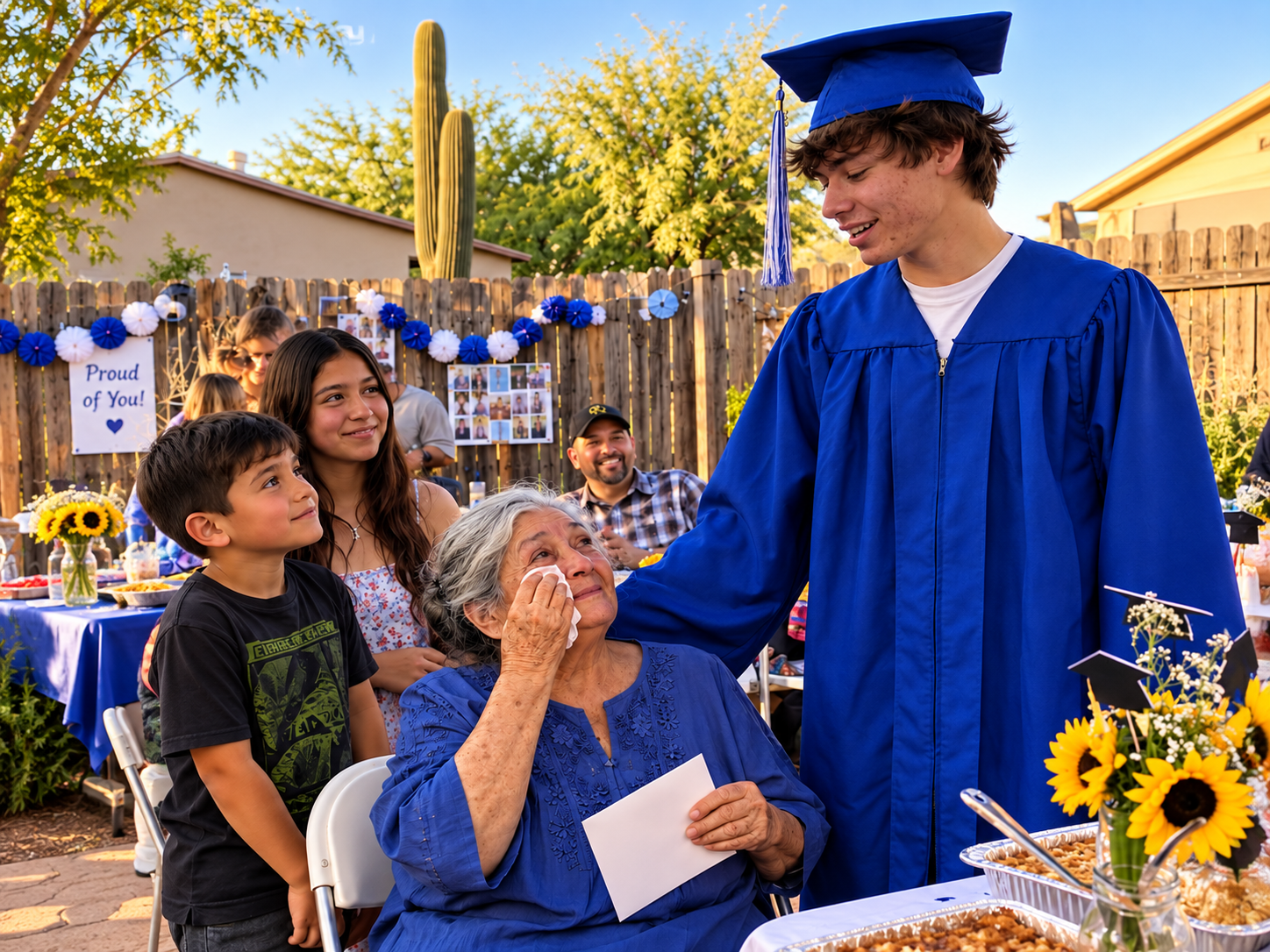
Everyone Was Smiling Until Grandma Opened the Envelope, Read the First Line, and Realized Her Grandson Had Hidden Something Much Bigger Than Graduation
Part 14 of 16

