
NOTE: This final part delivers the emotional resolution, closes the remaining family questions, and shows how the narrator chooses to preserve the truth without allowing old fear and secrecy to shape the next generation.
My son was sixteen when he finally asked me the question I had been expecting for years.
We were sitting in the kitchen.
The same kitchen.
The same windows.
The same doorway.
But almost nothing else was the same.
He was taller than me now.
His childhood photographs were framed along the hallway.
His old high chair had been given away years earlier.
The birthday cake stand still sat in the cabinet.
He looked at it.
Then he looked at me.
“Mom?”
“Yes?”
“Why do you keep that?”
I knew what he meant.
The cake stand.
I took it from the cabinet.
“Because of your third birthday.”
He frowned.
“Something happened.”
“Yes.”
“What?”
I sat down.
He pulled out the chair opposite me.
“Tell me.”
So I did.
Not every frightening detail.
Not the parts that belonged in police reports.
Not the moments that would have made a child imagine danger where there was none.
I told him the truth.
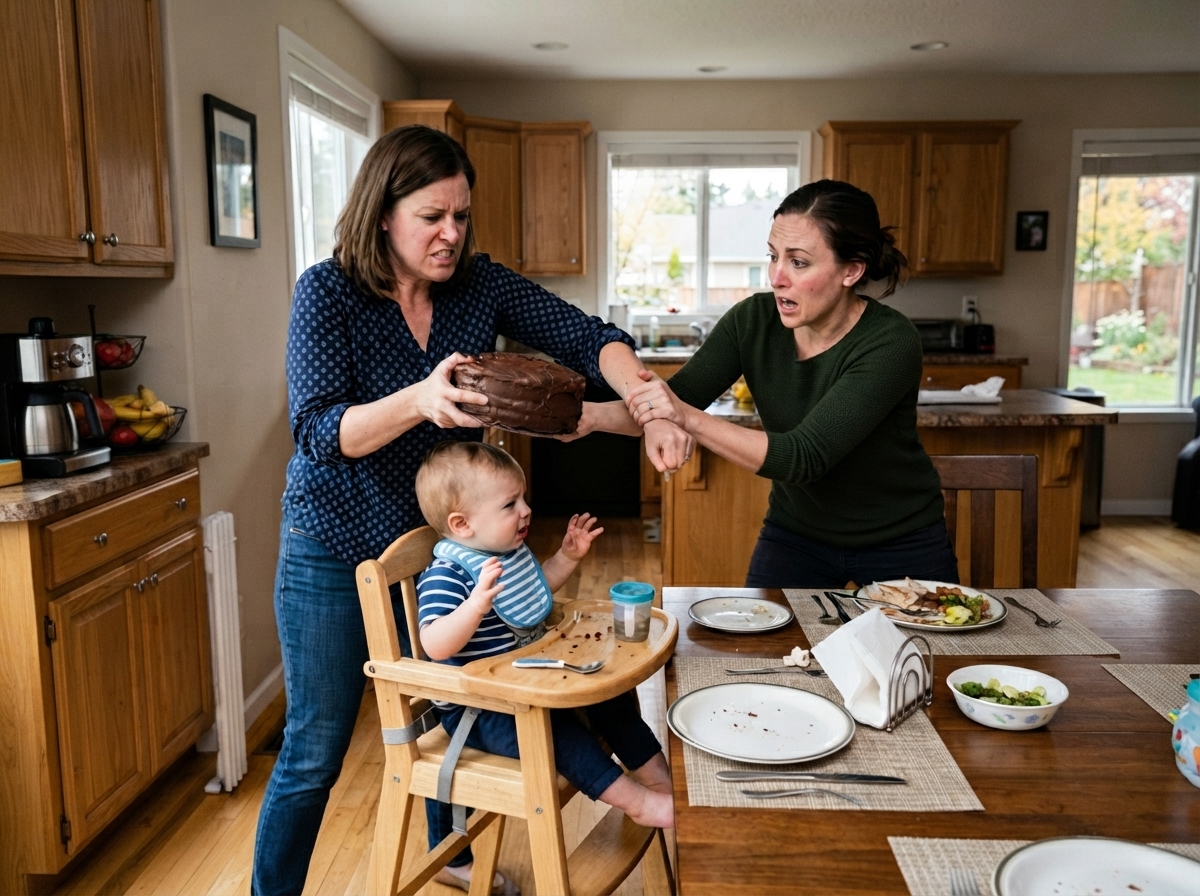
His aunt had believed the cake had been tampered with.
There had been a family secret involving the house.
A man named Lucas had been investigating old wrongdoing.
Another man named Victor had tried to control the evidence.
His grandfather had hidden documents because he was afraid.
His grandmother had kept silent because she believed secrecy would protect the family.
The truth had eventually come out.
My son listened without interrupting.
When I finished, he asked:
“Was I ever in danger?”
I thought carefully.
“There were moments when we weren't sure.”
“But the cake wasn't poisoned?”
“No.”
“Then Aunt Emma was wrong?”
“She was wrong about some things.”
“But she was trying to protect me.”
“Yes.”
He looked at the cake stand.
“Why didn't everyone just tell the truth?”
I smiled sadly.
“That is what we spent years learning.”
He thought about it.
“Were you angry?”
“Yes.”
“At Grandpa?”
“Yes.”
“Do you still love him?”
“Yes.”
That surprised him.
“How?”
“Because love doesn't require pretending someone was perfect.”
He nodded.
“Did you forgive him?”
“I forgave myself first.”
“For what?”
“For loving someone whose choices I disagreed with.”
He was quiet.
Then he asked:
“Did you forgive Grandma?”
I looked toward the window.
“Eventually.”
“Why?”
“Because she admitted what she did.”
“That was enough?”
“No.”
“What else?”
“She stopped hiding.”
That answer seemed to satisfy him.
He stood.
Then he hugged me.
“You should have told me sooner.”
I smiled.
“I know.”
“But you told me when I was ready.”
“Yes.”
He nodded.
“That matters.”
It did.
That was the lesson our family had learned the hard way.
Truth should not be used as a weapon.
It should not be hidden as a weapon either.
It should be given with care.
Over the years, the family archive grew.
Lucas's family added photographs.
Emma added Michael's notes.
My mother added letters.
I added my father's notebook.
My son eventually added his own account of the birthday.
He wrote only a few pages.
He remembered the cake.
He remembered being carried upstairs.
He remembered everyone looking frightened.
Then he wrote:
“I don't remember the fear. I remember that my family stayed together.”
I cried when I read it.
Because that was exactly what I wanted him to remember.
Not the danger.
Not the secrets.
The choice afterward.
We had chosen to stay.
We had chosen to talk.
We had chosen to tell the truth.
Victor's legal case eventually ended.
He was held accountable for the recent crimes that could be proven.
The older history remained part of the official record, even where prosecution was no longer possible.
Lucas moved away.
He built a quiet life.
We remained in occasional contact.
There was no dramatic friendship.
There didn't need to be.
He had been part of the story.
He had apologized.
We had accepted the apology without pretending the fear he caused never happened.
That was enough.
My mother grew older.
She eventually asked me to bring her the family archive.
She wanted to read everything.
We spent several afternoons going through the documents together.
Sometimes she cried.
Sometimes she laughed.
Sometimes she simply stared at photographs.
One afternoon, she held the picture of my father with Lucas.
“I wish he had told me everything.”
“So do I.”
“Maybe we could have done things differently.”
“Maybe.”
She nodded.
“But we can't know.”
“No.”
She looked at me.
“That used to frighten me.”
“What does it feel like now?”
“Peaceful.”
I understood.
Uncertainty had once terrified us because we believed uncertainty required immediate control.
Now we knew that sometimes uncertainty simply meant we didn't have an answer.
And that was okay.
Years later, when my son became a father himself, the meaning of the old birthday changed again.
He brought his daughter to our house.
She was small.
Curious.
Always reaching for things she wasn't supposed to touch.
One afternoon, she crawled toward the kitchen table.
I laughed.
“She has your personality.”
My son smiled.
“She has yours.”
His wife brought out a birthday cake.
Chocolate.
I stared at it.
My son noticed.
“You okay?”
“Yes.”
“You're thinking about the old cake.”
“I am.”
He laughed.
“That story is going to follow us forever.”
“Only because you keep telling it.”
“You're the one who wrote it down.”
“Fair.”
His daughter reached toward the frosting.
Everyone laughed.
Nobody panicked.
Nobody grabbed the cake.
Nobody looked toward the door.
It was simply a birthday.
And that ordinary moment meant more to me than I could explain.
The family had changed.
We had learned that fear could make people control things.
We had learned that secrets could survive longer than their creators.
We had learned that protecting someone without allowing them to know the truth could become another kind of harm.
Most importantly, we had learned that people could repair relationships without pretending nothing had happened.
My sister Emma and I became closer.
Not because we forgot the birthday.
Because we talked about it.
She apologized.
I forgave her.
Not immediately.
Not perfectly.
But genuinely.
My mother and I repaired our relationship too.
There were things she could never undo.
There were years she could never give back.
But she stopped asking me to protect her from the consequences of her decisions.
That changed everything.
The house itself became part of our family history.
We never sold it.
Not because we were afraid of losing it.
Because we wanted to remember what it represented.
At the entrance, we placed a small framed photograph.
Not of the birthday.
Not of Victor.
Not of the documents.
A photograph of the family around the table years later.
Everyone smiling.
The frame had one sentence beneath it:
“Truth is part of the family too.”
My son once asked why we kept that photograph there.
I told him:
“Because people forget what they don't practice.”
He understood.
We practiced honesty.
We practiced apologies.
We practiced boundaries.
We practiced remembering without living inside the past.
That was how the story ended.
Not with a courtroom.
Not with an arrest.
Not with a secret box.
With an ordinary family learning how to speak.
Sometimes I still think about the moment Emma reached for the cake.
If she hadn't, my son might have eaten it.
If Lucas hadn't marked it, perhaps we would never have searched the house.
If my mother had told me everything years earlier, perhaps the entire conflict would have ended sooner.
If my father had trusted the truth, perhaps none of it would have happened.
There are endless versions of the past.
But only one actually happened.
We could not change it.
We could only decide what happened next.
That became the most important lesson.
The past wasn't an inheritance we had to accept unchanged.
It was something we could examine.
Question.
Understand.
And finally put down.
One evening, long after everyone had gone home, I stood alone in the kitchen.
The cake stand was still in the cabinet.
I took it out.
I washed it.
Then I placed it on the table.
For years, that object had represented fear.
Now it represented something else.
A moment when a family discovered that silence could no longer protect anyone.
A moment when people finally had to choose honesty.
I looked through the doorway toward the living room.
My granddaughter was asleep on the couch.
My son was carrying her upstairs.
His wife followed.
Their voices were soft.
Normal.
Warm.
I smiled.
That was the ending I had wanted all along.
Not perfection.
Not a family untouched by mistakes.
Just a family that no longer needed secrets to hold itself together.
I put the cake stand back in the cabinet.
Then I turned off the kitchen light.
The house was quiet.
But this time, quiet did not mean someone was hiding something.
It meant everyone was safe.
And as I walked upstairs, I realized that the greatest thing we had recovered was never the property, the documents, or the money.
It was the freedom to tell the truth without being afraid of what it would destroy.
Because once the truth was finally spoken, we discovered something none of us had understood before.
It had not destroyed our family.
The secrets had nearly done that.
The truth was what gave us a chance to become one again.
The End
Read more original stories on Feel Every Story.
The Birthday Cake Was Still Warm When My Sister Tried to Take It Away, and the Reason She Gave Me Made Everyone at the Table Go Silent
Part 8 of 8

