
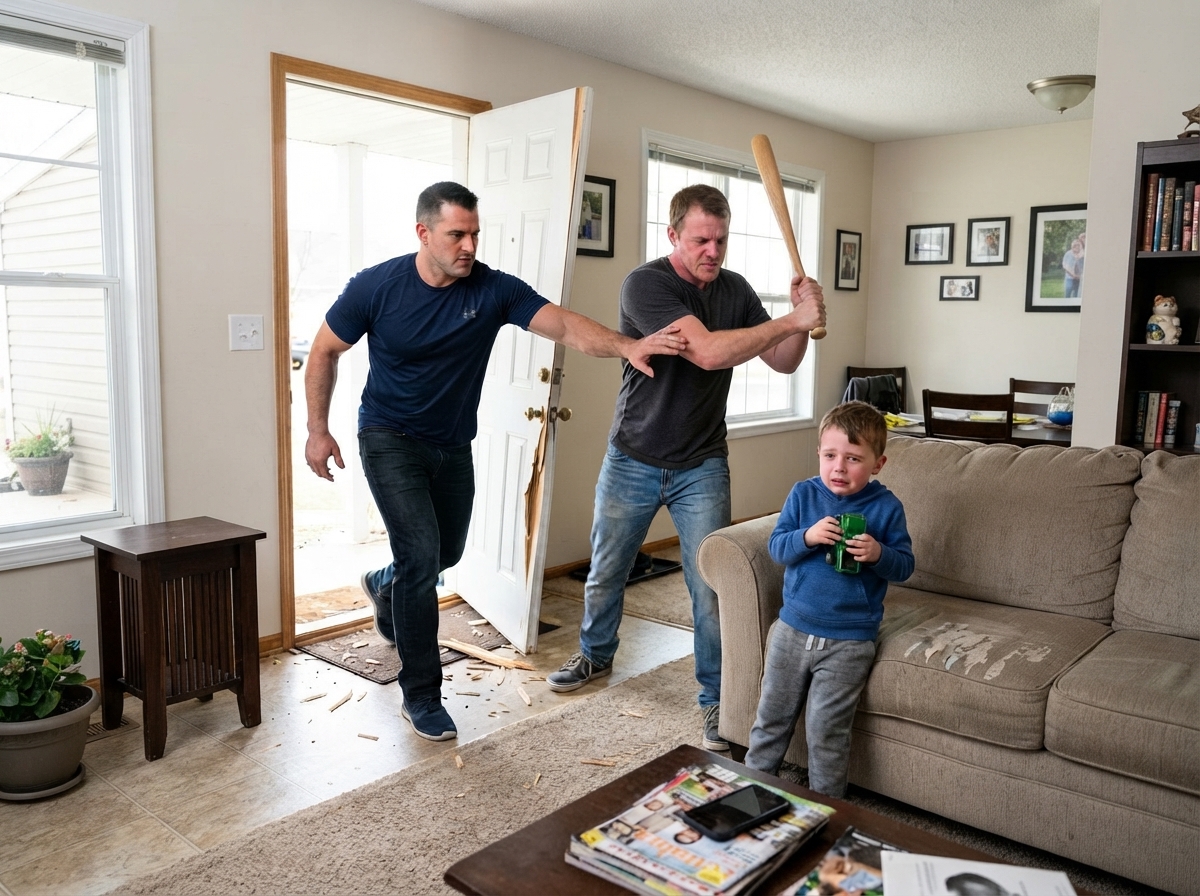
NOTE: This final part delivers the emotional resolution by showing the long-term consequences, Noah's adulthood, the lasting boundaries with the people involved, and the family legacy built from honesty.
Years passed.
The repaired front door eventually became an ordinary part of the house.
The scratches around the frame disappeared beneath fresh paint.
The old photographs were stored away.
The court documents were archived.
The names that once filled our conversations gradually became less important.
Evan remained part of the public record.
Daniel's brother served the consequences of his own decisions.
Marcus rebuilt his relationship with his son.
The school changed its procedures.
And our family moved forward.
Not perfectly.
Forward.
Noah grew into a thoughtful young man.
He never became frightened of adults.
He never became suspicious of everyone.
Instead, he became the kind of person who asked questions before judging.
I recognized that habit whenever I watched him with friends.
If two people argued, he listened to both.
If someone accused another student, he asked whether anyone had actually seen what happened.
Sometimes his friends teased him for being too careful.
He laughed.
"I've learned that stories can be wrong."
He never knew how much that sentence meant to me.
On his eighteenth birthday, we gave him a box.
Inside were photographs from his childhood.
His first baseball game.
His first day of school.
The family vacations.
The drawing of the repaired door.
He held that picture for a long time.
"I remember this."
"You were proud of the door."
He smiled.
"I thought I fixed it."
"You did."
He looked at us.
Then he asked the question I had been expecting.
"Can I know the whole story now?"
I looked at Daniel.
He nodded.
We sat together.
For the first time, we told Noah everything.
Not every graphic detail.
Not every legal document.
But the truth.
The accusation at school.
Marcus's anger.
The old construction company.
The missing file.
Evan's manipulation.
Daniel's secrecy.
His uncle's role.
The broken door.
The baseball bat.
The fear.
And the decision we made afterward.
Noah listened without interrupting.
When we finished, he remained silent.
Then he asked, "Why didn't you tell me sooner?"
"Because you were a child."
He nodded.
"I understand."
"Are you angry?"
He thought.
"At you?"
"At anyone."
He shook his head.
"I think I'm sad."
That answer felt right.
He looked at the old drawing.
"I remember being scared."
"I know."
"But I don't remember Marcus as the guy with the bat."
"No?"
"No. I remember him apologizing."
I smiled.
"He did."
Noah leaned back.
"Did Dad really keep the file secret?"
Daniel answered.
"Yes."
"Why?"
"I thought I was protecting everyone."
Noah looked at him.
"Did you learn anything?"
Daniel smiled.
"More than I wanted to."
Noah laughed.
Then he became serious.
"I think you taught me something too."
"What?"
"That keeping secrets isn't always protecting people."
I nodded.
"Yes."
He folded his hands.
"Did Grandma ever apologize?"
I answered honestly.
"She did."
"Did you forgive her?"
"I forgave what I could."
"Do you trust her?"
"No."
He nodded.
"I think those are different."
"They are."
That conversation was the true ending.
Not a courtroom.
Not an arrest.
Not a dramatic confrontation.
A son understanding a lesson his parents had learned the hard way.
Later that night, after Noah went to bed, Daniel and I sat outside.
The neighborhood had changed.
Some houses were new.
Others were gone.
Children played in yards where we had once seen our own son.
The world had continued.
I thought about that morning.
If someone had told me then that our family would eventually be okay, I would not have believed them.
I would have thought okay meant forgetting.
It didn't.
Okay meant remembering without being controlled by the memory.
It meant hearing a door slam without reliving the morning.
It meant seeing a baseball bat and thinking about baseball.
It meant watching Noah walk confidently toward strangers without feeling the need to pull him back.
It meant trusting Daniel again because he had earned that trust through years of honesty.
And it meant understanding that people can make terrible choices without those choices becoming the entire definition of a family.
Marcus remained a friend.
Not the closest friend.
But a trusted one.
His son and Noah stayed in contact.
Sometimes they joked about how absurd the original accusation had become.
The boys had grown up knowing that the adults once misunderstood each other.
They also knew that the adults eventually corrected the mistake.
That mattered.
Daniel's brother remained distant.
There was no dramatic reconciliation.
Daniel visited occasionally.
They spoke.
They acknowledged what happened.
But the relationship never returned to what it had been.
That was another lesson.
Some relationships survive consequences.
Some change permanently.
Neither outcome means the truth was wrong.
My father remained the person I thought about most often.
He had been gone before the broken door.
He had never known what would happen.
But his insistence on preserving evidence had mattered.
He had understood something important.
A truth that cannot be examined becomes a story.
A story repeated often enough can become dangerous.
He had protected the documents.
We had protected the truth.
And eventually, the truth protected us.
One year, I returned to the old storage facility.
The unit had been cleared long ago.
The metal door was gone.
Another family's belongings filled the space.
I stood there for a moment.
Then I realized I felt nothing except gratitude.
That place no longer belonged to the past.
It was simply a room.
I drove home.
Noah was there.
He had come to visit before starting his first job after college.
He was taller than Daniel now.
He stood in the kitchen making coffee.
"You're home."
"Yes."
"Everything okay?"
I smiled.
"Everything's fine."
He handed me a cup.
Then he noticed me looking at the front door.
"Still thinking about it?"
"Sometimes."
He nodded.
"Me too."
We stood quietly.
Then he said, "I think the door is stronger now."
I laughed.
"You're still obsessed with that door."
"It's a good door."
"It is."
He opened it.
Sunlight filled the entryway.
He looked back at me.
"Mom?"
"Yes?"
"Thanks for believing me."
My throat tightened.
"I always did."
He smiled.
"Even when everyone else didn't?"
"Especially then."
He hugged me.
For a moment, I remembered the eight-year-old boy clutching a green cup while adults argued around him.
Now he was a grown man standing confidently in the doorway.
The transformation felt almost impossible.
But it had happened.
The boy who had once been trapped inside an adult conflict had grown into someone who understood his own voice.
That was the outcome I cared about most.
Not the conviction.
Not the repaired door.
Not the missing file.
Not even the old case.
Noah had learned that his voice mattered.
Daniel had learned that honesty mattered.
I had learned that trusting myself mattered.
And our family had learned that safety was not created by pretending danger didn't exist.
It was created by facing reality together.
That night, Noah left.
Daniel and I watched his car disappear down the street.
"You okay?" Daniel asked.
I smiled.
"More than okay."
He took my hand.
"Do you ever think about what would have happened if Marcus hadn't come?"
I considered the question.
"Sometimes."
"What do you think?"
"I think the truth would still have come out eventually."
"Maybe."
"But I don't want to live inside what-ifs."
He nodded.
Neither did I.
The broken door had once represented everything we feared.
Now it represented something else.
A beginning.
That morning had forced us to confront every secret we had been carrying.
It had shown us what happened when fear replaced evidence.
It had shown us how quickly suspicion could turn people against each other.
It had shown us that children should never be made responsible for adult conflicts.
And it had shown us that truth does not always arrive as one dramatic revelation.
Sometimes it comes in pieces.
A photograph.
A document.
A phone call.
A child's answer.
A husband's confession.
A friend's apology.
A question asked at the right moment.
Piece by piece, the story becomes clear.
Years later, I still keep Noah's drawing of the door.
The paper has yellowed.
The edges are bent.
The colors have faded.
But the three figures remain.
A mother.
A father.
A child.
Standing together.
Safe.
I keep it because the drawing captured what all the official records could not.
Our family was never saved by a perfect person.
It was saved when imperfect people finally chose honesty.
Daniel had hidden something.
Marcus had acted recklessly.
Evan had manipulated people.
His brother had concealed the truth.
Noah had been falsely accused.
And I had spent too long believing that keeping peace mattered more than asking questions.
None of us could erase those choices.
But we could choose what came after them.
That was the real ending.
The door broke.
We repaired it.
The trust broke.
We rebuilt it.
The truth was hidden.
We brought it into the light.
And the boy who had once cried behind a sofa grew into a man who understood that silence was never the price of belonging.
Sometimes I wonder whether my father knew how much his decision would matter.
He couldn't have.
People rarely know which small choice will matter years later.
He simply kept the file.
Daniel eventually told the truth.
Marcus eventually apologized.
Noah eventually asked questions.
And I eventually learned that loving my family did not mean protecting everyone from consequences.
It meant protecting the truth so that my family could survive it.
The front door still stands.
It is stronger than the one we had before.
But its greatest purpose is not keeping people out.
It reminds me that a home should be a place where the people inside can speak honestly.
Where children can ask questions.
Where adults can admit mistakes.
Where fear does not get to write the story.
And whenever I hear that door close behind someone I love, I no longer hear the crash from that morning.
I hear something much simpler.
A lock turning.
A house settling.
A family coming home.
The End
Read more original stories on Feel Every Story.
The Door Exploded Open Before Sunrise, and My Son’s Terrified Face Told Me Something Was Wrong With the Story I Had Been Given
Part 8 of 8

