
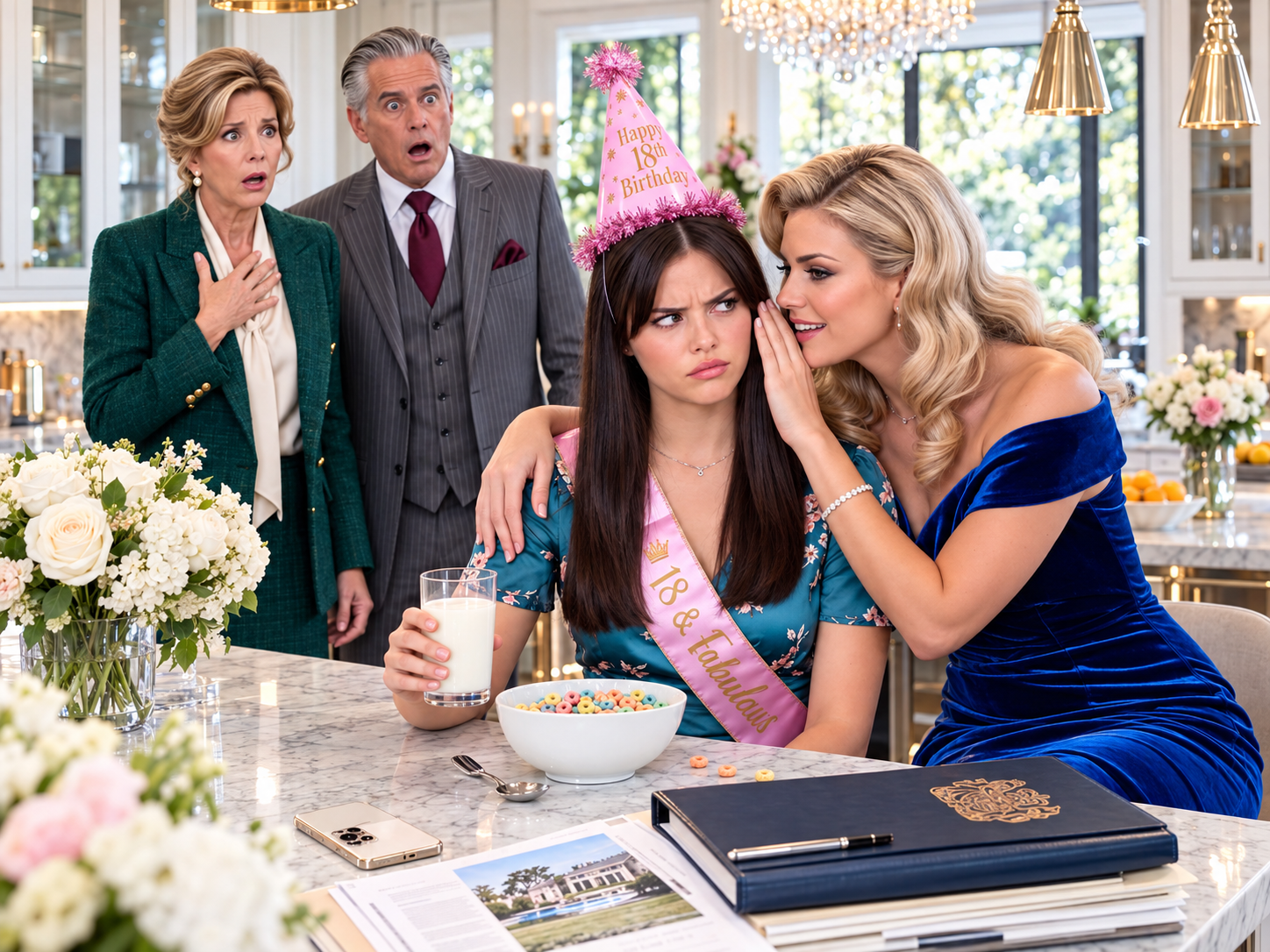
A year after my eighteenth birthday, I returned to the same house where everything had started.
It was no longer my family's home.
The property had been sold after Dad could not maintain the financial obligations connected to it. The new owners had renovated the kitchen and replaced the crooked front steps.
The gold birthday banner was gone.
So was the purchase agreement.
But I remembered the morning clearly.
Rebecca crying.
Dad laughing.
Mom telling me not to make things difficult.
And the question I had asked.
“What happens if I say no?”
At the time, I thought the answer would change my family's behavior.
Instead, my answer changed mine.
I stood outside the house for a few minutes before leaving.
I didn't feel anger.
I didn't feel triumph.
I felt grateful that I had walked away when I did.
The legal process had ended months earlier.
Dad had fulfilled the repayment arrangement.
The final amount returned to my trust included the unauthorized withdrawals and accumulated interest.
The records were closed.
Bennett Family Holdings no longer existed.
Rebecca had built a life of her own.
She had kept the smaller business she started and had become remarkably disciplined with money.
She once joked that the first year of independence had taught her more about budgeting than all of Dad's lectures combined.
Mom and Dad remained together, though their relationship had changed.
They kept separate financial accounts.
Mom told me that arrangement had actually improved their marriage.
“Turns out,” she said, “marriage works better when nobody secretly controls the other person's money.”
I laughed.
She was right.
Dad still struggled sometimes.
He occasionally tried to solve problems before asking whether anyone wanted his help.
But now, when he crossed a line, someone told him.
Usually Mom.
Sometimes Rebecca.
And occasionally me.
He had learned to listen.
Not perfectly.
But enough.
On the anniversary of my birthday, the four of us had dinner together.
It was the first time we had all sat at one table since the morning of the failed house purchase.
There was no speech.
No toast.
No discussion of inheritance.
We ate ordinary food.
Rebecca complained about work.
Mom talked about a book she was reading.
Dad told a story about Grandpa that none of us had heard before.
Apparently, when Bennett Mechanical had its first major contract, Grandpa had accidentally sent an invoice to the wrong company.
He had spent an entire afternoon fixing the mistake.
Dad laughed while telling it.
“Your grandfather kept saying, ‘Systems don't fail. People fail to follow them.’”
I smiled.
“That sounds exactly like him.”
Dad looked at me.
“He would have been proud of you.”
I lowered my eyes.
“Thank you.”
There was no hidden request after the compliment.
No folder.
No contract.
No expectation.
That mattered more than the words.
After dinner, Rebecca and I stayed behind.
She brought out a small box.
“I found this.”
Inside was the old gray welcome mat from the house.
I stared at it.
“You kept this?”
“I don't know why.”
We both laughed.
She turned serious.
“I wanted you to have it.”
I shook my head.
“Keep it.”
“Why?”
“Because it reminds you of what happened.”
She nodded.
“It does.”
We sat quietly.
Then she said, “I used to think you ruined my future.”
I looked at her.
“I know.”
“I was wrong.”
“You were scared.”
“So were you.”
“Yes.”
She looked at me.
“Would you do it again?”
I didn't need to ask what she meant.
“If I had to?”
She nodded.
“Yes.”
I smiled.
“Yes.”
Not because I wanted to hurt anyone.
Because I had finally learned that protecting myself did not require permission.
The trust continued to grow.
I used some of the money for education.
I invested another portion.
I kept enough liquid for emergencies.
And I never again allowed anyone else to manage the entire picture without understanding what was happening.
Fran remained my adviser.
Whenever I made a major financial decision, she asked the same question.
“Is this something you want, or something you feel obligated to do?”
I never forgot it.
Sometimes the answer was obligation.
Sometimes it was generosity.
The important part was knowing the difference.
One afternoon, I visited Fran's office.
She had kept Grandpa's original estate file.
“I think you should have this,” she said.
Inside was the brass key.
I frowned.
“I already have mine.”
She smiled.
“No. That's the original.”
I looked at it.
The key I had carried for years had been a copy.
Grandpa had given me a duplicate when I was eight.
The original had been stored with his estate documents.
I laughed.
“He tricked me.”
“He wanted you to learn that appearances aren't always the whole story.”
I turned the key over.
There was a tiny engraving on the back.
WB.
Walter Bennett.
I ran my thumb across the letters.
“What did it open?”
Fran smiled.
“The old workshop office.”
I laughed again.
“So all that time…”
“You thought it was symbolic.”
“It was symbolic.”
“It was also a key.”
That was Grandpa.
Practical even when sentimental.
I took the key home.
I placed it beside the copy on my desk.
Two keys.
One from childhood.
One from the estate.
One represented trust given to a little girl.
The other represented responsibility accepted by an adult.
I finally understood the difference.
Grandpa had never expected me to protect the money because it was valuable.
He expected me to protect my ability to choose.
That was what my father had misunderstood.
The inheritance was not simply three million dollars.
It was time.
Education.
Security.
The ability to make mistakes without depending on someone else's permission.
The ability to say no.
The ability to help someone because I wanted to, rather than because they had cornered me into it.
A few months later, I used part of my inheritance to establish a small scholarship for students who could not afford the mathematics program I had once missed.
I named it after Grandpa.
I did not tell my family until the scholarship was already funded.
When Dad found out, he called.
“Your grandfather would love that.”
“I hope so.”
“You didn't have to do it.”
“I know.”
He paused.
“That makes it better.”
I smiled.
“Yes.”
There was a long silence.
Then he said, “I think I'm finally beginning to understand.”
“Understand what?”
“That helping someone only counts as help when they are allowed to refuse it.”
I closed my eyes.
That was the lesson I had spent a year learning.
The lesson he had taken eighteen years to understand.
We said goodbye.
I placed the phone on the desk.
The two keys were still there.
I picked up the original.
It fit the lock of a small storage cabinet I had brought home from Grandpa's workshop.
Inside were old photographs, handwritten notes, machine diagrams, and a final birthday card.
I opened it.
The message was simple.
“Poppy, never confuse being loved with being owned.”
I sat down.
For the first time, I cried.
Not because I was hurt.
Because I finally understood him.
The morning after my eighteenth birthday, I had believed my inheritance had saved me from my family.
It hadn't.
What saved me was the right to choose.
The money only gave that choice room to exist.
My family had once believed the inheritance belonged to all of us because we were family.
Eventually, they learned that love did not make ownership collective.
I learned something too.
Saying no did not make me cruel.
Protecting myself did not make me selfish.
And forgiveness did not mean pretending nothing happened.
A year earlier, Dad had laughed when I asked what would happen if I refused.
He had assumed the answer was obvious.
It wasn't.
The answer was that the entire plan would collapse.
And after it collapsed, we were forced to build something more honest in its place.
Not a million-dollar house.
Not a family company.
Not a financial arrangement designed around control.
Something smaller.
Something harder.
Trust.
I put Grandpa's key back in the drawer.
Then I locked it.
This time, I knew exactly why.
The End
Read more original stories on Feel Every Story.
My Family Had Already Spent My Future Before I Was Old Enough to Defend It
Part 8 of 8

