The purchase agreement was hidden in Dad’s office behind a stack of old tax folders, as though putting it somewhere boring could make what was inside less suspicious. I found it three days before my birthday. The folder was thick enough to make my stomach tighten before I even opened it.
The buyer was my father.
The property price was $1.5 million.
The closing date was ten o’clock on the morning after my eighteenth birthday.
And the funding plan depended on my inheritance.
I photographed every page with my phone and returned the folder exactly where I had found it. I did not slam drawers or confront anyone. I had spent too many years watching my family turn emotional chaos into an excuse for bad decisions. I knew that if I reacted too soon, they would stop talking and start hiding.
So I listened.
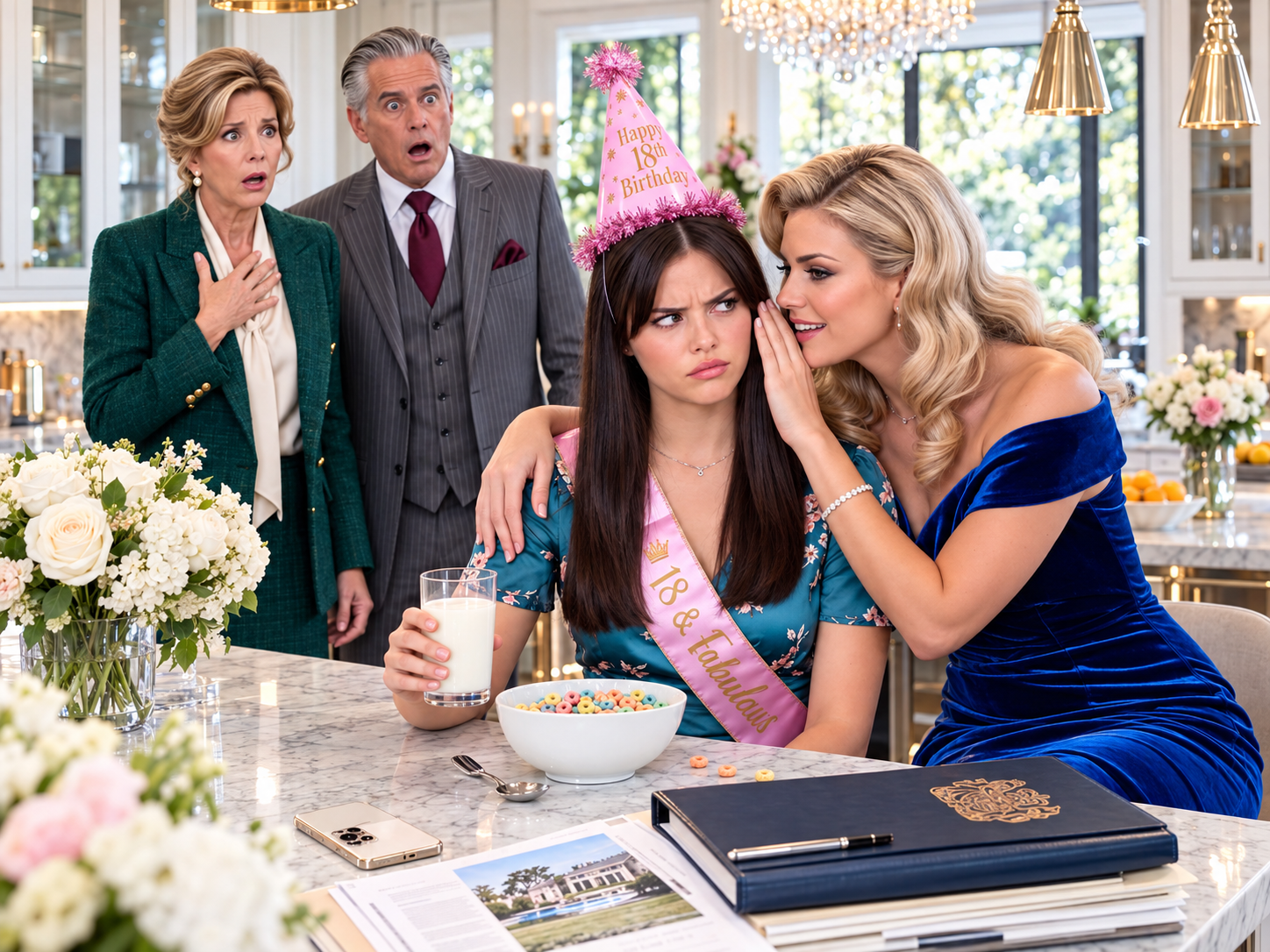
The next morning, Mom was sitting at the kitchen island with a real-estate brochure open in front of her. Rebecca was beside her, scrolling through photographs of dining tables.
“I like the lighter wood,” Rebecca said.
Mom shook her head.
“With the flooring in that house? Darker would look better.”
I poured myself cereal.
Neither of them noticed that I had gone quiet.
Rebecca looked up suddenly.
“What do you think, Pop?”
I looked at the screen.
“About what?”
“The dining room.”
I shrugged.
“Whatever you like.”
She laughed.
“That’s why I love you.”
The words made something inside me ache. She sounded sincere. She had no idea what was happening. She believed our parents were giving her a house, and she believed I was part of the generosity.
That made the situation more complicated than simple anger.
Rebecca had made plenty of irresponsible choices, but I had never seen her ask Dad to take my inheritance. She had never seen the trust statements. She had never sat beside me while my grandfather explained what he had built. If our parents had told her the house was a gift from the family, she had little reason to suspect the money was actually mine.
Still, the more I learned, the harder it became to excuse what my parents were doing.
The property was not simply a gift to Rebecca.
The floor plan showed a separate downstairs suite, complete with a bedroom, bathroom, sitting room, and private entrance. When I compared the dimensions with the furniture measurements Mom had been discussing, I understood.
My parents intended to move in.
They were planning to give Rebecca the upper level while they occupied the lower one. The house would become a comfortable family compound, purchased almost entirely with money that belonged to me.
Dad had even borrowed $75,000 against our current home for the earnest-money deposit.
That discovery made me sit down.
He had risked our family house because he believed the trust would provide the rest.
He had not merely imagined that I would cooperate.
He had already made financial commitments based on my cooperation.
Later that afternoon, I heard him on the phone again.
“The deposit is covered. Once she reaches eighteen, the remaining wire can be authorized.”
I stood outside the office with my hands clenched.
He sounded certain.
There was no hesitation in his voice.
No question about whether I might refuse.
To him, my answer had already been decided.
That evening, Rebecca showed me a photograph of a gray welcome mat.
“Too much?” she asked.
“It’s nice.”
“I want something simple. The house is already going to be gorgeous.”
I looked at her.
“Are you sure it’s yours?”
She frowned.
“What do you mean?”
“Nothing.”
She smiled again.
“They told me you were helping.”
I forced myself to nod.
That sentence stayed with me long after she went upstairs.
The next day, another envelope arrived. It came from the title and escrow company. I knew the name because Grandpa had taught me that important financial documents should never be ignored simply because they looked official.
I waited until Dad left for work.
Then I opened it.
The closing date was printed clearly.
Ten o’clock.
The morning after my birthday.
The timing was not accidental. The contract had been arranged so that the money would become accessible to me first and then immediately be used to fund the purchase.
I went back through the trust statements.
The missing money bothered me more than the house.
One hundred and eighty-five thousand dollars was not an accounting mistake. It was not a forgotten fee. The withdrawals formed a trail through years of family emergencies.
I found one for the month Rebecca had opened the art studio.
Another coincided with the purchase of her SUV.
Several were close to dates when Mom had complained that Rebecca was drowning in credit-card debt.
I added them with a calculator.
About $120,000 of the missing amount could be connected directly to Rebecca’s expenses.
The remaining withdrawals appeared to have covered other family costs, but there was no legitimate explanation for any of them.
I sat at my desk staring at the total.
My father had been the trustee.
That meant he had not simply spent money that happened to belong to his daughter. He had controlled money that he had a legal duty to protect.
The next evening, Dad found me in the kitchen.
“You’ve been quiet.”
“I’m tired.”
“Birthday coming up.”
“Yeah.”
He smiled and opened the refrigerator.
“You excited?”
“Should I be?”
He laughed.
“You’ll see.”
That answer told me enough.
I wanted to ask him whether he knew I had found the statements. I wanted to ask whether he had any idea what Grandpa had intended. Instead, I closed my notebook.
“Sounds good.”
Dad patted my shoulder.
“That’s my girl.”
The phrase followed me upstairs.
That’s my girl.
He meant obedient.
Reliable.
Predictable.
The daughter who would understand.
The daughter who would sign.
I called Fran that night.
She answered on the second ring.
“Poppy?”
My throat tightened when I heard her voice.
“Fran, I need your help.”
She did not ask why I was calling so late.
Instead, she said something that made me sit upright.
“Your grandfather told me this call would come.”
I closed my eyes.
“He did?”
“Yes. He said that when you reached eighteen, you might discover that the people around you had already made plans for your money.”
I looked toward the bedroom door.
“I found withdrawals.”
“How much?”
“About one hundred and eighty-five thousand.”
Fran was silent for several seconds.
Then her voice became very calm.
“Do you have copies of the statements?”
“Yes.”
“Good. Do not confront your father yet.”
I swallowed.
“Why?”
“Because we need to protect what remains before anyone realizes you know.”
She asked me to send the documents.
I did.
Ten minutes later, she called back.
“I have the master accounting records.”
My stomach dropped.
“Does it match?”
“It does.”
Every withdrawal was accounted for.
Every amount I had found appeared in the official records.
There was no misunderstanding.
No innocent explanation.
No paperwork error.
Fran told me that the moment I turned eighteen, control of the remaining trust assets would pass to me. She also explained that I did not have to use them for the house.
I already knew that.
What I needed was protection.
“What would you do?” I asked.
“I am not going to tell you what decision to make,” she said. “But I can tell you what options are available.”
We discussed attorneys, formal demands, and the possibility of pursuing my father for the money already removed.
I listened.
Then I said the one thing I had been certain about since I found the statements.
“I don't want revenge.”
Fran waited.
“I want the money that remains protected. I don't want another family meeting where someone tells me what I owe them.”
She explained a structure Grandpa had arranged for such a possibility: the remaining funds could be transferred into a new irrevocable trust once I reached adulthood. It would be called the Walter Bennett Legacy Trust, with me as the sole beneficiary and Fran as independent trustee.
The idea felt almost strangely quiet compared with the chaos downstairs.
No dramatic confrontation.
No shouting.
Just a legal barrier between my inheritance and everyone who had decided it belonged to them.
“What happens to the house?” I asked.
“If your father cannot fund the closing, the transaction becomes his problem.”
I looked at the clock.
Three days.
Then two.
Rebecca arrived from Chicago the day before my birthday carrying bags of clothes and a box containing the welcome mat.
She hugged me in the hallway.
“Tomorrow is going to be amazing.”
I smiled carefully.
“For who?”
She laughed.
“For all of us.”
I said nothing.
That night, Dad raised a glass at dinner.
“To new keys,” he announced, “new beginnings, and all of us under one roof.”
Everyone smiled.
I looked at my grandfather’s old brass key sitting in my pocket.
They thought tomorrow would begin with me giving something away.
They had no idea it would begin with me taking control of it.
Click Here to continue read next: PART3: Before Midnight, I Had to Decide Whether Protecting Myself Meant Finally Breaking My Family’s Favorite Arrangement
My Family Had Already Spent My Future Before I Was Old Enough to Defend It
Part 2 of 8