Months passed.
Life became quieter.
My parents moved into a smaller house outside the city.
It had no grand staircase.
No ballroom-sized dining room.
No framed business awards lining the hall.
My mother complained about the kitchen for exactly one week.
Then she stopped.
My father started cooking.
Neither of them had ever cooked when they lived in the old house.
Now he made soup on Sundays.
My mother began volunteering at a local community center.
She never mentioned it online.
That was how I knew the change was real.
Serena and I began speaking regularly.
At first, our conversations lasted ten minutes.
Then twenty.
Eventually, we started meeting for coffee.
She told me about her work.
I told her about the people I served with.
She asked questions.
Real questions.
Not polite ones.
She wanted to know what deployment was like.
She wanted to know why I had chosen the Navy.
She wanted to know what I was proud of.
I answered slowly.
It felt strange to be known without having to prove anything.
One Saturday, she asked me to visit our parents.
I almost refused.
Instead, I went.
The new house was ordinary.
A narrow porch.
Small garden.
Two bedrooms.
A kitchen where my father was making coffee.
My mother stood near the sink.
When she saw me, she smiled cautiously.
“I'm glad you came.”
“Me too.”
We sat around a small table.
There was no formal dinner.
No guests.
No cameras.
No crystal.
Just four people drinking coffee.
My mother finally spoke.
“I owe you an apology.”
I looked at her.
She continued.
“I don't expect you to forgive me because I say it.”
That mattered.
“I treated Serena's success like it was proof that I had succeeded as a mother.”
She looked down.
“And I treated your strength like something I could use.”
My throat tightened.
“I should have protected you.”
“You should have seen me.”
She nodded.
“Yes.”
My father reached across the table.
“We both should have.”
I didn't answer immediately.
Forgiveness had always sounded like a single moment in stories.
It wasn't.
It was a decision made repeatedly.
Sometimes every time a memory returned.
I could forgive them without pretending nothing had happened.
That distinction became important.
“I forgive you,” I said.
My mother cried.
“But things won't go back to how they were.”
She nodded.
“I understand.”
I believed her.
After coffee, my father showed me the garden.
He had planted tomatoes.
The sight made me laugh.
“What?”
“You used to hate gardening.”
“I've changed.”
“So have I.”
He smiled.
“I know.”
That afternoon, I drove back to base.
The road seemed shorter than before.
My life had become larger after the house disappeared.
I enrolled in a leadership course.
I began saving for my own home.
I replaced the old car I had sold.
I bought a small apartment near the water.
The first night I slept there, I left the curtains open.
Rain moved across the glass.
The room was quiet.
Mine.
No mortgage belonging to someone else.
No expectation.
No family performance.
Just my own life.
A few weeks later, I received a letter from my father.
He didn't ask for anything.
He simply wrote about the garden.
He told me the tomatoes had failed.
Then he joked that military logistics clearly had not prepared me for agriculture.
I laughed aloud.
I wrote back.
Our relationship didn't become perfect.
It became honest.
That was better.
Serena eventually told me she had spoken to the people who attended the gala.
She corrected the story whenever someone repeated it.
“She didn't just help,” she would say.
“She saved us.”
I asked her to stop saying that.
“Why?”
“Because I don't want to be remembered for saving the house.”
“What do you want to be remembered for?”
I thought about it.
“Serving.”
She smiled.
“That sounds like you.”
Maybe it did.
The strangest part was that the family finally stopped measuring my worth in money.
They no longer introduced me as the difficult daughter.
They didn't call me the one who had walked away.
They simply said my name.
That was enough.
One evening, my mother called.
“Your father wants to know if you'll come for Thanksgiving.”
I paused.
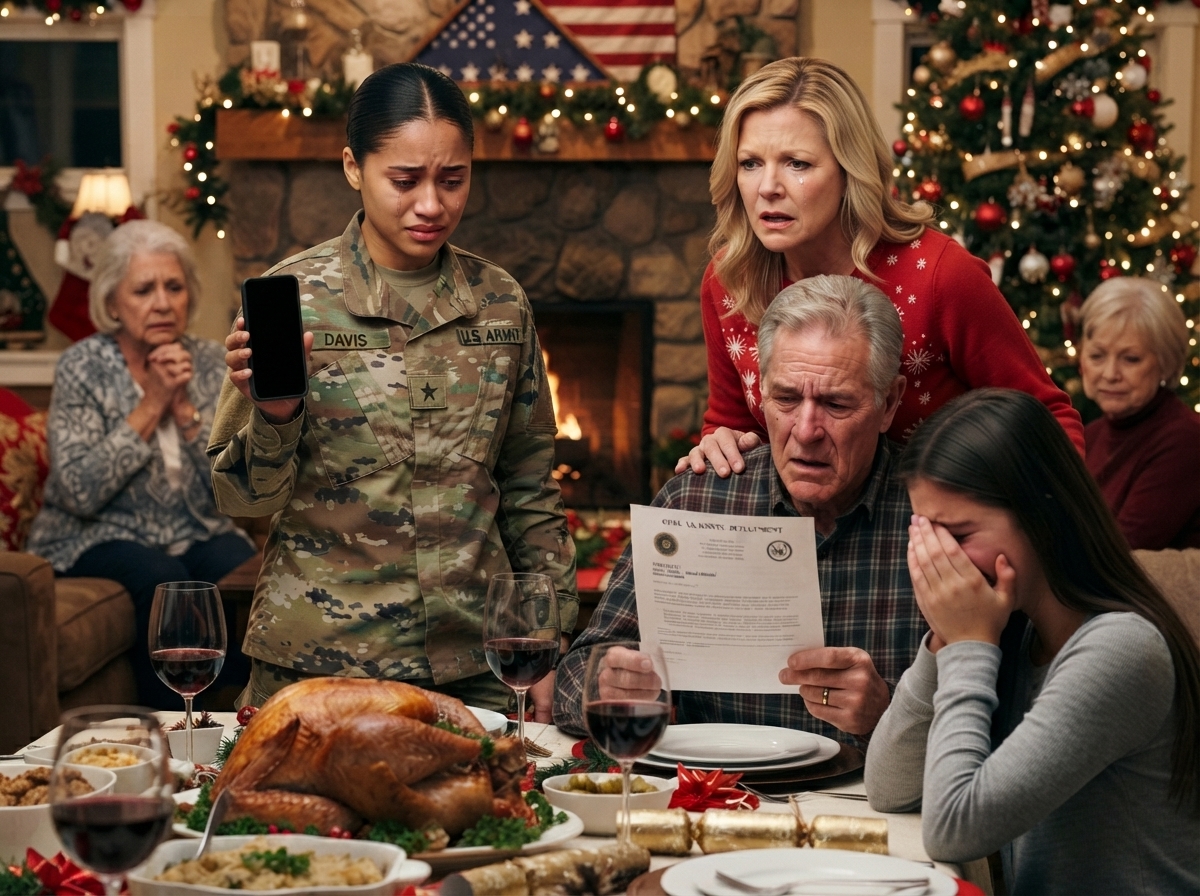
The memory of the previous Thanksgiving came back.
The table.
The uniform.
The insult.
The mortgage.
The silence.
I almost said no.
Then I said, “I'll come.”
She sounded relieved.
“Thank you.”
“But one condition.”
“What?”
“No speeches.”
She laughed.
“No speeches.”
“And no comparisons.”
“I promise.”
“And Dad isn't allowed to make me pay for dinner.”
She laughed again.
“He'll be offended.”
“Good.”
When Thanksgiving arrived, the table was much smaller.
No crystal.
No gala-style centerpiece.
No relatives watching.
Just four plates.
My father cooked the turkey.
It was dry.
We all pretended it wasn't.
My mother laughed until she cried.
Serena brought pie.
We ate.
We talked.
Nobody discussed money.
Nobody discussed reputation.
Nobody praised Serena at my expense.
Nobody apologized again.
That mattered too.
Sometimes healing was not another conversation about the wound.
Sometimes it was simply sitting at a table where nobody was trying to hurt you.
After dinner, my father stepped outside.
I followed.
The air was cold.
He looked at me.
“You know,” he said, “I was proud of you long before I admitted it.”
I looked at him.
“Why didn't you say it?”
He sighed.
“Because I was afraid of looking like I had failed.”
I nodded.
“That was never my failure.”
“I know.”
We stood quietly.
Then he said, “I'm proud of you.”
I believed him.
Not because he had finally said the right words.
Because his behavior had changed.
That was the part that mattered.
When I returned home that night, I took off my coat and placed it over the chair.
The old uniform hung in my closet.
I ran my fingers over the sleeve.
Once, I had worn it hoping someone would finally see me.
Now I wore it because it represented something that belonged entirely to me.
Service.
Discipline.
Choice.
I had spent years believing I needed my family's approval to know who I was.
I no longer did.
The house was gone.
The lie was gone.
The old version of my family was gone too.
What remained was smaller.
Less impressive.
But real.
And for the first time, that was enough.
Click Here to continue read next: PART8: Years Later, I Returned to the Place Where the Lie Began and Realized the Truth Had Changed More Than My Family Ever Could
At Thanksgiving, My Mother Finally Said What She Had Always Meant, and I Answered With the One Fact That Changed the Entire Table
Part 7 of 8