
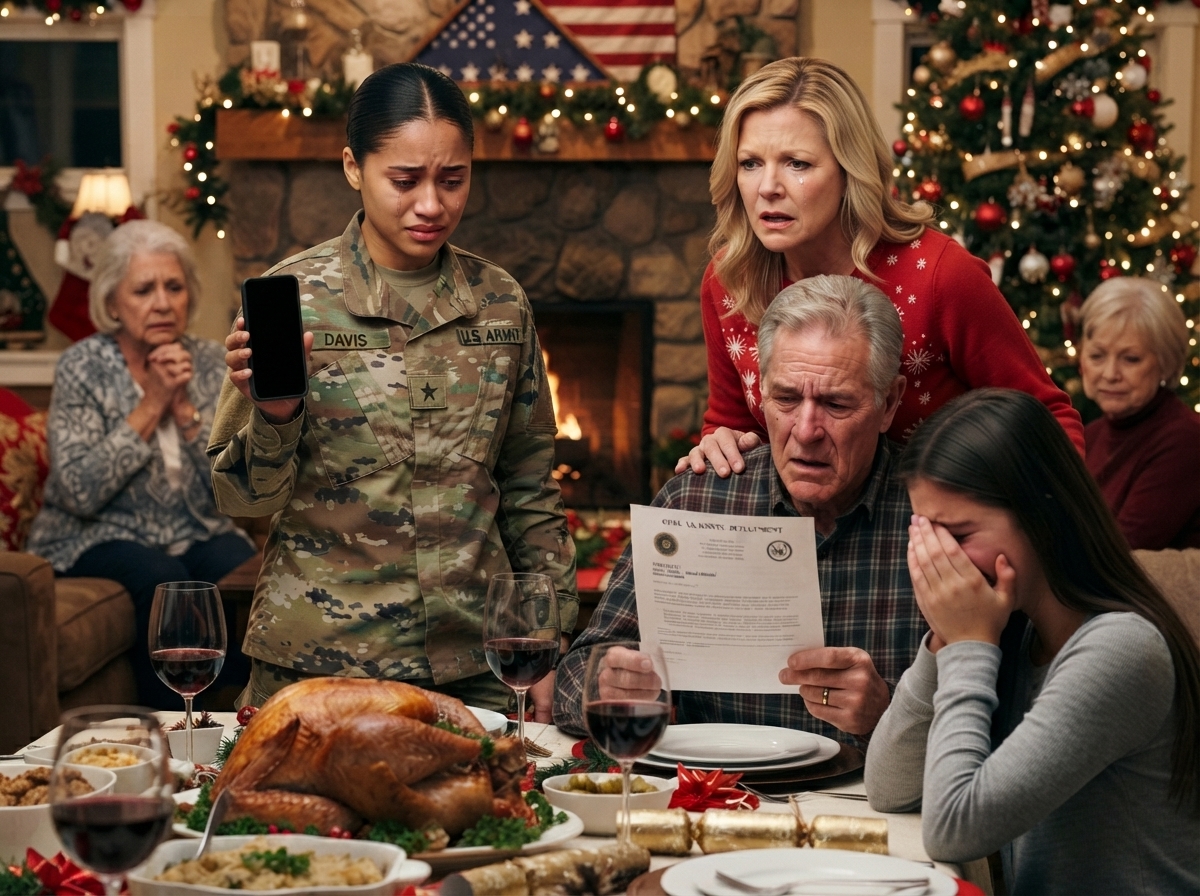
Years passed before I fully understood what the Thanksgiving confrontation had given me.
At the time, I thought I had simply stopped paying a mortgage.
I was wrong.
I had stopped paying for a version of myself that had never existed.
My parents' old house eventually became someone else's home.
A young couple bought it.
They renovated the kitchen.
They removed the wall where my father's business awards had hung.
They planted trees along the driveway.
I saw the changes one afternoon when I happened to drive past.
I slowed down.
Then I kept going.
I didn't need to stop.
That house no longer belonged to my story.
My parents were doing well.
Not wealthy.
Not glamorous.
Well.
My father still cooked on Sundays.
His tomatoes eventually improved.
My mother volunteered twice a week.
She had stopped introducing Serena before introducing me.
Serena became a partner at her law firm.
She also started a small scholarship fund for military families.
She refused to put her name on it.
When I asked why, she shrugged.
“Some things don't need to be about me.”
I smiled.
“Now you're learning.”
She laughed.
We had become sisters again.
Not the perfect kind from childhood photographs.
The real kind.
We disagreed.
We teased each other.
We occasionally argued.
But there was no competition anymore.
That was the greatest change.
My own career continued.
I took on larger responsibilities.
I trained younger officers.
I learned that leadership wasn't about being the loudest person in a room.
It was about making sure people weren't invisible.
I became especially attentive to the quiet ones.
The people who did the work without receiving recognition.
The people who arrived early and left late.
The people whose names rarely appeared in speeches.
I knew what invisibility felt like.
I never wanted to create it for someone else.
Years after the gala, I was invited to speak at a military leadership event.
The auditorium was filled with officers and civilian guests.
A young lieutenant approached me afterward.
“Ma'am,” she said, “I heard your story.”
I smiled.
“Which version?”
She laughed nervously.
“The real one.”
I waited.
She said, “My family doesn't respect what I do either.”
I could have given her a motivational speech.
Instead, I asked, “Do you respect it?”
She looked surprised.
“I think so.”
“Then start there.”
She nodded.
I told her something I had learned slowly.
You can love people without financing their expectations.
You can forgive someone without returning to the same arrangement.
You can walk away without hating anyone.
And you can refuse to become smaller simply because someone else feels more comfortable when you are small.
She thanked me.
Then she left.
I stood alone for a moment.
I thought about the young woman I had been.
She had believed sacrifice would eventually purchase acceptance.
It didn't.
What finally changed my life was not sacrifice.
It was a boundary.
A quiet decision.
No more.
I sometimes wondered what would have happened if my mother had praised my uniform years earlier.
If my father had defended me at the barbecue.
If Serena had asked one question.
If anyone had simply said, “We see how much you're carrying.”
Maybe everything would have been different.
But I stopped living inside those possibilities.
The past couldn't be repaired by imagining better versions of it.
It could only be understood.
And understanding made forgiveness possible.
Not easy.
Possible.
My mother and I became closer in a way I never expected.
She once admitted that she had spent much of her life afraid of being judged.
She had built a beautiful home because she thought beautiful things would protect her from that fear.
They didn't.
The house became a symbol she had to defend.
And I had become another symbol.
Serena represented the daughter she could display.
I represented the daughter she could rely on.
She finally understood how unfair that had been.
“I made you responsible for things that were never yours,” she told me.
“Yes.”
“I am sorry.”
“I know.”
That time, I hugged her.
It didn't erase anything.
But it mattered.
My father apologized too.
He admitted that he had allowed my mother to make decisions because confrontation frightened him.
“I thought keeping peace was kindness,” he said.
“It wasn't.”
“I know.”
“Peace without honesty isn't peace.”
He nodded.
“I know that now.”
Years after the gala, the three of us visited Serena's scholarship ceremony.
A group of military families stood in the room.
Young children ran between chairs.
Parents talked quietly.
There were no banners celebrating Serena.
No giant photographs.
No speeches about family reputation.
Her name appeared once on a small program.
She didn't mention the mortgage.
She didn't mention the gala.
She spoke about service and opportunity.
I watched her from the back of the room.
She caught my eye.
We smiled.
When the ceremony ended, she came over.
“Remember when Mom said you weren't half the woman I was?”
I laughed.
“Yes.”
“She was wrong.”
“I know.”
Serena smiled.
“You were never half.”
I shook my head.
“Don't start.”
She laughed.
“Fine.”
We hugged.
That night, I drove home alone.
Rain covered the windshield.
For a second, I remembered the night I had left Thanksgiving years earlier.
The same rain.
The same city.
A completely different woman behind the wheel.
Back then, I had been angry because I wanted them to recognize my value.
Now I didn't need them to.
That was the difference.
My value had never depended on the mortgage.
It hadn't depended on my uniform.
It hadn't depended on Serena.
It hadn't depended on my parents.
It belonged to me before any of them had understood it.
I reached my apartment and parked.
Before going inside, I looked at the reflection in the window.
Older now.
A few lines around my eyes.
A steadier expression.
Still the same woman.
But no longer waiting to be chosen.
I went upstairs.
My uniform hung neatly in the closet.
Beside it was the old promotion photograph.
I had framed it.
Not because it proved anything.
Because I liked the woman in it.
She had survived a lot.
She had kept going.
She had finally learned that love did not require disappearance.
I turned off the light.
Outside, the rain continued.
Somewhere across the city, my parents were probably asleep.
Serena was probably working too late.
The old house stood in someone else's neighborhood.
The gala was a distant memory.
The mortgage was long gone.
The lie had disappeared.
What remained was the truth.
I had not been the least important person in that room.
I had simply been the only person who didn't understand my own importance yet.
And once I did, I stopped asking permission to take up space.
That was the real ending.
Not the ruined celebration.
Not the canceled payments.
Not the house being sold.
Not even the apologies.
The real ending was quieter.
I had finally become the person I had been trying to prove I was all along.
Not the daughter who saved the house.
Not the sister who lost a competition.
Not the woman in the uniform my family once mocked.
Just Clara.
A woman who had served, sacrificed, forgiven, and finally learned when sacrifice had to end.
And that was more than enough.
The End
Read more original stories on Feel Every Story.
At Thanksgiving, My Mother Finally Said What She Had Always Meant, and I Answered With the One Fact That Changed the Entire Table
Part 8 of 8


One Comment on “PART 8 – Years Later, I Returned to the Place Where the Lie Began and Realized the Truth Had Changed More Than My Family Ever Could”