
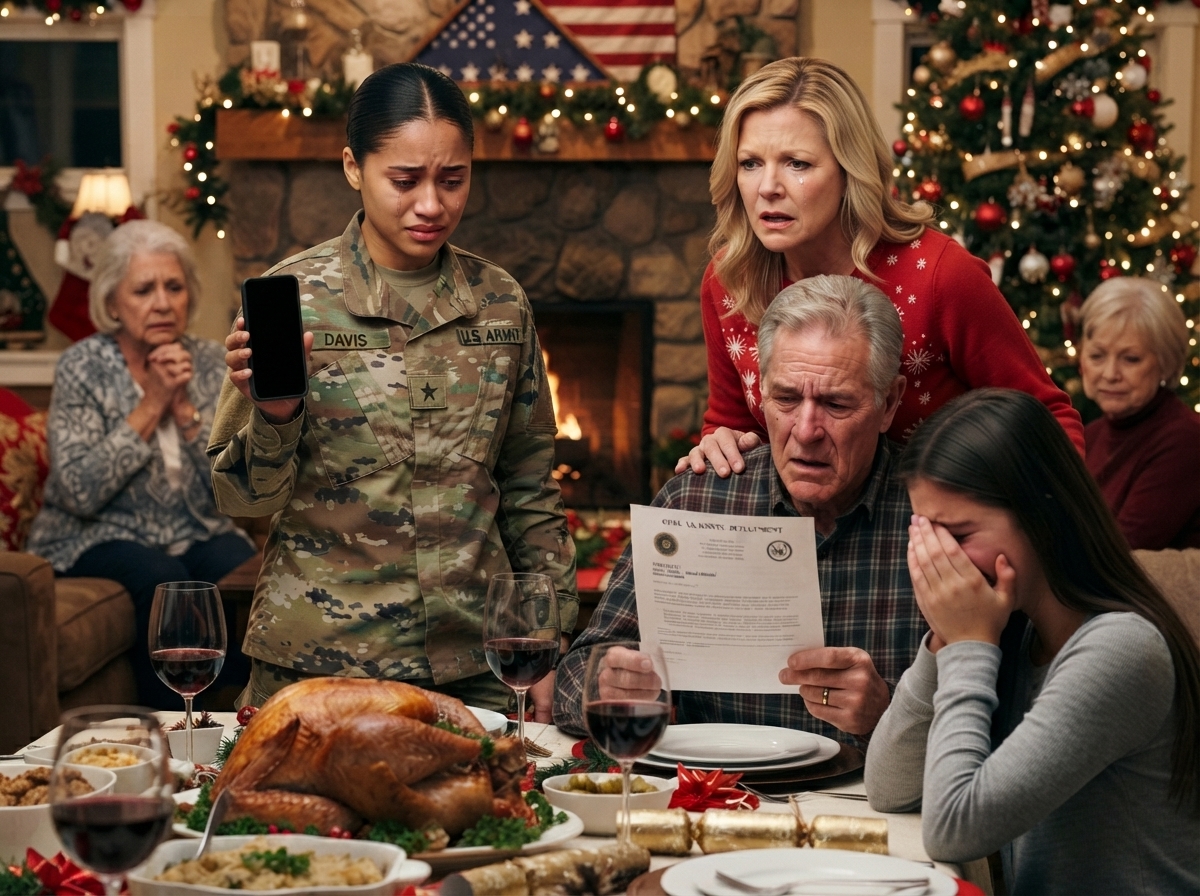
The turkey had barely stopped steaming when my mother decided to make me the evening's entertainment.
I knew something was wrong before she spoke. Marjorie Vale had a particular way of looking at me when she wanted to hurt me without appearing cruel. Her gaze traveled slowly from my pinned hair to the dark blue uniform I had worn straight from duty, then settled on my hands.
Those hands gave her away.
They were clean, but not soft. The skin around my knuckles was rough from years of work, and a faint scrape crossed one finger. I had spent the afternoon at Naval Base Kitsap before driving through Seattle traffic to reach my parents' house in time for Thanksgiving dinner.
Everyone else looked as though they had dressed for a magazine photograph.
The Vale dining room was designed for appearances. Tall windows reflected the wet darkness outside. White candles burned between crystal glasses. Gold-rimmed plates sat perfectly aligned beneath linen napkins. My father's business awards were visible through the open doorway, arranged along the hallway like proof that success belonged to our family by inheritance.
My older sister, Serena, fit the room better than I ever had.
She sat beside her fiancé in a fitted navy dress, talking about a complicated matter at her law firm. My father listened with the pleased expression he reserved for her. Every few minutes he nodded and said something encouraging.
“That sounds impressive.”
“You handled that well.”
“That’s my girl.”
I had heard those words all my life.
Just never directed at me.
I ate quietly and tried to let the conversation pass over me. Serena discussed a merger. My aunt Elise asked questions about her clients. My mother refilled wine glasses and laughed at exactly the right moments.
No one asked about my day.
No one asked how long I had been awake.
No one asked whether I had driven safely through the rain.
I was accustomed to that kind of absence. What I wasn't prepared for was what came next.
My mother placed her fork beside her plate and looked directly at me.
“You know, Clara,” she said, “you've never really been half the woman your sister is.”
The sentence landed harder than the volume of her voice suggested.
Forks stopped moving.
My aunt lowered her napkin.
Serena glanced down, but the tiny movement at the corner of her mouth told me she was pleased.
My father suddenly became very interested in his wine.
For thirty-two years, I had swallowed comments like that. I had learned to let them pass through me because challenging my mother always created a larger problem than enduring her.
But something had changed.
Maybe it was the uniform.
Maybe it was the exhaustion.
Maybe it was three years of watching money leave my account every month while my family pretended I contributed nothing.
Whatever the reason, I didn't swallow this one.
I set my fork down.
The metal touched porcelain with a small, sharp sound.
“Then Serena can start paying the mortgage.”
My father's glass stopped halfway to his mouth.
He looked at me.
“What mortgage?”
I turned toward him.
“The mortgage on this house.”
My mother's face changed first.
Not anger.
Fear.
That was when I knew I had finally said something she hadn't prepared for.
“For three years,” I continued, “I've been making the payments.”
A silence spread across the table.
Aunt Elise whispered, “What?”
Serena's smile disappeared completely.
My father stared at my mother.
“Marjorie?”
She twisted her napkin between her fingers.
“Clara, this isn't the time.”
“No,” I said quietly. “It isn't.”
The rain tapped steadily against the windows.
My father leaned forward.
“What exactly are you saying?”
“I've been paying the mortgage.”
His eyes moved back to my mother.
She didn't answer.
That told him enough.
I pushed my chair away from the table.
Nobody stopped me.
My mother said my name in the same tone she had used when I was a child and had embarrassed her in front of guests.
“Clara.”
I stood.
“You said Serena was more of a woman than I am. Fine. Let her carry the house.”
I walked away before anyone could recover.
The photographs in the hallway followed me toward the front door.
Serena at graduation.
Serena at law school.
Serena beside judges and executives.
Serena at charity events.
Every picture had a place.
My own photographs had spent years in drawers.
One had even been turned facedown behind a porcelain vase.
I had found it after returning from a deployment and had quietly put it back exactly where I found it.
That memory came back as I pulled on my coat.
Cold rain struck my face the moment I opened the door.
Behind me, voices finally erupted.
I didn't listen.
I crossed the driveway, climbed into my SUV, and started the engine.
Through the windshield, the house looked exactly as it always had: expensive, warm, secure.
A house that had been standing because of money I rarely talked about.
Money nobody wanted to acknowledge.
I drove toward the base.
Seattle became a blur of headlights and wet pavement. My hands tightened around the steering wheel until my wrists ached.
For years, my family had made me believe that my military service was something slightly embarrassing.
When neighbors asked what I did, my mother would say, “Clara works for the government.”
She never said Navy.
She never said officer.
She never said what I actually did.
I had spent years coordinating logistics, tracking supplies, arranging fuel transfers, managing inventories, and making sure ships received what they needed before leaving port.
My work was not glamorous.
It was necessary.
But necessary had never been enough for my mother.
Serena's achievements came wrapped in polished stories.
Mine came home in worn boots.
I remembered one Christmas when I had returned unexpectedly early from leave. My promotion photograph was sitting behind a vase, faced toward the wall.
Serena's magazine profile occupied the center of the mantel.
I had stood there in my uniform with melted snow dripping from my boots and stared at the photograph.
The woman in it looked proud.
I wasn't sure I recognized her anymore.
Then there had been the deployment.
Nine months away.
When I returned, my hands were cracked and my face was darker from months outdoors. My mother had looked at my calluses and sighed.
Then she took Serena's manicured hand in hers.
“Some women are meant for important rooms,” she'd said. “Others are suited to hard work.”
Serena hadn't even looked up from her phone.
My father hadn't corrected her.
That was the family rule.
If my mother wounded Clara, everyone pretended they hadn't noticed.
I reached the base and parked.
For a long time, I stayed inside the vehicle with the engine off.
My mother's words kept replaying.
You are not half the woman your sister is.
Maybe she believed that.
Maybe everyone did.
But I knew something she didn't.
The house she was so proud of had been surviving because of me.
And tonight, for the first time, everyone at that table knew it.
I walked into my room, removed my uniform jacket, and hung it carefully.
Then I sat at my desk.
My laptop glowed in the darkness.
On the screen was the account that had quietly funded my parents' mortgage for three years.
My finger rested on the trackpad.
I wasn't ready to stop it yet.
But for the first time, I was thinking seriously about what would happen if I did.
Click Here to continue read next: PART2: I Had Spent Years Protecting the House They Loved More Than Me, Until One Thanksgiving Made Me Question Why I Was Still Doing It
At Thanksgiving, My Mother Finally Said What She Had Always Meant, and I Answered With the One Fact That Changed the Entire Table
Part 1 of 8

