
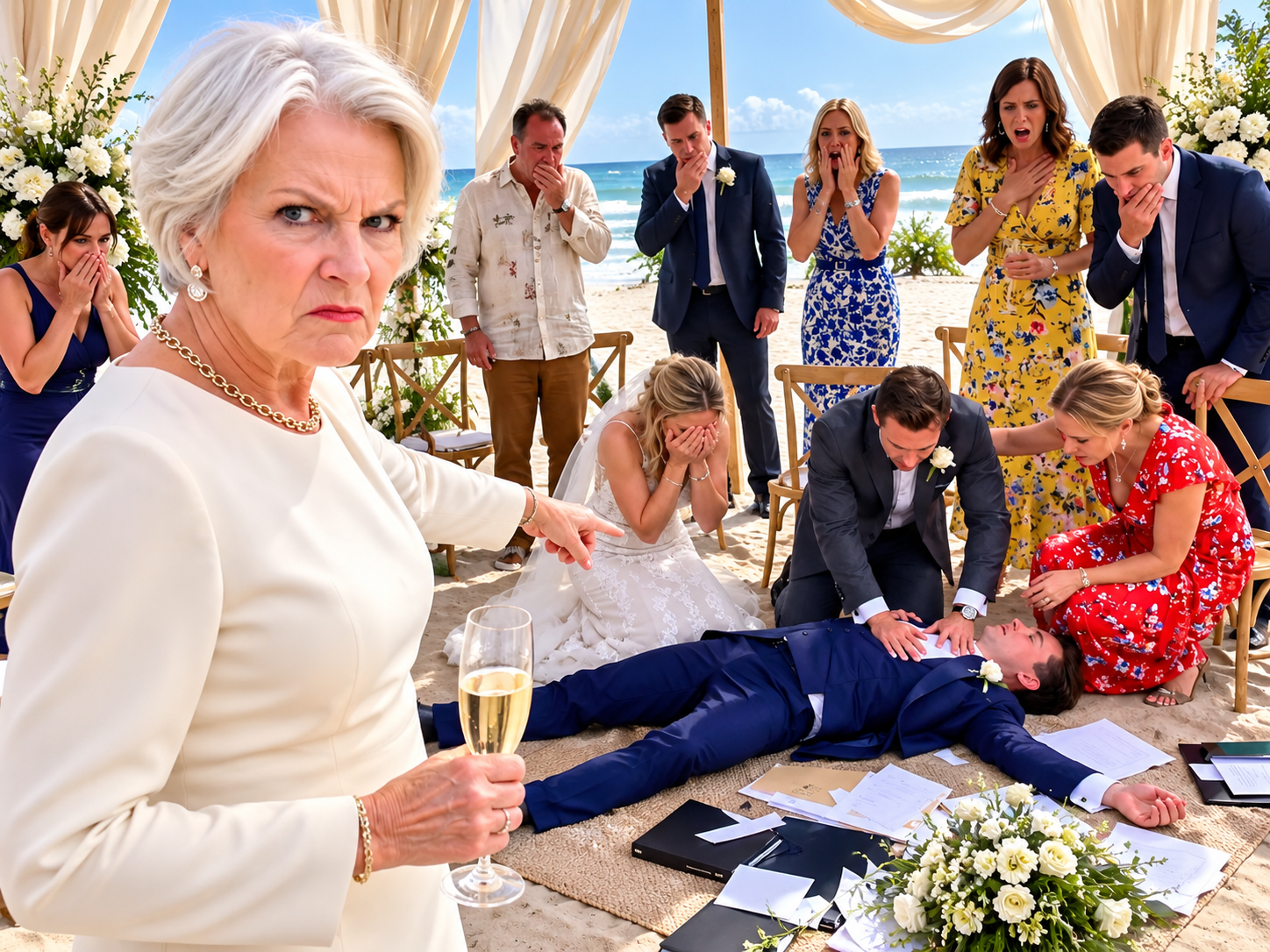
The wind coming off the Atlantic was colder than I remembered.
Lydia tucked her hair behind one ear as we stood near the place where the wedding altar had once been.
There was no trace of the ceremony now.
The sand had erased every footprint.
The pavilion had vanished.
Even the old path where the catering trucks had parked had been covered by new grass.
But I remembered everything.
The white silk.
The orchids.
The champagne.
The guests.
Marcus standing beneath the flowers with that confident smile.
And Lydia beside me, asking whether I had signed the papers.
It seemed impossible that all of it had happened only a few years earlier.
Lydia squeezed my hand.
“I used to think this place represented everything I lost.”
“What does it represent now?”
She looked toward the ocean.
“The moment everything changed.”
I waited.
She continued.
“I hated you for stopping me.”
“I know.”
“I hated you more for being right.”
I smiled faintly.
“You didn't have to admit that.”
“I do now.”
She sat on a weathered bench near the dunes.
I sat beside her.
For a while, we watched the water.
Then she said, “There is something I've never told you.”
I turned toward her.
“What?”
“When Marcus first approached me about the money, I knew something was wrong.”
The words landed quietly.
I stared at her.
“What do you mean?”
She folded her hands in her lap.
“I knew he was desperate.”
“For money?”
“Yes.”
“How long?”
“Months before the wedding.”
I said nothing.
She continued.
“He told me his company needed capital. At first, I thought it was temporary. Then he started asking about your accounts.”
My stomach tightened.
“What did you tell him?”
“Too much.”
She looked ashamed.
“I told him about the trusts. The Greenwich property. The Hamptons estate. The way you structured my inheritance.”
“Why?”
“Because I wanted him to think I was important.”
That answer hurt more than I expected.
“I wanted him to see me as someone who belonged in his world.”
She stared at the sand.
“He kept asking questions, and I kept answering them.”
“Did he ask you to move the two million?”
“Yes.”
“Did you know the companies weren't legitimate?”
“No.”
Then she paused.
“But I knew the money wasn't really being invested.”
I looked at her.
“Lydia.”
“I know.”
She took a breath.
“He told me we would put it back before you noticed.”
I closed my eyes.
That was the piece I had never known.
The fraud had not begun with complete deception.
It had begun with my daughter making a compromise.
A small one, in her mind.
A secret.
A shortcut.
A lie she believed could be repaired later.
Then another.
Then another.
By the time Marcus demanded fifty million, the distance between the woman Lydia had been and the woman she wanted to become had become enormous.
“Why didn't you tell me?” I asked.
She looked at me.
“Because I knew you'd fix it.”
The answer was almost a whisper.
I understood immediately.
She had trusted my money more than she trusted herself.
“If I told you, you'd pay Marcus to make it disappear.”
“I might have.”
“I know.”
She looked away.
“And that scared me.”
I frowned.
“Why?”
“Because I was already becoming someone I didn't recognize.”
The honesty in her voice made me quiet.
She continued.
“I knew that if you rescued me again, I would never have to become better.”
That was the first time I understood that perhaps, somewhere beneath her anger, Lydia had known exactly what I was doing when I refused.
She hadn't thanked me for it then.
She couldn't.
But part of her had understood.
I reached for her hand.
She held mine.
“I was angry at you for making me face myself.”
“I was angry at myself too.”
She looked at me.
“You don't have to take all the blame.”
“I don't.”
“Then stop saying you ruined me.”
I smiled sadly.
“I never said that.”
“You didn't have to.”
She looked directly at me.
“You made mistakes. So did I.”
I nodded.
“That is fair.”
She leaned back.
“Marcus taught me to blame everyone else. He always had a reason. His investors betrayed him. His partners stole from him. His family abandoned him. You were supposedly controlling me.”
“And you believed him.”
“I wanted to.”
That sentence stayed between us.
She had not been fooled because she was unintelligent.
She had been vulnerable because she wanted the story Marcus was selling.
He told her she deserved a life beyond mine.
He told her she was capable of living like the wealthy people she admired.
He told her my fortune was holding her back.
And because she already felt guilty about depending on me, his words sounded like liberation.
He hadn't offered freedom.
He had offered another form of dependence.
“You know what the worst part was?” Lydia asked.
“What?”
“After the arrest, I kept waiting for you to come save me.”
“I know.”
“I was angry that you didn't.”
“I know.”
“I thought you didn't love me anymore.”
I looked at her.
“I loved you enough not to.”
Her eyes filled.
“I understand that now.”
The waves struck the shore with a steady rhythm.
For a few minutes, neither of us spoke.
Then Lydia laughed softly.
“Do you remember the first paycheck I told you about?”
“Six hundred eighty-four dollars.”
“You remembered.”
“Of course.”
“I was so proud of it.”
“You should have been.”
“I bought groceries with it.”
“You told me.”
“I was embarrassed.”
“Why?”
“Because I thought it made me look poor.”
I smiled.
“And now?”
“Now I think it made me look free.”
I looked at her.
She smiled.
“I earned it.”
That was the word she had been missing all those years.
Earned.
Not given.
Not inherited.
Not purchased.
Earned.
She had learned to distinguish between what she was entitled to receive and what she was willing to work for.
That lesson had cost her almost everything.
But perhaps it had saved her from losing herself completely.
A few months later, Lydia invited me to speak at the nonprofit where she worked.
I almost refused.
“I don't know anything about your programs.”
“You know plenty about money.”
“I know about making mistakes with it.”
“That's why I want you there.”
I went.
The room was small.
About forty women sat in folding chairs.
Some looked nervous.
Some angry.
Some exhausted.
Lydia stood at the front.
She introduced me simply.
“This is my mother.”
Nothing more.
No mention of wealth.
No mention of the Hamptons estate.
No mention of the wedding.
Then she said, “She taught me something I didn't understand until I lost almost everything.”
She looked at me.
“Sometimes the person who loves you most is the person who refuses to make your bad choices painless.”
The room became very quiet.
I felt my throat tighten.
Lydia continued.
“I thought independence meant having access to money. I was wrong.”
She looked at the women.
“Independence means knowing what belongs to you, knowing what you're responsible for, and knowing that you can survive when someone takes away the things you thought you needed.”
Afterward, one of the women approached me.
“Your daughter is good at this.”
I smiled.
“She is.”
The woman looked toward Lydia.
“She listens.”
That mattered more than any compliment I could have received about my company.
Lydia had once been the person who expected everyone to listen to her.
Now she had become someone who listened.
That evening, we walked to the parking lot together.
“You were nervous,” I said.
“I was terrified.”
“You didn't look it.”
“I learned from you.”
I laughed.
“That's not always a good thing.”
“No.”
She smiled.
“But some things are.”
We stopped beside my car.
She hugged me.
Not carefully.
Not politely.
She hugged me like the little girl in the cardboard crown.
For several seconds, I closed my eyes.
I could smell her shampoo.
I could feel the weight of her arms around me.
I had missed that.
Not the daughter who wanted my money.
Not the bride who wanted my approval.
My daughter.
The person underneath all of it.
When she stepped back, her eyes were wet.
“I love you.”
“I love you too.”
“Even after everything?”
“Especially after everything.”
She smiled.
“That sounds complicated.”
“It is.”
We both laughed.
Our relationship would never become what it had been.
That was no longer the goal.
We were building something else.
Something slower.
Something less comfortable.
Something honest.
And for the first time, neither of us needed money to prove that it was real.
Click Here to continue read next: PART7: My Daughter Asked Whether She Would Ever Inherit My Fortune, and Her Answer Told Me She Had Finally Learned What Money Could Never Buy
My Daughter Wanted One Last Gift From Me, But Her Fiancé’s Demand Revealed What They Had Really Planned
Part 6 of 8

