
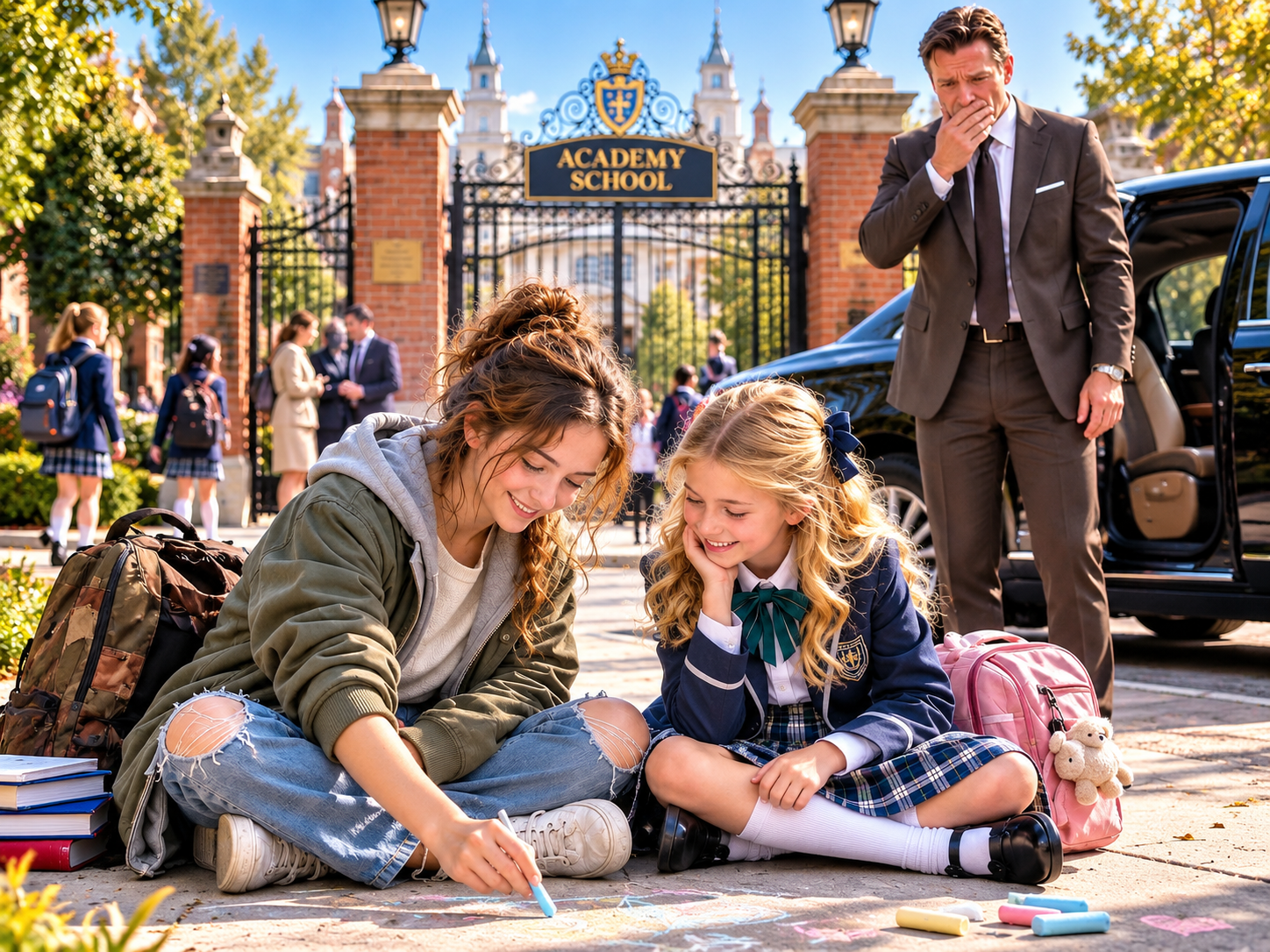
Maya arrived just before midnight.
She stood in our foyer beneath the chandelier and looked uncomfortable enough to apologize to the furniture.
“This is too much.”
“It is a house.”
“It has three staircases.”
“Two.”
She looked toward the hall.
“There are definitely three.”
I followed her gaze.
She was right.
I had lived there for years and had never counted.
That was the first indication that Maya noticed things I didn't.
I showed her the guest room.
She stood in the doorway without entering.
“Is this really mine?”
“For tonight.”
She nodded.
“Right.”
She put her borrowed clothes on the chair instead of unpacking them.
I noticed something else.
She kept her shoes on.
“You can take those off.”
“I know.”
She didn't.
I left.
At 6:30 the next morning, I found her sitting upright on the edge of the bed with her shoes beside her.
She had barely slept.
Later, I learned that she kept her shoes within reach for the first month because she believed she might have to leave quickly.
She also hid food.
Not because she was greedy.
Because she had learned that food could disappear when adults changed their minds.
Our housekeeper discovered granola bars beneath folded towels and said nothing.
The next day she placed a basket of snacks in Maya's room.
No announcement.
No speech.
Just food where Maya could see it.
For several weeks, wrappers began appearing neatly inside the basket.
That was how we measured progress.
Not with dramatic conversations.
With empty wrappers.
Sophie adapted faster than I did.
Within days, Maya became her tutor, older sister, adviser, and occasional accomplice.
“Maya says my teacher explains decimals badly.”
I looked up from my newspaper.
“Maya says you don't understand decimals.”
“She says the teacher skips steps.”
“That sounds different.”
“It isn't.”
Another day Sophie announced, “Maya says I'm old enough to choose my own haircut.”
I looked at Maya.
She raised both hands.
“I did not tell her to cut it herself.”
Sophie added, “She also says rich people use too many forks.”
Maya considered this.
“I stand by that.”
Sophie laughed.
So did I.
I was changing, though slowly.
The hardest thing for me to surrender was control.
One Saturday morning I handed Maya a printed schedule.
Breakfast.
Study.
School applications.
Lunch.
Shopping.
She read the page twice.
Then looked at me.
“What is this?”
“A plan.”
“For today?”
“Yes.”
She tore it in half.
Sophie made a shocked sound.
I stared at Maya.
Maya stared back.
Then she said, “Mrs. Harrison warned me.”
My stomach dropped.
“About what?”
“You.”
Sophie started laughing.
Maya continued.
“She said you think a calendar is a personality.”
Sophie nearly fell off the sofa.
I wanted to object.
Instead, I laughed.
That was the morning we went out for pancakes without making reservations.
For me, that was practically rebellion.
Finding Maya a new school became our next challenge.
Her academic records were extraordinary despite the interruptions.
She took an entrance examination and scored in the top one percent.
The principal of another independent academy called personally to offer her a place.
I asked about tuition.
They told me the number.
I told them Maya's original scholarship fund would cover it.
This time, the money would follow the student.
The audit at Whitmore uncovered more than I expected.
Maya wasn't the only scholarship recipient whose designated funding had been redirected after enrollment problems.
There were other children.
Different circumstances.
The same gap between what donors thought they were funding and what the institution had actually done.
Whitmore returned the unused portion of Maya's restricted scholarship.
They wanted the matter kept quiet.
I refused.
Secrecy had already protected the wrong people.
The independent review forced changes to the school's scholarship policies.
Dr. Whitmore resigned before the semester ended.
I told myself I didn't care.
That wasn't entirely true.
But the satisfaction faded quickly.
The bigger question was Sophie.
She was still attending Whitmore.
One evening, she sat beside me on the stairs.
“I don't like who I am there.”
“What do you mean?”
“Everybody is trying to be impressive.”
“You don't have to.”
“I know.”
She looked down at her shoes.
“But I start doing it anyway.”
I didn't argue.
We toured five schools.
Sophie chose the least expensive one.
It had a community garden, an art room, and a principal who wore sneakers.
During the tour, a fourth grader interrupted the principal and asked whether worms could become depressed.
The principal answered seriously.
Sophie leaned toward me.
“I like this place.”
She transferred the following year.
Within two months, she joined theater.
I had spent years believing Sophie disliked speaking in front of people.
I was wrong.
She disliked being measured.
At her first performance, she froze under the stage lights.
I stood in the audience with my hands clenched.
Maya was beside me.
She waited until Sophie looked toward us.
Then Maya crossed her eyes.
Sophie burst out laughing.
The audience laughed too.
The tension broke.
Sophie delivered every line perfectly.
Afterward, she ran straight toward Maya.
“You made me laugh.”
Maya shrugged.
“That's strategy.”
I watched them together.
Claire would have loved it.
For years, that thought would have destroyed me.
That night it still hurt.
But it no longer felt like being struck.
Grief had changed.
It had become something I could carry without pretending it wasn't there.
One evening, Sophie asked Maya about Claire.
“Do you remember the last thing Mom said to you?”
Maya put down her fork.
“She asked what I wanted to become.”
“What did you say?”
“I said I didn't know.”
Sophie frowned.
“Was she disappointed?”
“No.”
“What did she say?”
“That was good.”
I looked up.
Maya smiled.
“She said adults who decide too early what children should become sometimes stop noticing who those children already are.”
I felt the words settle heavily inside me.
“That sounds like Claire.”
Maya nodded.
“She also told me someday I'd meet Daniel.”
Sophie looked at me.
“What did she say about Dad?”
Maya tried not to smile.
“She said he'd annoy me.”
Sophie burst out laughing.
“She knew him that well?”
“Apparently.”
“What else?”
“She said he'd try to solve everything.”
I sighed.
“That sounds less flattering.”
“She told me not to let you.”
Sophie laughed so hard she nearly dropped her glass.
Then Maya became quiet.
“She loved you.”
I looked at her.
“She talked about you all the time.”
“What did she say?”
Maya hesitated.
“She said you acted like you didn't need anybody.”
My throat tightened.
“But she said you needed people more than anyone she knew.”
I couldn't speak for a moment.
I looked toward the empty chair at the end of the table.
For the first time since Claire died, I let myself imagine her voice without trying to silence it.
Months later, I gave Maya a box.
Inside were copies of Claire's notes, recommendations, photographs, and records.
At the bottom was the photograph from the old scholarship file.
Maya turned it over.
She read Claire's handwriting.
She laughed through tears.
“Daniel would like her.”
“What if she was wrong?”
“She was occasionally wrong.”
Maya looked at me.
“Not about this.”
Then she hugged me.
It lasted only a few seconds.
But neither of us pulled away immediately.
Two years later, Maya graduated near the top of her class.
She had offers from six universities.
Three included major scholarships.
Northwestern.
The University of Chicago.
MIT.
I tried to appear neutral.
Sophie did not.
“MIT has robots.”
Maya looked at her.
“That is not an academic argument.”
“Robots are always serious.”
When Maya's name was announced, Sophie screamed louder than anyone under the graduation tent.
Maya walked across the stage.
She accepted her diploma.
Then looked directly at us.
For one second I saw the teenager from the sidewalk again.
The girl with taped shoes.
The girl who expected every institution to eventually tell her she didn't belong.
I stood.
The people around us stood too.
Maya covered her mouth.
Afterward, Sophie ran to her.
“You did it!”
Maya hugged her.
“We did it.”
“No. You did.”
Maya looked at me.
I held out my hand.
She ignored it and hugged me instead.
Longer this time.
Then she handed me an envelope.
“Don't open it until tonight.”
“What is it?”
“Instructions.”
“That sounds dangerous.”
“Claire-style instructions.”
That evening, I opened the envelope.
Daniel,
You spent three years helping me get somewhere I was already trying to reach.
Thank you for finally learning the difference between helping and controlling.
I laughed.
Then I kept reading.
I used to think Claire saved me.
Then I thought you saved me.
Both ideas were wrong.
Claire opened a door.
You made sure it stayed open.
But I still had to walk through it.
Remember that when Sophie gets older.
She doesn't need you to build every road.
She needs to know you'll still be there when she gets lost.
At the bottom was one final line.
P.S. I'm choosing MIT. Do not buy an apartment in Cambridge.
I shouted upstairs.
“Maya!”
Her laughter came back through the hallway.
“No!”
“I wasn't going to!”
“You absolutely were!”
Then Sophie yelled from the other room.
“He already looked at real estate!”
Traitor.
That fall, Maya left for college.
At the airport, I watched her go through security.
She turned around.
“You're doing the thing.”
“What thing?”
“Standing there like I'm being deployed.”
“I am standing normally.”
“You're frightening the security agent.”
I stepped backward.
“Better?”
“No.”
She smiled.
Then became serious.
“I'll come home for Thanksgiving.”
“This is your home?”
The question escaped before I could stop it.
Maya looked at me.
“Where else would I go?”
I couldn't answer.
She hugged me.
Then disappeared into the crowd.
I stood there longer than necessary.
For once, I didn't make a schedule.
I didn't calculate the next step.
I didn't decide what should happen.
I simply let someone I loved walk forward.
Click Here to continue read next: PART4: Years After That Sidewalk Encounter, Maya Returned With a Different Kind of Scholarship and a Lesson Claire Had Wanted Me to Learn
I Came for My Daughter Twenty Minutes Early, Then Saw a Stranger Beside Her—and the Name Inside That Girl’s Backpack Stopped Me Cold
Part 3 of 8

