
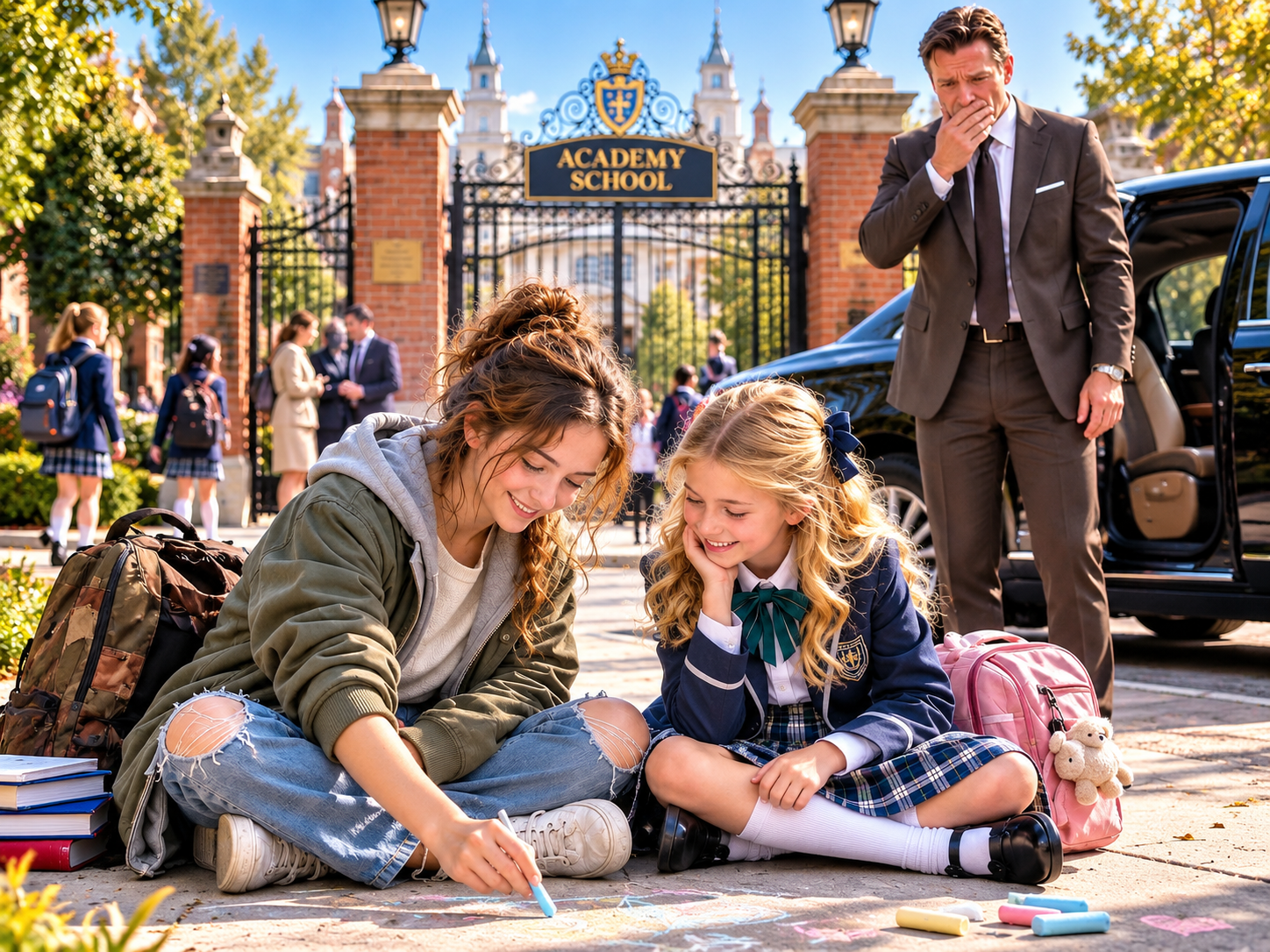
Five years after I first saw Maya sitting on that sidewalk, I stood outside a renovated brick building on Chicago's West Side.
There was no marble entrance.
No bronze wall covered with donor names.
No oversized photograph of wealthy people holding champagne glasses.
Above the door was a simple sign.
THE CLAIRE PROJECT.
Underneath it were three words.
Education. Housing. Continuity.
Maya had created the organization.
She had designed its purpose around the problem that nearly erased her education.
If a teenager lost stable housing, school should not disappear with the address.
If transportation changed, transportation should change with the student.
If records vanished, someone should help rebuild them.
If scholarship money was designated for a child, the money should follow the child.
It sounded simple.
That was why it mattered.
Maya stood beside me before the opening ceremony.
She wore a dark jacket, carried a folder full of notes, and looked nothing like the frightened girl from the pharmacy.
Almost nothing.
She still checked exits when entering unfamiliar buildings.
She still refused expensive gifts.
And she still corrected me when I made assumptions.
“You're nervous,” I said.
“No.”
“You've rewritten your speech six times.”
“Seven.”
“So you're nervous.”
She looked at me.
“I'm prepared.”
“That is what nervous people say when they own seven drafts.”
She smiled.
“Claire would agree with me.”
That silenced me for a second.
Claire's name no longer felt like a locked room.
It had become part of the house again.
Sophie arrived a few minutes later.
She was thirteen by then and carried a sketchbook everywhere.
She looked at the building.
“It doesn't look like a foundation.”
“That was intentional,” Maya said.
“Why?”
“Because teenagers don't need another place that looks like adults are doing them a favor.”
Sophie considered that.
“I like it.”
A reporter approached Maya before the ceremony.
“Why did you name this after Claire instead of using the Harrison name?”
Maya looked toward me.
Then took the microphone.
“Because Mrs. Harrison saw children before she saw problems.”
The reporter asked about her relationship with Claire.
Maya didn't give the easy answer.
“Did she save your life?”
“No.”
The reporter looked surprised.
Maya continued.
“She noticed me.”
The room quieted.
“There is a difference.”
Maya looked toward the students sitting in the front rows.
“When people say someone was saved, sometimes the story becomes mostly about the person who did the saving.”
She paused.
“Noticing someone is different.”
She explained that Claire had recognized ability where other adults saw circumstances.
She hadn't pretended Maya's problems were unimportant.
She simply refused to treat those problems as an identity.
I watched Maya speak and remembered the first afternoon.
The broken zipper.
The taped shoe.
The folded scholarship paper.
Sophie sitting beside her with a pencil.
And Claire's name appearing where I least expected it.
After the speech, the reporter turned to me.
“Mr. Harrison, what did you learn?”
I disliked the question.
Maybe because I knew the answer too well.
“Money is excellent at paying for things.”
People laughed.
“But it is terrible at noticing people.”
The room went quiet.
“My wife understood that before I did.”
I looked at Sophie.
“My daughter understood it before I did.”
Then I looked at Maya.
“And Maya made sure I understood it eventually.”
Outside, children were drawing with chalk on the sidewalk.
One little girl sat by herself working through a mathematics problem.
Maya saw her.
Of course she did.
She crouched beside the girl.
“Stuck?”
The girl nodded.
Maya picked up the chalk.
“Try moving this number here.”
The girl frowned.
Then she tried.
Her answer changed.
So did her expression.
Sophie stopped beside me.
For a moment, none of us spoke.
The scene was too familiar.
A child.
A sidewalk.
Mathematics.
A person sitting beside her instead of walking past.
Sophie slipped her hand into mine.
“Dad?”
“Yes?”
“Do you ever think about what would have happened if you had arrived at the normal time?”
I looked at Maya.
“Yes.”
“What would have happened?”
“I think I would have missed something important.”
Sophie leaned against my shoulder.
“You miss lots of important things.”
“Thank you.”
She smiled.
“You're getting better.”
I accepted that as high praise.
Years later, Sophie graduated from high school.
She was supposed to speak for four minutes.
She spoke for seven.
Apparently, our family had finally abandoned schedules completely.
Maya sat beside me.
She had finished college and begun graduate work in applied mathematics and education policy.
She still came home for Thanksgiving.
Still challenged my assumptions.
Still rejected expensive presents.
Still made Sophie laugh at exactly the wrong moments.
Sophie looked across the auditorium during her speech.
“When I was eight,” she said, “I thought the smartest person I knew was a homeless girl sitting outside my school.”
The auditorium became silent.
“She taught me fractions with a stick.”
Maya lowered her head.
Sophie smiled.
“Later, she taught me something harder.”
She looked toward the audience.
“She taught me that where someone stands today doesn't tell you where they belong tomorrow.”
My eyes blurred.
Then Sophie added:
“She also taught my dad that schedules are not personalities.”
The auditorium erupted.
I turned toward Maya.
“You two planned that.”
“Absolutely.”
Sophie waited for the laughter to fade.
Then she became serious.
“My mother helped Maya because she believed money should never decide a child's future.”
“Maya helped me because she believed knowledge should never belong only to people who could afford it.”
“And my dad eventually learned that loving someone sometimes means opening a door and resisting the urge to drag them through it.”
The room became still again.
Sophie looked across the audience.
“So wherever you go after today, notice people.”
“Not their clothes.”
“Not their address.”
“Not their last name.”
“Not what they can give you.”
“Notice them.”
She paused.
“One person noticing another person can change more than one life.”
Then she stepped away from the microphone.
Everyone stood.
Maya was crying.
I pretended not to.
After the ceremony, we went back to the Claire Project.
Near the entrance was a small bronze plaque.
Maya had selected the wording herself.
I had suggested something longer.
She rejected every version.
The final plaque contained only two words.
NOTICE SOMEONE.
No donor names.
No family crest.
No explanation.
Just the instruction.
I stood beside it for a while.
Maya joined me.
“You still don't like it.”
“I didn't say that.”
“You suggested six alternatives.”
“They were elegant.”
“They were boring.”
I smiled.
“That sounds like Claire.”
Maya looked at the plaque.
“She would have hated all six.”
“She would have.”
We stood in silence.
Then Maya pointed toward the sidewalk.
A boy was sitting beside another child.
They were drawing equations in chalk.
The younger child tried an answer.
Wrong.
He tried again.
Wrong.
The older boy didn't grab the chalk from him.
He didn't give him the answer.
He waited.
The younger child stared at the numbers.
Then his face changed.
He understood.
He laughed.
The older boy laughed with him.
I smiled.
I didn't interrupt.
I didn't ask whether they belonged there.
I didn't call anyone.
I didn't make a plan.
I simply watched.
That was the lesson I had been resisting since the day I arrived early at Whitmore Academy.
Claire had never believed that every struggling person needed to be rescued by someone with more money.
She believed something quieter.
Sometimes a person needs an adult to notice what they can become before circumstances convince them otherwise.
Sometimes they need a door.
Sometimes they need someone willing to keep that door open.
But eventually, they have to walk through it themselves.
Maya had.
Sophie would.
And, in ways I hadn't expected, I had too.
I looked down the sidewalk where everything had begun.
The pavement was ordinary.
The city moved around us.
Cars passed.
People hurried toward trains and offices and apartments.
No one looking at that street would have known that one afternoon had changed the direction of several lives.
Sophie came to stand beside me.
“Dad?”
“Yes?”
“Are you thinking about Mom?”
I looked toward the plaque.
“Yes.”
“Does it still hurt?”
“Yes.”
She slipped her hand into mine.
“Good.”
I looked at her.
“Good?”
“It means you still remember her.”
That was the kind of answer Claire would have loved.
I squeezed Sophie's hand.
Across the courtyard, Maya was helping another student with a mathematics problem.
She had become the person Claire had believed she could become.
Not because someone had rescued her.
Because someone had noticed her.
Because someone had opened a door.
Because, eventually, she had walked through it.
And because the girl who once sat on a sidewalk with a borrowed pencil had learned how to leave doors open for people who came after her.
I had spent years believing love meant preventing every fall.
Claire had known better.
Love could also mean staying close enough to help someone stand without deciding where they had to walk next.
I looked once more at the bronze plaque.
NOTICE SOMEONE.
For most of my life, I had believed the important moments were the ones I planned carefully.
That afternoon proved otherwise.
Sometimes the life-changing moment is the one you almost miss because you arrived too early.
Sometimes the stranger beside your child knows something about the person you lost that you desperately need to hear.
Sometimes a forgotten scholarship exposes a system that needs to change.
Sometimes a frightened teenager asks for one night, and you don't yet understand that she is asking for a place to belong.
And sometimes the person you think you are helping becomes the person who teaches you how to see.
I still think about that sidewalk.
Not because it was where Maya's story began.
It wasn't.
Her story had begun long before I knew her name.
I remember it because it was where our stories finally crossed.
Claire had left a promise behind.
Maya had carried it.
Sophie had noticed her.
And I had arrived early enough to see what I would otherwise have missed.
That was all.
And it was everything.
Click Here to continue read next: PART5: The Door Maya Opened for Others Soon Became Too Small, and the Choice She Faced Forced Her to Question Everything Claire Had Taught Her
I Came for My Daughter Twenty Minutes Early, Then Saw a Stranger Beside Her—and the Name Inside That Girl’s Backpack Stopped Me Cold
Part 4 of 8

