
The caller introduced himself as Daniel Voss, operations director at Calder Aerostructures. His voice had the careful strain of someone trying to keep a production crisis from spreading through the building.
“Our finishing center has been down since yesterday afternoon,” he said. “Three technicians have worked on it. The manufacturer says they can't send anyone until Monday.”
It was Wednesday.
“What machine?”
Daniel gave me the model number. I knew the machine family well enough to recognize its usual failure modes.
“What happens when you command a spindle start?”
“The interlock clears. The motor accelerates normally. Around forty percent, the vibration alarm appears and the drive shuts down.”
My pen stopped moving.
“What vibration alarm?”
Daniel read the code from the screen.
It wasn't the same alarm Bay Three had produced, but it belonged to the same monitoring family. The relationship was subtle enough that I might have dismissed it on another day.
I didn't.
“Has anyone replaced the vibration sensor?”
“Yes.”
“The cable?”
“Yes.”
“The drive?”
“No.”
“Good. Don't replace it yet.”
Walter, standing beside my truck, raised an eyebrow.
Daniel hesitated. “That's what the manufacturer wants us to replace.”
“How much?”
“About seventy thousand dollars before freight.”
“Hold the order.”
A silence followed.
“Can you come?”
I looked at the contract Eleanor had handed me that morning. It rested on the passenger seat beside Walter's new tool case.
Two days earlier, I would have needed somebody else's permission before leaving work.
Now the decision was mine.
“Yes.”
“What’s your emergency rate?”
The question felt different this time.
The six-hundred-thousand-dollar figure had belonged to a very particular circumstance: Meridian qualification, an immediate corporate crisis, and a company that had terminated me minutes before asking me to assume responsibility for its most valuable machine.
Calder was different.
I quoted a normal industrial emergency rate.
Daniel accepted without bargaining.
“When can you get here?”
“I’m leaving now.”
Walter opened the passenger door.
I looked at him.
“What are you doing?”
“Coming.”
“You work for Horizon.”
“Today is my day off.”
“You had plans.”
“I was going to replace a faucet.”
“And now?”
He climbed in.
“Now I’m making sure you don't bankrupt your new company before it has an office.”
“My company is organized.”
“Where are the invoices?”
“On my phone.”
Walter stared at me.
“That isn't organized. That's electricity.”
Twenty minutes later, we were on the interstate.
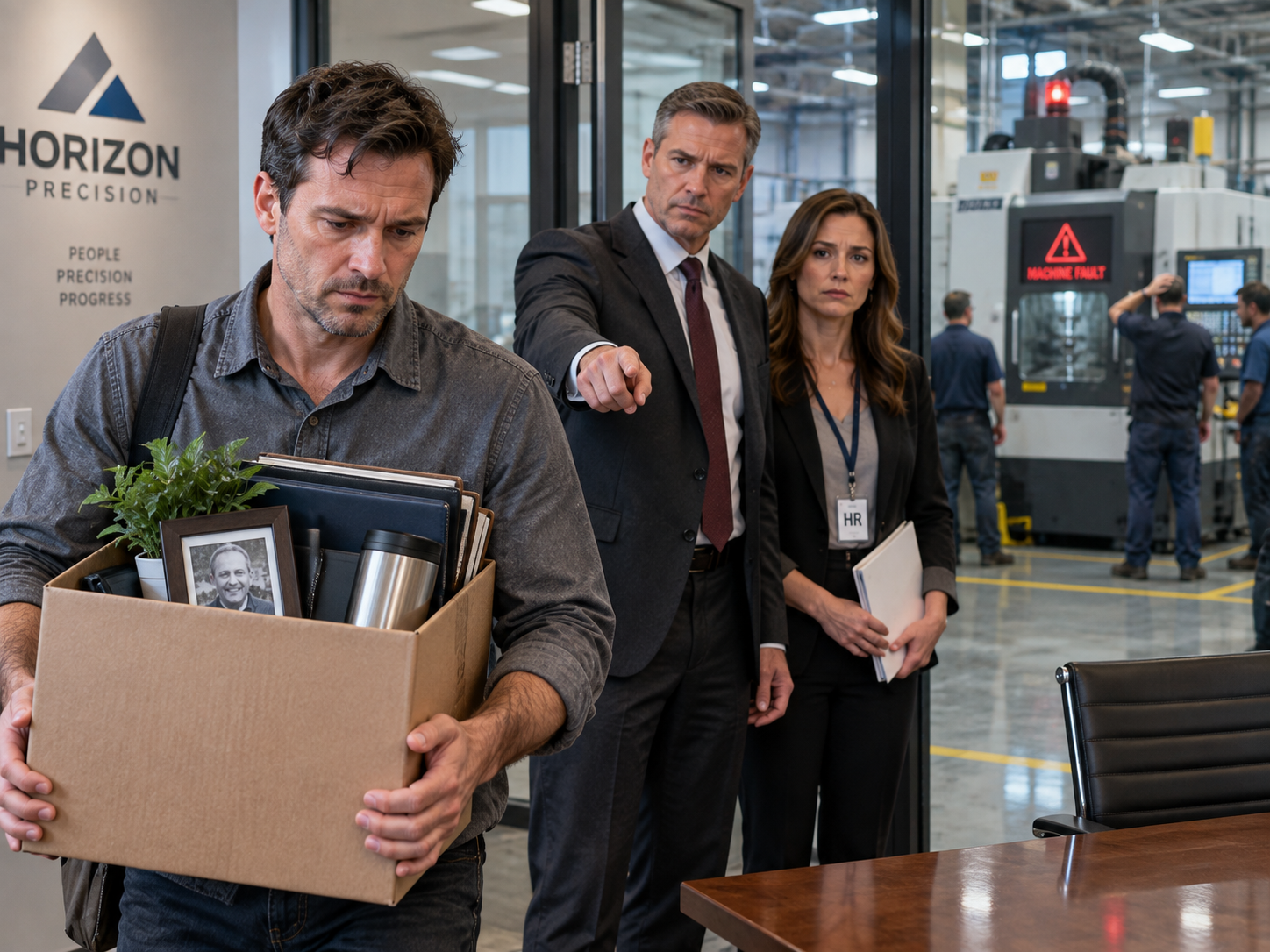
The cardboard box from Horizon sat behind the seats. Every bump made the old coffee mug knock softly against one of my engineering books.
Walter glanced backward.
“You planning to drive around with your whole career in a box?”
“Not forever.”
“Office?”
“Eventually.”
“Employees?”
“Eventually.”
“Accountant?”
I sighed.
“Eventually.”
Walter looked out the window.
“Bankrupt by Friday.”
Calder Aerostructures occupied a low industrial complex surrounded by fields, freight depots, and a scattering of warehouses. Inside, the familiar smell of aluminum coolant and cutting oil greeted us.
Daniel met us at reception.
He was younger than I had expected, perhaps forty, with his sleeves rolled up and safety glasses resting on top of his head.
“You Parker?”
“Yes.”
He looked at Walter.
“And you?”
Walter answered before I could.
“Adult supervision.”
Daniel laughed.
Not much, but enough to break the tension.
The finishing center was at the far end of the building. A maintenance technician named Luis had already removed the machine's side panels.
His tools were arranged in straight lines across a rolling cart.
I noticed that immediately.
People who organized their tools that carefully usually kept their thoughts organized too.
“What have you checked?”
Luis handed me a notebook.
Not a verbal explanation.
Actual measurements.
Voltage readings.
Connector resistance.
Sensor replacement.
Cable continuity.
Drive temperature.
Alarm timestamps.
I looked at him.
“This is good.”
He shrugged.
“The machine isn't running.”
“Good work can still end with an unresolved problem.”
Walter leaned toward Daniel.
“He says things like that when he's trying to sound expensive.”
I ignored him.
We started the machine.
The failure occurred exactly as Daniel had described.
Spindle command.
Acceleration.
Forty percent.
Vibration alarm.
Shutdown.
I watched the trace.
My stomach tightened.
The waveform looked wrong.
Not identical to Bay Three.
Similar.
Too clean.
“Luis, when did this begin?”
“Yesterday at 2:16.”
“Maintenance immediately before?”
“No.”
“Software changes?”
“No.”
“Parameter access?”
He shook his head.
“Protected.”
“Who has administrator credentials?”
“Me, the maintenance manager, and corporate engineering.”
I opened the event history.
The controller requested service credentials.
Luis entered them.
A record appeared from the previous afternoon.
At 1:58, vibration compensation had been modified.
I looked at Daniel.
“Someone changed your configuration.”
His expression hardened.
“No one should have.”
“Someone did.”
Luis leaned over my shoulder.
“That parameter is restricted.”
“Yes.”
I compared the altered value with Calder's commissioning backup.
Different.
Not wildly different.
Just enough.
“Restore the original.”
Luis hesitated.
“That's it?”
“Not yet.”
We restored the validated value.
The spindle accelerated again.
Twenty percent.
Forty.
Sixty.
No alarm.
At full speed, the vibration remained well below the threshold.
Daniel exhaled.
“Four technicians. Twelve hours.”
“They were looking for mechanical damage.”
“There wasn't any.”
“Exactly.”
Luis stared at the event log.
“Who changed it?”
“That is your next problem.”
Daniel looked uneasy.
“You think someone did this deliberately?”
“I think a protected value was changed.”
“That isn't what I asked.”
“I don't know intent.”
Walter had stopped joking.
He was staring at the access history.
“What account made the change?”
Luis scrolled.
“External service.”
Daniel frowned.
“We didn't have an outside service team here yesterday.”
I stepped closer.
“Show me.”
The account was generic.
Manufacturer-level.
Remote maintenance.
I opened the authentication details.
Then stopped.
The certificate issuer was familiar.
Northstar Industrial Systems.
Walter saw my face.
“You know it?”
“Yes.”
“Who are they?”
“A controls support subcontractor Horizon considered during Richard's outsourcing proposal.”
Daniel looked from me to the screen.
“They quoted us last month.”
“Did you hire them?”
“No.”
“Did they perform a systems assessment?”
Daniel thought.
“They gave us a presentation.”
“Who arranged it?”
“Adrian Kells.”
I knew the name.
Adrian had visited Horizon twice. Richard had introduced him as an efficiency consultant. The second meeting had been held behind closed doors.
Walter swore softly.
Daniel heard him.
“What?”
I pointed toward the controller.
“You need to preserve this access history.”
“Why?”
“Because someone may have used a vendor account without authorization.”
Daniel's expression changed.
“You've seen this before.”
“Yes.”
“Recently?”
I didn't answer.
He understood.
Luis exported the relevant logs to a secure drive. Daniel instructed his IT manager to create a forensic copy before giving anything to us.
That was exactly what I wanted.
Preserve the original.
Make copies.
Don't overwrite anything.
As Walter and I walked back toward the truck, he finally spoke.
“Richard wasn't just trying to sell Horizon his consulting company.”
“I don't know that.”
“Northstar was in his presentation.”
“Yes.”
“They remotely changed Calder.”
“Yes.”
“And Calder happened to have a failure right after Northstar tried to sell them support.”
“That still doesn't prove coordination.”
Walter looked at me.
“You engineers have an allergy to obvious conclusions.”
“We have an allergy to conclusions that arrive before evidence.”
My phone rang.
Eleanor.
I answered.
“Ethan.”
Her voice was tighter than before.
“I need you back at Horizon.”
“What happened?”
“We found something in Richard's office.”
“What?”
“A list.”
“What kind?”
“Companies.”
She paused.
“Calder Aerostructures is on it.”
I looked at Walter.
The list I had been trying not to imagine had just become real.
Click Here to continue read next: PART6: Richard’s Private Spreadsheet Named Twelve Companies, but the Hidden Columns Revealed That Their Failures Had Been Timed Around Moments of Maximum Exposure
The Badge Went Dead Before Anyone Explained Why, and Then the Machine Behind the Glass Began Failing in Ways That Made No Sense
Part 5 of 8

