
The photograph moved from hand to hand.
Nobody recognized the passenger except Carol.
I had spent years looking through Parker family albums. Christmas gatherings. Harvest dinners. Old photographs of tractors and birthdays. Harold when he was young. Grandma in dresses that belonged to another era.
Thomas Parker had never appeared.
Not once.
June placed the photograph in front of Carol.
“Tell me his name again.”
“Thomas.”
“Grandpa's brother?”
“Yes.”
“And we were told he died?”
Carol lowered herself into a chair.
“You weren't supposed to know about him at all.”
Mark stared at his mother.
“I've never heard that name.”
“That was deliberate.”
“Whose decision?”
“Your grandfather's.”
June leaned closer.
“My father is somewhere in Kansas with a man Grandpa erased from the family. That man used Grandpa's identification today. Whatever promise you made to keep this secret is finished.”
Carol looked toward Vernon.
He said nothing.
Daniel Mercer asked everyone to remain where they were while he explained what investigators knew.
Dale was told separately that he should not leave.
A deputy took position near the lobby.
“This investigation did not begin with Harold's will,” Mercer said.
Vernon nodded.
“The account access?”
“That was part of it. We also received notice of documents seeking control over assets associated with Harold.”
“The forged transfer?” June asked.
“Possibly connected. We're still establishing who prepared it.”
Dale crossed his arms.
“I already told everyone I forged nothing.”
Mercer looked at him.
“I didn't accuse you of forging anything.”
Dale's discomfort increased.
June turned back toward Carol.
“Start at the beginning.”
Carol rubbed her thumb along the broken heel in her hand.
“Thomas was three years younger than Dad.”
“They inherited together?”
“Yes.”
Their father had left both brothers farmland and other property.
Harold treated money cautiously. Thomas did not.
Harold repaired old machinery until replacement was unavoidable.
Thomas borrowed money for newer equipment.
Harold distrusted debt.
Thomas saw credit as proof that someone believed in him.
By the late 1970s, Thomas owed money to banks, equipment lenders, and private creditors.
Harold repeatedly rescued him.
“How much did Grandpa pay?”
“I don't know.”
“You know more than that.”
“I was a teenager.”
“That doesn't answer me.”
Carol looked exhausted.
“No. It doesn't.”
The brothers finally broke apart in 1984.
Thomas had pledged family property against debts without Harold's proper consent.
When the loans failed, creditors attempted to seize property the brothers had inherited.
June's voice sharpened.
“Did he forge Grandpa's name?”
Carol hesitated.
“I don't know what the legal term would be. Dad said Thomas signed documents he had no authority to sign.”
Mercer wrote something down.
“What happened after that?”
“They fought.”
“Families fight,” Mark said.
Carol shook her head.
“Not like this.”
Police became involved.
That changed the room.
“What happened?” June asked.
“I don't know everything. Mom wouldn't talk about it. Dad wouldn't either. Thomas left Kansas.”
“And then?”
“About a year later, we heard he died.”
“How?”
“A car accident.”
“Where?”
“Arizona.”
“Who went to the funeral?”
“Nobody.”
“Who saw the body?”
“Nobody.”
“Who confirmed the death?”
Carol's patience broke.
“There was a notice. Someone called. Dad said it was true.”
“Who called?”
“I don't remember.”
“You never checked?”
“This was decades ago.”
Carol's voice became defensive.
“We couldn't look everything up on our phones.”
Mercer closed his notebook.
“We checked now.”
Everyone looked at him.
“There is no Arizona death certificate matching Thomas Parker's family information.”
Carol closed her eyes.
Mercer continued.
“There is evidence Thomas used multiple identities.”
“Aliases?” Mark asked.
“Yes.”
“For crimes?”
“We're still investigating his history.”
June turned toward Vernon.
“Did Grandpa know Thomas was alive?”
Vernon removed his glasses.
“That question deserves a precise answer.”
“Give me one.”
“Harold knew Thomas did not die in the 1980s.”
Carol stood so abruptly her chair scraped backward.
“You knew?”
“I knew what Harold told me.”
“For how long?”
“More than forty years.”
Carol stared at him.
“You helped Dad let us believe our uncle was dead?”
“Harold believed Thomas remained a financial threat to the family.”
“That doesn't justify it.”
“I am not asking you to approve.”
June leaned forward.
“Why are you talking about what Grandpa allowed you to say?”
Vernon looked at her.
“Because Harold left different instructions if Thomas ever returned after his death.”
The room went still.
“You mean Grandpa expected this?” I asked.
“He considered it possible.”
“Why?”
“Someone contacted Thomas.”
June looked toward Dale.
Then toward the photograph of Robert.
“My father.”
Vernon did not answer.
Mercer did.
“We have phone records showing Robert Parker communicated repeatedly with a number associated with Thomas for approximately seven months.”
June's shoulders dropped.
“Seven months?”
“Yes.”
Carol whispered, “Robert knew Thomas was alive?”
“Yes.”
Mark turned toward Dale.
“Did you know?”
“No.”
“Don't lie.”
Dale looked angry.
“I knew Robert was searching for an older relative.”
“Why?”
“He said there might be ownership issues with Grandpa's land.”
June gave a short laugh.
“There it is.”
Dale frowned.
“What?”
“Money.”
“It wasn't about money.”
“Then why did you create Prairie Heritage Holdings?”
“For contracting.”
“And someone just happened to prepare fraudulent paperwork transferring Grandpa's assets to your company?”
“I didn't create those papers.”
“Who did?”
Dale said nothing.
Mercer stepped between them.
“We can establish responsibility for the documents separately.”
June pointed toward Robert's photograph.
“What were my father and Thomas doing today?”
Mercer hesitated.
“We believe they expected Harold to have assets outside the trust.”
June looked at Vernon.
“Did he?”
Vernon and Mercer exchanged a glance.
June caught it.
“Did he?”
“Not in the way Robert apparently expected.”
Vernon opened another compartment in the binder.
He removed an old yellowed envelope.
Harold's handwriting crossed the front.
FOR JUNE, IF THOMAS RETURNS.
June stared at it.
“Why leave this to me?”
“Harold believed Robert might try to make you responsible for whatever happened once Thomas appeared.”
June's mouth hardened.
“He knew Dad.”
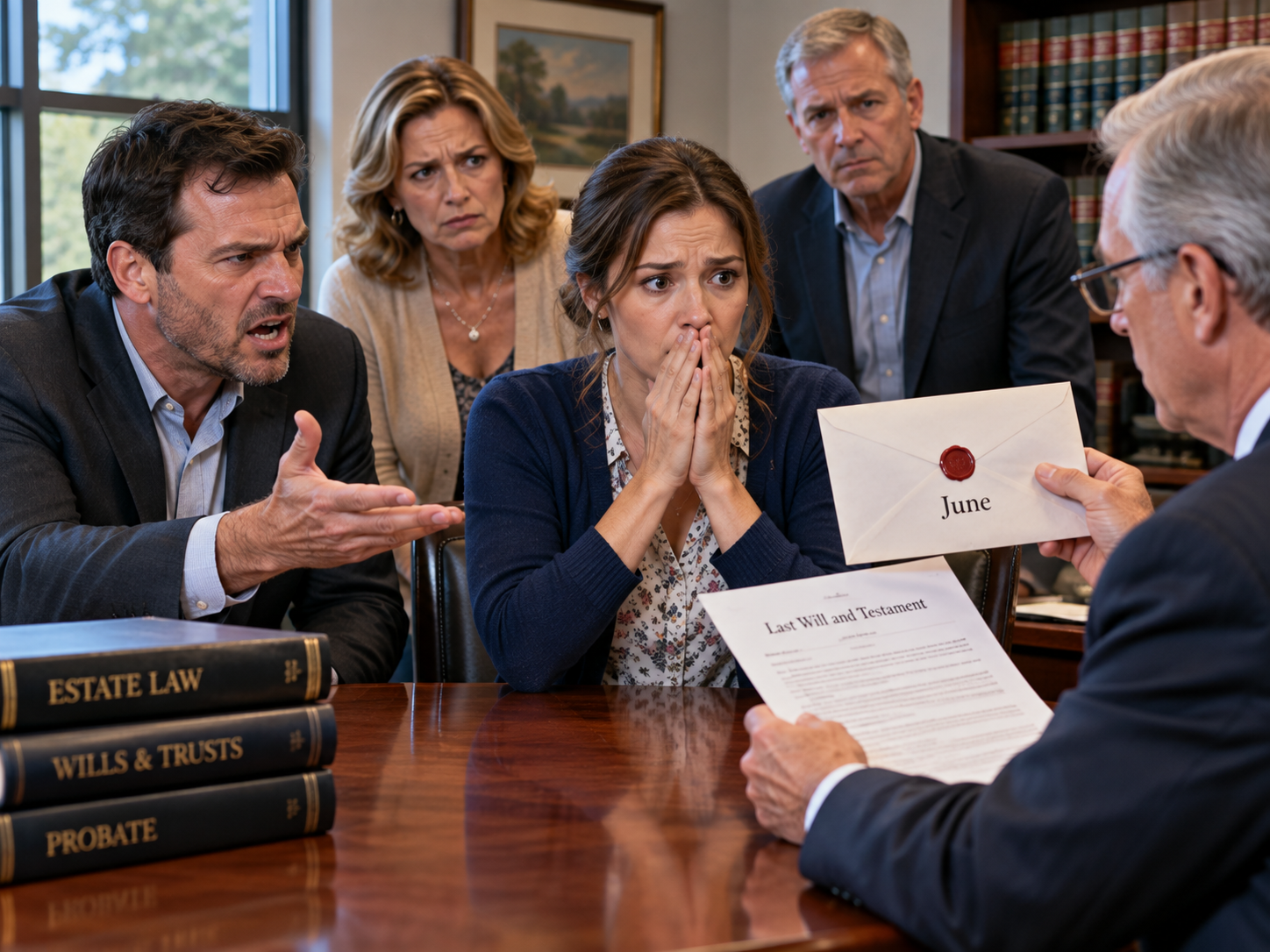
She opened the envelope.
Inside were property records, old correspondence, and a letter.
One document was dated 1984.
Thomas Parker had signed an agreement acknowledging that Harold had paid obligations Thomas had created against jointly inherited property.
In return, Thomas had surrendered his interests in the affected land.
Mark leaned over my shoulder.
“So Grandpa legally owned the farm.”
“Yes,” Vernon said.
“For all these years?”
“Yes.”
“Then why pretend Thomas was dead?”
“Because losing the property did not end Thomas's anger.”
Carol looked at Vernon.
“What did he do?”
“Harold explained that himself.”
June read silently.
Thomas had accused Harold of stealing his inheritance.
He threatened lawsuits.
Then creditors.
Then exposure of family secrets.
Eventually the threats became personal.
Harold's wife was mentioned.
So were his children.
Carol's face changed.
“He threatened Mom?”
“Yes.”
Harold eventually paid Thomas one final settlement on the condition that he leave Kansas and stop contacting the family.
Later, Thomas apparently allowed people to believe he had died while trying to escape creditors of his own.
Harold had not created the false death.
He had simply stopped correcting it.
“Why?” Mark asked.
June answered before Vernon could.
“Because nobody asks a dead man where he lives.”
Vernon nodded.
For decades, the lie worked.
Thomas vanished.
The family stopped asking questions.
Then Robert found him.
June stared at the letter.
“Why would Dad bring him back?”
Mercer answered.
“Your father appears to be under serious financial pressure.”
“How serious?”
“We're still determining the full amount.”
June rubbed her forehead.
“He already used Grandpa's identity.”
“Yes.”
“He used mine.”
“Yes.”
“And Grandpa paid his debt.”
“Yes.”
Her voice became very quiet.
“So Dad learned nothing.”
Nobody disagreed.
A phone rang in the lobby.
The teller answered.
A moment later she appeared.
“Mr. Mercer?”
He stepped outside.
We watched him through the glass.
He listened.
His posture changed.
Then he returned.
“Robert's SUV has been located.”
June stood.
“Where?”
“Outside Solomon.”
“Was Dad inside?”
“No.”
“Thomas?”
“No.”
“Then where are they?”
“We don't know.”
“The driver's door was left open. Robert's phone was inside.”
Mercer paused.
“There was also a county property map.”
Vernon leaned forward.
“What location was marked?”
“The old Parker farm.”
June gripped the chair.
“They went back there.”
“We believe at least one of them may have.”
“I'm going.”
“No.”
“My father could be there.”
“We don't know that.”
“The vehicle has a map pointing to the farm.”
“That's exactly why deputies will handle it.”
June looked ready to argue.
Then she stopped.
For the first time that day, she seemed to separate fear from action.
“Fine.”
Mercer relaxed slightly.
“But I'm not going home.”
“I didn't ask you to.”
“I'll stay wherever you stay until somebody tells me what Dad wanted from that house.”
Vernon opened Harold's binder again.
“There may be an answer.”
He removed an inventory sheet.
Desk.
Filing cabinet.
Bookcase.
Lockbox.
One line had been underlined twice.
BLACK LEDGER — NOT TO BE REMOVED FROM PROPERTY UNTIL AFTER MY DEATH.
Mark frowned.
“What black ledger?”
Vernon folded his hands.
“For more than fifty years, Harold kept detailed records of financial dealings involving members of his family.”
“Loans?”
“Loans. Guarantees. Property transfers. Repayments. Debts he forgave. Debts he chose not to forgive.”
Carol's eyes widened.
“Did Robert know about it?”
“Harold believed Robert discovered references to the ledger while searching the study.”
June looked toward the darkening windows.
“So Dad and Thomas aren't looking for hidden money.”
“Probably not.”
“They want records.”
Mercer's radio crackled.
Everyone stopped.
A deputy's voice came through in broken fragments.
“North side of property.”
Static.
“Door open.”
Another burst of static.
“No visible occupants.”
Mercer lifted the radio.
“Hold the perimeter. Nobody enters alone.”
June closed her fingers around Grandpa's brass key.
Only hours earlier, she had expected an ugly argument over a will.
Now she knew Harold had hidden millions from his family, that her father had used her identity in a fraud, that Dale's company was connected to forged paperwork, and that the uncle everyone had believed dead for forty years was alive.
Then the radio sounded again.
Mercer answered.
“What have you found?”
The deputy's voice returned.
“Movement near the barn.”
Mercer stood.
“Identify.”
A pause.
Then:
“Older male. Says he's Thomas Parker.”
Carol lowered her eyes.
Mercer was already reaching for the door when the deputy spoke again.
“He's alone.”
Mercer stopped.
“What about Robert?”
Silence.
Then the answer came.
“Thomas says Robert isn't with him anymore.”
June tightened her hand around the brass key.
For the first time, nobody in the room knew where Robert was.
And somewhere beyond the fading light, the old Parker farm was holding the answer.
Click Here to continue read next: PART5: The Man Who Had Been Declared Dead Walked Into the Farmhouse With Grandpa’s Ledger, but Robert Had Taken the One Page That Mattered Most
The Will Made Everyone Angry, but the Envelope With June’s Name on It Suggested Grandpa Had Prepared for Something Much Worse
Part 4 of 8

