
After the developer disappeared from the conversation, the atmosphere around the farmhouse changed.
Brandon stopped calling every few hours.
Melissa stopped sending messages filled with explanations.
The urgent tone vanished.
So did the confidence.
For the first time since Nicholas died, nobody was telling me what I should do next.
I had expected relief.
Instead, I discovered that freedom could feel unfamiliar when you had spent decades making decisions around other people.
The farmhouse was quiet.
Too quiet at first.
Nicholas's chair remained near the window.
His work boots were still by the back door.
A jacket hung on the peg where he had left it.
I could not bring myself to move any of it.
But I also refused to let grief become another reason for someone else to take control.
Vincent returned the following week with more paperwork.
The legal position was clear.
The land remained mine.
The farmhouse remained mine.
The orchard business remained under my control as surviving principal.
The document carrying the questionable signature could not simply be treated as proof of ownership.
The developer had been warned.
The sale was finished before it had begun.
Brandon came to the house one afternoon.
He stood on the porch with his hands in his pockets.
“Can I come in?”
I looked at him for a long moment.
“Yes.”
He stepped inside.
He did not sit immediately.
His eyes moved around the room.
The same room where he had spent childhood birthdays.
The same hallway where Nicholas had measured his height against the wall.
The same kitchen where Melissa had once learned to make pie.
Brandon finally sat down.
“I've been thinking.”
“I hope so.”
He gave a small, tired smile.
“I deserve that.”
I sat opposite him.
He looked older than he had a week earlier.
Not physically.
Something in his expression had changed.
“I was scared,” he said.
“I know.”
“I kept thinking about the money.”
“I know.”
“I thought if we sold the orchard, everything would be fixed.”
“Everything for whom?”
He looked at me.
“For me. For Melissa. I suppose I told myself it would help you too.”
“But you never asked.”
“No.”
He looked down.
“I thought you would refuse.”
“You were right.”
“I know.”
The silence between us was not comfortable.
But it was honest.
Brandon rubbed his palms against his knees.
“I am sorry I left you there.”
I said nothing.
He continued.
“I know saying sorry doesn't undo it.”
“No.”
“I don't expect it to.”
That mattered.
It was the first apology he had given me that did not contain a request attached to it.
He did not ask me to sign something.
He did not ask for money.
He did not ask me to sell.
He simply apologized.
“I don't know what happens now,” he said.
“Neither do I.”
He looked surprised.
“You don't?”
“No.”
For most of my life, I had believed mothers were supposed to know.
But I was learning that there were moments when uncertainty was healthier than pretending.
Brandon left without asking for anything.
A few weeks later, Melissa called.
“Can I come by?”
“Yes.”
She arrived without sunglasses.
She carried no folder.
No contract.
No carefully prepared argument.
She sat with me on the porch.
For a while, neither of us spoke.
Then she said, “I was afraid.”
I looked toward the orchard.
“Of losing your money?”
“Of losing everything.”
“You were willing to make me lose everything to prevent it.”
Her eyes filled.
“Yes.”
That answer hurt.
But it was honest.
“I kept telling myself you would forgive me,” she said.
“Why?”
“Because you're my mother.”
I turned toward her.
“That is not how forgiveness works.”
She wiped her cheek.
“I know that now.”
“No. You are beginning to understand it.”
She nodded.
“What do I do?”
I looked at the rows of trees.
“You live with what you chose.”
Her face fell.
Then I added, “And you make different choices.”
She stared at me.
“That's all?”
“For now.”
She began to cry.
“I love you, Mom.”
“I love you too.”
Her expression changed.
“But you're still angry.”
“Yes.”
She nodded.
“I understand.”
That was the beginning.
Not reconciliation.
Not yet.
Just honesty.
I did not restore their access to the business.
I did not give them authority over the property.
I did not make promises about inheritance.
I did not pretend that one apology erased the road.
The orchard needed someone who understood its daily demands, so I hired an experienced manager from two towns over.
He knew the frost schedules.
He understood irrigation.
He knew when seasonal workers were needed and when harvest had to move quickly.
Most importantly, he understood the difference between managing something and owning it.
That distinction mattered to me now.
I wanted help.
I did not want another person deciding my future for me.
The first months were difficult.
There were repairs.
There were bad weather forecasts.
There were days when the trees produced less than expected.
But the work was familiar.
I had spent forty years doing it beside Nicholas.
Slowly, the rhythm returned.
Morning inspections.
Phone calls.
Accounts.
Harvest schedules.
The ordinary responsibilities of a life that no longer belonged to anyone but me.
I also began thinking about what the orchard could become.
Nicholas had always believed land should leave something behind.
Not merely profit.
Something useful.
So I used part of the orchard's profits to establish a small scholarship for local students interested in agriculture and soil science.
The first time Vincent saw the paperwork, he smiled.
“Nicholas would have liked this.”
“I think so.”
Spring came.
The first blossoms appeared along the rows.
Their pale flowers stood against the dark branches, delicate and stubborn.
Melissa called before visiting.
That small gesture mattered.
She asked whether she could come.
I told her yes.
She sat with me on the porch for nearly an hour.
She talked about her debts.
Not asking me to pay them.
Not asking me to make them disappear.
She had begun working through them herself.
Brandon had done something similar.
He sold the expensive condominium he had struggled to maintain and moved somewhere smaller.
Neither decision was dramatic.
Neither solved everything overnight.
But for once, the consequences belonged to the people who had made the choices.
I did not rescue them.
That was one of the hardest things I had ever done as a mother.
It was also one of the healthiest.
There were still difficult days.
There were moments when I remembered the road and felt the old ache return.
I remembered the suitcase.
The dust.
Brandon's voice saying the house and business belonged to him.
I remembered how quickly my children had turned my life into an asset they could divide.
But I also remembered something else.
The moment I reached into my purse.
The moment my fingers touched the cash, the identification, the number, the papers.
Nicholas had prepared for uncertainty.
I had prepared too.
Not because we expected betrayal.
Because we understood that independence should never be surrendered simply because people love you.
My children had believed motherhood meant I would always save them.
They had confused love with rescue.
I had confused sacrifice with responsibility.
That was the part I had to change.
One evening, I walked through the orchard alone.
The air smelled of damp earth and new blossoms.
I stopped beneath one of the oldest trees.
Nicholas and I had planted it together.
I put my hand against its trunk.
The bark was rough.
Scarred.
Alive.
I thought about how trees survived.
They did not erase storms.
They did not pretend broken branches had never existed.
They continued growing around what had happened.
I could do that too.
I could forgive without forgetting.
I could love my children without handing them control.
I could remain their mother without becoming their emergency fund.
And I could keep the home Nicholas and I had built without feeling guilty for wanting to remain in it.
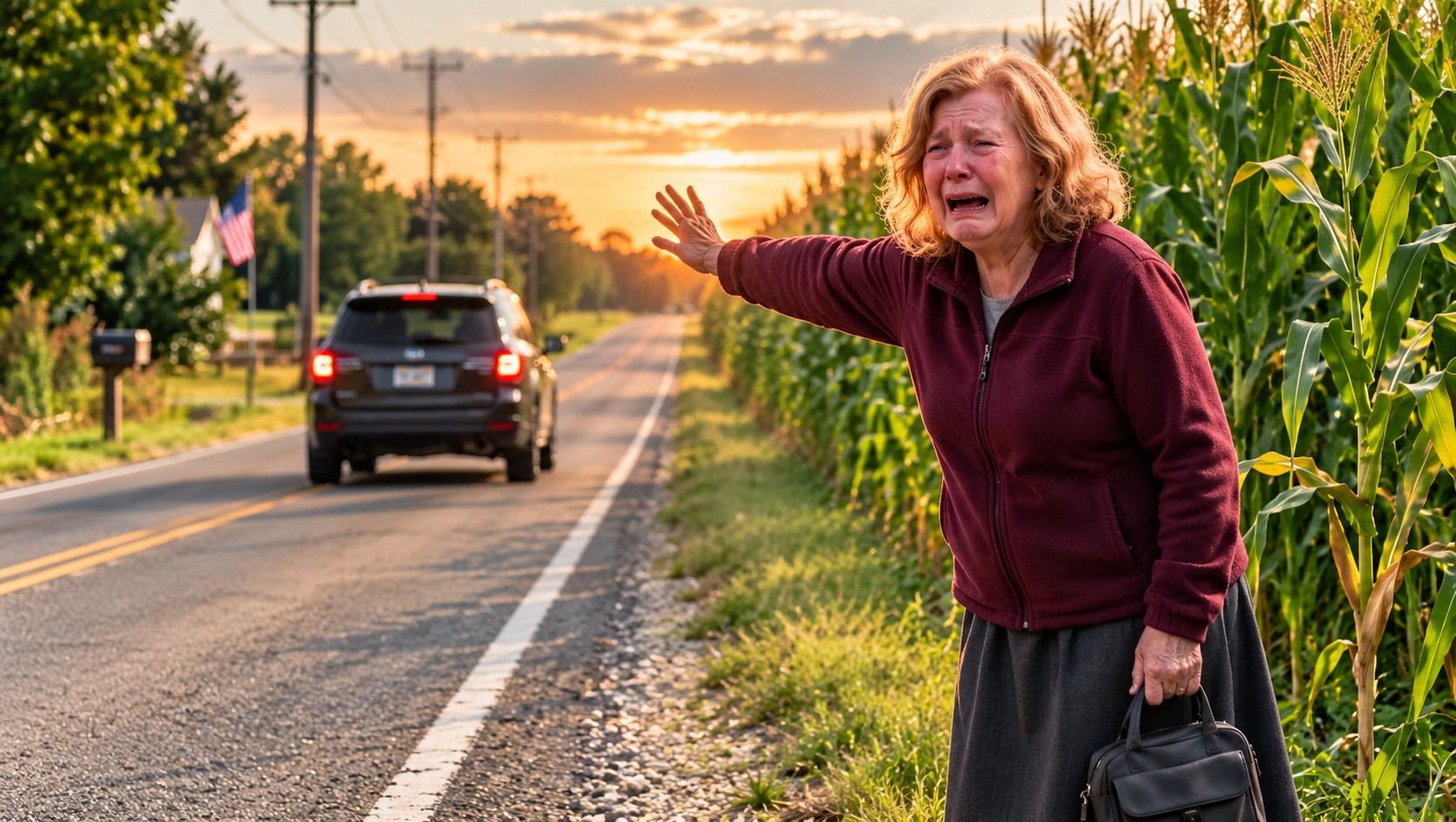
The road had been intended as an ending.
Instead, it became the place where something in me finally became clear.
Brandon and Melissa had thought they were taking away my future.
They had forgotten that the land had been mine long before they imagined inheriting it.
They had forgotten the name on the original deed.
Naomi Marie Blackwood.
Before I became Nicholas's wife.
Before I became their mother.
That woman had not disappeared.
She had simply spent decades putting everyone else first.
Now she was coming back.
I stood beneath the blossoms until the evening light faded.
The farmhouse windows glowed behind me.
The orchard stretched ahead.
For the first time in a long while, the future did not feel like something waiting to be decided by someone else.
It belonged to me.
And whatever happened with my children from that point forward would have to begin with one truth they had finally learned:
I could forgive them.
But forgiveness would never mean giving them the keys back.
The End
Read more original stories on Feel Every Story.
My Son Said He Was Taking Me Somewhere Safe, But the Road Ahead Told Me Exactly What He Had Already Decided
Part 4 of 4

