
The first few weeks after the legal review began were strangely quiet.
There were no dramatic confrontations at my front door. No shouting from Evan. No sudden appearance by Judith demanding that Delilah come home. Instead, our days filled with things that looked almost painfully ordinary: phone calls from attorneys, requests for records, envelopes arriving in the mail, and long stretches of waiting for someone to examine another document.
I learned quickly that the absence of noise did not mean nothing was happening.
Every few days, another question appeared.
Where had a particular signature originated?
Who had prepared a particular form?
Why had a transaction referred to authority that I had never granted?
Why had certain financial arrangements been discussed as though the house were available to secure them?
The questions were more important than our anger.
I kept reminding myself of that.
Delilah found it harder.
She had spent years living with uncertainty, and now she wanted certainty all at once. She wanted someone to tell her exactly what Evan had done, exactly why he had done it, and exactly what would happen to him.
Instead, she had to wait.
One afternoon, she sat at my kitchen table with a folder open in front of her.
“I hate waiting,” she said.
“I know.”
“It makes me feel like we're doing nothing.”
“We aren't doing nothing.”
She looked at the papers.
“It feels like it.”
I closed the cabinet door and sat across from her.
“Sometimes protecting yourself means refusing to act until you know what you're acting on.”
She gave me a tired smile.
“That sounds like something you'd say.”
“It probably is.”
She laughed quietly.
The sound made me happy.
Not because everything was solved.
It wasn't.
But because she could still laugh.
That mattered.
Noah was in the living room building a tower from plastic blocks. Every few minutes, we heard the tower collapse and Noah announce that it had been destroyed by dinosaurs.
Delilah listened to him.
“He's sleeping better.”
“I noticed.”
“He doesn't ask if we're going back.”
I looked at her.
“That must feel good.”
“It does.”
She lowered her eyes.
“Sometimes I still wake up thinking I'm in the car.”
That admission stayed with me.
She had been safe for weeks, yet her body had not completely accepted it.
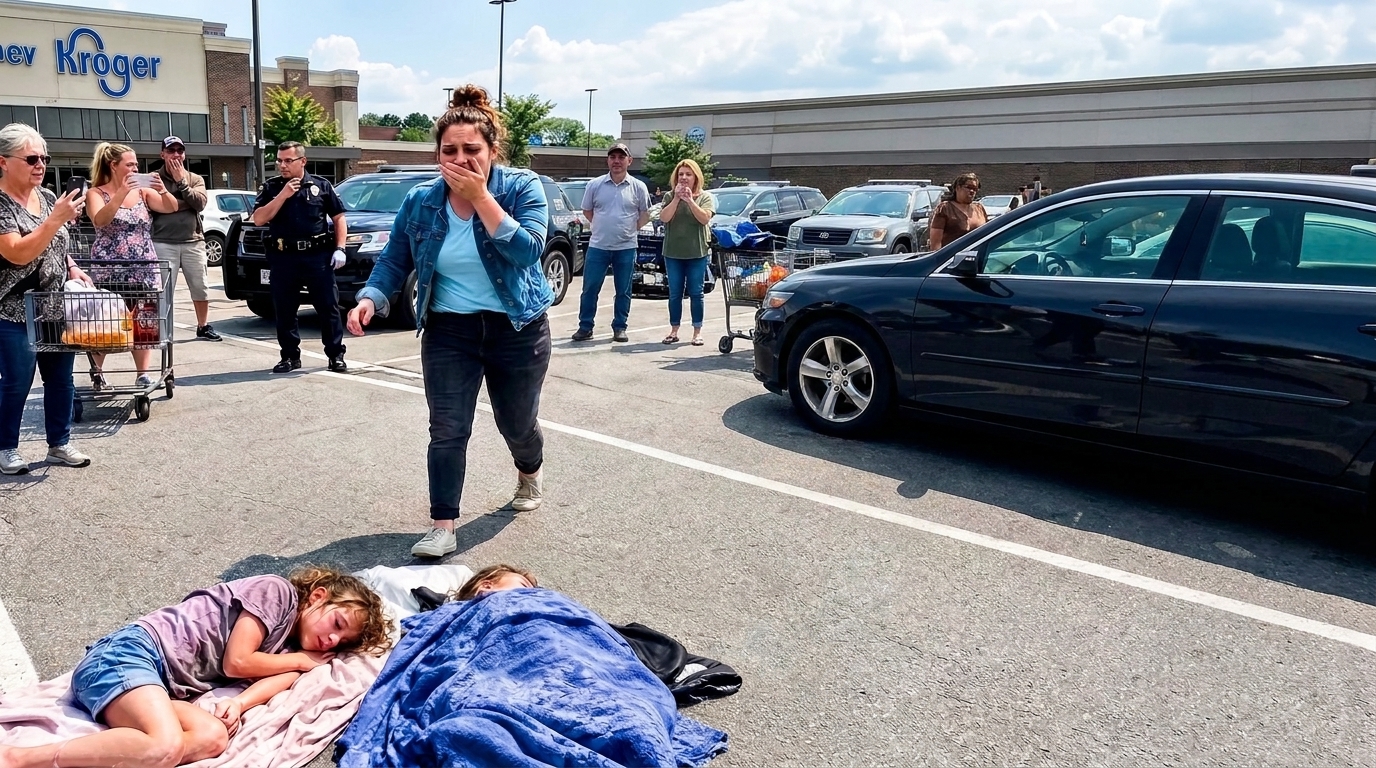
I remembered the morning I found her.
The blanket.
The cold glass.
Noah curled beneath it.
The way Delilah had looked at me as though being discovered was another thing she might be punished for.
Now she sat at my table in clean clothes with a cup of coffee beside her.
The difference was enormous.
Still, she wasn't finished healing.
Neither was Noah.
Children don't always explain fear.
Sometimes they simply change their behavior.
Noah became unusually careful around drinks.
Whenever he held a cup, he used both hands.
If even a little liquid spilled, he froze.
The first time I saw it happen, my heart broke.
A few drops of water landed on the kitchen floor.
Noah immediately looked toward Delilah.
“I didn't mean to.”
Delilah knelt beside him.
“I know.”
“I'll clean it.”
“You don't have to be scared.”
His eyes moved between us.
“Grandma isn't mad.”
“No.”
“Mom isn't mad?”
“Not at all.”
He relaxed.
Then Delilah hugged him.
I turned away for a moment.
That tiny spill told me more about what had happened in that house than any legal document could.
The documents showed what people had attempted to do with property.
Noah showed us what their behavior had done to a child.
As the investigation continued, my attorney received additional information.
The records showed that Evan's financial situation had been deteriorating before Delilah was forced out.
That part wasn't surprising anymore.
What surprised us was how closely some of the property-related activity had occurred around that decline.
Delilah read the dates twice.
“So this started before the argument.”
“Yes.”
She looked at me.
“Then I was right.”
“About what?”
“The orange juice wasn't the real reason.”
I nodded.
“We already suspected that.”
She sat back.
For a while, she stared at nothing.
“I kept thinking if I hadn't defended Noah, maybe none of this would have happened.”
I shook my head.
“No.”
“But if I had apologized—”
“They would still have had the same financial problems.”
She didn't respond.
“They would still have wanted the house.”
Her fingers tightened around the edge of the paper.
“And they still would have expected me to stay quiet.”
“Yes.”
She took a long breath.
“I hate that I thought it was my fault.”
“That is exactly what made it easier for them.”
She looked at me.
“What do you mean?”
“People who want control don't always need to threaten someone directly. Sometimes they convince the person they're controlling that every problem is their own fault.”
Delilah looked down.
“I think Judith did that first.”
“She may have.”
“She would criticize me, then I'd defend myself, and somehow I'd end up apologizing.”
I listened.
“She made me feel like I was always failing.”
“And Evan reinforced it.”
Delilah nodded.
“He would tell me I was overreacting.”
She paused.
“After a while, I stopped trusting my own judgment.”
That was the sentence I wanted her to hear herself say.
Not because I wanted her to suffer through it again.
Because naming the pattern made it easier to leave behind.
The next week, Evan contacted her directly.
She showed me the message before responding.
He wrote that he wanted to see Noah.
The request sounded reasonable on its surface.
A father asking to see his son.
But the message contained no acknowledgment of what had happened.
No apology.
No concern about the weeks Noah had spent away.
No recognition of the fear he had caused.
Instead, Evan wrote as though Delilah were the only obstacle between him and his child.
She stared at the screen.
“What should I say?”
“You don't have to decide tonight.”
“What if he uses Noah against me?”
“Then we let the proper process handle it.”
She nodded.
That answer disappointed her.
I could see it.
She wanted me to tell her exactly what to do.
But I had learned something too.
Saving my daughter did not mean making every decision for her.
I had spent years wanting to protect her.
Now I needed to help her become strong enough to protect herself.
Eventually, she answered Evan with a short message.
She would not discuss anything privately.
Any arrangements concerning Noah would go through the appropriate channels.
Then she put the phone down.
Her hands were shaking.
“You did it,” I said.
“I didn't say much.”
“You didn't need to.”
She looked almost surprised.
“I thought he'd make me feel guilty.”
“Did he?”
She considered it.
“No.”
That was progress.
Small, but real.
A few days later, another packet arrived from the attorney.
More records.
More dates.
More questions.
There was no single page that changed everything.
Instead, the pattern became increasingly difficult to explain away.
The property had value.
Evan had financial problems.
Documents had been created representing authority I had never given.
The house had been treated as an asset available for financial purposes.
And Delilah had been removed from the property after she began asking questions.
We still had to be careful.
Suspicion was not proof.
But we no longer needed to guess whether something had been wrong.
Something had.
The house itself remained secure.
That was the part that mattered most immediately.
No unauthorized transaction had changed the ownership.
My name remained on the official record.
I still owned the property.
And Evan could not turn years of living there into ownership simply because he had begun believing his own version of the story.
One evening, Delilah came over after work.
She looked exhausted.
“How was your day?”
“Good.”
“Just good?”
She smiled.
“One of my students finally understood a lesson she'd been struggling with.”
“You sound happy.”
“I was.”
She sat down.
“I forgot how much I liked teaching.”
I smiled.
“That sounds like you.”
She looked toward the window.
“Mom?”
“Yes?”
“I think I spent so long trying to keep everyone else happy that I forgot what I liked.”
I didn't answer immediately.
She continued.
“I stopped teaching because Noah was little, and that was my choice. But after that, every choice somehow became Evan's choice too.”
She looked at me.
“I don't want to live like that again.”
“You won't.”
This time, she didn't ask me how I knew.
She simply believed me.
Outside, Noah ran across the yard with his dinosaur in one hand.
His laughter carried through the window.
Delilah watched him.
“I want him to grow up knowing that accidents aren't crimes.”
I reached across the table.
“He will.”
She nodded.
The investigation continued.
The house remained protected.
The financial records kept revealing more about how badly Evan's business had been struggling.
But the most important change wasn't happening in the documents.
It was happening in my daughter.
She had stopped asking whether she was allowed to be angry.
She had stopped apologizing for needing help.
And slowly, she had stopped looking toward other people before deciding what she believed.
For years, Evan and Judith had benefited from her uncertainty.
Now that uncertainty was disappearing.
And I suspected they were about to discover that the woman they had pushed out of their house was no longer the woman they thought they could control.
Click Here to continue read next: PART6: Six Months After the Parking Lot, My Daughter Was Building a New Life, but One Last Question About the House Still Needed an Answer
I Found My Daughter and Grandson Asleep in a Car, and the Fear on Her Face Told Me This Was Far Worse Than a Family Argument
Part 5 of 8

