
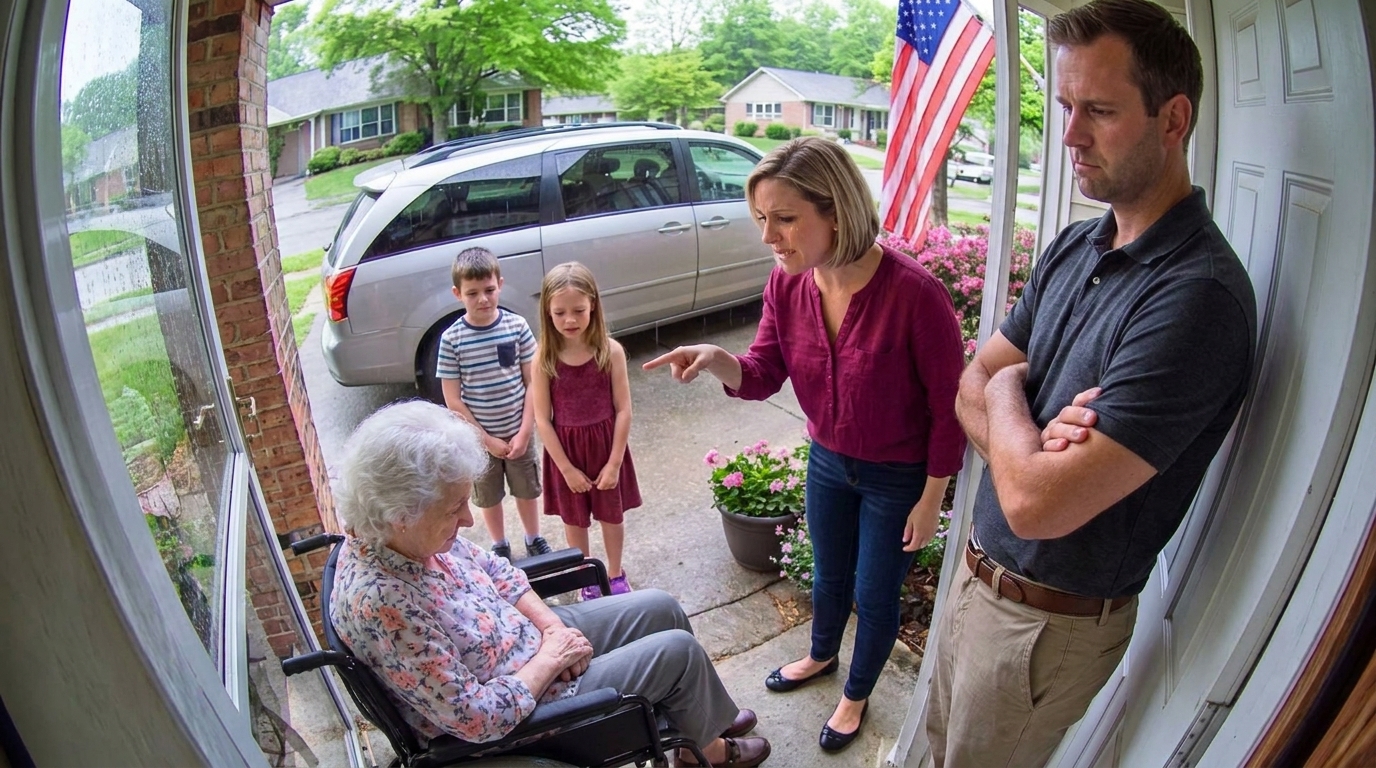
The cab had barely stopped at Michael’s curb when Helen Carter looked up at the house and wondered whether she had made a terrible mistake. Rainwater still clung to the pavement, and the wheels of her borrowed wheelchair made a faint grinding sound whenever she pushed herself forward. Beside her sat a small suitcase containing three dresses, two sweaters, medication, and the few things she had convinced herself she might need for a temporary stay. She had not come to ask for a home. She had come because she no longer had one she could safely live in.
Michael’s house looked almost exactly as Helen remembered it from Christmas. The trimmed hedges were neat. A bicycle lay on its side near the garage. Warm yellow light showed through the front windows. Somewhere inside, one of her grandchildren laughed. For several seconds Helen simply sat there, listening. That familiar sound gave her enough courage to roll toward the front door.
She pressed the bell.
Footsteps crossed the hallway. The lock clicked. When Michael opened the door, his expression changed so quickly that Helen noticed it before he said a word. His eyes moved from her face to the wheelchair, then to the suitcase resting behind her.
“Mom? What are you doing here?”
Helen swallowed. “I needed to see you.”
“You should have called.”
“I did.”
Michael glanced toward the living room. “I mean, you should have called before coming over.”
“I called yesterday,” she said softly. “You said you would call me back.”
His jaw tightened. “Things got busy.”
Helen looked past him and saw Ashley standing near the kitchen island with her phone in one hand. Ashley offered a thin smile but did not come closer. The children were there too, though Helen caught only a glimpse of one small face before Ashley motioned them toward the hallway.
Helen felt the familiar ache in her hip as she shifted in the chair.
“I can't manage the house anymore,” she said. “The stairs are impossible. The bathroom is upstairs. I nearly fell again yesterday. I only need somewhere to stay while I work out what to do.”
Michael stepped onto the porch and pulled the door almost completely behind him.
That small movement hurt more than Helen expected.
“I thought you might come,” he said. “But not like this.”
“Like what?”
“With luggage. Without asking.”
“I did ask.”
“You asked over the phone. That's different.”
Helen stared at him. The rain had stopped, but drops still fell from the roof in slow, regular taps.
“I am your mother, Michael.”
“I know that.”
“Then why does this feel like I am asking a stranger?”
Michael rubbed the back of his neck. “Mom, we have a routine here. The kids have school. Ashley has plans. I have work. We can't suddenly rearrange everything.”
“I am not asking you to rearrange everything.”
“You said you need somewhere to live.”
“For a week or two.”
Ashley finally stepped closer. “Helen, the guest room isn't available.”
Helen looked through the narrow opening of the door. She could see the hallway, the polished floor, and the staircase leading upward. The house was spotless. Nothing suggested renovation, moving boxes, or construction.
“It's being redone,” Ashley added.
“Oh.”
Helen lowered her eyes.
Michael said, “We could help you find an assisted-living place.”
“I can't afford one.”
“There are programs.”
“I receive eight hundred dollars a month.”
Ashley gave a sympathetic nod that somehow felt colder than silence. “There are people who specialize in these situations.”
Helen noticed the wording.
These situations.
Not “your situation.” Not “Mom's situation.”
Just another problem that needed to be transferred somewhere else.
She remembered a different day, years earlier, when Michael had stood in this same doorway with tears running down his face because the bank had rejected his mortgage application. Robert had quietly written a check large enough to help them buy the house. Helen remembered her husband saying, “He's our boy. We can give him a hand while he gets established.”
Michael had promised he would repay them.
Helen had never cared whether he did.
She mentioned it now only because she could not understand how the years had changed him so completely.
“Your father and I helped you get this house,” she said.
Michael's expression hardened.
“That was a loan.”
“Robert never treated it that way.”
“I paid you back.”
Helen almost answered, but stopped. They both knew he had returned only a small portion of what they had given.
Ashley folded her arms.
“Michael isn't saying he doesn't care about you.”
Helen looked at her. “I wish he would say what he does mean.”
Silence settled between them.
Finally Michael said, “We can help you contact social services.”
Helen nodded slowly.
“All right.”
“Mom—”
“No. It's fine.”
She turned her wheelchair toward the driveway.
Behind her, Michael said, “Don't be like this.”
Helen stopped.
She looked over her shoulder. “Like what?”
He hesitated.
“Realistic.”
She said nothing.
The cab driver helped secure her wheelchair in the back before closing the door. Through the window Helen watched Michael remain on the porch. He did not follow her. He did not reach for the suitcase. He simply stood there until the cab pulled away.
At home, the silence was enormous.
Helen's house had once seemed cozy. That evening every room felt too large. Robert's reading chair remained beside the lamp exactly where he had left it before his death. His glasses were still in the small wooden dish on the side table. A newspaper from the week before he died had somehow remained tucked beneath an old magazine.
Eight months had passed since the funeral, yet Helen still found herself expecting to hear his keys.
She moved carefully from the wheelchair to the couch and stared at the ceiling.
Robert had always been practical. He kept receipts in labeled envelopes. He repaired things rather than replacing them. He drove the same old Honda for years after he could have afforded something newer. When Helen complained about money, he always smiled and told her they were doing fine.
She had believed him.
Now she wondered whether “fine” had simply meant something she never understood.
The next morning, Helen decided she needed something to occupy her hands. Robert's office had remained untouched since his funeral. She had avoided it because opening the drawers felt like disturbing him.
The room smelled faintly of dust, paper, and the cedar blocks Robert used to keep insects away. Helen began with the desk. Receipts. Tax forms. Old warranty papers. A broken watch. Several envelopes containing photographs.
Then she reached the bottom drawer.
Behind a folder of medical bills was a cream-colored business card.
Helen recognized the name immediately.
Pinnacle Private Banking.
She turned it over.
Robert's handwriting covered the back.
There was an account number, followed by four words.
Emergency access only.
Helen read them twice.
She remembered Robert's habit of writing notes that made sense only to him. Usually she would have laughed. This time she did not.
She rolled the card closer to the window and studied the account number.
Why would Robert, a man who had always told her that their savings were modest, have a private banking account?
And why had he left instructions that she should access it only during an emergency?
Helen looked toward the doorway.
For the first time since Robert's death, grief gave way to something else.
Questions.
She placed the card carefully in her purse.
Then she called a cab.
Click Here to continue read next: PART2: The Account Robert Hid for Twenty-Two Years Was Worth More Than Helen Had Ever Imagined Possible
When the Door Closed, Helen Realized Her Son Had Become Someone She Could No Longer Reach
Part 1 of 8

