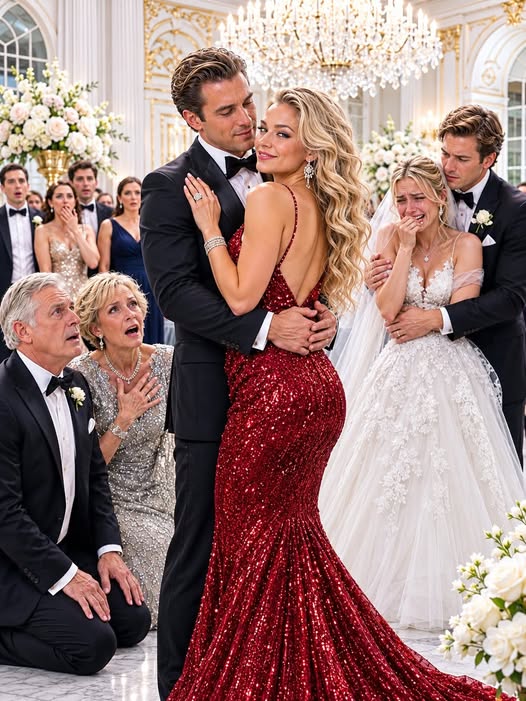
At my sister’s $5 million wedding in San Francisco, my father deliberately poured red wine all over my custom silk dress before sneering, “You’re a pathetic spinster! No one would ever want you.” My mother joined in the laughter as 300 guests watched me stand there soaked and publicly humiliated. I quietly made one phone call. Twenty minutes later, four men dressed in black suits walked into the ballroom. Then my secret husband appeared, and my family finally understood exactly who they had chosen to insult…
During my sister’s extravagant wedding celebration, my father used the microphone to humiliate me in front of 300 wealthy guests while a tray of red wine completely ruined my immaculate gown. “You’re a pathetic spinster!” my mother mocked. Yet only twenty minutes later, when four men in black suits pushed through the ballroom doors and my secret husband entered behind them, my family realized with absolute horror that they had humiliated the wrong woman.
“Table 19.” I looked across the glittering ballroom.
While my family occupied the glamorous center of the celebration, my assigned seat had been pushed into the darkest corner, almost directly beside the swinging doors leading into the kitchen.
I hadn’t even walked ten steps before my cousin Evelyn stepped into my path, her eyes immediately scanning my platinum-colored gown with obvious disdain.
“Josephine! You really do have a talent for finding things that look practical and cheap. Is that some kind of polyester blend? Just try not to make us look bad by sitting over there looking miserable.”
I gave her a restrained, polite smile.
She had absolutely no idea that the dress was made from custom Italian silk. But that wasn’t even the worst of what my family had planned for me.
As I turned away, a waiter suddenly hurried toward me from behind. He didn’t merely brush against me by accident. He deliberately struck my shoulder.
A huge wave of deep red wine splashed over me, instantly soaking through my beautiful white gown.
The music stopped so abruptly that the silence felt violent.
More than 300 people turned to stare.
At the head table, my perfectly composed sister struggled to hide the smile spreading across her face.
Then the microphone came alive.
My father slowly rose from his chair, his face red from champagne and spite.
“Well, ladies and gentlemen,” he announced through the enormous speakers, his voice overflowing with exaggerated sympathy. “I suppose certain things simply never change. Josephine, honestly. You’ve always been the clumsy one. And I suppose when you’re thirty-two, trapped in a dead-end office job, and unable to find even a date for your own sister’s wedding, you have to find another way to make everyone look at you.”
Uneasy whispers quickly turned into open laughter.
The wealthy members of San Francisco society were laughing at me in public.
This wasn’t an accident.
Every detail had been arranged to humiliate me and crush whatever dignity I had left.
But I wasn’t sixteen anymore.
I remained completely still.
I didn’t cry.
Instead, I stared straight at my father, my expression cold and empty.
The laughter slowly faded.
An uncomfortable silence settled over the entire ballroom.
“You think this is embarrassing for me, Roderick?” I asked quietly, yet my voice carried clearly across the room. “You think ruining my dress is enough to break me? This gown was hand-sewn by a master craftsman in Florence. The fabric alone costs more than the entire floral budget for this cheap little performance you’re calling a wedding.”
My mother let out a shocked gasp.
But they still didn’t know.
They had absolutely no idea that, at that very moment, my phone was glowing inside my clutch with a message from my secret husband, the most ruthless billionaire in the world.
And beyond the ballroom doors, the massive oak entrance was slowly beginning to open…
Do you want to know what happens next? Type ‘BALLROOM’ and you’ll see the the unexpected ending in the comments 
At my sister’s $5 million wedding
The young usher hesitated before handing me the seating card. His expression told me there was something wrong before I even looked down.
I followed his uneasy glance across the enormous ballroom.
The first eighteen tables surrounded a magnificent dance floor beneath three glittering crystal chandeliers. Table nineteen stood alone near the kitchen entrance.
It was almost hidden behind a tall arrangement of white orchids.
“That must be a mistake,” I said.
The usher checked his list again.
“I’m sorry, ma’am. Your placement was confirmed by Mrs. Whitmore personally.”
My mother.
Of course.
I looked toward the head table, where my parents were accepting congratulations from some of San Francisco’s wealthiest families.
My sister, Victoria, stood between them in a breathtaking designer wedding gown. She looked radiant beneath the warm golden lights.
Three hundred guests had gathered to celebrate her marriage to Nathaniel Brooks, the son of a prominent investment banker.
The wedding reportedly cost five million dollars.
And I had been assigned a seat beside the kitchen.
“Would you like me to ask the coordinator?” the usher offered.
I considered it for a moment.
Then I shook my head.
“No. You’ve done your job.”
He looked relieved.
I took the seating card and stepped aside, allowing another guest to approach.
My name is Josephine Whitmore. I am thirty-two years old, and I had spent most of my life learning how to remain invisible in my own family.
That evening, however, I had made a mistake.
I had allowed myself to believe things might finally be different.
My sister was getting married. Whatever had happened between us, I wanted to witness her happiness.
I wanted to be there when she walked into the next chapter of her life.
I had even commissioned a beautiful gown for the occasion.
The dress was made from pale platinum Italian silk. Its delicate fabric had been hand-finished in Florence by an artisan who understood elegance better than extravagance.
It wasn’t flashy.
It didn’t glitter beneath the lights or announce its value through an enormous designer logo.
It simply fit me perfectly.
For once, I had dressed without considering what my parents might think.
That small act of independence would become more important than I could have imagined.
“Josephine?”
A familiar voice interrupted my thoughts.
I turned.
My cousin Evelyn approached, holding a champagne flute and wearing a brilliant emerald necklace.
Her eyes moved immediately toward my dress.
“Well,” she said, smiling without warmth. “You certainly kept things simple.”
“Hello, Evelyn.”
She tilted her head.
“Is that polyester?”
“No.”
“Really? It has that unusual shine.”
“It’s silk.”
Evelyn gave a delicate laugh.
“Of course it is.”
She looked past me toward the tables.
“Your mother told me where you were sitting. Honestly, Josephine, I wouldn’t complain. At least you have a place.”
“I wasn’t complaining.”
“Good. Victoria has enough to worry about tonight.”
She leaned closer.
“And please don’t spend the evening looking miserable. Your parents invited some very important people.”
I studied her face.
Evelyn had been repeating my mother’s opinions since childhood. Occasionally, I wondered whether she possessed any of her own.
“I hope you enjoy the wedding,” I replied.
She appeared disappointed by my lack of reaction.
Then she walked away.
I remained beside the entrance while a string quartet played something soft and expensive.
For a moment, I thought about leaving.
Nobody would have noticed immediately.
My parents were busy entertaining their friends. Victoria had barely acknowledged me since the ceremony.
My absence might have spared everyone the inconvenience of pretending we were close.
Then I felt my phone vibrate inside my clutch.
A message appeared.
Adrian: How is the wedding?
Despite everything, I smiled.
Me: Beautiful. Very expensive. Emotionally questionable.
His reply arrived almost immediately.
Adrian: That’s a worrying combination.
I glanced toward my parents.
Me: I’m fine.
Three dots appeared.
Then:
Adrian: You don’t have to stay somewhere that makes you feel small.
I stared at those words longer than I intended.
Adrian had a remarkable ability to recognize what I was trying not to say.
He never demanded explanations.
He simply reminded me that I had choices.
Me: I promised I’d attend.
Adrian: Then attend. Just remember that a promise doesn’t require you to accept cruelty.
I slipped the phone away.
Nobody inside that ballroom knew Adrian was my husband.
Nobody knew we had married privately nine months earlier.
And nobody knew that the quiet, attentive man who made me coffee on Sunday mornings controlled one of the largest private investment companies in the world.
To the public, Adrian Vale was a billionaire whose decisions could move markets.
To me, he was the man who remembered how I liked my tea.
We had kept our marriage private for reasons that had nothing to do with embarrassment.
Adrian’s professional life attracted relentless scrutiny. Every public appearance created another headline.
I had spent my entire childhood being evaluated, compared, and displayed.
Neither of us wanted our marriage turned into a spectacle.
Most importantly, I wanted to discover what happiness felt like before my family had the opportunity to criticize it.
I had planned to tell them eventually.
Just not tonight.
“Josephine!”
My mother’s voice carried across the entrance.
Margaret Whitmore approached with her usual immaculate posture.
She wore a silver gown embroidered with tiny crystals. Her diamond necklace had probably cost more than my annual salary.
Her smile disappeared when she reached me.
“Why are you standing here?”
“I was finding my table.”
“You’re blocking the entrance.”
I stepped aside.
She glanced at my seating card.
“Oh, good. You’ve found it.”
“Table nineteen?”
“Yes.”
“Beside the kitchen?”
Her expression hardened.
“Please don’t start.”
“I asked a question.”
“And I’m answering it. Seating arrangements are complicated. We had to prioritize the people who matter to Victoria’s future.”
I felt something tighten beneath my ribs.
“The people who matter?”
“Business partners. Family connections. Nathaniel’s relatives.”
“And I’m her sister.”
“Josephine.”
My mother lowered her voice.
“That doesn’t automatically make you an important guest.”
The words were delivered with such practiced ease that I almost admired her efficiency.
She had spent thirty-two years making rejection sound like etiquette.
“Then perhaps you shouldn’t have invited me.”
Her eyes narrowed.
“Don’t be dramatic. Your father insisted that the immediate family be present.”
“How generous.”
“Watch your tone.”
I looked past her toward the magnificent floral installations.
Thousands of white roses surrounded the dance floor.
Crystal glasses shimmered beneath the chandeliers.
Everything had been arranged to create the appearance of perfection.
Only the relationships behind that perfection were falling apart.
“I’m not going to cause trouble,” I said.
“Good.”
My mother adjusted one of the bracelets on her wrist.
“And another thing. Please don’t tell anyone you’re still doing administrative work.”
“I don’t do administrative work.”
“Whatever your office position is called.”
“I’m a senior project manager.”
“Exactly. Office work.”
I exhaled slowly.
My career had never interested my mother.
She preferred professions that could be announced during charity dinners.
Surgeon.
Attorney.
Investment banker.
Corporate executive.
A job that required organization, technical knowledge, and years of experience sounded terribly ordinary to her.
“I’m proud of my work,” I replied.
“Then you’re easily satisfied.”
She smiled at a passing guest before turning back to me.
“Victoria needs your support tonight. Try not to make this about yourself.”
Then she walked away.
I stood there, absorbing the familiar sensation of being dismissed.
My mother never shouted when she could wound someone quietly.
That was her particular talent.
She could make cruelty sound like concern.
I eventually reached table nineteen.
There were eight chairs, although only three place settings had been prepared.
A folded linen napkin rested beside each plate.
The table’s centerpiece was considerably smaller than those surrounding the dance floor.
A waiter emerged from the kitchen.
He glanced at me, then at the table.
“Are you supposed to be seated here, ma’am?”
“Yes.”
He seemed uncomfortable.
“Sorry. We were told this table might remain unused until later.”
“Apparently the plans changed.”
He nodded and hurried away.
I sat down.
The kitchen doors swung open repeatedly behind me.
Every movement brought another gust of warm air carrying the smell of roasted meat, garlic, and butter.
From my chair, I could see Victoria laughing beside her new husband.
Nathaniel leaned close and kissed her cheek.
She looked genuinely happy.
For a moment, I allowed myself to remember the sister I had known before we became rivals in our parents’ eyes.
Victoria was three years younger than me.
When we were children, she followed me everywhere.
She used to knock on my bedroom door whenever thunderstorms frightened her.
I would lift the blankets and make room beside me.
She would curl against my shoulder and ask whether the lightning could reach us.
“Not here,” I always told her.
And she believed me.
Somewhere between childhood and adulthood, Victoria had learned that our parents’ approval came with conditions.
She became beautiful in precisely the way they wanted.
She dated men from approved families.
She joined the correct social circles.
She learned how to smile when our father made humiliating jokes about other people.
And gradually, she stopped knocking on my door.
I didn’t blame her for everything.
I understood the pressure she lived under.
But understanding someone did not erase the choices they made.
“Excuse me.”
I looked up.
An older woman stood beside the table.
She wore a navy dress and carried a small evening bag.
“Is anyone sitting here?”
“Not yet.”
She smiled gratefully.
“Wonderful. My feet are killing me.”
She settled into the chair opposite mine.
“I’m Helen Brooks. Nathaniel’s great-aunt.”
“Josephine Whitmore.”
Her eyebrows lifted.
“The bride’s sister?”
“Yes.”
She looked around our isolated table.
“Then what on earth are you doing back here?”
I almost laughed.
“Apparently enjoying a quieter view.”
Helen studied my face.
Then she removed her glasses and placed them beside her plate.
“Families can be peculiar about weddings.”
“That seems accurate.”
“My nephew spent twenty minutes explaining the importance of the seating hierarchy.”
She shook her head.
“Imagine arranging human beings like silverware.”
I smiled properly for the first time that evening.
Helen was refreshingly direct.
She spoke without examining the room to determine who might be listening.
We talked about the ceremony.
She admired the music.
I admired the garden where Victoria and Nathaniel had exchanged vows.
For several minutes, the conversation felt ordinary.
Then Helen asked what I did for work.
I told her.
Unlike my mother, she listened.
She wanted to know about the restoration projects I managed and the difficulties involved in coordinating designers, engineers, and contractors.
She asked thoughtful questions.
I found myself explaining an adaptive-reuse project that had transformed an abandoned building into affordable commercial space.
Helen seemed genuinely interested.
“You must be very good at what you do,” she said.
“I enjoy it.”
“That wasn’t what I said.”
I looked at her.
She smiled.
“People don’t describe difficult work with that much affection unless they understand it.”
The compliment caught me off guard.
I had almost forgotten how it felt to be praised without someone attaching a comparison.
“Thank you.”
Helen glanced across the ballroom.
“Your parents know about your work?”
“They know where I go every morning.”
“That wasn’t what I asked.”
I couldn’t help laughing.
“No,” I admitted. “They don’t really know.”
She didn’t press further.
Instead, she reached for her water.
“Then that’s their loss.”
The simple statement settled somewhere deep inside me.
I had spent years explaining myself to people who didn’t want to understand.
Sometimes a stranger could recognize more in ten minutes than a parent had recognized in thirty years.
Across the room, my father raised his champagne glass.
Roderick Whitmore was a tall man with silver hair and an expensive smile.
He owned several successful businesses and treated every conversation like a negotiation.
People admired his confidence.
They rarely saw what happened when someone disappointed him.
My father had always believed affection should be earned through obedience.
Victoria was rewarded for following his expectations.
I was criticized for questioning them.
When I declined a position at one of his companies, he called me ungrateful.
When I moved into my first apartment without requesting his approval, he called me reckless.
When I refused an introduction to a wealthy man he wanted me to date, he stopped speaking to me for six weeks.
He had never forgiven me for building a life he couldn’t control.
At the head table, he noticed me watching.
For an instant, our eyes met.
Then he looked deliberately toward my isolated seat.
He smiled.
I understood the message.
He wanted me to know the placement was intentional.
I lowered my gaze to the glass of water before me.
Helen followed my attention.
“Something wrong?”
“Nothing new.”
She considered that answer.
“Sometimes that’s the problem.”
Before I could respond, a familiar figure approached.
“Josephine.”
Victoria stood beside the table.
Her wedding dress swept across the carpet behind her.
Up close, she looked exhausted beneath her perfect makeup.
“Can we talk?”
I rose immediately.
“Of course.”
Her eyes flicked toward Helen.
“Privately.”
Helen lifted her glass.
“I promise not to listen.”
Victoria didn’t smile.
I followed my sister toward a quiet corridor near the ballroom.
She stopped beneath a large gilded mirror.
For a moment, neither of us spoke.
Then she looked at my dress.
“Did you really have that made for tonight?”
“Yes.”
“Why?”
The question surprised me.
“Because it’s your wedding.”
She folded her arms.
“Mother said you were trying to make some kind of statement.”
“By wearing a dress?”
“You know what I mean.”
“No, Victoria. I really don’t.”
She sighed.
“I just wanted one day when everything could be peaceful.”
“So did I.”
“Then why are you acting like this?”
I looked at her.
“Like what?”
“Cold. Defensive. Making Mother uncomfortable.”
My chest tightened.
“I haven’t done anything to Mother.”
“She said you complained about your table.”
“I asked why I was sitting beside the kitchen.”
Victoria looked away.
There it was.
A flicker of recognition.
She knew.
“You could have just accepted it,” she murmured.
“Did you approve the seating arrangement?”
She remained silent.
I waited.
Finally, she said, “The planners gave us several options.”
“And you chose that one?”
“I didn’t choose anything specifically to hurt you.”
“That isn’t what I asked.”
She turned toward me.
“Josephine, can we please not do this tonight?”
I took a slow breath.
“I’m not trying to ruin your wedding.”
“Then stop questioning everything.”
I studied the face I had loved since childhood.
Her eyes were the same pale gray as mine.
For years, I had mistaken that resemblance for closeness.
“Victoria,” I said quietly, “if you wanted me here, why am I the only immediate family member sitting out of sight?”
She opened her mouth.
Then closed it.
The pause told me more than her answer would have.
“I didn’t think you’d care,” she finally whispered.
I felt the words land.
“You didn’t think I’d care?”
“You’ve always said you hate these events.”
“I hate being humiliated at these events.”
She flinched.
For one brief second, I thought she might apologize.
Instead, she straightened her shoulders.
“Please don’t make this difficult.”
Then she walked back into the ballroom.
I remained in the corridor, looking at my reflection.
The platinum silk caught the soft light.
My hair was pinned neatly at the nape of my neck.
I looked composed.
Successful.
Independent.
Yet beneath that polished exterior, a familiar wound had opened.
I wasn’t angry because I had been seated near the kitchen.
I was angry because my family had once again transformed a simple celebration into proof that I mattered less.
My phone vibrated.
Adrian: Reception still going?
Me: Yes.
Adrian: Want me to call?
I hesitated.
Adrian had offered to attend with me.
I had declined.
Part of me wanted to face my family without relying on his name or reputation.
Another part wanted to protect our marriage from people who would immediately measure its value in dollars.
I had told him I could manage one evening.
Now I wondered whether my pride had become another form of self-punishment.
Me: Not yet.
His answer came quickly.
Adrian: All right. I’m nearby if you need me.
I stared at the screen.
Then I put it away.
When I returned to the ballroom, the lights had dimmed.
The first course was being served.
My father stood at the head table, speaking quietly with the wedding coordinator.
He held a microphone in one hand.
As I passed, I heard him say something that made me stop.
“Make certain she’s still here when we begin the family announcements.”
The coordinator glanced toward me.
My father followed his gaze.
His smile widened.
“Josephine,” he called pleasantly. “There you are.”
Something about his expression made my stomach tighten.
I had seen that smile before.
It was the smile he wore when he had already decided to teach someone a lesson.
And suddenly, I understood that table nineteen might only be the beginning.
“What family announcements?”
My father lowered the microphone.
For a moment, he looked almost amused that I had overheard him.
“Nothing you need to worry about.”
“Then why did you tell the coordinator to make sure I stayed?”
The coordinator glanced between us.
My father’s smile disappeared.
“Would you excuse us?”
She retreated immediately.
He waited until she was out of hearing range before turning toward me.
“Must you question every instruction?”
“I asked what you’re planning.”
“I’m planning to celebrate your sister’s marriage.”
“Then celebrate it.”
His eyes narrowed.
“You’ve become unusually unpleasant lately.”
I looked at the microphone in his hand.
It was a simple black device with a small silver band.
I remembered another microphone from years earlier.
My graduation dinner.
My father had invited twenty relatives to celebrate my university degree.
I had graduated with honors and secured an excellent position.
Halfway through dinner, he stood to make a toast.
Instead of congratulating me, he spent several minutes praising Victoria’s appearance and predicting she would marry someone important.
The guests laughed.
I sat beside my diploma, pretending the joke didn’t hurt.
Afterward, my father accused me of being humorless.
That was how our family operated.
Someone wounded me.
I reacted.
Then my reaction became the real offense.
I looked back at him.
“I won’t participate in another joke at my expense.”
He studied me carefully.
“Another joke?”
“You know what I mean.”
“Josephine, you’re thirty-two years old. When are you going to stop acting like a wounded teenager?”
“When you stop treating me like one.”
His jaw tightened.
For a moment, I thought he might raise his voice.
Then several guests approached, and his public smile returned instantly.
“Josephine,” he announced warmly, slipping an arm around my shoulders, “you remember the Carlisles.”
I recognized the couple.
They had attended several of my parents’ charity dinners.
Mrs. Carlisle looked delighted to see me.
“Your father says you’ve been keeping busy.”
“I have.”
“Still working in that little office?” my father asked.
His tone was light.
Almost affectionate.
I felt his fingers tighten against my shoulder.
I knew the performance expected of me.
Smile.
Minimize myself.
Let him entertain his friends.
Instead, I answered plainly.
“I manage commercial restoration projects throughout the Bay Area.”
Mrs. Carlisle looked interested.
“That sounds fascinating.”
“It is.”
My father chuckled.
“Josephine always makes everything sound terribly important.”
I turned toward him.
“It is important to the people using those buildings.”
The smile on his face remained fixed.
Mrs. Carlisle asked another question.
I answered it.
Her husband joined the conversation, explaining that their company had recently renovated a historic property.
For several minutes, we discussed design problems, permits, and the challenge of preserving original materials.
I almost forgot my father’s hand remained on my shoulder.
Then Mrs. Carlisle said, “You must have a wonderful career.”
“I’m fortunate,” I replied.
My father interrupted.
“Well, we keep hoping she’ll eventually settle down and find a husband.”
The conversation stopped.
He laughed.
“Not much luck there, unfortunately.”
Mrs. Carlisle’s expression changed.
She looked from him to me.
“Oh,” she said gently. “That’s hardly anyone else’s business.”
My father’s arm dropped.
I felt a brief surge of gratitude.
The couple soon excused themselves.
My father waited until they had moved away.
“You embarrassed me.”
I stared at him.
“How?”
“You contradicted me in front of my friends.”
“I answered their questions.”
“You made me look foolish.”
I almost smiled.
He had managed that without assistance.
But I kept the thought to myself.
“I didn’t come here to fight,” I said.
“Then stop challenging me.”
He leaned closer.
“Your sister understands how this family works. Perhaps you should learn from her.”
I stepped away.
“I’ve learned more than you realize.”
He watched me return to table nineteen.
I could feel his anger following me across the ballroom.
When I sat down, Helen was studying the dessert menu.
She looked up.
“Everything all right?”
“Family conversation.”
“Ah.”
She closed the menu.
“That explains the expression.”
I gave a small laugh.
“Is it that obvious?”
“Only to someone who’s survived several decades of family weddings.”
She leaned forward.
“Can I give you some advice?”
“Please.”
“Don’t spend the entire evening proving you deserve a place at their table.”
I glanced toward the center of the room.
“They’ve made that rather difficult.”
“Then perhaps it’s time to decide whether you want that particular place.”
I considered her words.
They sounded simple.
They weren’t.
My parents had spent years teaching me that belonging was something they could withdraw.
Even after I became financially independent, I continued treating their approval like a prize I might eventually earn.
I attended birthdays.
I remembered anniversaries.
I sent thoughtful gifts.
I arrived when they needed help.
And every year, I promised myself I would stop expecting kindness.
Yet every invitation carried the possibility of something different.
A genuine conversation.
An apology.
A moment of recognition.
That hope was stubborn.
It survived disappointments that should have destroyed it.
A waiter brought our first course.
Helen thanked him.
I noticed his hands were trembling slightly.
The ballroom staff had been rushing between tables since the reception began.
Every detail had to appear effortless.
I wondered how many people were working behind the scenes to maintain the illusion.
At the head table, my mother raised one finger.
A server hurried toward her.
She pointed at her plate with visible irritation.
I couldn’t hear the conversation.
I didn’t need to.
My mother had never considered service workers important enough to deserve courtesy.
She could spend thousands on a charity luncheon and humiliate the person pouring water.
It was one of the contradictions I had stopped trying to explain.
“Your mother looks formidable,” Helen observed.
“That’s one word for it.”
Helen smiled faintly.
“My sister-in-law was similar. She believed wealth entitled her to certainty about everyone else’s life.”
“How did you deal with her?”
“I stopped attending events where I was expected to apologize for existing.”
I looked at her.
“That sounds peaceful.”
“It was eventually.”
The orchestra began a familiar melody.
Couples moved toward the dance floor.
Victoria and Nathaniel stood together beneath the chandeliers.
They looked beautiful.
I watched my sister rest her forehead briefly against her husband’s.
Whatever else happened that evening, I hoped their marriage would give her something our childhood had lacked.
Safety.
Gentleness.
The freedom to disappoint someone without fearing abandonment.
For several minutes, I forgot my own discomfort.
Then Evelyn appeared again.
She carried a fresh glass of champagne.
“Josephine, there you are.”
I looked up.
“Hello again.”
Her smile tightened.
“Your mother wants you for the family photographs.”
“Where?”
“Near the terrace.”
I glanced toward Helen.
“Excuse me.”
“Of course,” she replied.
Evelyn led me through a side corridor filled with framed photographs of San Francisco landmarks.
At my sister’s $5 million wedding
You know, I still can’t believe you spent money on something so plain.”
“I like it.”
“That’s what matters, I suppose.”
She paused beside a large mirror.
“Although I understand why your mother was disappointed.”
I stopped.
“Disappointed about what?”
“Your appearance.”
I looked at her reflection.
“My appearance?”
“She thought you might finally make an effort tonight.”
The insult was so absurd that I almost laughed.
“I’m wearing a custom-made gown.”
“Well, it doesn’t look expensive.”
“Does that matter?”
“To your family? Obviously.”
I studied her for a moment.
“Evelyn, why do you keep commenting on my clothes?”
She blinked.
“I’m only being honest.”
“No. You’re repeating insults and pretending they’re advice.”
Her expression sharpened.
“There’s no need to be rude.”
“Then perhaps we should both stop.”
I continued down the corridor without waiting.
When we reached the terrace, several family members were already gathered beneath a decorative arch.
My mother stood beside the photographer.
Victoria was adjusting her veil.
My father was speaking with Nathaniel.
Nobody looked particularly pleased to see me.
“Finally,” my mother said.
“I came as soon as Evelyn found me.”
“Stand at the far end.”
I looked toward the photographer.
He had arranged the bride and groom in the center.
Our parents stood immediately beside them.
Nathaniel’s family occupied the remaining positions.
There was barely space for me.
“Josephine,” my mother snapped, “move closer to the flowers.”
I complied.
The photographer raised his camera.
“Wonderful. Everyone smile.”
Just before he took the photograph, my father stepped backward.
His elbow brushed my arm.
“Don’t crowd Victoria.”
I moved another inch.
The photographer frowned.
“Actually, sir, the family would look better if your daughter came slightly forward.”
My father laughed.
“Trust me. She’s fine where she is.”
The photographer hesitated.
Then he lowered his camera.
“I can adjust the composition.”
My mother sighed.
“Please don’t make this complicated.”
I looked at my sister.
She was staring at the floor.
“Victoria?”
She raised her eyes.
“Could I stand beside you for one photograph?”
The question hung between us.
It wasn’t a request for money.
It wasn’t an accusation.
It was a simple desire to stand beside my sister on her wedding day.
Victoria looked toward our mother.
Then toward Nathaniel.
Finally, she gave a small nod.
“Fine.”
I stepped forward.
My mother’s expression hardened.
The photographer positioned us.
For one brief moment, Victoria’s hand touched mine.
Her fingers were cold.
I remembered holding that same hand when we crossed busy streets as children.
“Ready?” the photographer asked.
We smiled.
The camera flashed.
Then my mother immediately ordered another photograph without me.
I stepped aside.
Nobody asked me to remain.
I watched them rearrange themselves into a perfect family portrait.
The absence of my face made the composition more balanced.
Apparently, that had always been the intention.
As the photographer finished, Nathaniel approached me.
“Josephine?”
I turned.
He looked uncomfortable.
“Thank you for coming.”
“Of course.”
“I know things have been tense.”
I studied him.
Nathaniel was generally polite, although he rarely challenged anyone.
He had spent enough time around my family to understand their habits.
“It’s your wedding,” I said. “I wanted to support you both.”
He nodded.
“Victoria appreciates it.”
I wasn’t certain she did.
But I accepted the kindness.
“Please take care of her.”
Something moved across his face.
“I intend to.”
“Good.”
He glanced toward the terrace doors.
“Your father seems especially… energetic tonight.”
I almost laughed.
“That’s one way to describe him.”
Nathaniel shifted uncomfortably.
“He’s preparing some remarks.”
“I noticed.”
“Victoria asked him to keep them brief.”
“Does he know that?”
Nathaniel gave a strained smile.
“I hope so.”
Then my sister called his name.
He excused himself.
I remained outside for another moment.
San Francisco spread beneath the evening sky.
Distant buildings glowed against the approaching darkness.
The city looked peaceful from above.
I had built an entire adult life there without my parents’ assistance.
I had friends.
A career.
A home.
And a marriage filled with the kind of affection I once believed existed only in other families.
Yet one evening near them could make me forget all of it.
I leaned against the terrace railing and removed my phone.
There was another message from Adrian.
Adrian: I finished earlier than expected.
Me: Good. Go home and get some rest.
Adrian: I might stop by the hotel.
My heart warmed.
Me: You don’t have to.
Adrian: I know.
I could almost hear his voice.
Calm.
Patient.
Certain.
He never confused love with obligation.
When we first met, I hadn’t known who he was.
We were attending a small community fundraiser related to a restoration project.
He had arrived without an entourage and spent most of the evening asking thoughtful questions about the building.
I assumed he was another donor.
We talked for nearly an hour.
He listened when I spoke.
He didn’t interrupt to explain my own work.
He didn’t ask whether my father was Roderick Whitmore.
He simply wanted to know what mattered to me.
Later, when I discovered his identity, I was furious.
Not because he was wealthy.
Because I thought he had deliberately concealed something important.
He apologized without excuses.
Then he asked whether he could see me again.
I said yes.
Our relationship grew slowly.
We argued occasionally.
We learned each other’s habits.
He discovered that I hated being photographed unexpectedly.
I discovered that he could negotiate enormous contracts but consistently misplaced his reading glasses.
He met my closest friends.
I met the people he trusted.
Eventually, our wedding took place in a small garden with a handful of witnesses.
There were no photographers.
No press releases.
No jeweled crown.
Just Adrian holding my hands and promising to choose me every day.
It was the happiest ceremony I had ever attended.
I closed my eyes briefly.
I wished he were standing beside me.
Not because he could frighten my family.
Because his presence made it easier to remember myself.
“Josephine.”
I opened my eyes.
Victoria stood in the terrace doorway.
She had removed her veil.
“Can we talk again?”
I straightened.
“Of course.”
She approached slowly.
For a moment, she seemed uncertain.
“I know you’re upset about the photographs.”
“I’m disappointed.”
She looked down.
“Mother gets controlling during events.”
“Victoria, Mother has been controlling since we were children.”
“I know.”
The admission surprised me.
My sister looked toward the city.
“She spent six months planning this wedding. Every day, something had to be perfect.”
“Did you want all of this?”
Victoria gave a tired laugh.
“At first.”
I waited.
She touched the diamond bracelet on her wrist.
“Eventually, I stopped knowing which decisions were mine.”
For the first time that evening, I heard my younger sister beneath the polished socialite.
“I understand that,” I said.
She looked at me.
“Do you?”
“Yes.”
I wanted to reach for her hand.
But something held me back.
We had spent too many years pretending small moments of honesty erased larger acts of cruelty.
“I still wish you had included me,” I continued.
Victoria’s expression became guarded.
“Please don’t ruin this.”
I felt the opening between us close.
“I’m not trying to.”
“Then just enjoy the evening.”
She turned away.
“Father has something special planned for the speeches.”
I watched her disappear.
The words settled uneasily in my mind.
Something special.
My father had used that phrase before.
At my twenty-fifth birthday dinner, he had arranged a surprise slideshow.
It contained photographs of awkward childhood moments, failed relationships, and unflattering pictures taken without my knowledge.
Guests laughed while I sat frozen.
Afterward, he told me to appreciate his sense of humor.
I had spent years dismissing those incidents as small humiliations.
But cruelty didn’t become harmless simply because the audience enjoyed it.
I returned to the ballroom.
The main course was being served.
At table nineteen, Helen was speaking with another guest.
She waved me over.
“Josephine, come meet my friend Patricia.”
The woman beside her smiled warmly.
We spoke about the ceremony and the food.
For almost twenty minutes, I experienced something extraordinary.
A normal conversation.
Nobody asked why I wasn’t married.
Nobody mocked my work.
Nobody compared me to Victoria.
I answered questions without defending myself.
I laughed.
I enjoyed my meal.
Then the room’s lighting changed.
A spotlight illuminated the head table.
The orchestra stopped.
My father stood beside the microphone.
“Ladies and gentlemen,” he announced, “before we begin the official toasts, I have a few words about family.”
I set down my fork.
Helen looked toward the stage.
Something in my father’s voice made my skin turn cold.
He scanned the ballroom.
Then his eyes found table nineteen.
He smiled directly at me.
And I knew the evening was about to become much worse.
“Family,” my father repeated, “is the foundation of everything worthwhile.”
Polite applause moved through the ballroom.
I remained seated, watching him beneath the spotlight.
His voice carried the practiced warmth of a man accustomed to controlling a room.
“Tonight, we celebrate not merely a marriage, but the joining of two extraordinary families.”
More applause.
Victoria smiled beside Nathaniel.
My mother lifted her champagne flute.
The guests settled comfortably into their chairs.
I recognized the familiar rhythm of my father’s public speeches.
He would praise himself indirectly.
He would compliment anyone important enough to advance his interests.
Then he would make a joke at someone else’s expense.
The only question was whether I would be the target.
“I have always believed a parent’s greatest achievement is raising children who understand responsibility,” he continued.
My stomach tightened.
“Victoria has made us exceptionally proud.”
He turned toward my sister.
“She has demonstrated grace, judgment, and an understanding of what truly matters in life.”
The guests applauded.
Victoria lowered her eyes modestly.
Then my father smiled.
“Of course, every family has its more independent spirits.”
Several relatives laughed.
I knew what was coming.
“Some children follow the path you prepare for them,” he said. “Others insist on discovering every possible wrong turn themselves.”
A few more laughs.
His eyes found mine.
I placed my napkin carefully beside my plate.
Helen leaned toward me.
“Is he talking about you?”
“Usually.”
My father continued.
“Fortunately, tonight is not about old disappointments.”
He laughed.
The audience followed.
Something inside me went still.
There were many ways to respond.
I could stand.
I could shout.
I could leave.
But I knew how quickly he would transform any reaction into proof that I was unstable.
Instead, I remained seated.
I would not give him the performance he wanted.
He finally raised his glass.
“To Victoria and Nathaniel.”
The room joined him.
“To Victoria and Nathaniel.”
Applause filled the ballroom.
The speech ended.
I exhaled.
It had been unpleasant.
But perhaps that would be all.
Then my father returned the microphone to its stand without switching it off.
He leaned toward my mother.
Their conversation carried faintly through the speakers.
“She’s still here?”
My mother’s answer was too quiet to hear.
My father chuckled.
“Good.”
The coordinator hurried forward and switched off the microphone.
A few guests exchanged uncomfortable glances.
My father appeared unconcerned.
I looked toward Victoria.
She was whispering something to Nathaniel.
Her expression was tense.
I wondered whether she knew what her father had planned.
The thought hurt more than I expected.
I could endure another insult from him.
But my sister’s possible involvement threatened something I had never completely surrendered.
The belief that somewhere beneath her ambition, Victoria still loved me.
Helen touched my hand.
“Are you all right?”
“Yes.”
“You don’t sound convinced.”
I looked at her.
“I’m deciding what to do.”
“Good.”
She nodded toward the head table.
“Because that wasn’t an accident.”
“I know.”
“And I don’t think he’s finished.”
Neither did I.
The next course arrived.
Servers moved smoothly between the tables while music resumed.
I tried to eat.
The food tasted like nothing.
My attention remained fixed on the head table.
My father spoke with the coordinator again.
He gestured toward the far side of the room.
Then toward me.
The coordinator’s expression grew uncomfortable.
She shook her head slightly.
My father leaned closer.
Whatever he said made her stop objecting.
She nodded reluctantly.
I had spent years interpreting my father’s moods.
A tightening jaw meant criticism.
A sudden compliment meant he wanted something.
A broad public smile often meant someone was about to pay for disappointing him.
Tonight, he was smiling far too much.
I excused myself from the table.
Helen watched me rise.
“Going somewhere?”
“To ask a question.”
“Be careful.”
“I will.”
I crossed the ballroom toward the coordinator.
She noticed me approaching and immediately straightened.
“Miss Whitmore.”
“Could I speak with you?”
“Of course.”
Her name badge identified her as Lauren.
She couldn’t have been older than twenty-eight.
Her hair was pinned neatly, although a loose strand had escaped near her temple.
She looked exhausted.
“Is something wrong with your meal?” she asked.
“No.”
“Your table?”
“That’s not why I’m here.”
Her eyes moved toward my father.
I noticed.
“Lauren, has someone asked you to arrange something involving me?”
She hesitated.
“I don’t understand.”
“I think you do.”
Her fingers tightened around the clipboard.
“I’m responsible for the evening’s schedule.”
“And does that schedule include embarrassing the bride’s sister?”
She looked genuinely alarmed.
“Miss Whitmore, I would never—”
“I know. I’m not accusing you.”
I lowered my voice.
“I’m asking whether someone else has given you instructions.”
She swallowed.
“I can’t discuss private client arrangements.”
I looked at her for a long moment.
Then I nodded.
“I understand.”
She seemed relieved.
I turned to leave.
“Miss Whitmore?”
I stopped.
Lauren glanced toward the head table.
Then she said very quietly, “If you’re uncomfortable, perhaps you should step outside before the next announcement.”
The warning was almost inaudible.
But I heard it.
I looked back at her.
“Thank you.”
She said nothing.
Her expression told me she had already risked more than she intended.
I returned toward the dance floor.
My father was laughing with a group of guests.
He looked pleased with himself.
I wondered what kind of man spent five million dollars celebrating one daughter’s marriage while preparing to humiliate the other.
The answer was painfully familiar.
A man who valued appearances more than people.
A man who enjoyed applause.
A man who considered humiliation a useful form of discipline.
I could leave.
The thought became more attractive with every step.
I could collect my clutch, thank Helen, and walk out.
I could meet Adrian somewhere quiet.
We could order dinner in our kitchen.
Nobody would care about seating charts or speeches.
Nobody would need me to pretend.
But another thought held me back.
I had done nothing wrong.
Why should I be the one to disappear?
For years, I had withdrawn whenever my father decided I didn’t belong.
I left family dinners early.
I stopped attending certain holidays.
I found excuses to avoid gatherings where his insults seemed inevitable.
Every retreat protected me temporarily.
It also allowed him to believe he could decide when I was welcome.
I wasn’t staying to fight.
I was staying because I had as much right to occupy that room as anyone else.
“Josephine.”
My sister appeared beside me.
Her expression was strained.
“What did you say to Lauren?”
I stopped.
“Why?”
“She looked upset.”
“I asked her a question.”
“About what?”
“About Father’s plans.”
Victoria closed her eyes briefly.
“Please.”
I studied her.
“Do you know what he’s planning?”
She didn’t answer immediately.
The hesitation was enough.
“Victoria.”
“He’s just trying to have some fun.”
The words hurt.
“Fun?”
“Josephine, you know how he gets.”
“Yes. I do.”
“Then don’t encourage him.”
I stared at her.
“I’m supposed to ignore it?”
“Just laugh.”
The simplicity of her answer almost took my breath away.
“Laugh at what?”
“At whatever he says.”
“And if he insults me?”
She looked away.
“Don’t make it worse.”
I felt an unexpected sadness.
My sister wasn’t asking our father to stop.
She was asking me to cooperate.
“You knew,” I said.
Victoria’s eyes returned to mine.
“Knew what?”
“That he planned something.”
“I didn’t know the details.”
“But you knew enough.”
She lowered her voice.
“It’s my wedding.”
“I know.”
“Then please don’t turn this into some dramatic confrontation.”
I looked around us.
Guests were chatting.
Servers were pouring wine.
A violinist adjusted his instrument.
Everything appeared beautiful and ordinary.
That contrast made the conversation more painful.
“Victoria, I’m not the one planning to humiliate somebody.”
She folded her arms.
“You always think everyone is against you.”
“Do you believe that?”
She didn’t answer.
I waited.
Finally, she whispered, “You make things difficult sometimes.”
I nodded slowly.
There it was.
The family explanation.
I made things difficult because I noticed what happened.
I made things difficult because I remembered.
I made things difficult because I refused to call cruelty love.
“Then I’ll make one thing very easy,” I said.
She watched me.
“If Father intends to embarrass me, tell him to stop.”
“Josephine—”
“That’s all I’m asking.”
Her eyes filled with frustration.
“You know he won’t listen to me.”
“Have you tried?”
She looked down.
For a moment, I saw the answer.
No.
She had not tried.
Not because she believed his behavior was harmless.
Because challenging him would cost her something.
I understood that fear.
I had lived with it for years.
But understanding it didn’t make her silence harmless.
“Enjoy your wedding,” I said.
I turned away.
Victoria caught my wrist.
“Don’t leave angry.”
I looked at her hand.
Her grip was light.
Almost pleading.
“Then give me a reason not to.”
She released me.
I walked away before she could answer.
Near the ballroom entrance, I stopped beside a tall window.
The city lights stretched across the glass.
I removed my phone.
Adrian had sent another message.
Adrian: I’m at the hotel.
My heart gave a small, startled leap.
Me: Why?
Adrian: Meeting finished. Thought I’d be close.
I looked toward the lobby beyond the doors.
Me: You didn’t need to come.
Adrian: I wanted to.
A second message appeared.
Adrian: I won’t enter unless you ask.
I leaned against the window frame.
That was Adrian.
He understood that support did not mean taking control.
He could have walked into the ballroom and transformed the entire evening through his presence alone.
Several people in that room probably knew his name.
Some might have done business with his company.
My parents would certainly recognize him.
And the moment they discovered our marriage, their treatment of me would change.
That possibility was precisely why I had avoided telling them.
I didn’t want respect that depended on my husband’s fortune.
I wanted them to recognize me.
Josephine.
Their daughter.
Victoria’s sister.
A person worthy of kindness before anyone knew whom she had married.
I typed slowly.
Me: Things are getting uncomfortable.
He answered:
Adrian: What happened?
I looked toward my father.
He was examining a tray held by one of the servers.
A strange unease moved through me.
Me: Father has something planned. Victoria knows. Neither will explain it.
The typing indicator appeared.
Adrian: Do you feel safe?
I considered the question.
Physically, yes.
Emotionally, I wasn’t certain.
Me: I’m safe. Just tired.
Adrian: I can come get you.
I stared at the message.
I wanted to say yes.
Instead, I thought about the little girl who used to wait outside her father’s study, hoping he would notice her report card.
I thought about the teenager who practiced smiling before family dinners.
I thought about the young woman who worked so hard to prove she deserved respect.
That woman had finally built a life without him.
Yet she was still standing beside a ballroom window, wondering whether to run.
Me: Give me a little time.
His reply was immediate.
Adrian: Of course. One call, Josephine. That’s all it takes.
I slipped the phone into my clutch.
Behind me, somebody laughed loudly.
I turned.
My father stood with Evelyn and two older relatives.
Evelyn glanced toward me.
Then she whispered something.
My father smiled.
The three of them laughed.
I could have walked over and demanded an explanation.
I didn’t.
I was beginning to understand that some people weren’t interested in misunderstanding me.
They understood perfectly.
They simply enjoyed having someone to diminish.
A server approached with a tray of sparkling water.
I took a glass.
“Thank you.”
He nodded.
As he moved away, I noticed another young waiter waiting near the head table.
He held a tray containing several glasses of red wine.
One of the glasses was noticeably fuller than the others.
My father leaned toward him.
The waiter looked uncomfortable.
He said something I couldn’t hear.
My father touched his elbow and pointed across the ballroom.
Toward table nineteen.
The waiter followed the direction.
His eyes found me.
Then quickly dropped.
I stood motionless.
An explanation formed in my mind.
I immediately rejected it.
Surely my father wouldn’t arrange something that childish.
Surely he wouldn’t involve a member of the hotel staff.
Surely there were limits.
But I had spent thirty-two years discovering that my father’s limits depended entirely on whether he expected consequences.
I watched the waiter disappear behind a decorative partition.
My father turned toward the microphone again.
He was smiling.
A cold sensation moved through my chest.
I approached Helen.
She noticed my expression immediately.
“Something’s wrong.”
“I think I know what they’re planning.”
“Who?”
“My father.”
I looked toward the head table.
Helen followed my gaze.
“Would you like me to come with you?”
I shook my head.
“No.”
“Josephine—”
“I need to decide what to do.”
She studied me for a moment.
Then she nodded.
“Whatever you decide, don’t confuse dignity with silence.”
The words stayed with me.
I had always believed dignity meant enduring humiliation without reacting.
But perhaps that was simply the definition my family preferred.
Perhaps dignity could also mean saying no.
Perhaps it could mean refusing to participate.
Perhaps it could mean allowing people to see the truth.
I stood.
At the head table, the coordinator approached my father again.
He dismissed her with a small movement of his hand.
Victoria looked toward me.
For the first time all evening, she appeared frightened.
Our eyes met.
I waited for her to move.
To warn me.
To call me aside.
To do anything.
Instead, she lowered her gaze.
Something inside me settled.
I was done expecting rescue from people who had repeatedly chosen the audience over me.
A few moments later, the orchestra finished its song.
The lighting shifted.
My father stood beside the microphone.
The waiter carrying red wine emerged from the far side of the ballroom.
He began walking toward me.
I could see how tightly he gripped the tray.
His eyes remained fixed straight ahead.
I stepped slightly aside to give him room.
He adjusted his path.
Again, he moved directly toward me.
I looked past him.
My father was watching.
He lifted his glass.
And smiled.
“Excuse me,” I said as the waiter approached.
He didn’t slow down.
I moved toward the edge of the carpet.
He changed direction.
Then his shoulder struck mine.
The impact wasn’t enormous.
It didn’t need to be.
The tray tilted sharply.
Several glasses overturned.
Red wine surged through the air.
For one suspended instant, I watched the liquid arc beneath the chandeliers.
Then it struck my dress.
Cold wine spread across the platinum silk.
It soaked my bodice.
It ran down the delicate folds of the skirt.
A glass hit the floor and shattered beside my shoes.
Someone gasped.
The waiter stumbled backward.
The orchestra stopped.
Within seconds, the ballroom fell silent.
I looked down.
Deep red stains were spreading through fabric that had taken weeks to create.
At my sister’s $5 million wedding
A drop of wine fell from my wrist onto the pale carpet.
I heard somebody whisper my name.
Then laughter came from the head table.
It was brief.
Almost suppressed.
But unmistakable.
I looked up.
Victoria had turned her face away.
Her shoulders were moving.
Evelyn covered her mouth.
My mother leaned toward my father.
And my father smiled.
The waiter stood beside me, pale and rigid.
“I’m so sorry, ma’am.”
His voice trembled.
“I didn’t mean—”
I looked at him.
He could barely meet my eyes.
I remembered how deliberately he had altered his path.
I remembered my father pointing toward me.
And I understood.
This wasn’t a mistake.
I was standing in the middle of a carefully arranged humiliation.
A member of the staff had been placed in an impossible position.
My father had turned a human being into part of his entertainment.
“Are you hurt?” I asked the waiter.
He blinked.
“What?”
“Did the glass cut you?”
He looked down at his hands.
“No, ma’am.”
“Good.”
I stepped carefully away from the broken glass.
“Then please get someone to clean this before anybody gets injured.”
The waiter looked stunned.
He nodded and hurried toward the kitchen.
The silence around me continued.
Three hundred guests watched.
Some looked embarrassed.
Others looked curious.
A few were already reaching for their phones.
I stood beneath the lights in my ruined gown, feeling the wine cool against my skin.
Then the microphone came alive.
“Well,” my father announced, “that was quite a performance.”
Laughter rippled across the ballroom.
I turned toward him.
He stood near the head table, holding his champagne glass.
His expression was one of exaggerated concern.
“Josephine, really. Must you always find a way to attract attention?”
The laughter grew.
My mother shook her head dramatically.
“Oh, Roderick,” she said loudly, “you know how she is.”
A guest near the dance floor chuckled.
My father continued.
“Ladies and gentlemen, please forgive the interruption. Our eldest daughter has always been somewhat… unfortunate.”
He paused for effect.
“When you’re thirty-two, unmarried, and spending your days in a dead-end office job, I suppose you need excitement somewhere.”
My face burned.
The wine was cold.
The humiliation wasn’t.
He raised his glass.
“Some daughters bring home exceptional husbands.”
He gestured toward Victoria.
“And others can’t even bring home a date.”
More laughter.
My mother joined him.
“Poor Josephine,” she called. “Still a pathetic spinster.”
The word struck with surprising force.
Spinster.
It sounded ridiculous in that beautiful ballroom.
A cruel insult from another century.
Yet my mother delivered it as though it were the most natural description of her daughter.
My father nodded.
“Exactly. Perhaps someday someone will want her.”
He laughed again.
Then he added, “Although I wouldn’t advise holding your breath.”
The audience’s response changed.
Some guests laughed loudly.
Others fell silent.
A few exchanged troubled looks.
I saw Helen rise from her chair.
I lifted one hand slightly.
She stopped.
I didn’t want anyone else caught in the middle.
Not yet.
My father looked delighted.
He believed he had succeeded.
He believed the wine had reduced me to the frightened daughter he remembered.
He expected tears.
Or anger.
Or a dramatic exit.
Any of those reactions would allow him to claim I had ruined Victoria’s wedding.
I felt the old instinct rising inside me.
Apologize.
Explain.
Disappear.
Then I thought about Adrian.
I thought about our quiet wedding.
I thought about the life I had built.
And I realized my father’s opinion no longer had the authority I had given it.
The room seemed to grow clearer.
I could see the individual faces.
The stained carpet.
The frightened waiter standing near the kitchen.
The photographer lowering his camera.
My mother smiling.
Victoria watching me.
I lifted my chin.
“Roderick.”
My father blinked.
The sound of his first name startled him.
I had always called him Dad in public.
“What did you say?”
“I said your name.”
The room quieted.
He gave a strained laugh.
“Well, isn’t someone feeling dramatic?”
I took one careful step forward.
The silk shifted against my legs.
“You think this is embarrassing for me?”
He stared at me.
“Josephine, don’t make a scene.”
The irony nearly made me smile.
“You’ve just used a microphone to insult me in front of three hundred people.”
He lowered his glass.
“It’s a joke.”
“No.”
My voice remained calm.
“It wasn’t.”
A hush spread through the room.
My father looked toward the guests.
He expected support.
For the first time, not everyone was smiling.
I continued.
“You arranged for a waiter to collide with me. You watched it happen. Then you laughed.”
His face tightened.
“That’s a ridiculous accusation.”
“Is it?”
I glanced toward the young waiter.
He stood near the service entrance, looking terrified.
I didn’t ask him to speak.
He had already been placed in a terrible position.
I returned my attention to my father.
“You think ruining my dress is enough to break me?”
He opened his mouth.
I didn’t let him interrupt.
“This gown was hand-sewn in Florence. The fabric alone is worth more than you’d imagine.”
My mother gasped.
I looked toward her.
“And it isn’t polyester, in case Evelyn is still wondering.”
Several guests shifted uncomfortably.
Evelyn’s face reddened.
My father took a step forward.
“Enough.”
I shook my head.
“No. Not this time.”
He gripped the microphone.
“You will not disrespect me in front of my friends.”
I looked around the ballroom.
“Then perhaps you shouldn’t have invited them to watch you disrespect your daughter.”
The silence was immediate.
My father’s expression changed.
He wasn’t used to hearing me answer him without apology.
For a moment, I saw genuine uncertainty.
Then anger replaced it.
“You ungrateful little—”
“Roderick.”
My mother rose quickly.
She placed a hand on his arm.
“Darling, please.”
I almost thought she intended to stop him.
Then she turned toward me.
“Josephine, apologize.”
I stared at her.
“For what?”
“For embarrassing your father.”
I looked down at my ruined gown.
Then back at her.
“Mother, I’m the one covered in wine.”
“You should have moved out of the waiter’s way.”
The words were so absurd that nobody laughed.
Even she seemed to hear them after speaking.
I waited.
She refused to look away.
“You’ve always been clumsy.”
I exhaled slowly.
“Do you genuinely believe that?”
“Don’t question me.”
“I’m asking whether you believe what you’re saying.”
Her mouth tightened.
“I’m not discussing this with you.”
“Of course not.”
I looked toward Victoria.
My sister sat frozen beside Nathaniel.
Her face was pale.
“Victoria.”
She looked up.
“Did you know?”
Her lips parted.
“Josephine—”
“Did you know Father intended to do this?”
Nathaniel turned toward her.
He looked genuinely shocked.
Victoria glanced between us.
“I didn’t know about the wine.”
I studied her.
The answer was carefully chosen.
“But you knew he planned something.”
She lowered her eyes.
“I thought it would be a joke.”
“Did you think I would laugh?”
She didn’t answer.
My throat tightened.
I had known my parents could be cruel.
But some part of me had hoped my sister would protect the occasion from becoming another family performance.
She hadn’t.
I wasn’t certain whether that hurt more than the wine.
My father slammed his glass onto the table.
“That’s enough.”
His voice echoed through the speakers.
“You will not interrogate the bride at her own wedding.”
I turned toward him.
“Then perhaps you should have allowed her wedding to remain a wedding.”
His expression hardened.
“You’re making a fool of yourself.”
I looked at the guests.
Some were staring at their plates.
Others were watching him with open discomfort.
One older man had folded his arms.
Mrs. Carlisle was speaking quietly to her husband.
Helen stood beside table nineteen.
Nobody looked entertained anymore.
For the first time, my father seemed to recognize that the room wasn’t responding as he expected.
He lowered the microphone.
His voice became quieter.
“Josephine, come here.”
“No.”
He stared.
“What?”
“I said no.”
The word felt strange.
Not because I had never spoken it before.
Because I had spoken it without preparing an explanation.
My father stepped away from the head table.
“You will come here, and we will resolve this privately.”
I looked at the red stains across my dress.
“There was nothing private about what you did.”
He stopped.
“Do not test me.”
I felt something old stir in my chest.
Fear.
It had followed me through childhood.
It had made me rehearse conversations before entering his study.
It had taught me to recognize danger in the smallest changes in his voice.
But tonight, fear no longer determined my choices.
I was thirty-two years old.
I had my own career.
My own home.
My own husband.
My father could disapprove of me.
He couldn’t control me.
I reached for my clutch.
My mother watched.
“What are you doing?”
I opened it.
“Making a phone call.”
My father laughed sharply.
“To whom?”
I didn’t answer.
“Your manager?” he asked. “Someone from that little office?”
I removed my phone.
He continued, encouraged by his own joke.
“Or perhaps one of those imaginary boyfriends you always seem to mention?”
A few people looked confused.
I had never invented a boyfriend.
I simply stopped discussing my private life with my parents.
My mother folded her arms.
“Josephine, put that away.”
I ignored her.
My hands were steady.
I opened Adrian’s contact.
The name on the screen was simple.
Adrian 
No title.
No company name.
No indication of the enormous world that surrounded him.
I pressed call.
He answered immediately.
“Josephine?”
The sound of his voice nearly broke my composure.
Not because I was helpless.
Because I had spent the evening holding myself together without anyone who truly cared whether I was hurting.
“Adrian.”
His tone changed.
“What happened?”
I looked around the ballroom.
Three hundred people were watching me.
My father stood near the microphone.
My mother looked furious.
My sister appeared close to tears.
“Can you come inside?”
There was no hesitation.
“Of course.”
I swallowed.
“I’m in the main ballroom.”
“I know.”
A pause.
Then he asked, very gently, “Are you hurt?”
I looked down at my dress.
“No.”
“Are you sure?”
“Physically, yes.”
His breathing changed.
“What did they do?”
I closed my eyes briefly.
“Father arranged for someone to spill wine on me. Then he humiliated me in front of everyone.”
Silence.
I could almost picture Adrian standing somewhere in the hotel.
Still.
Listening.
Containing his reaction because he knew I needed calm, not outrage.
“Where are you standing?” he asked.
“Near the dance floor.”
“Stay where you feel comfortable. I’m coming.”
“Adrian—”
“Yes?”
I looked toward my father.
“I don’t want you to hurt anyone.”
His answer came immediately.
“I won’t.”
“And I don’t want a scene.”
“You’ve already been made part of one.”
I swallowed.
He continued.
“I’ll come because you’re my wife, Josephine. Not because anyone needs to learn how much money I have.”
My eyes stung.
“Thank you.”
“I love you.”
“I love you too.”
The call ended.
I lowered the phone.
My father laughed.
“Well? Is your imaginary rescuer coming?”
I looked at him.
“Yes.”
He shook his head.
“Good grief.”
My mother turned toward Victoria.
“Can someone please escort her out?”
I slipped the phone into my clutch.
Nobody moved immediately.
The room had changed.
My father no longer seemed charming.
My mother’s comments no longer sounded playful.
Their carefully cultivated image was beginning to crack.
But they were too accustomed to obedience to recognize the danger.
My father approached me.
“Josephine, listen carefully.”
I remained still.
“You have already humiliated this family enough.”
I looked at him.
“I haven’t humiliated anyone.”
He leaned closer.
“If you don’t apologize, don’t bother coming to another family gathering.”
For years, that threat would have devastated me.
Tonight, it sounded different.
Not like punishment.
Like an offer.
“I understand,” I said.
He blinked.
“That’s all?”
“Yes.”
“You’re willing to lose your family over a dress?”
I looked at him for a long moment.
“This was never about the dress.”
He seemed incapable of understanding.
Then he smiled coldly.
“You’ll regret this when you’re alone.”
I thought of Adrian’s voice.
I thought of our home.
I thought of the people who had loved me without demanding I shrink.
And I finally understood something.
My father wasn’t frightening me with loneliness.
He was describing the future he wanted for me.
A future where I would return, apologize, and accept anything to avoid being abandoned.
I wasn’t going to give him that future.
“I don’t think I will,” I said.
Behind him, the ballroom doors remained closed.
Twenty minutes had not yet passed.
My family had no idea who was on the other side of the hotel.
And I had no intention of telling them.
“Your imaginary husband isn’t coming, Josephine.”
My mother delivered the insult softly.
She stood close enough that only a few surrounding guests could hear her.
I looked at her.
“I never said he was imaginary.”
She gave a thin smile.
“You’ve spent years refusing perfectly suitable introductions. Now you expect us to believe you’ve secretly found someone?”
“I don’t expect anything from you.”
That answer unsettled her.
She had been prepared for an argument.
She wasn’t prepared for indifference.
“Then why make such a ridiculous phone call?”
“Because I wanted someone I trust.”
Her expression changed.
For a moment, something almost human moved across her face.
Then she folded her arms.
“Your father is extremely upset.”
“I noticed.”
“You should apologize before this becomes worse.”
I glanced toward the red wine staining my dress.
“Worse for whom?”
She didn’t answer.
The ballroom remained suspended in uncomfortable uncertainty.
The orchestra had resumed playing, but the music sounded distant.
Guests spoke in low voices.
Some pretended to study their menus.
Others watched openly.
Several people had moved away from the head table.
The carefully organized celebration was unraveling.
My father paced near the stage.
He spoke sharply to the coordinator.
She listened without interrupting.
Then she glanced toward me.
I understood that he was probably trying to have me removed.
For once, I wasn’t frightened.
I had already made the decision he feared most.
I wasn’t going to beg.
“Josephine.”
Helen approached, carrying a folded white shawl.
“I thought you might want this.”
I looked at the soft fabric.
“Thank you.”
She placed it gently around my shoulders.
The warmth made me realize how cold I had become.
“Would you like to sit down?”
“Not yet.”
Helen studied my face.
“Are you waiting for someone?”
“Yes.”
“Someone good?”
I felt my expression soften.
“Very.”
She smiled.
“Then I’ll stay until he arrives.”
The kindness nearly undid me.
She had known me for less than two hours.
Yet she was willing to stand beside me while my own family tried to erase me.
“You don’t have to,” I whispered.
“I know.”
She adjusted the shawl.
“That’s what makes it a choice.”
I looked away briefly.
My eyes were beginning to burn.
I didn’t want to cry in front of my father.
But I was no longer ashamed of feeling hurt.
There was a difference.
A photographer approached hesitantly.
“Miss Whitmore?”
I turned.
He held his camera against his chest.
“My name is Daniel. I was photographing the reception.”
“Yes?”
“I wanted to make sure you’re all right.”
“I’m managing.”
He nodded.
Then he glanced toward the head table.
“I saw what happened.”
I waited.
He lowered his voice.
“I photographed the waiter just before the collision. Your father was speaking to him.”
My stomach tightened.
“I saw that too.”
Daniel looked uncomfortable.
“I don’t want to get involved in family matters.”
“I understand.”
“But I also don’t want anyone claiming you caused the accident.”
The statement moved through me like a sudden warmth.
For years, my father’s greatest advantage had been controlling the story afterward.
He insulted me.
Then he told relatives I had overreacted.
He excluded me.
Then he claimed I had chosen not to attend.
He humiliated me.
Then he insisted I lacked a sense of humor.
Evidence had never mattered much inside our family.
But outside it, facts still existed.
“Thank you for telling me,” I said.
Daniel nodded.
“I won’t delete the photographs.”
He walked away.
I looked toward my father.
He was speaking with Evelyn.
Both appeared angry.
Evelyn gestured toward the guests.
Then toward the entrance.
My father shook his head.
Whatever they were planning, it wasn’t working as smoothly as expected.
I checked my phone.
Five minutes had passed.
Adrian had sent one message.
Adrian: I’m speaking with hotel security. I’ll be there shortly.
I felt relieved.
Not because I expected him to punish anyone.
Because I knew he would arrive calmly, without giving my father another opportunity to portray me as unreasonable.
A few moments later, Nathaniel approached.
He had removed his jacket.
His expression was strained.
“Josephine, I’m sorry.”
I looked at him.
“For what?”
“For what happened.”
“Did you know?”
He shook his head.
“No.”
I studied him carefully.
“I knew there was supposed to be another speech,” he continued. “I didn’t know about the waiter.”
I believed him.
Nathaniel had always seemed uncomfortable with my father’s behavior.
He had simply become accustomed to avoiding conflict.
“I’m sorry your wedding has become this,” I said.
He shook his head.
“Don’t apologize.”
His voice was firmer than I expected.
“You didn’t do anything.”
The words struck deeply.
So many people had watched me suffer.
So few had been willing to say that simple truth aloud.
Nathaniel looked toward Victoria.
“She should have stopped him.”
I remained silent.
He exhaled.
“I need to speak with her.”
I nodded.
He turned away.
I watched him approach my sister.
For several moments, they spoke quietly.
Then Victoria’s expression changed.
She looked shocked.
Nathaniel appeared upset.
He wasn’t shouting.
But he wasn’t smiling either.
I realized their wedding had reached a moment no amount of money could prevent.
A moment when two people discovered how differently they understood loyalty.
My heart ached for my sister.
I hadn’t wanted her wedding to become painful.
But I wasn’t responsible for protecting her from the consequences of her own decisions.
A few feet away, Mrs. Carlisle approached.
Her husband stood beside her.
“Josephine,” she said gently, “we wanted to tell you that your father’s comments were completely inappropriate.”
I looked at her.
“Thank you.”
Her husband nodded.
“No parent should speak to a child that way.”
I felt the strange weight of being believed.
For years, relatives had avoided criticizing my father.
They depended on his generosity.
They enjoyed his invitations.
They were impressed by his success.
His money made people hesitant to challenge him.
Tonight, however, his cruelty had become too visible.
He couldn’t dismiss three hundred witnesses as oversensitive.
Mrs. Carlisle touched my arm.
“If you need anything, please ask.”
I nodded.
They returned to their table.
I stood quietly.
Nine minutes had passed.
My father approached again.
This time, his anger was barely contained.
“Josephine.”
I turned.
“We’re going to settle this now.”
I looked at him.
“How?”
“You will apologize to your mother and sister.”
“For what?”
“For creating a spectacle.”
I stared at him.
“You arranged the spectacle.”
His jaw tightened.
“Do not repeat that accusation.”
“Then tell me why you spoke to the waiter before he hit me.”
A flash of uncertainty crossed his face.
It vanished almost immediately.
“I speak to staff all the time.”
“Of course.”
“You’re being paranoid.”
I remained silent.
He leaned closer.
“You should understand something. People in this room respect me.”
I looked around.
Several guests were watching.
Some quickly looked away.
“Then I hope you appreciate their respect,” I replied.
His nostrils flared.
“You think you’re clever?”
“No.”
I took a slow breath.
“I think I’m tired.”
The answer seemed to confuse him.
“Tired?”
“Tired of pretending your behavior is normal.”
He opened his mouth.
I continued.
“Tired of apologizing because you enjoy embarrassing me.”
“Josephine—”
“And tired of believing that one day you’ll decide I’m worthy of the kindness you give strangers.”
His face changed.
For a brief moment, the anger disappeared.
He looked at me as though I were speaking a language he didn’t understand.
Then his expression hardened again.
“You’ve always been jealous of Victoria.”
I shook my head.
“No.”
“She’s beautiful. Successful. Married.”
“I know.”
“And you can’t stand it.”
I looked toward my sister.
She was standing beside Nathaniel, looking miserable.
“I love Victoria,” I said.
My father laughed harshly.
“You have a strange way of showing it.”
“By attending her wedding?”
“By ruining it.”
I took one step backward.
“I didn’t ruin anything.”
His voice rose.
“You brought this on yourself.”
Several nearby conversations stopped.
I looked at him.
“Then tell everyone exactly what I did.”
He blinked.
“What?”
“Tell them.”
I gestured toward the ballroom.
“Tell them why you decided I deserved this.”
For a moment, he said nothing.
Then he looked toward the microphone.
I understood the impulse.
He wanted a stage.
He wanted the authority of amplification.
He wanted three hundred people listening while I stood without a voice.
But he seemed to recognize that another speech might not help him.
Instead, he lowered his voice.
“You will regret challenging me.”
I felt strangely calm.
“Perhaps.”
He leaned closer.
“You have no idea how difficult your life can become.”
The words were familiar.
He had used similar threats when I refused to work for him.
When I moved away.
When I declined his financial help.
He still believed my independence was temporary.
He still believed I would eventually need something only he could provide.
I looked directly into his eyes.
“You don’t control my life.”
He gave a bitter laugh.
“Who do you think you are?”
The question hung between us.
For the first time, I didn’t feel the need to answer it.
I knew who I was.
My father’s approval could no longer change that.
I stepped away.
He watched me with open disbelief.
Across the room, my mother was speaking to Evelyn.
She looked irritated.
Evelyn glanced toward me, then toward the entrance.
I saw her lips form the word security.
I knew what they wanted.
They wanted me removed before I could embarrass them further.
I looked at my phone.
Twelve minutes had passed.
Another message appeared.
Adrian: Are you still in the ballroom?
Me: Yes. Near the dance floor.
Adrian: I’m coming through the main entrance.
I looked toward the enormous oak doors.
They remained closed.
I felt my heartbeat quicken.
Not from fear.
From relief.
I would soon see my husband.
I would soon hear his voice without a telephone between us.
I would soon be able to stop holding myself together alone.
Behind me, my mother approached.
“Josephine, your father has asked security to escort you out.”
I turned.
“Has he?”
“Yes.”
She looked almost pleased.
“Perhaps this will teach you not to create unnecessary drama.”
I studied her face.
“Do you remember when I was sixteen?”
Her expression changed.
“What?”
“When Father humiliated me at my birthday dinner.”
She frowned.
“Not this again.”
“You told me to apologize.”
“Because you behaved badly.”
“I cried.”
“You made a scene.”
I looked at her.
“I was sixteen.”
My mother shifted uncomfortably.
“That was a long time ago.”
“Yes.”
I nodded.
“And we’re still having the same conversation.”
For a moment, she seemed uncertain.
Then she straightened.
“You always dwell on the past.”
“No.”
I looked toward the ballroom doors.
“I’ve spent years trying to escape it.”
My mother followed my gaze.
“What are you waiting for?”
I smiled faintly.
“My husband.”
She stared.
Then she laughed.
“Oh, Josephine.”
I didn’t respond.
She shook her head.
“Now you’re inventing a husband?”
I looked at her.
At my sister’s $5 million wedding
“I married nine months ago.”
The words were quiet.
But they changed everything.
My mother’s smile vanished.
“What?”
“I got married.”
She stared at me.
“That’s impossible.”
I almost laughed.
“It’s actually quite possible.”
“You would have told us.”
I looked at her.
“Would I?”
She opened her mouth.
Then closed it.
For the first time, she seemed to recognize the distance between us.
But instead of asking why I had kept such an important event private, she became angry.
“How dare you hide something like that?”
I felt sadness rather than guilt.
“Mother, you just called me a pathetic spinster in front of three hundred people.”
“That was a joke.”
“No.”
I shook my head.
“It wasn’t.”
She looked toward my father.
“Roderick!”
He turned immediately.
She hurried toward him.
I watched them speak.
My mother’s gestures became increasingly frantic.
My father glanced at me.
Then he laughed.
He clearly didn’t believe her.
I looked at the clock above the ballroom entrance.
Seventeen minutes.
My husband was close.
The coordinator approached with two security officers.
They wore hotel uniforms.
Their expressions were professional but uncomfortable.
“Miss Whitmore,” Lauren said gently, “I’m afraid there’s been a request for you to leave.”
I looked at her.
“From my father?”
She hesitated.
“Yes.”
I nodded.
“I understand.”
One officer stepped forward.
“Would you come with us, ma’am?”
I glanced toward the entrance.
Then back at him.
“I’m waiting for my husband.”
He looked toward Lauren.
She appeared uncertain.
“My husband is coming through the main doors,” I continued. “I’ll leave with him peacefully.”
The officer studied my expression.
“Is there any immediate problem we should know about?”
“No.”
I paused.
“Except that my father arranged for a staff member to spill wine on me.”
Lauren’s face paled.
The officer looked toward the stain.
Then toward my father.
“I see.”
He lowered his voice.
“Let me speak with my supervisor.”
I nodded.
“Thank you.”
The officers stepped away.
My father noticed the exchange.
He approached quickly.
“What is taking so long?”
The coordinator turned.
“Mr. Whitmore, we’re addressing the situation.”
“Then remove her.”
The officer looked at him.
“Sir, we’re trying to avoid further disruption.”
My father bristled.
“I am paying for this event.”
“Yes, sir.”
“Then do your job.”
The officer’s expression remained neutral.
“Part of my job is ensuring everyone’s safety.”
My father looked furious.
I stood silently.
For years, he had spoken to employees as though their livelihoods made them extensions of his will.
Tonight, someone had finally declined to obey him immediately.
The reaction was almost fascinating.
My father turned toward me.
“This is your last chance.”
I looked at him.
“To do what?”
“To apologize.”
I shook my head.
“No.”
His expression darkened.
“Then get out.”
I heard Helen move beside me.
I heard the distant clink of glasses.
I heard Victoria whisper something to Nathaniel.
And then I heard a different sound.
The heavy oak doors at the far end of the ballroom began to open.
A few guests turned.
Four men in impeccably tailored black suits entered.
They moved calmly, their attention focused on the room rather than the celebration.
The nearest hotel security officer straightened immediately.
He recognized them.
My father frowned.
“Who are those people?”
I looked toward the entrance.
The four men stopped just inside the ballroom.
Then they stepped apart.
And the man I loved walked through the doors.
“Josephine.”
Adrian’s voice carried across the suddenly quiet ballroom.
I turned toward him.
For one moment, everything else disappeared.
The chandeliers.
The guests.
My father’s anger.
The wine cooling against my skin.
All of it seemed distant.
My husband stood near the entrance, wearing a dark tailored suit and the familiar expression he wore whenever he was worried about me.
He didn’t look at the head table.
He didn’t examine the decorations.
He didn’t acknowledge the wealthy guests turning toward him.
His eyes found mine.
Then he walked directly across the ballroom.
The four men in black suits remained near the entrance.
They were members of his security team.
Their presence was noticeable, but they weren’t threatening anyone.
Adrian had never needed theatrical intimidation to command attention.
His calm was enough.
I took one step toward him.
Then another.
When he reached me, he stopped.
His eyes moved across my stained gown.
For the first time, I saw his composure falter.
“Josephine.”
He touched my arm gently.
“Are you hurt?”
I shook my head.
“No.”
He looked carefully at my face.
“Are you sure?”
I nodded.
Then, unexpectedly, tears filled my eyes.
Not because the wine had ruined my gown.
Not because three hundred people had watched me suffer.
Because someone had finally arrived whose first concern was whether I was all right.
Adrian opened his arms.
I stepped into them.
He held me carefully, mindful of the wet silk.
For several seconds, I pressed my face against his shoulder.
The entire ballroom remained silent.
“I’ve got you,” he whispered.
I closed my eyes.
Those three words meant more than every expensive gift I had ever received.
He didn’t promise revenge.
He didn’t demand an explanation.
He simply stood beside me.
When I stepped back, he brushed a tear from my cheek.
“Do you want to leave?”
I looked toward my family.
“Not yet.”
He studied me.
Then he nodded.
“All right.”
Behind us, someone whispered loudly.
“That’s Adrian Vale.”
Another voice responded.
“Are you serious?”
I turned slightly.
Several guests were staring.
A man near the head table rose from his chair.
His expression had changed from confusion to recognition.
Mrs. Carlisle looked toward her husband.
He leaned close and whispered something.
Her eyes widened.
Adrian noticed none of it.
Or perhaps he noticed and simply didn’t care.
He took my hand.
“Tell me what happened.”
I looked toward my father.
“He arranged for a waiter to spill wine on me.”
Adrian’s expression became still.
“Are you certain?”
“I saw him speaking to the waiter. The photographer saw it too.”
He nodded.
“And then?”
“He used the microphone to humiliate me.”
Adrian looked toward the stage.
My father stood frozen beside the head table.
His face had lost its color.
For years, Roderick Whitmore had treated important people with almost exaggerated courtesy.
He recognized Adrian immediately.
Of course he did.
Adrian Vale’s name appeared regularly in financial newspapers.
His company invested in infrastructure, technology, and major commercial developments.
He was known for making difficult decisions without hesitation.
Business leaders respected him.
Competitors feared negotiating against him.
And my father had apparently spent years hoping to meet him.
Now Adrian stood in front of him.
Holding my hand.
My father swallowed.
“Mr. Vale.”
Adrian looked at him.
“Mr. Whitmore.”
The exchange was brief.
My father forced a smile.
“What an extraordinary surprise.”
Adrian said nothing.
My father glanced at our joined hands.
Then toward me.
His expression tightened.
“Josephine, perhaps you should explain.”
I looked at him calmly.
“Explain what?”
“Why Mr. Vale is here.”
Adrian answered before I could.
“Because my wife called me.”
The silence was absolute.
My mother made a small sound.
Victoria’s mouth fell open.
Evelyn stared.
My father blinked.
“Your… wife?”
Adrian looked directly at him.
“Yes.”
He tightened his fingers around mine.
“Josephine is my wife.”
For several seconds, nobody spoke.
Then the room erupted into whispers.
I saw guests turning toward one another.
Some looked astonished.
Others appeared fascinated.
Several people reached for their phones before reconsidering.
My father’s expression was almost unrecognizable.
He looked at me.
Then at Adrian.
Then at our hands.
“You’re married?”
“Yes,” I replied.
“To Adrian Vale?”
“Yes.”
He stared.
“How?”
The question was so absurd that I almost laughed.
“The usual way, Father.”
My mother stepped forward.
“When?”
“Nine months ago.”
Her face flushed.
“Nine months?”
“Yes.”
“And you didn’t tell us?”
I looked at her.
“No.”
She pressed a hand against her chest.
“How could you do something so cruel?”
I felt an almost unbearable sadness.
She had watched my father humiliate me minutes earlier.
She had laughed when he called me unwanted.
Yet the discovery that I had married without inviting her was the injury she could finally recognize.
I took a slow breath.
“I wanted a wedding where I felt safe.”
My mother went still.
Adrian looked toward me.
His expression softened.
My father cleared his throat.
“Now, Josephine, there’s no need to bring private family disagreements into this.”
I looked at him.
“You brought them into the ballroom with a microphone.”
His face darkened.
But he didn’t answer.
Not with Adrian standing beside me.
That difference told me everything.
He had insulted me without hesitation.
Now he was measuring his words because my husband was wealthy enough to matter.
I had never felt more certain that I had been right to keep our marriage private.
Adrian turned toward my father.
“I understand my wife was publicly insulted.”
My father forced a laugh.
“I’m afraid there’s been a misunderstanding.”
I felt Adrian’s hand tighten slightly.
“A misunderstanding?”
“Yes. A harmless family joke.”
Adrian looked at my stained dress.
“Which part was harmless?”
My father hesitated.
“The waiter had an accident.”
I spoke quietly.
“It wasn’t an accident.”
My father glanced at me.
“Josephine, please.”
Adrian looked toward Lauren.
“Would you mind asking the hotel manager to join us?”
Lauren nodded.
“Of course, Mr. Vale.”
My father immediately stepped forward.
“That won’t be necessary.”
Adrian remained calm.
“I think it would be helpful.”
The authority in his voice wasn’t loud.
It didn’t need to be.
He wasn’t threatening anyone.
He was asking that the situation be addressed properly.
My mother attempted another smile.
“Mr. Vale, you must understand. Josephine can be extremely sensitive.”
Adrian looked at her.
“Sensitive?”
“She takes things personally.”
He glanced at me.
Then back at her.
“You called her a pathetic spinster.”
My mother’s face drained.
Someone had clearly told him what happened.
Or perhaps my voice had carried over the phone more than I realized.
She opened her mouth.
“That was said in jest.”
Adrian studied her for a moment.
“Would you find it funny if someone said that about your younger daughter?”
My mother looked toward Victoria.
She said nothing.
Adrian nodded once.
“I thought so.”
I watched my parents carefully.
For the first time in my life, they seemed uncertain how to behave around me.
They weren’t seeing their daughter.
They were seeing Adrian Vale’s wife.
That realization was painful.
But it was also freeing.
Their approval had always been conditional.
Now the condition had changed.
I no longer wanted to meet it.
Victoria finally approached.
Nathaniel remained beside her.
Her makeup was still perfect, but her eyes were red.
“Josephine.”
I turned.
She looked at Adrian.
Then at me.
“You’re really married?”
“Yes.”
She swallowed.
“Why didn’t you tell me?”
I studied her face.
“Would you have been happy for me?”
The question seemed to wound her.
“Of course.”
I waited.
Victoria looked away.
Then she whispered, “I don’t know.”
The honesty surprised me.
She pressed her lips together.
“I want to say I would have been. But I don’t know.”
I felt something shift.
Not forgiveness.
Not reconciliation.
Just the first honest answer my sister had given me all evening.
Nathaniel touched her shoulder.
She looked at him.
Then back at me.
“I knew Father planned a joke,” she admitted.
My stomach tightened.
“I know.”
“I didn’t know about the wine.”
I nodded.
“I believe you.”
Her eyes filled.
“But I should have stopped him.”
“Yes.”
She looked down.
“I was afraid he’d ruin the wedding if I challenged him.”
I looked around the ballroom.
The expensive decorations remained untouched.
The flowers were still beautiful.
The chandeliers still glittered.
Yet the wedding had already become something entirely different from what she imagined.
“Victoria,” I said gently, “he ruined part of it anyway.”
She began to cry.
I didn’t embrace her immediately.
Some wounds deserved acknowledgment before comfort.
“I spent years protecting you from him,” I continued. “I hoped that someday you might do the same for me.”
She covered her mouth.
“I’m sorry.”
The words were barely audible.
But they were real.
I felt the old impulse to reassure her.
To tell her it was fine.
To make her comfortable.
Instead, I said, “Thank you for saying that.”
Adrian stood quietly beside me.
He didn’t interrupt.
He understood this wasn’t his conversation to control.
The hotel manager arrived a few moments later.
He introduced himself and listened carefully while I explained the incident.
The photographer offered to provide his images.
Lauren confirmed that my father had given unusual instructions involving the wine service.
The young waiter was asked to speak privately with management.
I insisted he not be confronted in front of the guests.
He had looked frightened from the beginning.
Whatever pressure my father had placed on him, I didn’t want another person humiliated for the sake of appearances.
The manager assured me the matter would be reviewed.
My father tried to interrupt several times.
Adrian didn’t argue with him.
He simply allowed the staff to do their work.
That calm made my father’s agitation even more obvious.
Eventually, the manager excused himself.
The situation had been documented.
There was no need for another public confrontation.
My father looked toward Adrian.
“Mr. Vale, perhaps we could speak privately.”
Adrian glanced at me.
“About what?”
My father forced a smile.
“Surely we can resolve this without unnecessary hostility.”
Adrian’s expression remained neutral.
“I’m not interested in hostility.”
“Excellent.”
“I’m interested in making sure Josephine is treated with respect.”
My father nodded too quickly.
“Of course. Absolutely.”
I watched him.
The sudden change was astonishing.
Twenty minutes earlier, he had called me undesirable.
Now he was smiling at my husband as though we had always been a loving family.
I felt no triumph.
Only exhaustion.
Adrian noticed.
He leaned toward me.
“Do you want to go home?”
I looked around the ballroom one final time.
Helen stood near table nineteen.
She smiled when our eyes met.
Mrs. Carlisle gave me a small nod.
Nathaniel had an arm around Victoria.
My mother remained beside my father.
Neither had apologized.
I realized I didn’t need them to.
Not tonight.
Perhaps not ever.
I turned toward Adrian.
“Yes.”
His expression softened.
“Then let’s go.”
My father stepped forward.
“Josephine, wait.”
I stopped.
He looked from me to Adrian.
“Surely we shouldn’t end the evening like this.”
I studied him.
“Why not?”
He hesitated.
“We’re family.”
The words felt strange coming from him.
They had always appeared when he wanted me to surrender.
Never when I needed protection.
I looked at my ruined dress.
Then at his face.
“Being family doesn’t give you permission to be cruel.”
My father swallowed.
“Josephine—”
“I came here because I love Victoria.”
My voice remained steady.
“I wanted to celebrate her marriage. I wanted to be part of something happy.”
I looked toward my mother.
“Instead, you reminded me why I’ve spent so much of my adult life keeping my distance.”
She stared at me.
For once, she had nothing to say.
My father looked toward Adrian again.
It was almost instinctive.
He wanted to appeal to the person he considered powerful.
Adrian simply waited.
He wasn’t going to rescue my father from the consequences of his own behavior.
I took a breath.
“I hope you enjoy the rest of the evening.”
My father looked stunned.
“That’s it?”
I nodded.
“That’s it.”
Then I turned away.
Victoria approached before we reached the doors.
“Josephine.”
I stopped.
She looked small despite the magnificent wedding gown.
“Will you ever speak to me again?”
I felt tears return.
I loved my sister.
That hadn’t disappeared.
But love couldn’t repair everything by itself.
“I don’t know what our relationship will look like,” I answered.
She nodded slowly.
“I understand.”
I looked at her.
“Start by deciding what kind of person you want to be when nobody’s applauding.”
Her eyes filled again.
Then she stepped aside.
I walked toward the entrance with Adrian.
The four security men followed at a respectful distance.
Nobody stopped us.
Nobody laughed.
Nobody called me a spinster.
The ballroom doors closed behind us.
The silence of the corridor felt extraordinary.
Adrian looked at me.
“Are you cold?”
“A little.”
He removed his jacket and placed it around my shoulders.
I smiled weakly.
“You’re going to ruin your suit.”
He glanced at the wine stains.
“I think the suit will survive.”
I laughed.
The sound surprised both of us.
It was small and shaky.
But it was real.
We walked toward the elevators.
For several moments, neither of us spoke.
Then I stopped.
“Adrian?”
He turned immediately.
“Yes?”
“I’m sorry.”
His expression changed.
“For what?”
“For bringing you into this.”
He looked at me carefully.
“Josephine.”
I lowered my eyes.
“I know you hate public scenes.”
He gently lifted my chin.
“I don’t care about the scene.”
I swallowed.
“I care about you,” he continued.
The simplicity of his answer made my chest ache.
“I should have told you sooner.”
“You told me when you were ready.”
He brushed a loose strand of hair from my face.
“And I came because you asked.”
I looked at him.
“That’s all?”
“That’s all.”
I felt tears slide down my cheeks.
Adrian held me again.
This time, I didn’t try to hide them.
For years, I had believed strength meant never crying in front of anyone.
Adrian had taught me something different.
Strength could mean trusting someone enough to stop pretending.
When we reached our car, he opened the door.
I paused before getting inside.
“Do you think I handled it badly?”
He considered the question seriously.
“No.”
“You don’t think I should have left earlier?”
“I think you made the best decision you could with what you knew.”
I looked down.
“I kept hoping they’d behave differently.”
He touched my hand.
“Of course you did.”
I swallowed.
“Is that foolish?”
“No.”
He shook his head.
“It’s human to want your parents to love you well.”
The words settled inside me.
He continued.
“But you don’t have to keep standing in the same place while they prove they won’t.”
I nodded slowly.
Then I climbed into the car.
As we drove away, the hotel disappeared behind us.
San Francisco shimmered through the windows.
The city looked peaceful.
Somewhere behind us, three hundred guests were probably discussing what had happened.
There would be rumors.
Questions.
Perhaps photographs.
My family’s carefully maintained image would suffer.
But for the first time, I didn’t feel responsible for repairing it.
I leaned against Adrian’s shoulder.
He took my hand.
“Home?” he asked.
I closed my eyes.
“Yes.”
And for the first time that evening, the word felt like a promise.
The days that followed were quieter than I expected.
My father called repeatedly.
At first, his messages were angry.
He accused me of embarrassing him.
He demanded that I explain why I had concealed my marriage.
Then his tone changed.
He asked whether Adrian might be interested in discussing business.
I didn’t answer.
My mother sent a long message describing how devastated she felt.
She wrote about family obligations.
She wrote about forgiveness.
She wrote about how much she had sacrificed for her children.
She didn’t mention the wine.
She didn’t mention the microphone.
She didn’t apologize.
I read the message once.
Then I put my phone aside.
For the first time, I didn’t spend hours composing a response.
I simply returned to my life.
The hotel investigated the incident.
The photographer’s images and staff accounts supported what I had witnessed.
My father had pressured the waiter to approach me in a manner that made the collision likely.
The hotel apologized formally.
I asked that the young employee not be punished for acting under pressure from an influential guest.
The manager assured me the matter would be handled appropriately.
My damaged gown was sent for professional assessment.
The silk could not be fully restored.
I was disappointed.
But the dress no longer represented the humiliation.
It represented the moment I had stopped accepting it.
Three weeks later, Victoria contacted me.
Her message was brief.
She didn’t ask about Adrian’s money.
She didn’t mention our parents.
She simply asked whether we could have coffee.
I hesitated.
Then I agreed.
We met at a quiet café near my office.
Victoria arrived without expensive jewelry or a carefully arranged entourage.
She looked nervous.
For several minutes, we talked about ordinary things.
Work.
The weather.
Her honeymoon.
Then she put down her cup.
“I owe you a real apology.”
I waited.
She looked directly at me.
“I knew Father was planning to embarrass you. I didn’t know how far he’d go, but I knew enough to stop it.”
My throat tightened.
“I was afraid,” she continued. “And I decided your humiliation was easier than confronting him.”
I said nothing.
She wiped her eyes.
“That was cowardly.”
I looked at her.
“Yes.”
She nodded.
“I know.”
For the first time, my sister didn’t ask me to make her feel better.
She allowed the truth to remain between us.
“I don’t expect you to forgive me immediately,” she said.
“I can’t.”
“I understand.”
We sat quietly.
Then she reached across the table.
“I miss my sister.”
I looked at her hand.
I remembered thunderstorms.
Blankets.
The little girl who had trusted me to keep her safe.
I wanted to believe we could find something honest beneath all the years of comparison and fear.
But I wasn’t willing to pretend nothing had happened.
“I miss her too,” I whispered.
Victoria began to cry.
I took her hand.
Not as a promise that everything was forgiven.
As a possibility.
A beginning that would require effort from both of us.
My relationship with my parents remained distant.
They continued sending invitations.
I declined most of them.
Occasionally, my father sent polite messages that sounded as though they had been reviewed by someone in public relations.
I didn’t respond unless he had something sincere to say.
He never asked Adrian for another business meeting.
Perhaps he finally understood that my marriage wasn’t an opportunity he could exploit.
Or perhaps he simply realized I would no longer cooperate.
Either way, the distance brought peace.
One Saturday morning, Adrian found me in our kitchen.
I was standing beside the window, drinking tea.
The sunlight fell across the counter.
He approached quietly.
“What are you thinking about?”
I smiled.
“The wedding.”
His expression softened.
“Still?”
“Sometimes.”
He stood beside me.
“Bad memories?”
“Not entirely.”
I looked at him.
“I keep thinking about what happened after you arrived.”
He waited.
“Everyone suddenly treated me differently.”
His face became serious.
“I know.”
“I hated that.”
“I know.”
I looked down at my cup.
“For a moment, I wondered whether I mattered more because I was your wife.”
Adrian turned toward me.
“You mattered before I knew your name.”
My eyes filled unexpectedly.
He took the cup from my hands and placed it on the counter.
Then he held both my hands.
“You mattered before anyone knew mine.”
I looked into his eyes.
There was no audience.
No microphone.
No expensive flowers.
No one to impress.
Just the man I loved standing in our sunlit kitchen.
And I finally understood the difference between being displayed and being cherished.
My family had spent years deciding where I belonged.
Table nineteen.
The far edge of the photograph.
The darkest corner of the ballroom.
But my place in the world had never been theirs to assign.
I stepped closer to Adrian.
He kissed my forehead.
Then he reached for two fresh cups.
“More tea?”
I smiled.
“Yes, please.”
He filled them both.
And we stood together by the window, watching the morning begin.
If this story moved you, share it with someone who would love to read it.
