This quiz is asking for an opinion, not a question with one objectively correct answer. Watergate, the Vietnam War, January 6, 2021, and Joe Biden are very different subjects, and people may judge their impact on America’s reputation differently.
I’ll frame the script neutrally, explain the historical context of each option, and invite viewers to share which they believe had the greatest impact—without presenting a political opinion as a proven fact.
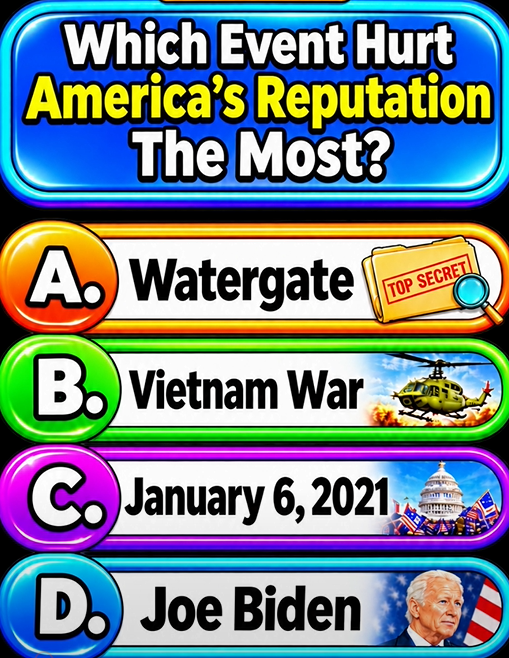
🎬 FACEBOOK REELS QUIZ SCRIPT
Which Event Hurt America’s Reputation the Most?
1. HOOK — A Question About America’s Image
Throughout American history, the United States has experienced moments that changed how the world viewed the country.
Some events damaged public confidence in American leadership. Others created international controversy, divided American society, and raised difficult questions about democracy, government accountability, and foreign policy.
But here’s a challenging question:
Which event or political period do you believe hurt America’s reputation the most?
Was it the Watergate scandal, which shook public trust in the American presidency?
Was it the Vietnam War, a conflict that divided the nation and damaged America’s international credibility?
Was it January 6, 2021, when the United States Capitol was attacked during the certification of the presidential election?
Or do you believe Joe Biden’s presidency negatively affected America’s image around the world?
There are four choices, and your answer may depend on which historical consequences you consider most important.
2. INTRODUCTION — Understand the Four Choices
Let’s examine each option before making a decision.
A — Watergate.
Watergate was one of the most famous political scandals in American history. It began with a break-in at the Democratic National Committee headquarters in Washington, D.C., in June 1972. The investigation eventually exposed political misconduct and a presidential cover-up. The scandal resulted in President Richard Nixon resigning in August 1974.
Watergate became a lasting symbol of political corruption and a crisis of trust in government.
B — Vietnam War.
The Vietnam War was a long and devastating conflict involving the United States, North Vietnam, South Vietnam, and other international actors.
American military involvement expanded dramatically during the 1960s. The conflict caused enormous human suffering, sparked widespread protests, divided American society, and raised serious questions about American military strategy and foreign policy.
The war ended with the fall of Saigon in 1975, leaving a lasting impact on American society and its international image.
C — January 6, 2021.
On January 6, 2021, a violent crowd attacked the United States Capitol while Congress was meeting to certify the results of the 2020 presidential election.
The attack interrupted the certification process, endangered lawmakers and law enforcement officers, and became one of the most extraordinary challenges to the peaceful transfer of presidential power in modern American history.
It also attracted worldwide attention and raised questions about the strength of American democratic institutions.
D — Joe Biden.
Joe Biden served as the 46th president of the United States from January 2021 to January 2025.
His presidency involved major domestic and international challenges, including inflation, immigration, the war in Ukraine, tensions in the Middle East, and debates about American leadership abroad.
Supporters and critics have very different opinions about his decisions and their consequences for America’s international reputation.
3. SUSPENSE — Four Choices, Different Historical Consequences
Now, let’s think about what makes this question so difficult.
Watergate damaged confidence in the presidency and demonstrated how political misconduct could threaten the nation’s institutions.
The Vietnam War raised difficult questions about military intervention, government transparency, and America’s ability to achieve its foreign policy objectives.
January 6 became an internationally recognized moment of political violence inside the Capitol, the symbolic center of American democracy.
And the Biden presidency generated competing assessments of American leadership, foreign policy, economic performance, and international relationships.
But these choices are not exactly the same kind of subject.
The first three are historical events or conflicts, while the fourth refers to a four-year presidential administration and its record.
That distinction matters because a single event can be evaluated differently from an entire presidency.
So, which one do you believe caused the greatest damage to America’s reputation?
Was it the event that weakened trust in government? The war that damaged international credibility? The attack that challenged democratic institutions? Or the decisions made during a presidential administration?
There is no universally accepted historical ranking.
4. ENGAGEMENT — Cast Your Vote!
Now it’s your turn to decide!
Which of these choices do you believe hurt America’s reputation the most?
A — Watergate
B — Vietnam War
C — January 6, 2021
D — Joe Biden’s presidency
Write your answer in the comments!
But don’t just leave a letter. Tell us why you selected it.
Do you believe America’s reputation depends most on the honesty of its leaders, its actions overseas, the stability of its democratic institutions, or the performance of its president?
Let’s see how people from different generations and backgrounds view these important moments in American history.
5. ANSWER REVEAL — There Is No Single Official Answer!
Here’s the surprising part: This is an opinion poll, not a question with one objectively correct answer.
Each choice represents a different historical controversy, and each has affected America’s reputation in a different way.
Let’s explore the historical significance of all four choices.
First: Watergate — A Crisis of Presidential Trust.
The Watergate scandal began on June 17, 1972, when five men were arrested after breaking into the Democratic National Committee headquarters at the Watergate complex in Washington, D.C.
What initially appeared to be a burglary developed into a much larger political investigation.
Investigators uncovered connections between the break-in and individuals associated with President Richard Nixon’s reelection campaign. The scandal grew as evidence emerged of efforts to conceal the administration’s involvement.
The Senate established a special committee to investigate the scandal. Public hearings brought the controversy into American homes and attracted enormous attention.
The investigation eventually exposed serious abuses of presidential power and attempts to obstruct the inquiry.
In 1974, the United States Supreme Court ruled in United States v. Nixon that the president had to provide the requested White House recordings. Those recordings contained evidence that further weakened Nixon’s position.
Facing almost certain impeachment and removal from office, Nixon announced his resignation on August 8, 1974, and left office the following day.
Watergate damaged public confidence in political leadership and became a permanent reference point for government misconduct.
However, it also demonstrated that American institutions could investigate a president, enforce legal accountability, and hold powerful officials responsible.
That is an important part of the historical story: Watergate exposed serious institutional failures, but the investigation also demonstrated the importance of checks and balances.
Second: The Vietnam War — A Major Challenge to American Credibility.
The Vietnam War had an enormous impact on America’s reputation, both internationally and domestically.
The United States became deeply involved in supporting South Vietnam during the Cold War, seeking to prevent the spread of communism in Southeast Asia.
American military involvement expanded significantly during the 1960s. By 1968, hundreds of thousands of American troops were serving in Vietnam.
However, the war became increasingly controversial.
Television coverage brought images of the conflict into American homes. Growing casualties, unclear military objectives, and disagreements between official statements and events on the battlefield weakened public confidence in government explanations.
Large antiwar demonstrations took place across the United States. Students, activists, veterans, religious organizations, and ordinary citizens debated whether American involvement was justified.
The war also created serious divisions between generations and communities.
Internationally, the conflict damaged America’s image among people who questioned the morality, effectiveness, and consequences of its military intervention.
The final American combat troops withdrew in 1973 under the Paris Peace Accords. In April 1975, North Vietnamese forces captured Saigon, bringing the war in South Vietnam to an end.
The conflict left deep scars. More than 58,000 American service members died, while Vietnamese civilians and combatants suffered devastating losses.
The Vietnam War remains one of the most consequential and controversial chapters in American foreign policy.
It changed how many Americans viewed their government, their military, and the responsibilities of the United States as a global power.
Third: January 6, 2021 — An Attack on the United States Capitol.
January 6, 2021, became a defining moment in modern American political history.
On that day, Congress gathered at the Capitol to count and certify the electoral votes from the 2020 presidential election.
A crowd gathered in Washington following a rally near the White House. Some members of the crowd later forced their way into the Capitol, assaulted police officers, damaged property, and interrupted the congressional proceedings.
Lawmakers and staff members were evacuated or sheltered as law enforcement officers attempted to secure the building.
The certification process was suspended for several hours before Congress returned and completed its work.
The attack shocked Americans and attracted international attention.
For many observers around the world, the images of violence inside the Capitol raised serious questions about political polarization, democratic stability, and the peaceful transfer of power.
The United States has long presented itself as a model of constitutional government and democratic institutions. Seeing the Capitol attacked during an election certification was therefore especially significant.
The event also led to extensive congressional investigations, criminal prosecutions, and continuing political debate.
The January 6 attack remains a major subject in discussions about American democracy, political violence, election integrity, and institutional resilience.
Fourth: Joe Biden’s Presidency — Debates About American Leadership.
Joe Biden became the 46th president of the United States on January 20, 2021, after serving as vice president under Barack Obama.
His administration faced several major challenges.
Domestically, the country experienced high inflation, debates over immigration and border security, political polarization, and disagreements about government spending.
Internationally, the Russian invasion of Ukraine in February 2022 became a major test of American leadership. The Biden administration provided substantial support to Ukraine and worked with NATO allies to respond to Russia’s actions.
The administration also faced difficult decisions involving the Israel-Hamas war, relations with China, and other international challenges.
Opinions about Biden’s foreign policy and America’s reputation during his presidency varied considerably from country to country.
For example, Pew Research Center surveys in 2024 found that international confidence in Biden differed significantly across the countries surveyed. Some populations expressed relatively high confidence, while others were much more critical.
This illustrates why it would be inaccurate to claim that everyone around the world viewed his presidency in the same way.
Supporters often emphasized alliance-building, international cooperation, infrastructure investment, and economic recovery.
Critics focused on inflation, immigration, the withdrawal from Afghanistan, and disagreements over international policy.
A fair historical assessment requires examining the evidence, considering different perspectives, and distinguishing between a president’s personal popularity and the broader reputation of the United States.
So, Which One Hurt America’s Reputation the Most?
The answer depends on what you measure.
If you focus on presidential corruption and public trust, Watergate is a powerful example.
If you focus on military credibility and the international consequences of American foreign policy, the Vietnam War stands out.
If you focus on democratic institutions and the peaceful transfer of power, January 6 is especially significant.
If you focus on the overall performance of recent American leadership, you may choose Joe Biden’s presidency, although opinions about that record remain deeply divided.
These events cannot be measured using one simple historical score.
They happened in different periods, involved different circumstances, and affected America’s reputation in different ways.
The most interesting part of this quiz is hearing how people explain their choices.
6. ENDING — Share Your Opinion!
Now we’ve explored all four choices!
There is no official correct answer, because the question asks for your personal judgment about America’s reputation.
So, which one would you choose?
A — Watergate
B — Vietnam War
C — January 6, 2021
D — Joe Biden’s presidency
Share your answer and explain your reasoning in the comments.
Remember, historical discussions are more meaningful when we listen to different perspectives and support our opinions with facts.
Follow USA Brain Challenge for more American history, politics, and knowledge challenges.
Keep learning, keep thinking, and keep challenging your brain!
Fact-check and presentation notes
-
Watergate led to Nixon’s resignation in August 1974.
U.S. Senate+1
-
The Vietnam War had lasting consequences for American credibility, public trust, and foreign policy.
Naval History and Heritage Command+2
-
The January 6 attack interrupted Congress’s electoral certification and prompted official investigations.
Oversight.gov+1
-
International views of Biden varied across countries; Pew’s 2024 survey documented substantial differences.
Pew Research Center+1
My recommendation: Consider changing the quiz title to “Which of These Had the Greatest Negative Impact on America’s Reputation?” This makes it clearer that viewers are being asked to express an opinion, not identify a factually correct answer.
