The general counsel did not answer immediately. She placed the printed timeline on the table beside me and waited until I had settled back against the sofa.
“The footage shows Chloe entering the bridal suite after you left,” she explained. “She was alone for approximately two minutes. When she came out, she was carrying a small velvet pouch. We are reviewing the recording from the corridor outside the suite as well.”
I stared at her. “Did she have the ring?”
“We cannot determine that from the first angle. The camera inside the suite does not capture every part of the dressing area.”
“Then how does that help?”
“It establishes that the sequence of events may be different from the one described to us. We are checking the adjacent corridor and speaking with the people who had access.”
I pressed my hands together. The information did not prove that Chloe had taken the ring or that she had intended to accuse me. But it confirmed that the investigation was no longer limited to the moment when she pointed at me in the ballroom.
For three years, the Mercers had made assumptions about me and treated those assumptions as facts. I had been called ungrateful for declining expensive gifts, disloyal for visiting my parents, and selfish for asking Daniel to spend holidays with me rather than automatically following his mother's plans. Their version of me had become so familiar to them that they no longer needed evidence to support it.
Tonight, the same habit had taken a more serious form.
A few minutes later, Thomas returned with a member of the security team. They had reviewed the corridor recording and recovered the relevant section from the bridal suite entrance. He explained that the footage showed Chloe leaving the suite with the velvet pouch, then approaching her mother near a side corridor. The camera did not record their conversation clearly, but it showed Eleanor opening her handbag and placing something inside.
“Have you found the ring?” I asked.
“Not yet,” Thomas said. “We have requested permission to examine the items that may be relevant, and the police are now involved in that process. We won't assume what the footage means until the evidence is verified.”
His caution frustrated me, but I understood it. I did not want another accusation made before anyone had established the facts. The same standard that should have protected me earlier had to apply now, even when the evidence seemed to point in a particular direction.
My phone rang.
“Dad,” I answered.
“Thomas has updated me,” he said. “How are you feeling?”
“Tired. Angry. I just want to know what happened.”
“You will. But don't let their behavior push you into making a decision you haven't had time to consider.”
I looked toward the closed door. “What decision?”
“What you want to do about your marriage. What you want to say to your husband's family. Whether you want to pursue a complaint about the way you were treated. Those decisions belong to you. We will make sure you have the information and support you need, but no one gets to make those choices for you.”
I felt my eyes sting. It was the first time anyone that evening had spoken about my future without treating it as a problem to be managed.
“Thank you,” I whispered.
“You don't have to thank me for being your father.”
For a moment, I could not speak. I had spent the entire evening trying to remain composed in front of people who had made my pregnancy a spectacle. My father's simple words nearly undid me.
I took a breath and told him I was all right for the moment. He reminded me that my mother was available if I wanted her company, then ended the call so the security team could continue its work.
Outside the lounge, the ballroom had grown quieter. The guests were no longer clustering around Chloe. Some sat at their tables, while others spoke in low voices near the windows. The temporary security hold was being managed by the staff, with emergency access available under their procedures. Nobody was being threatened or punished by the locked doors. The building's team was preserving the scene and preventing the incident from dissolving into conflicting accounts before the relevant records could be secured.
Chloe had stopped pacing. She sat at the head table with her arms folded, staring at her phone. Eleanor stood behind her, speaking in a low voice that grew sharper whenever Chloe attempted to respond.
Daniel was nowhere in sight.
I did not know whether he was talking to the hotel managers, calling a lawyer, or trying to decide how to explain his behavior. I discovered that I no longer cared enough to search for him.
The door opened, and a uniformed officer entered with Thomas and the hotel's general counsel. The officer introduced himself and explained that he was gathering initial statements regarding the missing ring and the incident involving my belongings and clothing. He asked whether I was comfortable speaking with him in the lounge.
I agreed.
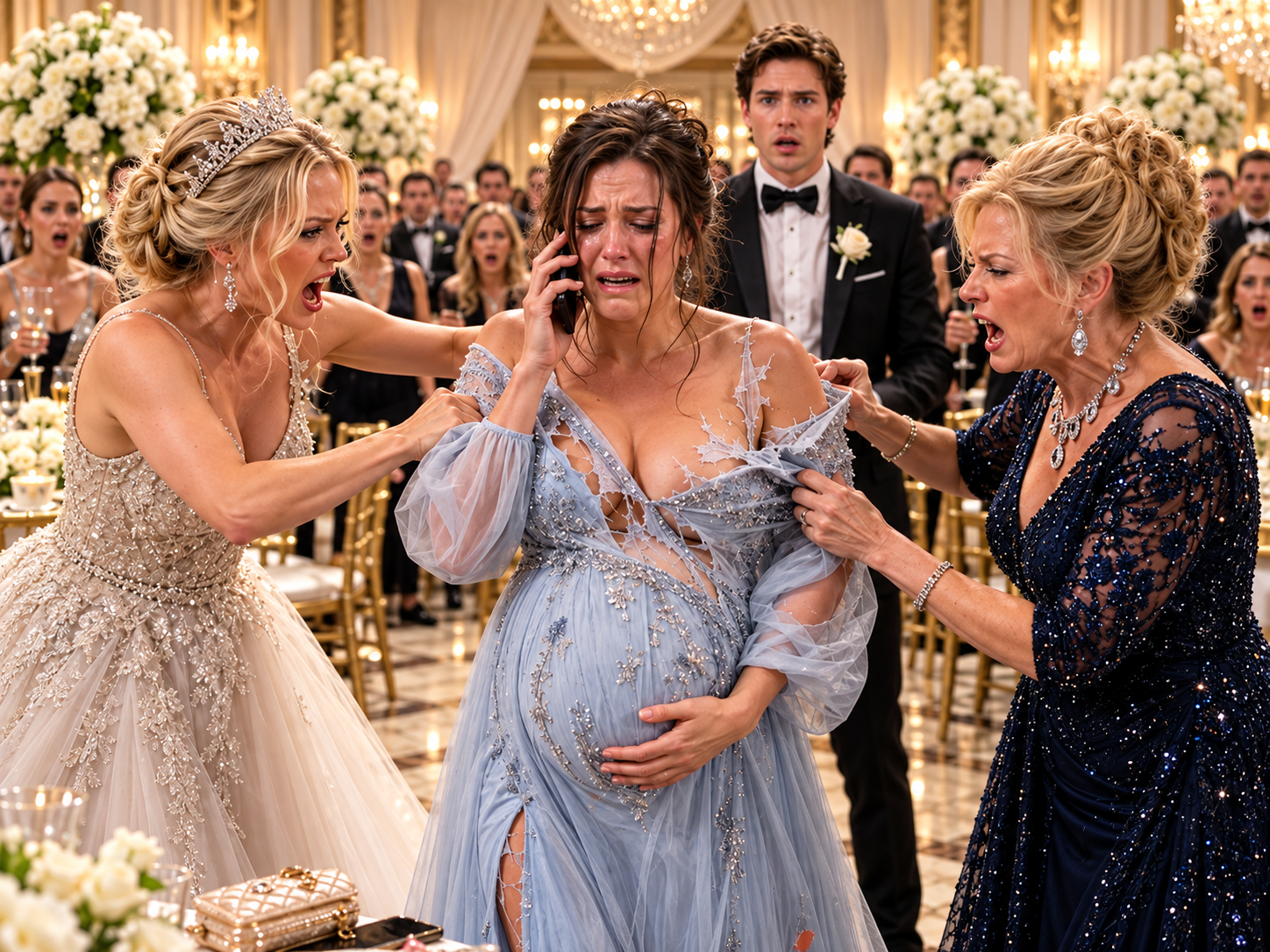
He asked me to describe what had happened, beginning with Chloe's accusation. I explained that I had brought her water in the bridal suite, that I had not touched her ring, and that she later demanded a search of my purse. I described Daniel handing it to her, the contents being emptied onto the floor, and Eleanor deliberately stepping on the train of my gown before pulling at the fabric.
I told him that I had asked them to stop.
He listened without interrupting, then asked whether I had any injuries.
“My back is sore, but I don't know whether that's from standing or from what happened. I haven't noticed bleeding or anything else unusual.”
He said a medical assessment would be sensible, especially given my pregnancy. I agreed. The hotel arranged for a qualified medical professional to check me while the officer continued speaking with witnesses. The examination did not identify an immediate emergency, but I was advised to contact my maternity care provider and seek urgent assessment if I developed pain, bleeding, reduced fetal movement, or other concerning symptoms.
That practical attention to my well-being meant more to me than any speech about family loyalty could have.
When the examination was complete, I returned to the lounge. Thomas was waiting by the door.
“We've located the ring,” he said.
I stood very still. “Where?”
“It was inside Eleanor Mercer's handbag.”
I stared at him.
“Are you certain?”
“The officer has confirmed the item matches the description. The ring has been documented, and the circumstances of how it came to be there are being investigated.”
I felt no satisfaction at first. Only disbelief. The ring had been in the possession of the woman who had called me a thief, who had demanded that my belongings be searched, and who had torn my dress while I was eight months pregnant.
“Did she know it was there?” I asked.
“That is something the officer will need to establish through statements and evidence.”
I nodded slowly. I would not make the same mistake the Mercers had made. Finding the ring in Eleanor's handbag was a consequential fact, but it did not by itself answer every question about intent. The remaining evidence mattered.
Thomas accompanied me back toward the ballroom. The guests turned as I entered, and I felt the weight of their attention again. This time, however, I did not lower my head.
The officer stood near the head table. Eleanor was beside him, her face pale with fury. Chloe had risen from her chair, and Nathan stood several feet away, watching her with an expression I had not seen earlier in the evening.
“The ring has been recovered,” the officer announced. “We are documenting the circumstances and will speak with the relevant individuals.”
Eleanor's voice rose immediately. “It must have been placed in my bag without my knowledge.”
Chloe turned toward her mother so quickly that her earrings swung. “What are you talking about?”
Eleanor stared at her. “Don't start.”
The officer raised a hand, asking them to let him finish. He explained that the discovery did not end the investigation. He would need to establish how the ring had entered the handbag and whether any deliberate attempt had been made to mislead others.
Chloe looked from her mother to the officer, then toward me.
“You can't prove anything,” she said.
The words came too quickly.
Nathan's expression changed. “Chloe, why would you say that?”
“Because she's been trying to make me look bad all night!”
“You accused her of stealing a ring that was in your mother's bag.”
“I didn't put it there.”
“Then explain how it got there.”
Chloe opened her mouth, but Eleanor interrupted her.
“This is a private family matter. We will deal with it ourselves.”
“No,” I said.
The word came out quietly, but the nearby conversations stopped.
Eleanor turned toward me. “Excuse me?”
“You don't get to decide that this is private after making it public. You accused me in front of everyone. You let your daughter empty my purse onto the floor. You tore my dress, and you watched me struggle to cover myself while my husband stood there.”
I looked at Daniel, who had reappeared near the edge of the crowd.
“You helped them.”
He flinched as though I had struck him.
“I thought we could resolve it quickly,” he said.
“You thought I was the easiest person to sacrifice.”
“That's not fair.”
I looked at him for a long moment. “You had three years to decide what being my husband meant. Tonight, when I needed you, you chose your mother's approval over my dignity. You can disagree with my description, but you cannot change what you did.”
Daniel looked down.
For once, he had no promise ready. No explanation about Eleanor's temper, no assurance that Chloe had been under stress, no request that I wait until the family had calmed down. The facts were standing in front of him, and he could not ask me to pretend they were something else.
My father arrived shortly afterward.
He entered through the side corridor with two members of his team, wearing a dark suit and a plain overcoat. His hair was silver at the temples, and his expression was composed. He did not stride toward Eleanor or raise his voice to attract attention. He walked directly to me.
“Vivienne.”
I went to him, and he wrapped his arms around me carefully, mindful of my stomach. For the first time since Chloe had begun shouting, I allowed myself to tremble.
He held me until my breathing steadied.
“Are you hurt?”
“Not seriously, as far as the examination could tell.”
“Good. We'll follow the medical advice.”
He drew back and looked at my torn gown, then at the scattered belongings that had been collected and documented. His expression did not change, but I saw his jaw tighten.
He turned toward Thomas and the officer, greeting them respectfully. He asked whether the evidence had been preserved and whether the guests were free to leave once the necessary statements had been taken. They explained the current status, and he accepted their answers without attempting to direct the investigation.
Only then did he face the Mercers.
Eleanor straightened, trying to recover the authority she had wielded earlier. “Adrian, I'm sure this has been blown out of proportion. There was a misunderstanding about the ring.”
My father regarded her calmly.
“A misunderstanding does not explain why my pregnant daughter was publicly accused, why her personal belongings were thrown onto the floor, or why her clothing was torn.”
Eleanor glanced toward the guests. “We were upset. It was an important family heirloom.”
“Then you should have reported it missing and allowed the proper people to investigate.”
Chloe crossed her arms. “She was the one who made it a scene.”
My father looked at her. “You pointed at her in front of nearly two hundred people and demanded that she be searched. You have just learned that the ring was recovered from your mother's handbag. The appropriate authorities will determine how it came to be there.”
Chloe's face flushed. “You think your money gives you the right to talk to us like that?”
“No,” my father replied. “The facts give me the right to ask why my daughter was treated this way. My money has nothing to do with her innocence.”
The answer silenced her.
My father turned toward Daniel. “You married my daughter. She trusted you to stand beside her. Tonight, when she was humiliated and frightened, you handed her belongings to the people humiliating her.”
Daniel's voice was barely audible. “I made a mistake.”
“Yes,” my father said. “You made a choice. Whether you understand the difference is something you will have to decide for yourself.”
He did not threaten to destroy Daniel's career or order the hotel to ruin the Mercers. He did not announce that their family would never work in business again. Instead, he asked the hotel's counsel to provide the relevant records to the authorities, and he confirmed that any complaints arising from the incident should proceed through the appropriate channels.
Then he addressed the room.
“My daughter does not owe anyone here an explanation of her family, her finances, or her right to be treated with dignity. No one should have to prove that they belong before they are entitled to basic respect.”
His voice remained level.
“The security hold will be lifted when the officers have completed their immediate work. Guests who wish to leave may do so in accordance with the staff's instructions. No one is being held here to satisfy my anger. We are here because an allegation was made, evidence needs to be preserved, and an incident must be documented properly.”
The difference between his response and Eleanor's was unmistakable. She had tried to command the room through humiliation. He had insisted that the room follow a process.
As the security team began releasing the exits in stages, guests slowly gathered their belongings. Some approached me to apologize for watching without intervening. Others avoided my eyes. I did not demand an apology from every person who had been present. I was too tired to manage the conscience of the entire ballroom.
Nathan came toward me before leaving.
“I'm sorry,” he said. His eyes were red, and he looked as though the evening had aged him. “I should have questioned Chloe sooner. I saw how she was treating you, and I kept hoping she'd stop.”
I accepted his apology without offering absolution.
“Next time, don't wait for someone else to tell you that something is wrong.”
He nodded. “I won't.”
Chloe remained beside the head table while the officer spoke with her and Eleanor separately. Her wedding reception had been interrupted, her accusation had collapsed, and the people who had once followed her lead were now asking questions. She looked at me once, and for a moment I saw something that might have been shame beneath her anger.
I did not approach her.
Eleanor attempted one final conversation with my father, insisting that the family should meet privately and settle the matter without damaging anyone's reputation. He told her that any discussion about the incident could take place after the relevant facts had been established, but he would not ask me to withdraw a complaint or accept an apology simply to protect the Mercers from embarrassment.
Then he returned to my side.
We left the ballroom together, walking through the foyer beneath the same chandeliers that had illuminated my humiliation earlier that night. The doors stood open now, and the cool air from outside drifted into the building. My father held my arm as we crossed the marble floor, not because I was incapable of walking, but because I wanted the comfort of his presence.
In the car, he asked whether I wanted to go to the hospital for a further check or return home and contact my maternity care provider. I told him I wanted to follow the medical advice we had received and call my doctor before deciding. He nodded and made sure the driver knew we would stop if I needed anything.
For several minutes, neither of us spoke.
Then I began to cry.
I cried for the dress, for the ring, for the guests who had watched, and for the husband who had handed over my purse as though my dignity were a small price to pay for a quiet evening. I cried because I had spent three years trying to earn acceptance from people who had never intended to offer it freely.
My father did not tell me to be strong. He did not remind me of the power his company held or suggest that the Mercers would soon regret their behavior. He simply took my hand and let me cry.
When I finally looked up, I asked him a question I had been carrying for years.
“Why didn't I tell them who you were?”
He considered it before answering.
“Because you wanted to be loved for yourself. There was nothing wrong with that.”
“But they thought I was poor.”
“They thought your family's wealth determined your worth. You cannot control what other people choose to value.”
I looked down at my hands. “I thought if I was patient enough, Daniel would eventually stand up for me.”
My father squeezed my fingers. “You gave him opportunities to show you who he was. Tonight, he showed you. What you decide to do with that knowledge is up to you.”
I leaned back against the seat, feeling the exhaustion of the evening settle into my bones. I did not know what would happen to my marriage. I did not know whether Chloe or Eleanor would face legal consequences for their actions, or whether the investigation would establish that the ring had been deliberately moved. Those questions would take time, and I would not answer them on the basis of anger alone.
But I knew what I would no longer do.
I would not apologize for being born into a family that valued privacy over display. I would not accept humiliation as the price of belonging. I would not teach my daughter that love meant remaining silent when someone treated her badly.
The next morning, I called my maternity care provider and followed the recommended guidance. My daughter was moving normally, and I had no signs of an emergency, but I was told to seek immediate care if anything changed. I rested while my father arranged for the necessary records to be preserved and made sure I had access to independent legal advice.
Over the following days, the evidence was reviewed. The ring's recovery from Eleanor's handbag became a central part of the inquiry, alongside the security footage, witness statements, and the accounts of what had happened in the ballroom. The findings would have to speak for themselves. My father did not demand a particular verdict, and I did not make public accusations beyond what I could substantiate.
Daniel called repeatedly. At first, he said he had made a mistake and wanted to come home. Later, he admitted that he had spent years avoiding conflict with his mother by asking me to tolerate things he would never have accepted from anyone else. He said he had convinced himself that keeping Eleanor happy was the same as protecting his marriage.
I listened once, then told him that I needed time and space. I would not decide the future of our marriage while he was frightened by the consequences of his actions. He could seek counseling, reflect on his choices, and take responsibility for what he had done, but I would not promise to return simply because he was finally willing to apologize.
For the first time, he did not argue.
My father remained beside me, but he never tried to make my decisions for me. He helped me understand my options, supported me through the practical arrangements, and reminded me that I could take one step at a time. He did not use his wealth to purchase an outcome. He used his resources to make sure I was safe, informed, and free to choose.
Months later, when I held my daughter in my arms, I thought about the night the ballroom doors had closed. I remembered the fear in Chloe's face, Eleanor's fury, and Daniel standing silent beside the scattered contents of my purse. I also remembered the moment my father answered the phone and asked whether I was hurt before asking anything else.
That was the difference I wanted my daughter to understand as she grew older. Power was not the ability to frighten a room into obedience. It was the ability to protect someone without taking away their choices. Love was not a promise that nobody would ever hurt you. It was the willingness to stand beside you when they did.
The Mercers had believed I was a penniless parasite because they could not imagine a woman who wanted to live without displaying her family's wealth. They had mistaken my privacy for weakness and my patience for permission. They had assumed that because I did not boast about my father, I had no one who would stand up for me.
They were wrong.
But my father's influence was never the most important thing he gave me that night. It was the reminder that I did not need to earn the right to be treated with dignity, and I did not have to remain in a marriage that required me to surrender it.
The doors had closed because the hotel needed to preserve the scene and establish the truth. They opened again when the necessary work was complete.
I walked out with my father, carrying no stolen ring, no borrowed status, and no obligation to return to the life I had endured.
I had my daughter, my own voice, and the freedom to decide what came next.
and my father about the boundaries I needed to establish before Daniel could become involved in her care. I had not made those decisions to punish him. I had made them because my daughter deserved to enter the world surrounded by calm, not by the unresolved anger of the adults responsible for her.
“You can hold her,” I said at last, “but first, wash your hands. And sit down. I don't want you standing over us.”
Daniel nodded immediately. He put the flowers on the windowsill, washed his hands at the sink, and returned to the chair beside my bed. When the nurse helped me position the baby in his arms, he looked down at her with such concentration that for a moment I saw the man I had once believed he could be.
“Hello, little one,” he whispered. “I'm your dad.”
Our daughter stirred, opened her mouth in a tiny yawn, and settled against his chest. Daniel's eyes filled with tears. He looked at me as if he expected the sight to undo everything that had happened between us.
It did not.
I could feel tenderness for the man holding our child and still remember him standing in the ballroom while Chloe scattered my belongings across the marble floor. I could recognize that his love for his daughter might be genuine without pretending that his treatment of me had been acceptable. Those truths could exist together, even if he found them difficult to understand.
“She needs both of us to behave like adults,” I said quietly. “She needs consistency. She needs safety. And she needs to grow up without learning that love means letting people humiliate you.”
Daniel looked down at the baby again. “I know.”
“You've said that before.”
He swallowed. “Then I need to show you.”
I did not answer. I had learned that promises could be offered in a moment of fear and forgotten when the person making them felt comfortable again. If Daniel wanted to change, he would have to do it without treating my forgiveness as a reward he was owed.
My father stood and moved toward the door. Before leaving, he asked whether I wanted him to stay while Daniel visited. I told him I was comfortable for now, and he reminded Daniel that the nurse should be called if I needed anything. Then he left us alone, closing the door gently behind him.
For several minutes, Daniel said nothing. He watched our daughter sleep, occasionally adjusting his hold when she moved. The room was quiet except for the soft hum of the ventilation system and the distant sound of a trolley moving along the corridor.
“Did you really never tell me the truth about your father because you thought I would treat you differently?” he finally asked.
I looked at him. “I didn't tell you every detail about his business because it wasn't relevant to why I married you.”
“But you must have known your family could have helped us.”
“Helped us with what?”
He hesitated. “With the house. With investments. With the business. There were things I struggled with that you never mentioned.”
I felt the familiar exhaustion return. Even now, after everything that had happened, he was looking backward at the money he might have accessed instead of the person he had failed to protect.
“My father would have helped us if we had asked him for help honestly,” I said. “But I didn't marry you to make you financially comfortable. I married you because I believed you loved me. I wanted a husband, Daniel, not someone who would measure my value by what my family could provide.”
He lowered his eyes.
“And if you had told me earlier?”
“Would you have treated me better at the wedding?”
He did not answer.
“That is why I kept it private,” I continued. “I wanted to know whether you respected me when you thought I had nothing to offer you. Now I have my answer.”
He looked as though he wanted to disagree, but the words never came. Eventually, he returned our daughter to me with the nurse's help and stood beside the bed.
“I'll come back tomorrow, if you allow it.”
“Ask before you come. Don't assume.”
He nodded and left the room without asking me to comfort him.
After the door closed, I looked down at my daughter. Her hand had slipped free of the blanket, and her fingers opened and closed in the air. I touched her palm with my own, and she caught one of my fingers.
I had imagined motherhood as a beginning filled with hope. I had not imagined that it would arrive alongside the collapse of the life I thought I understood. Yet holding her made one thing clearer than anything else had: I could not control what other people chose to do, but I could decide what I would allow to shape her future.
That evening, my mother arrived with a small bag of baby clothes, a fresh nightdress for me, and a container of homemade soup. She kissed my forehead before looking at the baby, and the expression on her face softened completely.
“She has your eyes,” she whispered.
“She has Daniel's chin,” I replied.
My mother smiled, then settled into the chair beside me. She did not ask whether I intended to reconcile with Daniel. She did not suggest that a newborn needed her parents together at any cost. She simply helped me arrange the blanket around the baby and asked what the doctor had said about my recovery.
For the first time in days, I felt no pressure to defend a decision I had not yet made.
Outside the hospital window, evening settled over the city. My phone continued to receive messages, but I turned it face down. The investigation would continue. Daniel would have to decide whether he was willing to change. I would have to decide what kind of future I wanted.
None of those decisions needed to be made before sunrise.
END PART 5
The End
Read more original stories on Feel Every Story.
The Bride Accused Me Before Two Hundred Guests, but My Husband’s Silence Hurt More Than the Insult That Started Everything
Part 4 of 4