
One quiet afternoon in May, Taryn came over for coffee. Eli was at school, Colin was working, and neither of us had anywhere else to be. We sat at the kitchen table with our cups between us, talking about the garden and the plans she and Colin were making for summer. It was the kind of visit I had begun to enjoy most: no event to organize, no schedule to manage, and no expectation that our time together had to produce anything beyond the pleasure of being together.
At one point, Taryn looked toward the dining room and asked, “Do you ever regret all those Christmases?”
I knew which years she meant. The question brought back the first holiday after her marriage, when six people had gathered around my table and I had been delighted to have everyone under one roof. I remembered how the family had gradually grown, how Judith's overnight stays had become routine, and how my bedroom had eventually become the expected place for her and Glen. I remembered the grocery lists, the long days in the kitchen, and the feeling of sitting down only after everyone else had eaten.
I took a moment before answering. “I regret that I didn't speak up sooner,” I said. “But I don't regret having my family here. Those are two different things.”
Taryn lowered her eyes. “I think I've worried that you look back and feel like we took advantage of you.”
“I did feel taken for granted sometimes,” I answered honestly. “But I don't believe anyone sat down and decided to make my life harder. The arrangement developed because it was convenient, and I kept agreeing to it. Eventually, everybody stopped asking whether it still worked.”
She nodded slowly. “I thought you would tell me if you didn't want to do something.”
“I thought I should be able to handle it,” I said. “And when I started finding it difficult, I told myself it was only a few days a year. I didn't realize how much those few days affected me until I looked at everything together.”
For years, I had treated each holiday as a separate obligation. Christmas was one event, Easter another, and a birthday barbecue simply a family gathering. I had not counted the cumulative cost of the cooking, cleaning, planning, childcare, and disrupted rest. When I finally considered the whole pattern, I understood why my knees hurt after holidays and why I sometimes felt exhausted before the next event had even been discussed.
Taryn stirred her coffee. “I think I did the same thing. I saw each gathering as something that worked because you'd always managed it. I never stopped to think about how much of your time it took.”
“That is what happens when something becomes familiar,” I said. “People stop noticing the work behind it. Sometimes the person doing the work stops noticing it, too, because they are so busy getting everything finished.”
We sat quietly for a moment. I could tell that Taryn was trying to understand the years from my perspective, and I did not want to rush her toward a reassuring answer. I wanted her to know that I could acknowledge the hurt without pretending our family memories had become worthless.
“I loved seeing Eli grow up in this house,” I continued. “I loved the first Christmases, when everyone was excited and we were figuring things out. I loved having the family together. But I wish I had understood sooner that I could enjoy those things without doing everything myself.”
“I'm sorry,” Taryn said. “I know I've said that before, but I am.”
“I know you are.”
I reached across the table and touched her hand. I did not need her to apologize endlessly, and I did not need to absolve the past as though it were a debt that had to be settled. What I wanted was for us to keep treating each other with the honesty we had begun to practice.
Taryn told me that she had been thinking about what she wanted Eli to learn about family. She wanted him to see that people helped one another, that traditions mattered, and that caring for someone meant noticing when they needed support. She did not want him to grow up believing that one person should quietly do everything while everyone else enjoyed the result.
I was glad she had thought about it. I told her that children learn as much from what they see as from what adults explain. Eli had watched us prepare meals together, share cleanup, and make plans that considered everyone's needs. He had also seen me sit at the table and enjoy the gathering. Those ordinary experiences could teach him that family life worked best when care moved in every direction.
Later that month, Eli came over to help me plant flowers. He carried a small trowel and insisted on choosing where each plant should go. His choices were not always practical, but I let him explain his reasoning before we decided together. We spent most of the afternoon outside, and when he became tired, we went inside for a snack.
While we sat at the kitchen table, he asked whether we would have Christmas at my house again. I told him we would decide when the time came. He looked disappointed for a moment, then asked whether we could still make cookies together if Christmas happened somewhere else.
“Of course,” I said. “We don't need to wait for Christmas to do that.”
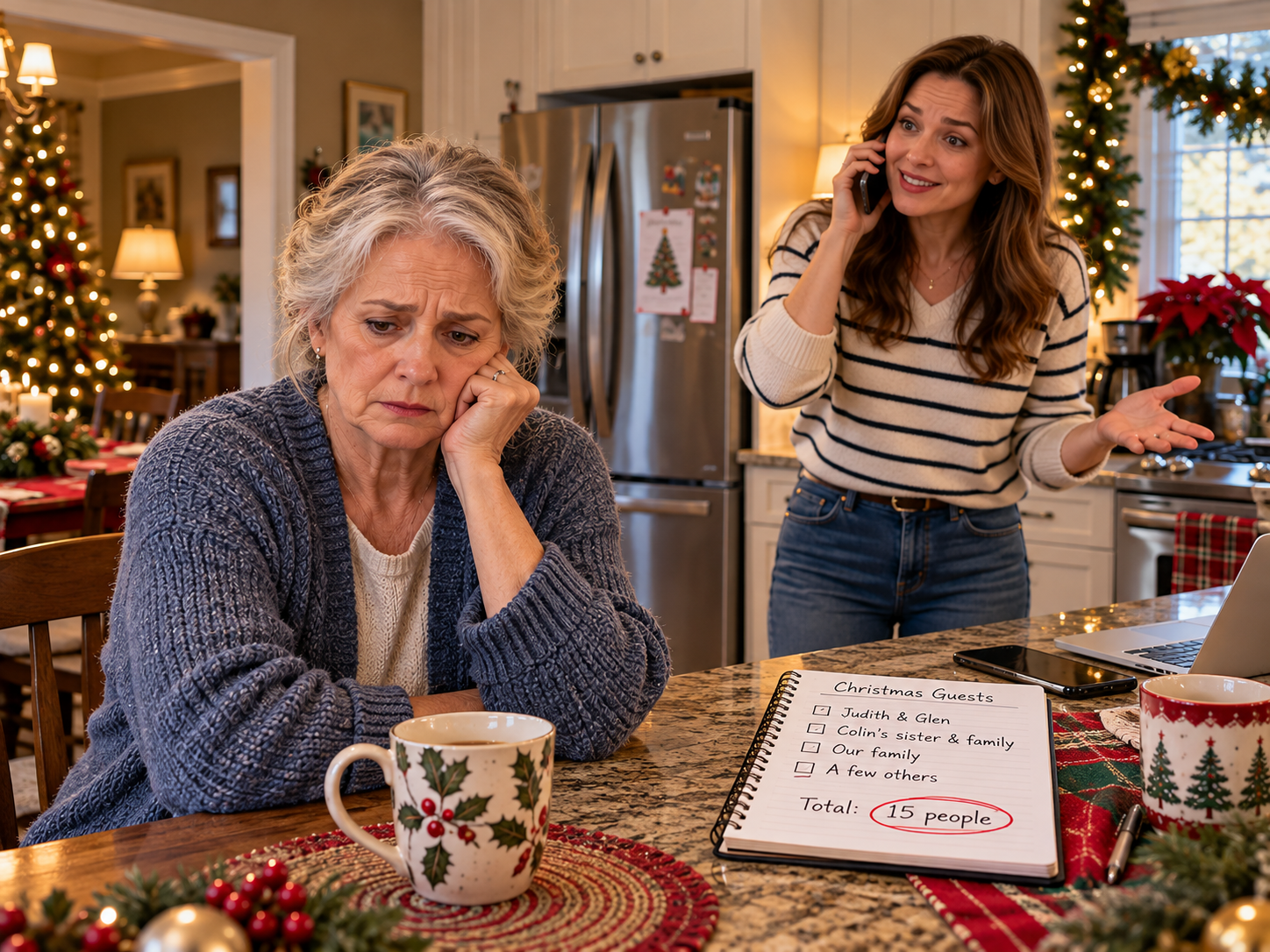
His face brightened. The question reminded me that some of the pressure I had felt around family traditions came from treating certain activities as if they could happen only in one place and under one arrangement. The most important parts of the holiday could continue even if the details changed. I could bake with Eli on an ordinary afternoon. I could see Taryn without organizing a meal for fifteen people. We could create memories without turning every visit into an event.
That summer, I began making more plans for myself. Margaret and I arranged a few afternoons together, and I spent time tending the garden I had once neglected whenever family events approached. I started reading in the evenings instead of using every spare hour to prepare for something that might happen days later. These were small choices, but they reminded me that my life did not need to pause whenever someone might want to gather.
I also became more willing to let other people handle tasks in their own way. When Taryn helped prepare a meal, I did not correct every detail. When Colin arranged the chairs, I allowed him to decide where they should go. When relatives brought dishes that were different from what I would have chosen, I thanked them and made room on the table. Sharing responsibility meant sharing control, and I had to accept that a family gathering did not need to look exactly as I would have arranged it.
One afternoon, Taryn asked me to help her prepare a recipe for a small dinner at her house. We worked side by side in my kitchen, measuring ingredients and talking about ordinary things. She asked me to show her a step she had never learned, and I explained it without taking over. When she made a mistake, we adjusted the mixture and continued.
“I used to think you could do all this without thinking,” she said, watching me prepare the next step.
“I've had a lot of practice,” I replied. “But practice doesn't mean it takes no effort.”
She smiled. “I think I finally understand that.”
The exchange made me think about how easily skill could hide labor. Because I had cooked for years, the work appeared effortless to other people. Because I had hosted so often, the planning seemed natural. My ability had made it easier for others to overlook the effort involved, but I no longer needed to turn that ability into an endless obligation.
As the months passed, I found myself thinking less about whether Taryn had fully understood every part of the past. I could not control what she remembered or how she interpreted each holiday. I could control whether I continued to be honest about what I wanted. That was enough to keep our relationship moving in a healthier direction.
In August, we had a small family dinner at Colin and Taryn's house. I arrived as a guest, carrying a dish I had volunteered to make. Taryn greeted me, Colin finished preparing the meal, and Eli showed me a project he had been working on. After dinner, everyone cleaned up together. I left before it became too late and returned home feeling content.
On the drive back, I thought about the woman I had been during those early years. She had wanted everyone to be happy, and she had believed that the best way to ensure it was to remove every inconvenience from their path. I felt tenderness toward her. She had not been foolish or weak. She had simply believed that her needs could wait indefinitely, and she had not understood what that belief would cost.
I would not spend the rest of my life punishing myself for those years. I could learn from them without allowing regret to become another burden. The important thing was that I had changed the pattern before it became the only way my family knew how to be together.
When September arrived, I felt ready to discuss the coming holidays without fear. I knew there might be requests I could not accommodate and plans that needed adjustment. I also knew that we had learned how to talk about those things. The family had not become less close because I stopped doing everything. In many ways, we had become closer because I no longer carried quiet resentment into every gathering.
Taryn and I continued to talk openly. Sometimes she asked whether a plan would be too much work, and sometimes I volunteered a suggestion before she asked. The difference was that neither of us treated my help as automatic. We were building a relationship in which generosity could be offered freely and accepted with gratitude.
Looking back, I understood that the greatest loss during those seven years had not been the hours spent cooking or the nights on the folding bed. It had been the gradual disappearance of my own voice from decisions about my home and time. I had allowed myself to become the person who made the tradition possible while rarely asking whether the tradition still made room for me.
I had found that voice again, not through anger or punishment, but through a series of honest conversations. I had learned to say what I could offer and what I could not. Taryn had learned to ask, listen, and share the work. We had both discovered that love was stronger when it did not depend on silence.
By the end of summer, I could look at our family memories with a clearer heart. I still cherished the laughter, the food, and the moments with Eli. I no longer needed to pretend that exhaustion was the price of those memories. The past could remain precious without becoming a rule for the future.
Click here to continue reading: PART 16: When We Began Discussing Christmas Again, I Knew the Real Change Was That My Family No Longer Expected Me to Earn My Place by Doing Everything
My Daughter Announced That Fifteen People Would Spend Christmas at My House, and I Finally Realized Nobody Had Asked Whether I Wanted to Host
Part 15 of 20

