
The case moved faster after Officer Bell was detained.
Not quickly enough for Mara.
Nothing in the legal system moved quickly enough for someone who had spent eleven months counting the days.
But this time, the direction had changed.
The bank records were authenticated.
The memory card was examined.
The recording matched the original security system's timestamp.
The handwriting in the notebook was analyzed.
The transactions were traced.
The evidence chain that had once been used to convict Mara began pointing somewhere else.
Samuel visited her twice a week.
Each time, he brought another piece of the truth.
The envelope containing the money had never been properly entered into evidence.
The photograph of Mara in the kitchen had been taken by Bell.
The transfer had been initiated through Daniel's company but authorized under a forged digital signature.
The account ultimately belonged to a company controlled by Bell.
Grant had testified because Bell threatened to expose his involvement in the larger scheme.
Daniel had participated, but his role had been exaggerated after he tried to withdraw.
And the notebook had contained the records that could connect them all.
The original notebook was eventually found.
Not in storage unit 214.
Not in the apartment.
Not behind the clock.
It had been hidden inside a hollow panel beneath the floor of Daniel's sister's garage.
Daniel had moved it there before his arrest because he believed Grant was searching the house.
He had never told anyone.
Until the recording made lying impossible.
When Samuel placed the notebook on the table during one of their meetings, Mara stared at the worn black cover.
“This is it?”
“This is it.”
She touched it.
Eleven months ago, she had believed a notebook like this might save her.
Now she understood that paper could not save anyone by itself.
People had to decide what truth they were willing to defend.
The trial court vacated Mara's conviction three weeks later.
The prosecutor announced that the evidence used against her had been compromised.
The language was formal.
Mara listened from a small courtroom with her hands folded in her lap.
No one called it a miracle.
No one used dramatic words.
The judge simply said the conviction could not stand.
Mara closed her eyes.
For eleven months, she had imagined hearing those words.
When they finally came, she did not feel victorious.
She felt tired.
Then she heard Lily behind her.
“Mommy.”
Mara turned.
Lily stood beside her grandmother.
The child smiled.
Mara smiled back.
That was the moment the glass disappeared.
Not physically.
Emotionally.
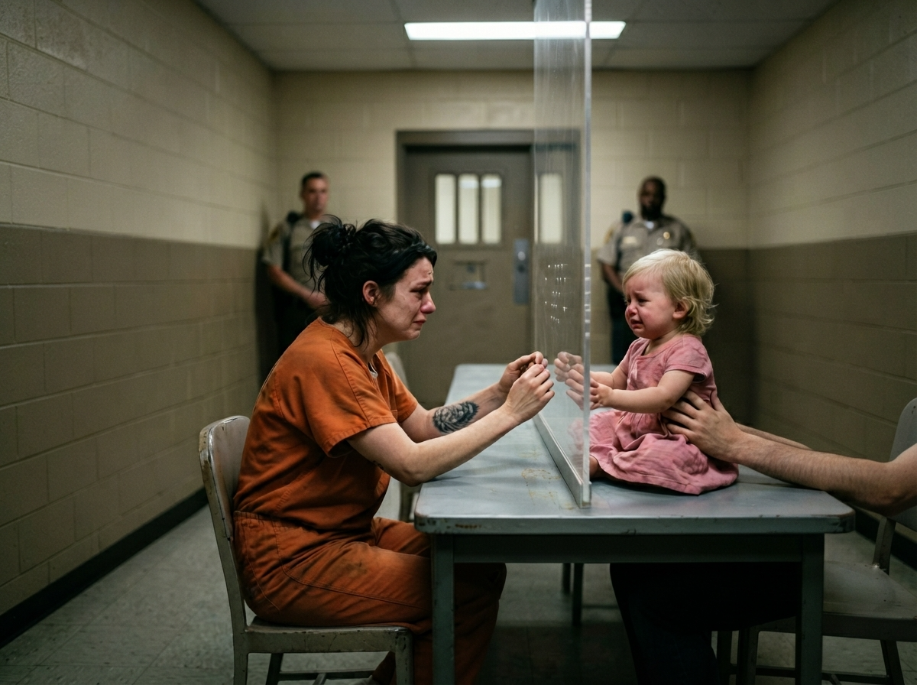
For months, a sheet of reinforced glass had divided them.
Now Lily ran across the courtroom.
Mara dropped to her knees.
The little girl threw both arms around her.
Mara held her tightly.
She could feel Lily's hair against her cheek.
“You're real,” Lily whispered.
Mara laughed through tears.
“So are you.”
“I missed you.”
“I missed you every day.”
Lily pulled back.
“Are we going home?”
Mara looked toward the courtroom doors.
“Yes.”
Outside, reporters waited.
Cameras flashed.
Questions came from every direction.
Was she angry?
Would she sue?
Did she forgive Daniel?
Would she testify against Bell?
Mara answered only one.
“Yes, I'm angry.”
She did not say it loudly.
She did not need to.
Anger was part of what remained.
So was grief.
So was relief.
And so was the knowledge that no court decision could return the year that had been taken from her.
Daniel pleaded guilty to the financial crimes in which he had participated.
He did not ask Mara to forgive him.
That mattered.
When they met once before his sentencing, Daniel sat across from her in a plain room.
There was no glass between them this time.
For a while, neither spoke.
Finally Daniel said, “I am sorry.”
Mara looked at him.
“I believe you.”
His eyes filled.
“But I'm not ready to forgive you.”
“I understand.”
“You don't get to decide when I do.”
“I know.”
Mara nodded.
“Then we're clear.”
Daniel looked down.
“How is Lily?”
“She's sleeping better.”
He closed his eyes.
“Good.”
Mara stood.
At the door, she stopped.
“You were afraid.”
Daniel looked up.
“Yes.”
“You were also selfish.”
“Yes.”
“You can be both.”
He nodded.
Mara left.
She never promised him anything beyond that.
Grant cooperated with investigators after Bell's arrest.
His testimony helped establish the larger financial scheme, but it did not erase his role.
He accepted a sentence for his participation.
Bell faced multiple charges.
The evidence from the memory card became central.
The recording showed exactly what had happened the night before Mara's arrest.
It showed Bell entering the apartment.
It showed him removing the security card.
It showed Grant discussing the plan.
It showed Daniel signing under pressure.
And it showed a four-year-old girl watching from the hallway.
The final piece was the clock.
Investigators reconstructed it in court.
The red crayon mark Lily had made was still visible.
The number 214 had not been random.
It was Lily's attempt to remember the storage unit number Daniel had once mentioned.
But the tiny black drive hidden behind the clock contained the recording.
The box had been a decoy.
The clock had held the truth.
When the judge asked Lily whether she understood why her drawing mattered, she nodded.
“I wanted Mommy to know.”
That was all she said.
It was enough.
Months later, Mara returned to the old apartment.
The kitchen looked smaller than she remembered.
The clock was gone.
Only a pale rectangle remained on the wall where it had hung.
Lily stood beside her.
“Do you miss it?”
Mara looked at the mark.
“No.”
“Why?”
“Because I don't need the clock to remember anymore.”
Lily took her hand.
They walked into the kitchen.
The morning light came through the window.
For the first time in nearly a year, Mara could hear ordinary sounds without listening for a locked door.
A kettle.
A bird outside.
Lily humming.
Mara opened a cupboard.
“There are eggs.”
Lily made a face.
Mara laughed.
“Still no?”
“Never.”
Mara took out bread.
“I can make toast.”
“Don't burn it.”
“I make no promises.”
Lily laughed.
The sound filled the kitchen.
Mara stopped for a moment.
She listened.
There had been a time when she thought freedom would feel like running.
Instead, it felt like standing still without being afraid.
Later that afternoon, Samuel visited.
He brought one final document.
Mara read it.
The state had formally acknowledged the wrongful conviction.
There was compensation.
There were apologies.
There were official words for something that had never felt official.
Mara folded the document.
“Does this fix it?”
Samuel shook his head.
“No.”
She nodded.
“I didn't think so.”
He sat beside her.
“What will you do?”
Mara looked through the window.
Lily was drawing at the kitchen table.
“A lot of things.”
“Such as?”
“Learn how to be a mother again.”
Samuel smiled.
“You never stopped being one.”
Mara looked at Lily.
“I know.”
She paused.
“But she had to learn how to be my daughter again.”
That was the part no judgment could repair for them.
They had lost eleven months.
They would never get them back.
There would be birthdays Mara had missed.
Stories she would never hear firsthand.
A first day of school she had not seen.
Small changes in Lily's voice and habits that had happened while Mara was behind concrete walls.
They would have to learn each other again.
Slowly.
Without pretending nothing had happened.
That evening, Lily climbed onto the couch beside her.
“Mommy?”
“Yes?”
“Can I ask something?”
“Anything.”
“Were you scared when you were in prison?”
Mara thought carefully.
“Yes.”
“Every day?”
“Some days.”
“What did you do?”
Mara looked down at her daughter's hand.
“I remembered you.”
Lily smiled.
“That's what I did too.”
Mara kissed her forehead.
Outside, the sky darkened.
The kitchen light reflected against the window, making the glass look almost like the visitation barrier that had separated them for so long.
Mara noticed it.
Then Lily took her hand.
The reflection shifted.
For a moment, Mara could see both of them together.
No table.
No guard.
No locked door.
No glass between them.
Mara squeezed her daughter's fingers.
The truth had not erased what happened.
It had not returned the stolen year.
It had not transformed Daniel into someone he had never been.
It had not undone Lily's fear.
But it had given them something more useful than a perfect ending.
It had given them the chance to tell the story correctly.
And sometimes, Mara learned, justice did not arrive as the dramatic moment she had imagined while sitting alone in a prison cell.
Sometimes it arrived as a little girl reaching across a table.
Sometimes it was a hidden memory card.
Sometimes it was a frightened man finally telling the truth.
And sometimes it was simply an unlocked door.
Mara looked at Lily.
“Ready for bed?”
Lily nodded.
“Can you read the story?”
“Of course.”
“Not the short one.”
Mara smiled.
“The long one?”
“The longest.”
Mara stood and took her daughter's hand.
They walked down the hallway together.
Behind them, the kitchen remained quiet.
The empty place on the wall where the clock had once hung was still visible.
Mara did not cover it.
She didn't need to.
It was a reminder of what had been hidden, what had been found, and what could never again be taken for granted.
Lily squeezed her hand.
Mara squeezed back.
Then they disappeared into the warm light of the bedroom, leaving the old kitchen behind.
The End
Read more original stories on Feel Every Story.
She Had Thirty Minutes to Convince the Child Behind the Glass That She Had Not Abandoned Her
Part 8 of 8

