
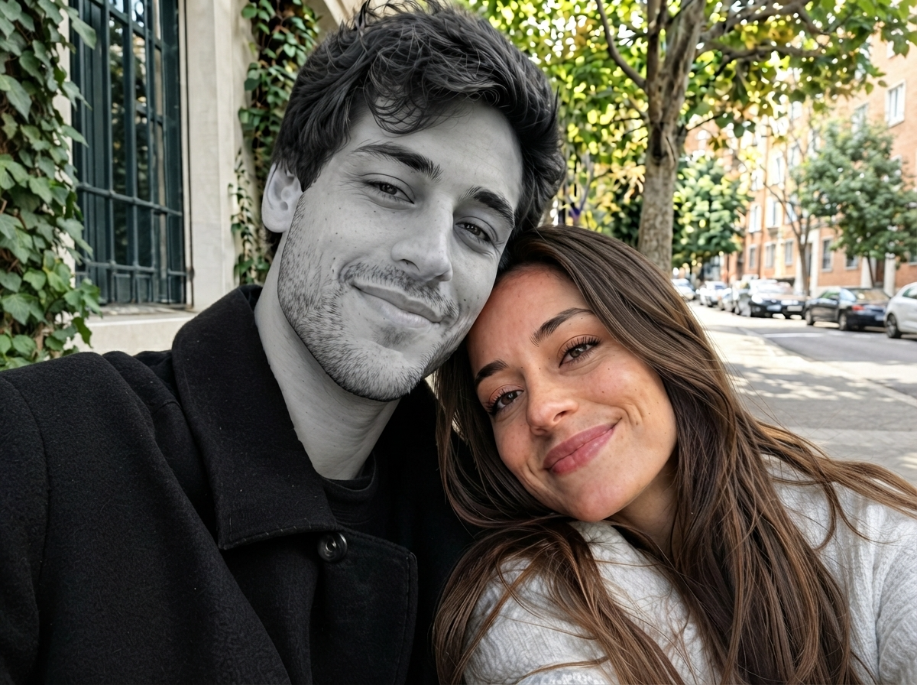
Twenty years after the first photograph, Nora returned to Mercer Street alone.
She did not tell Julian.
She wanted one quiet morning.
The trees were enormous now.
Their branches met above the sidewalk.
The old brick building had been renovated.
The café was gone.
A bookstore occupied the ground floor.
Nora stood beneath the trees and opened her phone.
The original photograph appeared on the screen.
She had digitized it years earlier.
The woman in the background remained.
So did Julian.
So did herself.
The image looked almost innocent.
Nora smiled.
She had spent half her life with that photograph.
It had frightened her.
Angered her.
Changed her.
Then, gradually, it had become something simpler.
Evidence of a moment.
She lowered the phone.
A man walking his dog passed her.
He nodded politely.
Nora nodded back.
Nothing happened.
She liked that.
She walked to the bookstore.
Inside, the owner recognized her.
“Are you Nora?”
“Yes.”
“I've read your book.”
Nora smiled.
“I hope you liked it.”
“I did.”
The owner pointed toward a small display.
There was a copy of Nora's book.
Beside it was a photograph of Mercer Street.
Not the original.
A newer image.
The same trees.
The same sidewalk.
But no strangers.
The owner said, “People like the story.”
Nora looked at the photograph.
“I think people like stories where the truth eventually makes sense.”
“Didn't yours?”
“Some of it.”
She smiled.
“The rest is life.”
The owner laughed.
Nora bought a coffee and left.
She sat beneath the trees.
Julian eventually found her.
“You disappeared.”
“I came here.”
“I guessed.”
He sat beside her.
For several minutes, they watched the street.
“You remember?”
“Of course.”
He looked older now.
Gray at the temples.
A few lines around his eyes.
Nora smiled.
“You look happy.”
“I am.”
“Good.”
He nudged her shoulder.
“So are you.”
“Yes.”
They remained quiet.
Then Julian asked, “Do you think about what would have happened if we hadn't taken the photograph?”
Nora considered.
“Sometimes.”
“And?”
“We probably would have found out eventually.”
“Would we?”
“I don't know.”
He laughed.
“You hate that answer.”
“No.”
She looked at him.
“I finally respect it.”
He nodded.
The truth was not always a complete picture.
Sometimes it was a collection of facts surrounded by uncertainty.
That did not make it worthless.
It made it human.
They walked down the street.
Nora stopped near the old building.
“This is where she stood.”
Julian looked around.
“Yes.”
“You were terrified.”
“I was sixteen kinds of terrified.”
She laughed.
“Only sixteen?”
“Maybe seventeen.”
They took one last photograph.
A passerby offered to take it.
Nora handed him the phone.
She and Julian stood beneath the tree.
The stranger counted.
“One, two, three.”
The picture was taken.
Nora looked at it.
She laughed.
“What?”
“Someone is behind us.”
Julian looked.
A man carrying groceries had accidentally walked into the frame.
They both laughed.
Nora saved the photograph.
No investigation.
No zooming.
No questions.
Just a person walking through the background.
That was the moment she realized she was finally free of the old habit.
She did not need to know who he was.
They returned home.
Elise was waiting with Nora's mother.
Dinner was already prepared.
The table was crowded.
There were children.
Grandchildren.
Friends.
Neighbors.
Someone had brought too much dessert.
Julian complained that there was not enough coffee.
Nora laughed.
The room was noisy.
Ordinary.
Alive.
She looked around.
This was what Robert had wanted.
Not a family without secrets.
Not a family without mistakes.
A family that could live without fear controlling every conversation.
Her mother raised a glass.
“To ordinary days.”
Everyone laughed.
Nora raised hers.
“To ordinary days.”
After dinner, the children found the old camera.
They wanted to take pictures.
Nora gave it to them.
One child pointed it at the table.
Another made a ridiculous face.
Someone shouted that the picture was blurry.
Everyone laughed.
Nora watched.
She did not correct them.
Some photographs could be imperfect.
They did not need to become evidence.
Later, after everyone left, Nora sat with Julian.
The house was quiet again.
He brought the wooden drawer from the cabinet.
“You know what I was thinking?”
“What?”
“Maybe we should move the photographs.”
“Where?”
“Somewhere else.”
Nora looked at him.
“Why?”
“Because they don't need to be hidden anymore.”
She considered it.
They took the photographs from the drawer.
The Mercer Street image.
The wedding.
Elise.
Robert.
Nora's mother.
The children.
They placed them in albums.
Not locked away.
Not displayed as sacred objects.
Simply kept with the rest.
Nora closed the album.
“That feels right.”
Julian nodded.
The next morning, she returned to the archive.
A new box waited on her desk.
She smiled.
Another story.
Another family.
Another beginning.
She opened it.
Inside was a collection of letters from a woman who had lived through a difficult marriage.
Nora read the first page.
The woman wrote about ordinary things.
Laundry.
Money.
Children.
Weather.
A neighbor.
Then one sentence caught Nora's attention.
I want my children to know I was more than what happened to me.
Nora stopped.
She understood.
She wrote the collection note carefully.
She did not reduce the woman to tragedy.
She preserved the whole life.
That was the work.
Not finding villains.
Not creating heroes.
Not turning every unanswered question into a mystery.
Remembering people accurately.
That afternoon, Nora received a message from Julian.
Dinner tonight?
She replied:
Always.
Then she returned to the archive.
The day passed quietly.
At closing time, Nora walked through the reading room.
The shelves held thousands of lives.
Some stories were public.
Some were private.
Some were unfinished.
Some would never be understood completely.
She no longer found that frightening.
She locked the door.
Outside, the evening air was warm.
The maple trees moved gently in the wind.
Nora looked up.
She thought about the first photograph.
A young woman.
A young man.
A stranger in the background.
A family secret.
A lifetime of consequences.
She thought about all the people who had tried to protect one another and all the ways protection could become another form of silence.
She thought about Robert.
About Elise.
About her mother.
About Adrian.
About Julian.
Then she thought about herself.
For years, she had believed that the most important thing was discovering what had happened.
Eventually, she understood that knowing what happened was only the beginning.
The harder question was what to do afterward.
She had chosen to remember without surrendering her future.
That was enough.
At home, Julian was waiting.
He had made dinner.
The dog barked.
The kitchen light was warm.
Nora took off her coat.
“How was your day?”
“Good.”
“Anything interesting?”
She smiled.
“Several stories.”
“Any mysteries?”
“No.”
He looked relieved.
“Excellent.”
She kissed him.
They sat down to eat.
The conversation moved to ordinary things.
A broken pipe.
A neighbor's new puppy.
A trip they might take next summer.
The archive's heating system.
The children's school.
Nothing dramatic.
Nothing hidden.
Nora looked around the table.
This was the life the photograph had almost interrupted.
And yet, in another sense, it had helped them reach it.
The photograph had forced them to ask questions.
The questions had forced them to confront the past.
The truth had forced them to make choices.
The choices had created this ordinary evening.
That was enough.
Years later, when Nora's grandchildren asked about the photograph, she would show it to them.
They would ask who the woman was.
She would explain.
They would ask why it mattered.
She would tell them.
Then they would probably lose interest and ask for ice cream.
Nora would laugh.
She would let them.
Because the story did not need to control them.
They could know it.
They could remember it.
Then they could go outside and make their own photographs.
That was the ending Nora had once been unable to imagine.
Not a dramatic revelation.
Not revenge.
Not a perfect reconciliation.
Just a family that had finally stopped living according to an old secret.
The past remained.
The evidence remained.
The photographs remained.
But they no longer demanded anything.
Nora closed the album.
Julian turned off the kitchen light.
They went upstairs.
Outside, Mercer Street was quiet beneath the trees.
Somewhere, a camera clicked.
Someone laughed.
A door closed.
A car passed.
The ordinary world continued.
And this time, Nora did not look over her shoulder.
She simply went to bed beside the person she had chosen.
The photograph stayed behind in the album.
The story stayed in the archive.
The memories stayed with the family.
And the future remained unwritten.
The End
Read more original stories on Feel Every Story.
The Photograph Was Supposed to Be a Simple Memory, Until Nora Noticed the Stranger Behind Them and Realized Julian Had Been Hiding Something
Part 16 of 16

