
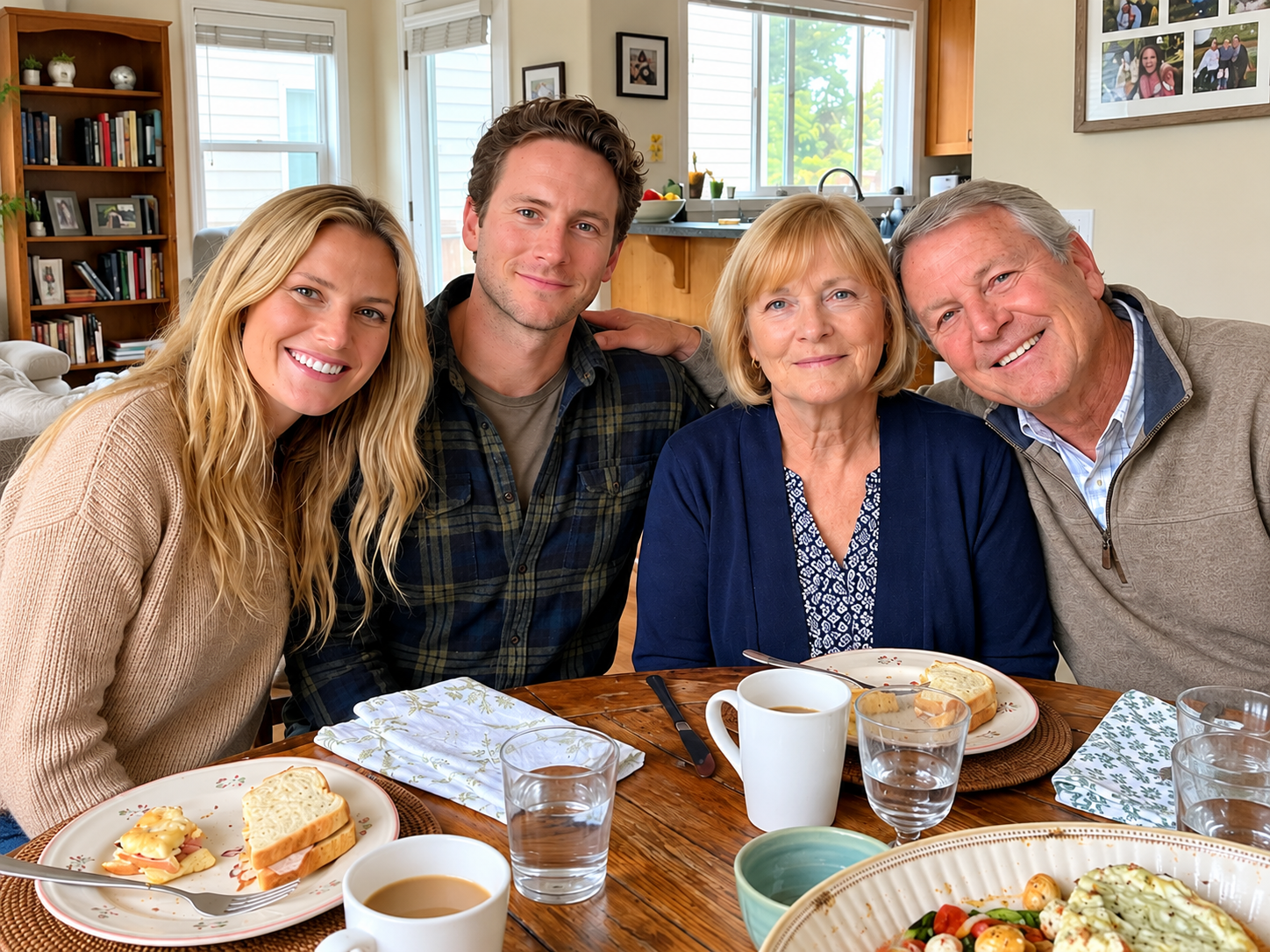
The baby was born in spring.
Her name was Evelyn Thomas Hale.
Claire chose Evelyn for her grandmother.
Daniel chose Thomas for the man he had never met.
Robert held the baby for the first time and immediately began crying.
Margaret laughed.
“You said you wouldn't.”
“I didn't say anything.”
“You said you were going to be calm.”
“I lied.”
Daniel stood beside them.
He looked exhausted.
Claire was resting in the hospital bed.
“She has your eyes,” Robert told her.
Claire smiled.
“She has Daniel's stubbornness.”
Daniel looked offended.
“I heard that.”
Robert laughed.
The moment was ordinary.
That was why it mattered.
No hidden device.
No mysterious envelope.
No locked box.
Just a newborn sleeping against her grandfather's chest.
Robert thought about Thomas.
He wondered whether Thomas had imagined a moment like this.
Probably.
But he would never know.
And that uncertainty no longer frightened him.
The family returned home several days later.
The first photograph of Evelyn was placed beside the maple tree.
Claire wanted the child to grow up knowing where her name came from.
Not as a burden.
As a connection.
When Evelyn was old enough to understand, they would tell her.
Not everything at once.
But nothing would be hidden simply because it was painful.
Robert spent the summer repairing the old porch.
Daniel helped.
They replaced two boards.
Painted the railing.
Fixed a loose step.
Claire watched from the garden while holding Evelyn.
The baby kicked her feet beneath a blanket.
Robert looked over.
“You know, your grandfather would have complained about the paint.”
Claire laughed.
“Then I'm glad he isn't here to see it.”
Robert smiled.
“Me too.”
There was no bitterness in the words.
Only affection.
The investigation connected to Victor's old financial network finally closed.
Several people had cooperated.
Some matters could not be prosecuted because the evidence was too old.
Others had already been resolved through previous proceedings.
The authorities preserved the remaining records.
Robert did not follow every development.
He had learned that there was a point when justice became administration.
His family's part was finished.
They had told the truth.
They had preserved the evidence.
They had given the records to the proper people.
The rest belonged to history.
Rebecca continued managing the archive.
She occasionally visited Claire.
The two women developed an unusual friendship.
Rebecca had known Thomas as a colleague.
Claire had known him as a daughter.
Together, they filled gaps in each other's understanding.
One afternoon, Rebecca brought a final photograph.
Thomas was sitting alone at a small café in Canada.
He was reading a newspaper.
The date was 2005.
On the table beside him was a photograph of Claire.
Claire stared.
“He carried my picture.”
Rebecca nodded.
“For years.”
Claire touched the image.
“I wish I had known.”
Rebecca smiled sadly.
“You do now.”
That was enough.
The photograph joined the archive.
But Claire kept a copy.
Evelyn grew quickly.
By the time she was three, she loved the maple tree.
She would run beneath it and collect leaves.
Robert often sat on the porch watching her.
One afternoon, she brought him a leaf.
“Grandpa.”
“Yes?”
“This one is broken.”
Robert took it.
“It is.”
“Can we fix it?”
Robert smiled.
“No.”
Evelyn frowned.
“Why?”
“Some things can't be fixed.”
She looked disappointed.
“But we can keep it.”
Robert nodded.
“Yes.”
She put the leaf in his hand.
“Then keep it.”
Robert looked at the leaf.
It was small.
Yellow.
A little torn.
He placed it carefully between the pages of his notebook.
Years later, he would remember that moment.
Not because it was dramatic.
Because it was simple.
Evelyn had unknowingly taught him the lesson he had spent decades learning.
Not everything needs to be repaired to be worth keeping.
Sometimes memory is enough.
The family continued celebrating birthdays.
Thanksgivings.
Christmas mornings.
Ordinary Sundays.
The old blue envelope remained in the archive.
The red notebook stayed with Claire.
Thomas's final letter remained in her personal collection.
Robert kept Eleanor's journal nearby.
None of them needed to read the documents every day.
Their purpose had changed.
They no longer existed to prove something.
They existed so that nobody would have to guess.
When Evelyn turned seven, Claire told her the first part of the family story.
They sat beneath the maple tree.
Daniel joined them.
Robert listened from the porch.
Claire showed her daughter a photograph of Thomas.
“This was your grandfather.”
Evelyn studied the picture.
“He looks nice.”
“He was.”
“Where is he?”
“He died before you were born.”
Evelyn looked sad.
“Did you know him?”
Claire nodded.
“A little.”
Robert smiled.
Claire continued.
“He made mistakes.”
Evelyn frowned.
“Bad ones?”
“Some.”
“Did he say sorry?”
“Yes.”
“Did people forgive him?”
“Some did.”
Evelyn thought about that.
“Did you?”
Claire smiled.
“Yes.”
The child looked at the photograph again.
“Then he's okay.”
Claire's eyes filled.
“Yes.”
Robert looked away.
He understood what Claire had done.
She had given her daughter the truth without giving her fear.
That was what Thomas had wanted.
That was what Robert had learned.
That was what the family had finally accomplished.
Years later, Daniel asked Robert whether he regretted opening the blue envelope.
Robert smiled.
“Not anymore.”
“What about before?”
“Many times.”
Daniel nodded.
They sat on the porch.
The maple tree was older.
The house had been repainted.
Evelyn was now a teenager.
The family archive had grown into a small local collection.
People came to research old financial records.
Students studied the case.
Claire occasionally gave talks about preserving evidence.
She never described herself as a victim.
She described herself as someone who inherited a complicated history.
Robert liked that.
One evening, Daniel asked him the question he had been carrying for years.
“Do you think Dad would have been proud?”
Robert knew he meant Thomas.
He thought carefully.
“I don't know.”
Daniel looked surprised.
“Really?”
“No.”
Robert smiled.
“But I think he would have been relieved.”
“Why?”
“Because we stopped being afraid.”
Daniel looked toward the maple tree.
“That sounds like something he'd say.”
“Maybe.”
They sat quietly.
The porch light came on.
Inside, Claire was helping Evelyn with homework.
Margaret was making tea.
The house smelled like cinnamon.
Robert smiled.
The past had once felt like an occupying force.
Now it was simply part of the furniture.
Present.
Visible.
No longer in control.
Robert reached into his pocket.
He still carried the final letter from Thomas.
He unfolded it.
The paper was worn from years of handling.
He read one line.
You cannot spend your life paying for my decision.
Robert smiled.
He folded it again.
Then he looked toward Daniel.
“I finally understand.”
“What?”
“He wasn't asking me to forget.”
Daniel waited.
“He was asking me to live.”
Click Here to continue read next: PART12: On the Anniversary of Thomas’s Disappearance, the Family Returned to the Old House and Finally Let the Last Secret Become Part of Their History
The Family Breakfast Looked Perfect Until My Wife Dropped Her Fork and Whispered That Something Beneath the Table Was Wrong
Part 11 of 16

