
The final envelope remained unopened for three days.
Harold kept it on the kitchen table.
He knew it contained something June had intended specifically for him, but after everything they had uncovered, he was afraid of what another truth might demand.
On the fourth morning, he opened it.
Inside was a letter.
No evidence.
No names.
No accusations.
Just June's handwriting.
She wrote that she had known the truth about Harold's father for months before her death. She had also known that Richard was frightened, that Bell was ruthless, and that the land fight would eventually return.
But she had discovered something else.
Harold's father had left the property to Harold deliberately.
Not because he wanted his son to become a protector.
Because he wanted Harold to have the freedom to choose.
June wrote that his father had spent his life fighting people who believed ownership meant control.
He did not want Harold to inherit another fight.
He wanted him to inherit a choice.
Harold stopped reading.
The words hurt because they were so ordinary.
His father had never told him that.
June had known.
Perhaps that was why she had carried the secret.
Harold continued.
She apologized for the lies.
She admitted that protecting someone could become another form of controlling them.
She wished she had trusted Harold enough to tell him everything.
Then she wrote the final paragraph.
If you are reading this, you already know more than I ever wanted you to know. Please don't spend the rest of your life becoming the person who hurt us. Let the truth belong to the people who need it, and let the rest of your life belong to you.
Harold lowered the letter.
For several minutes, he simply sat there.
Daniel found him at the table.
"You opened it."
Harold nodded.
"What did she say?"
Harold handed him the letter.
Daniel read it slowly.
When he finished, he looked at Harold.
"She knew you."
"Yes."
"Better than you thought."
Harold smiled sadly.
"Apparently."
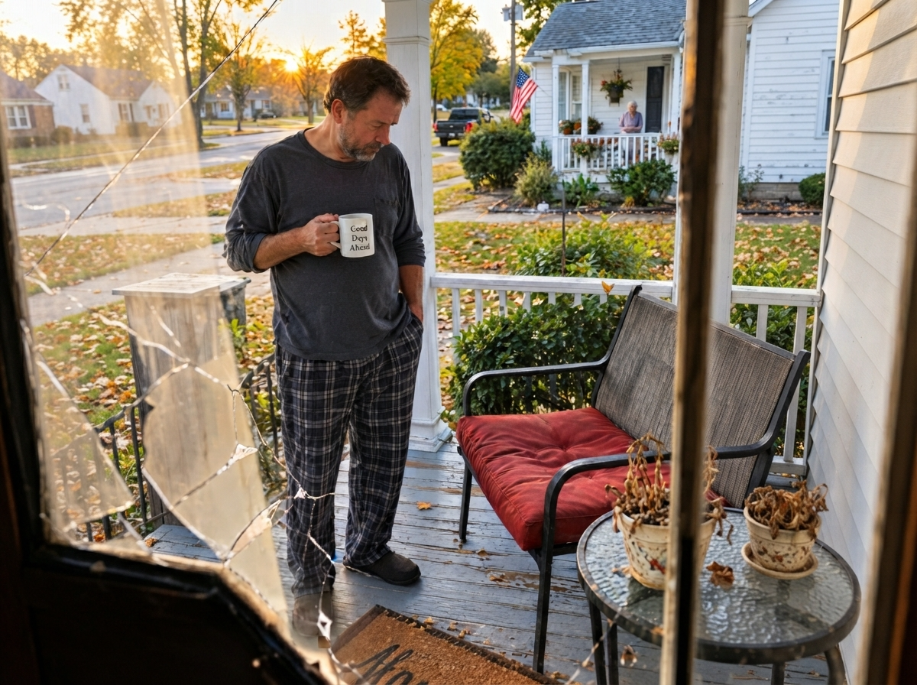
Outside, workers were repairing the last section of the porch.
The broken window had been replaced.
The chair had been cleaned.
The small round table was still there, though the plant sitting on it had died during the investigation.
Harold carried the dead plant outside.
He set it beside the steps.
Then he noticed the footprint.
A faint impression remained beneath the chair despite several days of rain.
He stared at it.
Daniel came outside.
"Still thinking about footprints?"
Harold shook his head.
"No."
He looked toward the street.
"I'm thinking about where they lead."
The legal investigation continued for months.
Charles Bell's company faced extensive scrutiny.
The property records were corrected.
The water rights were transferred into the community trust that Harold's father had established decades earlier.
The old factory was eventually purchased by the town.
Part of it became a public archive.
Harold donated his father's documents.
He kept only the family photographs and June's letters.
He did not want the evidence hidden.
But he did not want to live beside it either.
Richard eventually pleaded guilty to several offenses connected to the property scheme and obstruction of the original investigation.
His testimony helped investigators identify people who had remained hidden for decades.
Harold attended the hearing once.
He sat quietly.
Richard looked older than before.
When their eyes met, Richard lowered his head.
Harold did not forgive him.
Not that day.
Perhaps not ever.
But he no longer needed Richard to explain his life.
Margaret testified too.
She told the court about the night Harold's father died.
Her voice shook.
She admitted that she had waited forty years because she was afraid.
Afterward, Harold found her outside.
"You did the right thing."
Margaret looked at him.
"I should have done it sooner."
"Yes."
She nodded.
"I know."
They stood together without pretending the past could be repaired.
Some things could only be acknowledged.
That was enough.
Eleanor continued working with the investigators.
Before leaving town, she gave Harold one final object.
A photograph of June.
Not the photograph from the cemetery.
A different one.
June was sitting on the porch.
She was holding Harold's ridiculous mug.
She was laughing.
On the back, Eleanor had written:
She was brave because she was afraid.
Harold kept the photograph beside the letter.
Winter came again.
The first snow arrived quietly one evening.
Harold woke before sunrise.
For a moment, he forgot everything.
Then he saw the repaired window.
He touched the glass.
No cracks.
No hidden message.
No shadow across the porch.
He made coffee.
He picked up the mug.
GOOD DAYS AHEAD.
This time, he smiled.
He opened the front door.
Cold air entered.
The street was covered with a thin layer of snow.
Margaret was already outside.
She looked across at him.
"You're up early."
"So are you."
"I heard something."
Harold glanced around.
"What?"
"A bird."
He laughed.
"That's what woke you?"
"Don't make fun of me."
He stepped onto the porch.
For the first time, the morning felt ordinary.
Not suspicious.
Not threatening.
Just cold.
A few minutes later, Daniel arrived.
He had become a familiar presence during the investigation.
Harold had initially thought of him as the police officer who appeared because of a broken window.
Now he thought of him as someone who had helped put the past back into its proper place.
"How's the window?" Daniel asked.
"Still there."
"Good."
Daniel handed him a folder.
"The final property documents."
Harold took them.
"Is it over?"
Daniel considered the question.
"The case is."
Harold nodded.
That was enough.
The house remained his.
Not because Bellridge had failed.
Not because Richard had been arrested.
Not because his father's plan had finally worked.
It remained his because Harold had chosen not to surrender it out of fear.
That distinction mattered.
Later that afternoon, Harold walked to the cemetery.
Snow covered June's grave.
He brushed it away gently.
"I found it," he said.
There was no one there to answer.
He told her about the documents.
The arrests.
Margaret's testimony.
Eleanor.
The community trust.
The repaired window.
Then he told her about the letter.
"I wish you'd trusted me sooner."
The wind moved through the bare trees.
Harold smiled.
"But I understand now."
He placed the photograph of June beside the flowers.
Not permanently.
Just for a moment.
Then he put it back in his coat.
As he walked home, he passed the old factory.
The building had been cleaned.
The windows were repaired.
A new sign had been installed.
COMMUNITY ARCHIVE.
Harold stopped.
Through the glass he could see photographs from the neighborhood's history.
Children.
Families.
Old businesses.
The street as it had looked forty years earlier.
His father's photograph was there.
So was one of June.
Harold stood quietly.
He had once believed that preserving the past meant keeping every secret.
Now he understood something different.
Remembering did not require hiding.
Sometimes remembering meant opening the door.
That evening, Margaret came over for dinner.
Daniel joined them.
They ate at the kitchen table.
No one discussed Bellridge.
No one mentioned Richard.
They talked about the weather.
Margaret complained about the new supermarket.
Daniel told a terrible joke.
Harold laughed harder than he expected.
After dinner, Margaret noticed the mug.
"You kept it."
Harold looked at the words.
"Yes."
"June bought that."
"I know."
Margaret smiled.
"She liked terrible slogans."
"She did."
Harold looked toward the repaired window.
"I used to hate it."
"And now?"
He turned the mug in his hand.
"Now I think she was right."
The next morning, Harold replaced the old porch chair.
He planted a new flower in the round table's pot.
He repaired the railing.
He did not remove the evidence of what had happened.
He simply refused to let the broken window become the defining feature of his home.
Weeks later, the first public meeting about the community trust was held.
Harold spoke briefly.
He did not call himself a hero.
He did not describe his father that way.
He simply told the truth.
His father had been frightened.
June had been frightened.
Margaret had been frightened.
Even Richard had been frightened.
Fear had shaped decades of decisions.
But fear was not an excuse for what people did with it.
When Harold finished speaking, the room remained quiet for a moment.
Then someone applauded.
Harold sat down.
He looked toward the back.
Margaret was smiling.
Eleanor nodded.
Daniel leaned against the wall.
Harold thought of June.
He wished she could see the room.
Not because everything had been fixed.
It hadn't.
Some families were still grieving.
Some people would carry guilt for the rest of their lives.
Some questions about the oldest property deals would never be answered.
But the secret was no longer controlling anyone.
That mattered.
Months later, Harold woke before sunrise again.
He stepped onto the porch with his coffee.
The neighborhood was quiet.
A woman across the street watered her plants.
A dog barked somewhere beyond the corner.
A delivery truck rolled slowly past.
Nothing happened.
And Harold found that he was grateful.
He looked at the repaired window.
Then at the chair.
Then at the street where June had once walked home carrying groceries.
He took a sip of coffee.
GOOD DAYS AHEAD.
This time, the words did not feel like a promise someone else had made for him.
They felt like a choice.
Harold sat down.
He watched the sun rise between the houses.
For forty years, he had thought the past was something that had been taken from him.
Now he understood that the past could explain him without owning him.
His father's records had revealed the truth.
June's letters had revealed the cost of keeping it.
Margaret's silence had revealed what fear could do.
Eleanor's files had shown how long the deception had lasted.
Richard had finally confessed.
Bell had been exposed.
The property had been protected.
The window had been repaired.
And Harold was still here.
He lifted the mug once more.
For the first time, he did not read the words as an instruction.
He read them as an invitation.
Then he smiled toward the quiet street and let the morning begin.
The End
Read more original stories on Feel Every Story.
At Seven in the Morning, Harold Found His Porch Window Shattered, Yet the Broken Glass Held a Clue That Made Him Afraid to Call the Police
Part 8 of 8

